India: Machinery Imports and Cable Compliance for the Automation Catch-Up Market
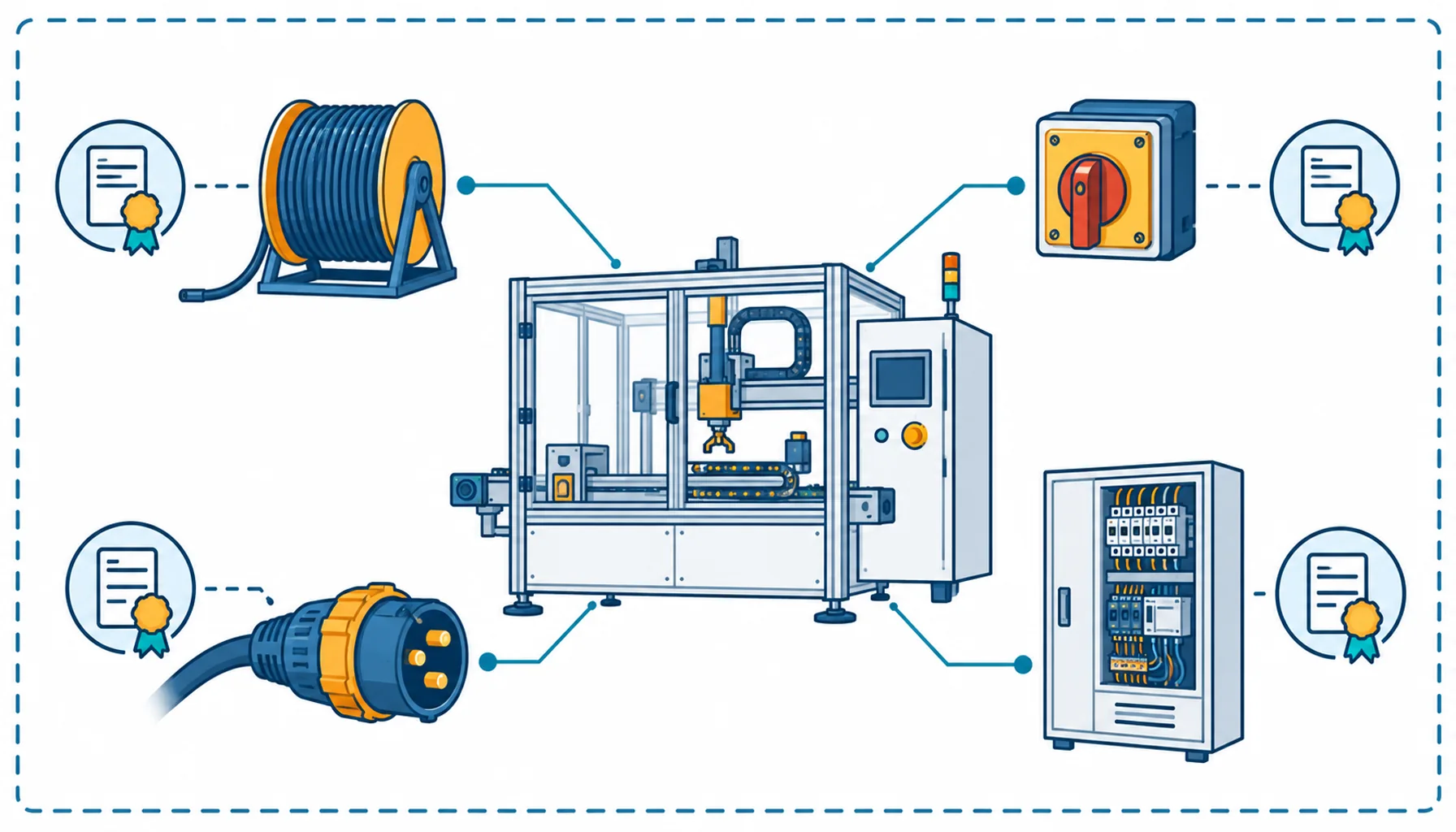
Quick Answer: India has no single mark for an imported machine, but cable is a regulated product with a compulsory licence held by the manufacturer, verified at customs before release.
India is the market where the compliance question catches foreign suppliers off guard, not because the rules are unusually strict but because they sit in an unexpected place. There is no Indian equivalent of a CE mark that a machine as a whole must carry, so a European or Japanese builder reasonably assumes the paperwork is straightforward. Then the shipment reaches a port and the cable inside the machine turns out to be a controlled product, licensed to a manufacturer, checked against a portal at the moment the bill of entry is filed. The machine was never the regulated thing. The cable was.
Introduction
The Indian automation market is growing from a low base at one of the fastest rates anywhere, which makes it attractive and also explains why so much of the compliance infrastructure is less familiar to foreign suppliers than the European or North American equivalents. Volume has arrived faster than institutional memory. A supplier who has shipped into Germany for twenty years has a feel for what a notified body wants. The same supplier may have no feel at all for what the Bureau of Indian Standards expects, and that gap is where projects lose weeks.
Two things are worth establishing before anything else. First, India regulates products through Quality Control Orders, and cables appear on those lists, which means a Bureau of Indian Standards licence and the ISI mark apply to the cable rather than to the machine it is fitted into. Second, the licence belongs to the manufacturer and is tied to a named factory and a named standard, not to the importer, which changes who has to act and how early. The wider regional comparison of how these schemes differ is set out in the guide to cable certification checklists.
The Market: Rapid Growth From a Small Base
India installed roughly 9,100 industrial robots in 2024, about seven per cent more than the year before, which places it sixth in the world by annual installations. The operational stock stood at around 52,600 units at the end of that year, tenth globally. Both figures are records, and both are dwarfed by the leaders: a single large Chinese automotive plant can deploy in one year what India installs nationwide.
Density tells the same story from the other direction. India’s robot density in manufacturing remains a small fraction of the global average and a tiny fraction of the leaders, with South Korea above 1,200 units per 10,000 workers and Singapore in the high hundreds. Growth is concentrated in automotive, with electronics, pharmaceuticals, food processing and logistics following. The practical reading is that a large share of India’s automation is being installed now, by integrators who are themselves scaling, and who buy machines from abroad and then have to keep them running. That is the demand behind the cable question.
There Is No Machine-Level Mark, and That Catches People Out
A machine entering India does not need a single conformity mark covering the whole assembly. What exists instead is a set of product-level requirements that reach into the machine part by part, plus statutory duties on the factory that operates it. The Factories Act and the state factory rules place safety obligations on the occupier, the central electricity regulations govern the electrical installation itself, and the national wiring and earthing codes describe how that installation should be built. None of these is a mark on a machine, and all of them shape what an inspector will look at after commissioning.
The component requirements are the ones that travel with the hardware. Where a product falls under a Quality Control Order, it cannot be manufactured, imported, sold or distributed in India without the appropriate Bureau of Indian Standards licence. Cable is on that list. So are plugs and sockets, switches, and a range of switchgear, which together cover a significant part of what arrives inside an automation package. The buyer’s project is therefore less about a machine certificate and more about the licence status of several components, each held by a different manufacturer, each verifiable separately.
The Cable Standards That Are Actually Compulsory
The cable standards a foreign supplier meets most often are the PVC insulated series, the cross-linked polyethylene series, and the standards covering conductors, insulation compounds and elastomer insulated constructions. Each applies to a defined voltage band and construction, and the licence is granted against one standard at one facility. A cable that looks identical to a licensed construction but is made to a different standard is a different case.
| Standard | What it covers | Where an imported machine meets it | Who holds the licence |
|---|---|---|---|
| PVC insulated cables up to 1100 V | Single and multicore PVC insulated cables, including flexible types, for working voltages up to 1100 V | Control and power wiring inside the panel and between machine sections | The cable manufacturer, against a named manufacturing facility |
| PVC insulated heavy duty cables | Heavy duty PVC insulated cables in parts covering up to 1100 V and higher voltage bands | Machine supply cables and distribution within the plant | The cable manufacturer, per standard and per site |
| Cross-linked polyethylene insulated cables | XLPE insulated cables, in parts covering up to 1100 V and from 3.3 kV upward | Where the machine connects to a higher voltage supply or a dedicated feeder | The cable manufacturer, per standard and per site |
| Conductors for insulated cables | Conductor construction, resistance and class for insulated cables and flexible cords | Determines whether the construction offered matches the graded requirement | The cable manufacturer, as part of the product licence |
| PVC insulation and sheath | Compound requirements for PVC insulation and sheathing material | Compound selection where PVC is used in a warm, humid plant | The cable manufacturer, and its compound supplier in practice |
| Elastomer insulated cables | Rubber and elastomer insulated cable constructions, with separate parts for flexible types | Moving cables, festoon runs and connections exposed to flexing or oil | The cable manufacturer, per construction |
The Licence That Decides Whether the Container Clears
For an overseas manufacturer, the route is the Foreign Manufacturers Certification Scheme, administered by the Bureau of Indian Standards under the standards legislation and the conformity assessment regulations. Its shape explains why India-bound projects need to start their compliance work earlier than most.
The application is filed by the manufacturer, not by the importer, for one product against one Indian standard at one named factory. A resident Authorised Indian Representative has to be appointed first, and that representative carries legal responsibility for the dealings with the Bureau. An inspection team then travels to the overseas factory, typically spending two to three days assessing production equipment, in-house testing capability and quality systems. Samples are sealed during that visit and sent to a recognised laboratory in India for testing against the standard. A performance bank guarantee, in the order of ten thousand US dollars depending on the applicable schedule, forms part of the terms.
The licence is granted against the specific product specification and the named facility. A change of raw material, a substituted component or a shift of production to a different plant can leave shipments non-compliant even while the licence remains nominally valid. Grant normally takes about six months from the recording of the application, and six to nine months is realistic in practice once inspection scheduling and query responses are counted. What this means for a project is blunt: the licence is not something a supplier can produce on request, and a delivery commitment given before one is in hand is a delivery commitment with the schedule outside the supplier’s control.
Where the Machine-Import Argument Gets Complicated
The awkward question is whether cable shipped as part of a machine falls under the same requirement as cable shipped on its own. The licence requirement attaches to products placed on the market under the control orders, and a machine package declared as a machine is not obviously a consignment of cable. In practice the answer turns on how the shipment is declared and what the invoice and packing list describe. Where the cable appears as a separate line item, or where a spare drum travels with the tools, the stricter reading is the safe one.
There is a second reason to plan conservatively. Customs verification happens against the standards portal at the time the bill of entry is filed, and what is checked is whether a valid licence exists, whether the standard matches, and whether the named facility matches where the goods actually came from. A licence that has lapsed, been suspended, or simply does not correspond to the declared product stops the consignment. Demurrage on the container and ground rent on the goods begin accruing from the first day, and re-export or conditional release are slower and more expensive than verifying status before shipment. For an importer, this is especially uncomfortable, because the licence belongs to the manufacturer and its status can change without the importer being told. The sourcing risks that sit alongside this one are collected in the analysis of international sourcing mistakes and the comparison of OEM and ODM supply models.
Electrical Practice Is Not European Practice
Three differences shape the specification and get missed when a machine is designed for another market. Distribution is 415 V three phase and 50 Hz on a 230 V single phase basis, so voltage bands and insulation levels should be confirmed against the actual supply rather than assumed from a European design. Ambient temperatures inside non-air-conditioned factory halls routinely reach the mid-forties Celsius, and dust and monsoon humidity come with them, which means current-carrying capacity needs correcting for the real ambient rather than quoting the reference condition — the same arithmetic set out in the cable selection guide. Earthing and conductor identification follow Indian codes and local practice rather than European conventions, and panels built abroad to a European scheme can create confusion during commissioning, which is where the checklist in the industrial power distribution guide is useful.
None of this is exotic. It is simply the difference between designing for a temperate plant and designing for a hot, dusty, humid one, and the cost of getting it wrong lands on the integrator who has to keep the line running. Where a machine has moving axes, the flexing cable is also exposed to that environment continuously rather than occasionally, which makes compound selection a durability question as much as a compliance one. The documentation side, including the national marks that accompany substance and safety requirements, is covered in the guide to electrical equipment certification.
| Item | Why it gates the project | Realistic lead time |
|---|---|---|
| Confirm which components sit under a control order | Cable and switchgear are commonly regulated even where the machine as a whole is not | Days, but it decides everything downstream |
| Identify the applicable Indian standard | A construction made to a different standard is a different licence case | Days, with a wrong answer costing months |
| Appoint a resident authorised representative | The application cannot be processed without one | Weeks after the commercial relationship is agreed |
| Factory inspection slot for the overseas plant | Inspection teams travel to the manufacturing site, which depends on scheduling | Weeks to months |
| In-house testing capability at the factory | Inspectors check that the plant can verify the parameters the standard requires | Calibration and records need to exist before the visit |
| Sample testing in an Indian laboratory | Samples are sealed on site and sent onward for testing | Weeks, including shipping and queue |
| Licence grant | Normal period is about six months from recording, longer in practice | Six to nine months |
| Licence status check before each shipment | Customs verifies against the portal when the bill of entry is filed | Minutes, and it prevents a port problem |
When the Licence Is Not the Answer
Three boundaries. A licence confirms that a construction meets an Indian standard; it says nothing about whether that construction suits a particular moving axis, and a licensed cable can still fail early in a poorly chosen application, which is where the guidance on cable failure causes applies. Second, the licence covers the cable, not the machine, so nothing about it substitutes for the wiring, earthing and installation requirements that fall on the operating factory. Third, a licence is a living document tied to a facility and a specification, so it needs the same discipline as any other qualification record: check it before the order, check it before the shipment, and treat any change of material or plant as a new case rather than an amendment.
RFQ Checklist: Cable for an Indian Machine Project
Send these with the inquiry so licensing and engineering are planned on the same calendar:
- Which components in the package fall under a control order, and which do not
- The Indian standard each cable construction has to meet, confirmed at inquiry stage rather than after the order
- Whether a licensed construction is required, and who will hold the licence
- The status of the licence, its expiry, and the named facility it covers
- Supply voltage and frequency at the site, with insulation levels confirmed against them
- Design ambient temperature and humidity inside the factory hall, with sizing corrected for it
- Whether the cable is for a fixed installation or a moving axis, since flexing duty drives the construction
- Earthing, conductor identification and any site-specific practice that differs from European convention
- Whether spare drums or separate cable line items will be shipped, since that changes how the consignment is declared
Conclusion
India is not a difficult market to enter, but it is a market where the regulated item is rarely the one a foreign supplier expects. There is no machine-level mark to obtain, so attention moves to the components, and cable is one of them. That makes licensing a manufacturer-level task with a six to nine month horizon, tied to a standard and a factory, verified at the port on the day the entry is filed. Projects that treat this as a qualification exercise rather than a shipping detail find the route predictable; projects that treat it as paperwork find a container sitting at a port while a licence is chased.
Kexingyu Cable Group (KXYE) supplies control, power and motion cable for automation packages with the test documentation and technical files these submissions need, and where a project requires a licensed construction we source it through our partner arrangements and identify the licence holder honestly rather than implying something we cannot show. Send the destination state, the standards the project must meet and whether the cable travels as part of the machine or as a separate item through the RFQ page, and we will tell you plainly what has to be licensed and how long that will take.