South Korea: What 1,220 Robots per 10,000 Workers Means for Cable Demand
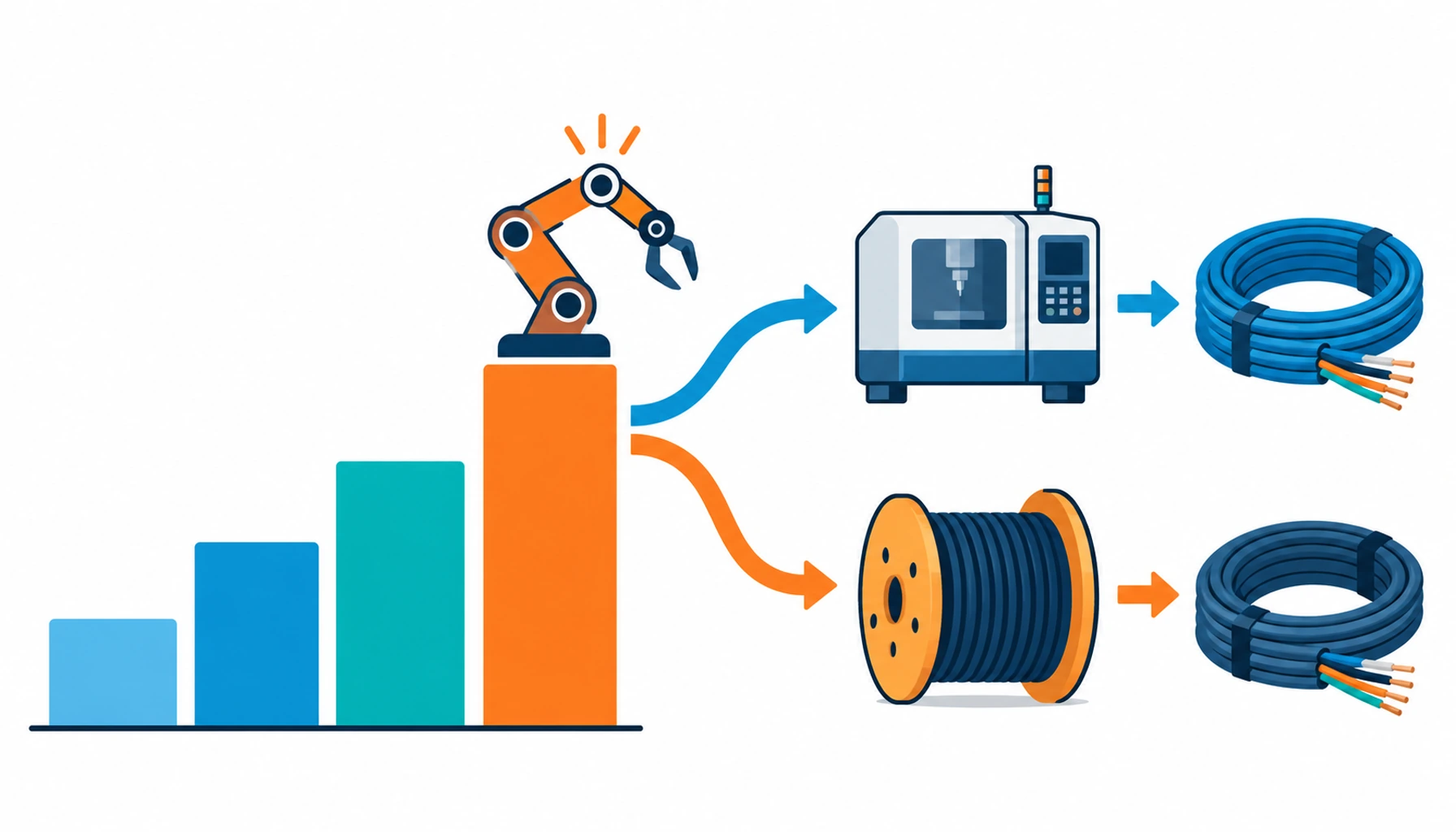
Quick Answer: South Korea runs 1,220 industrial robots per 10,000 manufacturing employees, twice the global average, and that installed density turns cable into a recurring consumable.
Korea has held the top of the robot density table for so long that the number risks reading like wallpaper. It should not. A density figure is not a trophy, it is a description of how a factory floor behaves: how closely machines are packed, how hard they run, and how often the flexible parts between them get replaced. When IFR published World Robotics 2026 in September 2026, Korea’s density had climbed to 1,220 robots per 10,000 manufacturing employees, a 20.6 per cent jump in a single year. For anyone selling cable into that environment, the number describes a market that behaves differently from almost anywhere else.
Introduction
Most national robot stories are growth stories: a country installs more robots than last year, and the supply chain expands to serve the new machines. Korea’s story is a maturity story layered on top of growth. The country has been automating hardest for two decades, which means it now operates the world’s most concentrated fleet of ageing robots alongside a steady stream of new ones. Both ends of that fleet buy cable. New cells need it at commissioning; old cells need it again and again as jackets wear through and shields fail.
This article looks at Korea purely from the demand side: what the density statistics actually measure, which industries put the robots there, and how a fleet of that age and concentration changes what buyers expect from a motion cable. The regulatory side, including the KC mark and its scope, is covered separately in its own guide and is not repeated here. The sourcing fundamentals behind supplier selection are the same as anywhere else and are summarised in the checklist for evaluating a cable manufacturer in China.
What the Density Number Actually Counts
Robot density has one official definition: operational industrial robots per 10,000 manufacturing employees. The denominator is employees in manufacturing, not the total workforce and not the population, which is why density figures vary so wildly between secondary sources that quote different denominators. The numerator is the operational stock, meaning robots still in service, not the number delivered in a single year. When IFR’s World Robotics 2026 puts Korea at 1,220, it means that for every ten thousand people employed in Korean manufacturing, there are 1,220 robots working alongside them.
For scale, the global average sits at a fraction of that figure, and even highly automated economies such as Singapore, Germany and Japan land well below Korea. The 20.6 per cent year-on-year rise matters too. It is not a country squeezing the last gains out of an ageing statistic; it is the world’s densest fleet still getting denser quickly. Each point of density is a machine that bends cable for a living, and the Korean figure describes more bending cable per worker than anywhere on earth.
Two reading mistakes are worth heading off at the start. The first is comparing density to installation volume as if they compete; they measure different things, and a country can rank high on one and low on the other. The second is treating density as a uniform national trait. Korea’s density is concentrated in specific industries and specific factory types, and that concentration is exactly what shapes the cable requirement.
Why Density Drives Cable Demand Twice
A dense fleet buys cable twice. The first purchase is obvious: every new robot cell ships with power, encoder, brake and signal cable, and Korea commissions new cells at a pace second to none in per-worker terms. The second purchase is quieter and, over a fleet’s life, larger. Cable is the shortest-lived component in a motion system. Servo drives last decades; gearing lasts years; the flexible cable that travels the drag chain or the dress pack lasts a fraction of either, and it fails by design limits rather than by accident.
The arithmetic is unforgiving. A drag chain on a three-shift electronics line may travel tens of metres per cycle, millions of cycles per year. Even a cable specified honestly for its duty will reach the end of its service life on a schedule measured in a few years, not decades. In a market with the world’s highest concentration of running machines, that replacement stream compounds every year the fleet keeps growing. Suppliers who model Korea as a one-time installation market misread it; it behaves as an installed-base annuity with a new-installation kicker.
Global market data backs the shape of that model. QYResearch sizes the global robot drag chain cable market at roughly USD 850 million in 2026, growing to about USD 1.24 billion by 2032, and notes that mature automation markets replace earlier and more often than emerging ones. Replacement share rises with fleet age, and no large fleet is older, per worker, than Korea’s.
Where the Robots Are: Electronics and Automotive
Korea’s density is not spread evenly across manufacturing. It concentrates in two industries that happen to be the two hardest on cable. Electronics, led by display, semiconductor and battery assembly operations, runs compact, high-speed cells where robot arms work in tight quarters and cable carriers are short but brutal, cycling fast with tight bend radii. Automotive, led by the country’s domestic OEMs and their tiered suppliers, runs heavier payloads, longer travels and welding environments that add heat, spatter and electromagnetic noise to the mechanical duty.
| Industry | Typical robot duty | Cable stress profile | What buyers press hardest on |
|---|---|---|---|
| Electronics and display | Compact high-speed pick-and-place, cleanroom-adjacent cells, short carriers cycling fast | Tight bend radii, high cycle counts, sensitive encoder signals in a crowded RF environment | Bend-cycle ratings backed by real test data, shield transfer impedance |
| Battery and EV components | Handling pouches and modules, bonding cells, fast gantry motion | Oil and electrolyte exposure, abrasion from fast indexing, long vertical drops | Coolant and oil resistance, jacket abrasion performance |
| Automotive body and powertrain | Welding, sealing, heavy handling on long dress pack runs | Heat and spatter, torsion on wrist axes, EMI from weld controllers | Torsion life, spatter-resistant jackets, EMC behaviour |
| General machine building | Machine tending, press feeding, palletising for export equipment | Mixed duty, wide temperature range, export certification requirements | Honest datasheets, flexible minimum order quantities |
What a Dense Fleet Does to Cable Specification
The practical consequence is that “Korean market requirements” is not one requirement. An electronics integrator in Gyeonggi Province and an automotive tier-two supplier in Ulsan will reject different cables for different reasons, and a supplier who treats the country as a single specification will lose both. The failure modes behind those rejections are predictable, and the analysis of why cables fail on machines maps them sector by sector.
When Density Numbers Are Not the Answer
High density changes engineering behaviour in ways that show up in procurement. When robots are packed closely, cable carriers shrink and bend radii tighten, because floor space is the constraint the whole layout is fighting. A cable that performs adequately at a generous bend radius may fail early at the radius the cell actually allows, so Korean buyers interrogate the relationship between rated cycles and the radius those cycles were tested at. The reasoning is set out in the guide to matching cable size and rating to the real run.
Close packing also concentrates electromagnetic noise. Dozens of drives, servos and weld controllers in a small volume create an RF environment where a marginal shield stops being marginal, and encoder feedback errors start looking like mysterious robot faults. Korean engineering teams, long habituated to this, specify shield construction and grounding detail more aggressively than buyers in newer automation markets, and they check it. Sizing density correctly also means planning the electrical infrastructure around the machines, which is where the industrial power distribution checklist comes in.
Finally, maturity changes the purchasing conversation. In an emerging market the question is “will it work”; in Korea it is “when will it need replacing, and what does the replacement cost in downtime”. Suppliers who arrive with cycle-life test reports, batch traceability and a straight answer on duty ratings do better than those with a big catalogue and no data, a difference the comparison of OEM and ODM supply models makes explicit.
| Decision | Why it weighs more in Korea | What to settle before quoting |
|---|---|---|
| Flex rating versus actual bend radius | Packed cells force tighter radii than catalogue test conditions | The cycle rating at the radius the cell will really run, not the free-air figure |
| Shield class and grounding | Noise density from packed drives and weld cells breaks marginal shields | Braid coverage, transfer impedance data and the grounding scheme at the machine |
| Jacket chemistry | Oil, coolant and spatter exposure differ sharply by industry | PUR or equivalent where coolant is present, spatter-resistant grades at weld cells |
| Replacement planning | Mature fleets buy cable twice and the second time costs downtime | Batch traceability and a spares path agreed before the first shipment |
| Documentation depth | Buyers with two decades of automation habit verify claims | Test reports for flex life, oil resistance and EMC, matched to the shipped batch |
RFQ Checklist: Cable for a Korean Robot Project
Three cautions keep the statistics honest. First, a national density figure says nothing about a specific project; a Korean buyer still has to specify cable against its own duty cycle, radius and environment, and a supplier should quote against the machine, not the macro chart. Second, density measures installed robots, not their age or condition, and the replacement opportunity inside a mature fleet depends on how those machines are run, which varies plant by plant. Third, density is not a proxy for ease of entry: the world’s most demanding cable buyers live in the world’s densest market, and access to Korea is governed by its own product rules, touched on only briefly here because they are covered in full in the certification guide to cable certification schemes. Price-sensitive buyers comparing origins should also read the checklist for vetting an equipment manufacturer before treating quotations as equivalent.
Conclusion
Include these in the inquiry so the quote reflects the real duty:
- Robot duty per axis: payload class, travel length and cycles per shift, three shifts stated if true
- Actual bend radius in the carrier or dress pack, not the free-air minimum
- Industry environment: coolant, oil, spatter, cleanroom class or washdown where relevant
- Signal types carried: encoder, brake, bus communication, with shield requirements stated
- Flex-life test evidence requested at the specific radius and speed of the application
- Traceability and batch test documentation requirements
- Whether the order is initial installation or fleet replacement, since packaging and spares planning differ
- Any customer-specific standards inherited from the Korean OEM at the top of the supply chain