India: Automation Catch-Up and the Cable Opportunity in the World's Fastest-Growing Robot Market
Quick Answer: India’s robot installations grew about 15 per cent in 2025 to rank sixth globally, and a fleet this young and scattered creates motion cable demand that is small today and structurally explosive.
Markets that automate early and markets that automate late behave differently, and India is the textbook late adopter. Its manufacturing sector is vast, its robot fleet is small, and the gap between the two is the whole story. IFR’s World Robotics 2026 records Indian installations growing around 15 per cent in 2025, keeping the country sixth globally by annual installations, while its operating stock remains a tenth of China’s or less and its robot density sits far below even the global average. A market in that position does not buy cable the way Germany or Korea does. It buys the way a country buying its first robots does, and that changes everything about the demand.
Introduction
The trajectory is easy to trace. World Robotics 2025 recorded roughly 9,100 installations in 2024, about seven per cent growth, and the 2026 edition puts 2025’s growth near fifteen per cent, a pace few large economies match. Growth from a small base can look unimpressive next to China’s 354,000-unit year, and in absolute terms it is. But automation catch-up compounds differently: each installed robot trains integrators, each trained integrator lowers the cost of the next project, and each successful project converts a neighbouring factory owner from sceptic to buyer. The installed stock, around 52,600 units at the end of 2024 on IFR’s count, is less important than the slope behind it.
This article stays on the demand side: who is buying, what duty they run, and what first-robot purchasing does to cable requirements. The compliance machinery for machines and cable entering India, including the BIS licensing process, is covered fully in a separate article and is not repeated here. Buyers comparing sources can start with the checklist for vetting an equipment manufacturer and the overview of Chinese equipment certification.
Who Is Actually Buying the First Robots
India’s automation demand clusters in recognisable pockets. Automotive remains the anchor: the country’s car, two-wheeler and component plants automate first and deepest, and EV manufacturing investment is widening that base. Electronics assembly has grown with smartphone production moving scale into Tamil Nadu and Uttar Pradesh, bringing with it exactly the compact, high-cycle cells that electronics automation uses everywhere. Beyond those two, general industry, food processing, pharmaceuticals and warehousing are the catch-up frontier, buying their first machine-tending cells, palletisers and conveyor automation rather than their twentieth.
The first-robot buyer behaves in a characteristic way. They buy a complete cell from an integrator rather than engineering it in-house, they lean heavily on the integrator’s supplier choices, and they have no historical failure data to guide specifications. Cable arrives as part of a package, chosen by whoever the integrator trusts. That makes the integrator layer the real cable market: whoever equips India’s integrators equips the country’s factories, one cell at a time.
What Early-Fleet Demand Means for Cable
Three features distinguish first-generation fleets. First, specification is inherited rather than earned: cable enters on the integrator’s judgement and the machine builder’s standard, so the documentation that travels with the cable is often the buyer’s only quality signal. Second, duty is underestimated. New automation users routinely run cells harder than the duty the integrator quoted, because the machine’s capacity looks free once installed; cable sized without margin fails in year one and teaches the owner that automation is unreliable. Third, the environment is harder than European defaults: un-airconditioned halls in much of India run hot for months, dust is aggressive during dry seasons, and power quality swings stress drive-side electronics, all of which land on the cable before anything else fails.
Each feature points to the same buying lesson: in a first-robot market, cable margin is cheap insurance. A construction with honest duty headroom, a jacket chosen for heat and dust rather than the catalogue default, and test evidence the buyer can read will outlast a nominally equivalent cheaper drum by years. The sizing method that builds in that margin is set out in the guide to cable size selection, and the mechanical failure patterns behind early-fleet complaints are explained in the analysis of why cables fail on machines.
| Segment | Stage of automation | Cable duty profile | What the buyer needs most |
|---|---|---|---|
| Automotive and EV components | Deepest automation; multi-robot cells standard | Weld heat, oil, heavy payloads, three-shift cycles | Duty-matched constructions with traceable evidence |
| Electronics assembly | Scaling fast with smartphone and component clusters | Compact cells, tight radii, high cycle counts, clean signals | Flex evidence at real radii; shield performance |
| General industry first-robot buyers | Earliest stage; single cells and retrofits | Mixed duty, hot halls, dust, wide ambient swings | Margin and simplicity: honest ratings, robust jackets |
| Warehousing and logistics | Emerging with e-commerce expansion | Continuous motion, charging interfaces, round-the-clock duty | Cycle-proven cable and responsive supply |
The Density Gap as a Demand Forecast
The segments differ in sophistication but share one structural trait: none has a deep local motion cable supply base it can trust blindly, and most import either the cable or the machines containing it. Imports into India carry their own compliance machinery, which the dedicated guide covers; from the demand side, the practical point is simpler. Whatever the paperwork, the physical cable still has to survive the hall, and the hall is hotter, dustier and electrically messier than the machine’s original design assumed. Infrastructure feeding these plants follows the planning logic in the industrial power distribution checklist.
When Catch-Up Forecasts Are Not the Answer
The most useful number in India’s automation statistics is the one it lacks. Against Korea’s 1,220 robots per 10,000 manufacturing employees and a global average many multiples of India’s own figure, the headroom is not a gap, it is a runway. Catch-up markets do not follow the leaders’ path exactly, and India’s services-heavy economy will automate unevenly, but the direction is set by arithmetic that no one disputes: a billion-plus economy with a rising wage floor and a manufacturing share the government wants to grow will keep converting manual cells into automated ones.
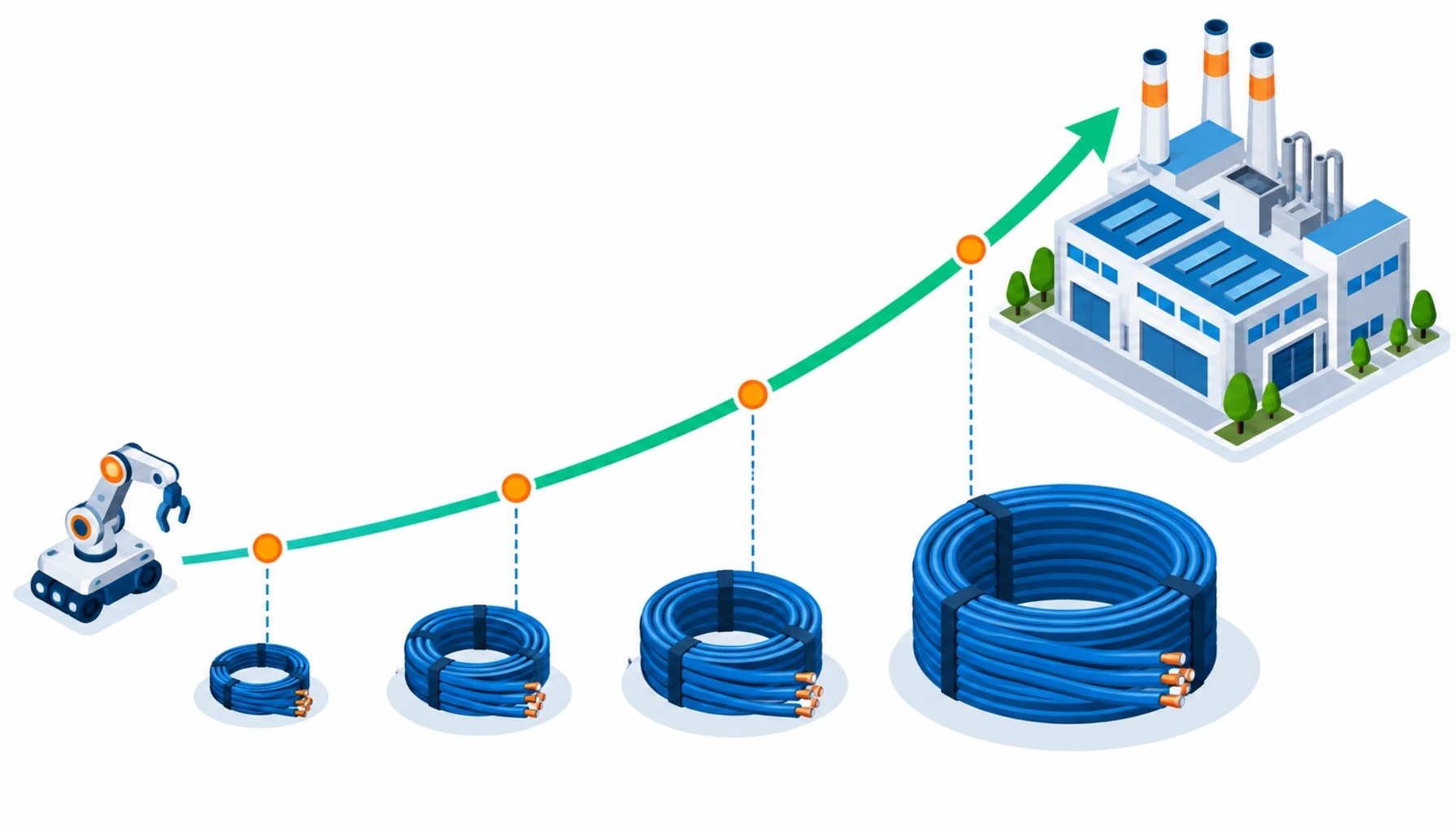
For cable, the forecast has two phases. The near term belongs to integrators and first-robot buyers, where volume is fragmented and service wins orders. The later phase belongs to replacement, as the fleet installed in this decade ages into its first cable refits in the next. Suppliers who establish constructions and documentation habits during the first phase inherit the second, because replacement buyers start from what is already in the machine. That compounding, more than any single year’s installation figure, is why the cable opportunity in India is described as structural.
| Decision | Why it matters here | Practical handling |
|---|---|---|
| Margin over minimum | New users overrun quoted duty and halls run hot | Size for real duty with headroom; state the assumptions in the quote |
| Heat and dust rating | Ambient and airborne conditions exceed European defaults | Confirm compound ratings against the hall's actual temperature range |
| Integrator enablement | Integrators choose cable for dozens of first-time buyers | Educate and stock for the integrator layer, not just end users |
| Documentation clarity | Buyers lack failure history; papers are the quality signal | Ship test evidence in readable form with every drum |
| Future replacement path | This decade's fleet refits in the next | Keep constructions stable and records re-issuable for refits |
RFQ Checklist: Motion Cable for an Indian Automation Project
Three cautions. First, growth rates flatter small bases: a 15 per cent rise from a low number still leaves India’s installations an order of magnitude below China’s, and suppliers who size their India bet on percentages rather than units will overbuild. Second, the market is uneven; pockets of world-class automation sit beside vast manual sectors, and cable demand concentrates where the pockets are. Third, compliance is not optional even in a catch-up market: India’s product licensing regime applies to cable as it does elsewhere, and the dedicated guide to Indian machine imports and the certification overview in the cable certification checklist remain the honest starting points before any shipment.
Conclusion
Send these so the quote reflects the real conditions:
- Plant location and whether the hall is climate-controlled, with the true temperature range
- Duty per axis: travel, cycles per shift, and the shift pattern actually planned
- Actual bend radius and carrier type, measured where replacing existing cable
- Environmental exposure: dust, oil, coolant, and any washdown requirement
- Power quality notes at the site, since drive-side stress lands on cable and terminations
- Whether the buyer is a first-robot owner or an expanding fleet, since support needs differ
- Required compliance paperwork, named at inquiry stage
- Support expectations: documentation, spare drums and replacement planning