Sample and Bend-Test Validation Before Bulk Orders: A Buying Protocol
Quick Answer: Pre-order sample validation turns a flex-life claim into a measurement on a production-intent cable, at a fraction of the bulk order’s cost, and it is the last cheap moment to discover a construction problem.
By the time a bulk order arrives, the decisions that matter have already been made. The construction is fixed, the tooling is set, the reels are wound, and the only remaining variable is whether the cable behaves as promised. That is a poor place to run an experiment, and yet it is where most buyers first measure anything at all.
Introduction
Sampling before the order moves the measurement to the only point where it can still change the outcome. A production-intent sample costs a supplier a day of line time and a buyer a fraction of the order value, and it answers the questions that no datasheet settles: whether this factory, on this equipment, with these materials, produces a cable whose conductor survives the bend pattern your machine will apply.
This article describes a five-stage protocol for pre-order validation, the tests worth running, and the honest limits of what a sample can prove. It is aimed at buyers who have already narrowed the field to one or two suppliers and need a defensible basis for committing production volume.
Why the Sample Stage Belongs Before the Order
Incoming inspection and pre-order sampling answer different questions, and confusing them is expensive. Inspection at goods-in asks whether the delivery matches the order: correct lengths, correct marking, correct batch references, no transit damage. It cannot answer whether the construction will survive a million cycles, because that answer takes weeks on a rig and a comparison against a claim.
Pre-order sampling asks the harder question while there is still leverage. A factory that produces a sample with a slow flex result will usually discuss a construction change, because the order has not shipped and the relationship is still being built. The same conversation after a bulk delivery is a warranty claim, and warranty claims are adversarial by design. The economics are equally clear: a bend rig programme costs a fraction of what a refit costs in labour, downtime and customer goodwill, and the sample stage is the only point in the process where all three are still avoidable. The same logic drives the broader discipline of testing equipment before acceptance in other categories of industrial supply.
What a Sample Has to Be
Most of the value in a sample programme is destroyed by accepting the wrong sample. A sample must be production-intent: built on the same line, on the same equipment, with the same materials and process parameters as the bulk order will be. A laboratory hand-build, a pilot-line special, or a length pulled from an unrelated campaign all answer the wrong question. If the factory cannot offer a production-intent sample, that is itself information about how the order will be made.
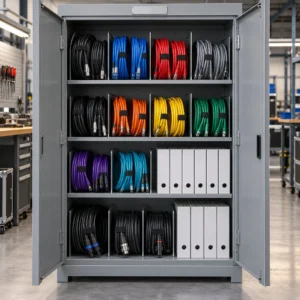
The sample must also arrive with its paperwork: the construction sheet it was made to, the batch reference, and the routine electrical test record. A sample without documentation is a piece of cable, not evidence. Retain part of it unopened and store it in a controlled place, because a retained reference from the approved sample is what makes a later batch comparison possible without arguing about memory.
The Five-Stage Protocol
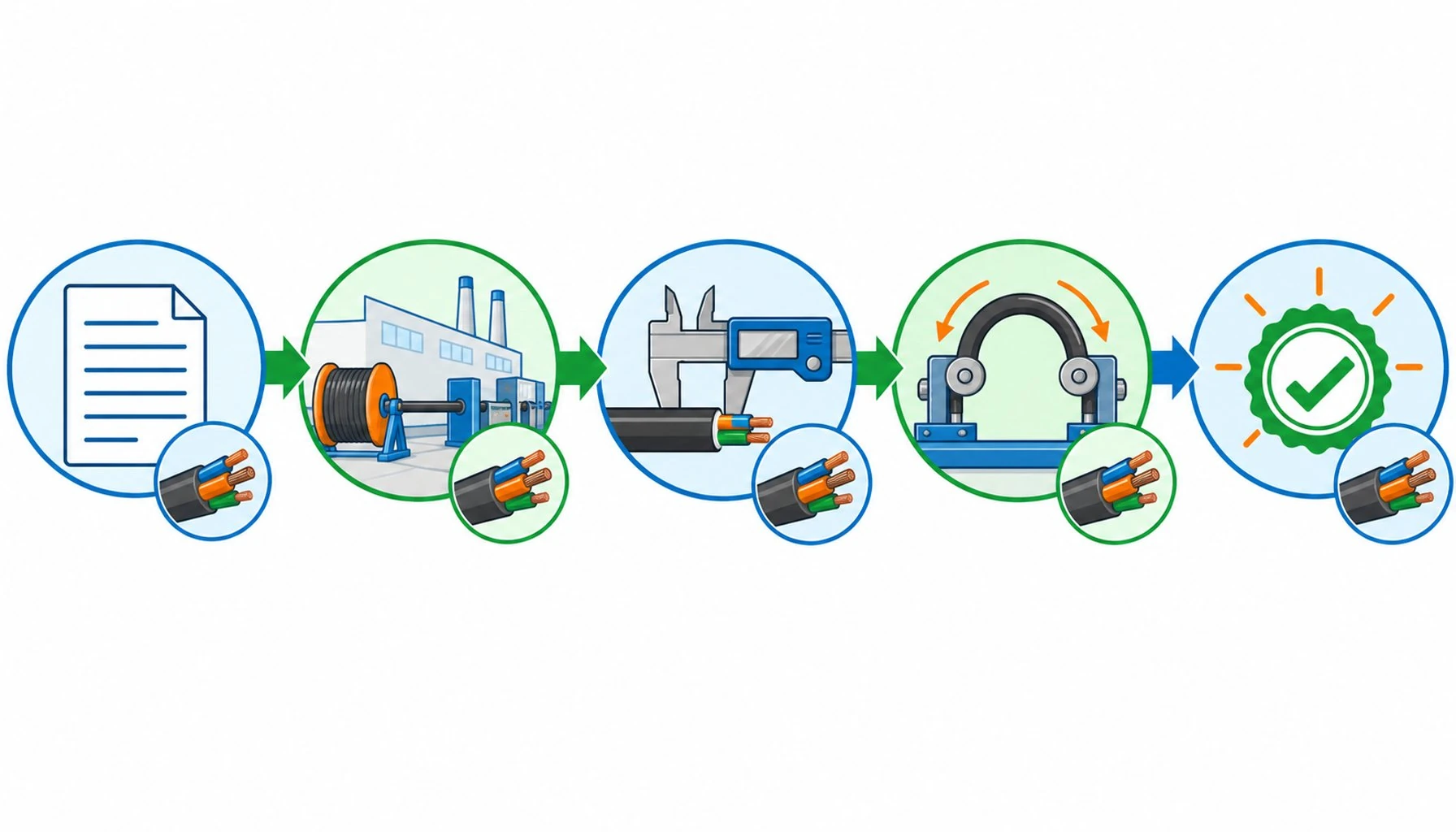
The stages below run in order, and each one has a decision attached. Written first, measured second, compared third, frozen fourth, retained fifth. Buyers who skip the writing stage usually end up arguing about results they cannot interpret, because there was never a criterion to interpret them against.
| Stage | What you do | Pass criterion | Decision it settles |
|---|---|---|---|
| 1. Write the protocol | Define duty, rig, radius, cycle target, monitoring and witness points | Both parties sign the same document | Whether results will be interpretable at all |
| 2. Order the sample | Production-intent length, with construction sheet and batch record | Same line, materials and parameters as the bulk order | Whether the sample represents the product |
| 3. Baseline inspection | Dimensions, marking, continuity, dissection of one length | Matches the construction sheet within tolerance | Whether the build matches the paperwork |
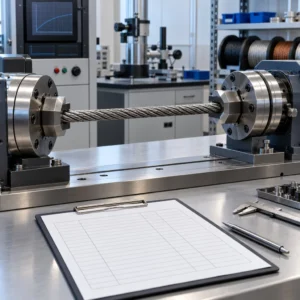
| 4. Duty simulation | Bend, rolling bend or torsion on a representative rig | Reaches the agreed cycle target without failure | Whether the construction fits your application |
| 5. Compare and freeze | Benchmark against the claim and any rival sample, then freeze the build | Result meets the target and is documented | Whether to release the bulk order, and against which build |
What Each Test Reveals
Stage three earns its place more often than buyers expect. Dissecting a length and checking conductor stranding against the construction sheet catches the substitution that a dimensional check misses, because a cable with fewer, coarser wires can measure identically on the outside. That single comparison is why the retail-like practice of approving a sample by appearance and flexibility is unreliable. The dimensional discipline involved follows the same reasoning as cable size selection, where the outside diameter tells you less than the conductor underneath it.
Reading the Result Honestly
Choice of test matters as much as choice of sample. A reverse bend rig, a rolling bend in a carrier and a torsion rig apply different stresses, and a construction that excels in one can fail early in another. Run the motion your application actually applies, and if the cable sees two motions in service, say so, because a combined duty is a harder test than either one alone.
| Test | What it reveals | Typical setup | Common pitfall |
|---|---|---|---|
| Reverse bend | Conductor fatigue under repeated flexing | Cable cycled over two radii in opposite directions | Radius set larger than the real installation |
| Rolling bend in a carrier | Behaviour in a drag chain, including twist | Representative chain length at service speed | Chain sized differently from the application |
| Torsion | Performance in a robot wrist or rotary axis | Twist to a stated angle each way, monitored | Using a bend rig for a torsion duty |
| Cold bend | Jacket and insulation behaviour at low temperature | Conditioned chamber at the service minimum | Testing at ambient and assuming cold performance |
| Electrical under motion | Continuity and shielding integrity while flexing | Continuous monitoring during the cycle run | Testing electrically only before and after |
| Jacket exposure | Resistance to oil, coolant and abrasion | Immersion or wipe cycles on a specimen | Judging compound suitability from a datasheet alone |
When Pre-Order Sampling Is Not the Answer
Electrical monitoring during the run is the stage most often dropped and the one most worth keeping. A cable can pass a flex life test mechanically while its shield integrity degrades for most of the run, which matters a great deal if the cable carries an encoder signal or a bus. Continuous monitoring converts a mechanical test into an answer about the whole product, and the failure signatures it captures are the ones catalogued in common cable failure causes.
RFQ Checklist: Setting Up a Sample Programme
Three cautions keep a sample programme from overselling itself. The first is that a rig is a model, not the machine: a cable that survives two million cycles on a rig may still fail early on an installation whose radius or routing differs, so the rig setup has to resemble the real duty rather than flatter it. The second is that a pass validates a construction at a moment in time; repeatability across batches is a separate property, protected by change control and retained samples rather than by the original test. The third is that a sample programme does not replace acceptance at delivery, because the delivery is where length, marking and batch identity get verified, and those are the checks that keep the delivered product connected to the tested one.
Where certification is part of the requirement, the sample stage is also the moment to confirm scope. Ask which standard applies to the exact construction and size before the bulk order, and treat the answer as a written commitment. Where a specialty motion build is not covered directly, certification can often be arranged through the cooperating manufacturing system, with the scope confirmed before production. The scope questions collected in the cable certification checklist are the ones to put to the supplier at this point rather than later.
Conclusion
Three situations make the protocol unnecessary. A repeat order on a frozen construction with a clean service history needs a retained sample comparison, not a new test programme. A low-cycle or static application does not need a flex rig at all, and running one adds weeks without adding information. And a first enquiry with a supplier you have not qualified is better spent on capability questions and a factory conversation than on a test report, because a good result from an unverified factory proves less than a mediocre one from a verified line. The qualification questions that come first are gathered in the checklist for evaluating a Chinese cable manufacturer.