MOQ and Lead Time for Specialty Motion Cable: Planning Your Project
Quick Answer: A specialty motion cable’s minimum order and lead time are set by stranding setup, compound batch sizes, marking tooling and certification runs rather than by reluctance, and they can be planned around instead of argued with.
The conversation about a custom motion cable usually reaches the same wall. The engineering is settled, the construction is agreed, and then a quotation arrives with a minimum quantity several times the project requirement and a lead time that lands after the installation date. At that point the buyer has two options: argue, or plan.
Introduction
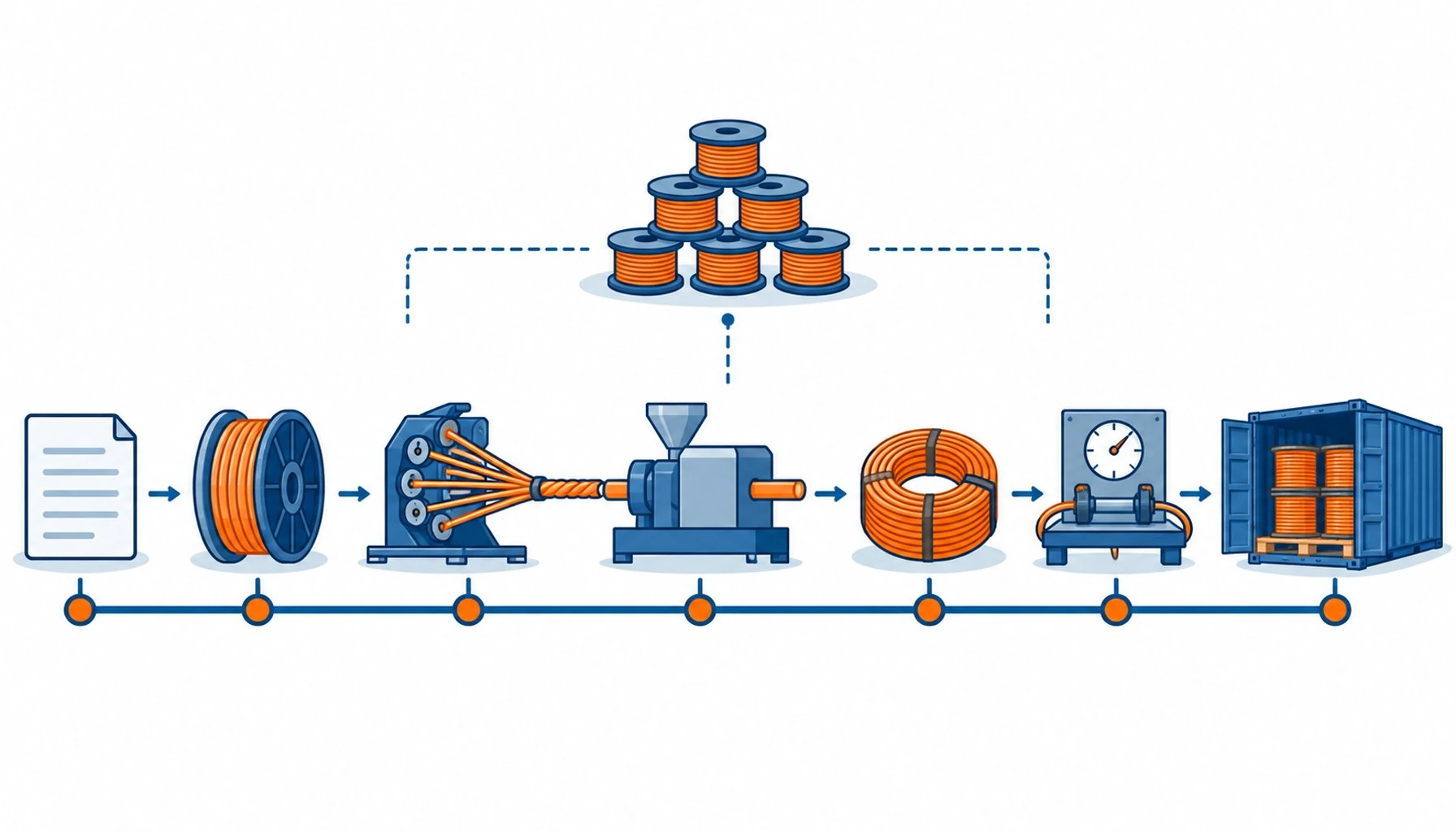
Planning works better, because the minimum and the lead time are outputs of the production process rather than negotiating positions. A specialty motion construction runs through stranding, extrusion, shielding, jacketing, printing and testing, and several of those steps have economic thresholds below which the run costs more than it earns. The thresholds do not disappear when a buyer objects to them; they either get paid for in the unit price or they move into a smaller quantity at a higher rate.
Understanding where the floor comes from changes three decisions: how much to order, when to start, and what to standardise so the next project does not repeat the problem. This article breaks down the drivers behind specialty cable minimums, the phases that consume the weeks, and the planning tools that work in practice.
Why Specialty Cable Has a Higher Floor Than Standard Cable
A standard flexible cable is made in campaigns. The line runs a large quantity of one construction, then switches, and the setup cost per metre is trivial. A specialty motion cable is the opposite: the order is small, the construction is unusual, and the setup is repeated for every order. Add a jacket marking requirement and the changeover includes artwork and plates, and add a certification requirement and the qualification batch must be large enough to draw type test samples from and still leave saleable product.
The result is that the same factory, using the same equipment, can quote a two hundred metre minimum for a standard item and a two kilometre minimum for a specialty motion build without either number being unreasonable. This is also why the answer to a minimum order question is often a range rather than a figure: the floor depends on which steps have to be set up fresh for the construction in question.
The Drivers Behind a Minimum Order
Most minimums trace back to a handful of places, and knowing which one applies to your construction tells you whether the number is negotiable at all.
| Driver | What creates it | How it shows up in a quote |
|---|---|---|
| Stranding setup | Line changeover, fine wire spool handling and lay length setup | A run length below which setup dominates the metre price |
| Extrusion run | Minimum run needed before the line and compound are stable | Usually the largest single contributor to the minimum |
| Compound batch | Specialty PUR and TPE compounds bought by drum or production batch | Small orders effectively buy the whole batch |
| Marking tooling | Printing plates or ink setup for custom jacket text | Custom marking lifts the floor above a plain build |
| Certification batch | Type test samples must be drawn from a production batch | Qualification orders are larger than the project needs |
| Reels and packing | Minimum reel quantities and returnable drum logistics | Short orders pay full reel and freight cost per metre |
| Testing and records | Routine electrical tests and batch documentation per run | Fixed cost per batch regardless of order size |
Where the Weeks Actually Go
Read a minimum order figure against this table and the negotiation becomes technical. If extrusion run length is what drives the floor, ordering the whole year’s requirement in one campaign is the only real answer, because the setup exists whether the order is two hundred metres or two thousand. If marking tooling drives it, dropping custom jacket text for standard marking removes the tooling entirely and the minimum falls with it. If the certification batch drives it, the minimum is not negotiable at all, because the type test needs a real production quantity behind it, and the sensible move is to plan the qualification order as the project’s first delivery rather than as a cost to be minimised.
Planning Tools That Work
Lead time on a specialty cable is rarely production time. Production for a two kilometre run may take days. The weeks disappear in the queue of technical clarification, sampling, testing and documentation that surrounds it, and every one of those steps has a duration that depends on decisions the buyer controls. A sample that has to be built, shipped and cycled on a rig adds weeks; a certification that has to be arranged adds more; a specification that changes after the sample is approved resets part of the clock.
That is why the earliest useful lead time question is not “how long” but “how long for each phase, and which phases can run in parallel”. Suppliers working on long-lead electrical equipment tend to be good at this conversation, and the planning approach behind the switchgear lead time projections translates directly to cable: identify the critical path, buy the long-lead item early, and accept that a cheap but late delivery is expensive.
| Phase | What drives the duration | How to compress it |
|---|---|---|
| Technical clarification | Number of open specification questions | Send the full RFQ inputs in the first message |
| Sample production | Scheduling the construction on the line | Accept the factory's next available slot, not a preferred one |
| Sample testing | Cycle target, rig availability and test speed | Agree a cycle target that answers the question without running to destruction |
| Certification arrangement | Scope confirmation and assessment scheduling | Confirm scope at RFQ stage, and start the process before sampling ends |
| Bulk production | Run length, line capacity and queue position | Book capacity once the sample passes, and consolidate the year's volume |
| Testing and documentation | Routine tests, batch records, packing checks | Agree the documentation pack upfront so nothing is drafted at the end |
| Shipping and customs | Incoterm, route, and clearance documentation | Fix the Incoterm and confirm the paperwork list before production starts |
When a Specialty Minimum Is Not the Answer
Two phases are worth planning as one. Certification and bulk production can overlap if the qualification batch is planned as the first commercial delivery, which converts a serial delay into a parallel one. The paperwork side is covered in the comparison of FOB and CIF terms, where the cost and risk split also decides who chases the documentation, and misunderstandings there are among the recurring items in any review of international sourcing mistakes.
RFQ Checklist: Planning Around a Minimum
Four approaches handle specialty cable minimums better than negotiation. Consolidation is the first and most effective: combine all the constructions and sizes a site or a machine programme needs into one order so the setup is amortised across everything. Call-off arrangements are the second, where the factory produces a campaign quantity and the buyer draws it down against a schedule, paying for stock rather than for setups. Standardisation is the third: reducing the number of near-identical constructions in a catalogue lowers the floor for every future order, because the factory is no longer setting up for a one-off. And the fourth is designing the cable in early, which turns a lead time problem into a scheduling problem with months of slack.
Buffer stock belongs in the conversation as well, particularly for machines in the field. A modest safety stock of the approved construction costs less than a production slot bought at short notice, and it covers the failure that would otherwise idle a machine while a replacement is made. Whether the construction can be held economically is a question for the supplier, and the qualification questions behind that answer are collected in the checklist for evaluating a Chinese cable manufacturer.
Conclusion
Three situations argue against custom. If the application is a standard flexible duty, a catalogue construction will do the job at a fraction of the minimum and a much shorter lead time; specifying specialty where duty does not require it is the most common cause of a self-inflicted minimum. If the project cannot absorb the qualification lead time, buying a stockist’s standard item now and developing the specialty build for the next programme keeps the machines running. And if the annual volume cannot justify a campaign, a call-off arrangement with a supplier who already makes a similar construction is usually cheaper than commissioning a bespoke one, even if the construction is not an exact match.