Rack Power Hit the Copper Limit: What It Changes in Your Busbar and Cable Spec
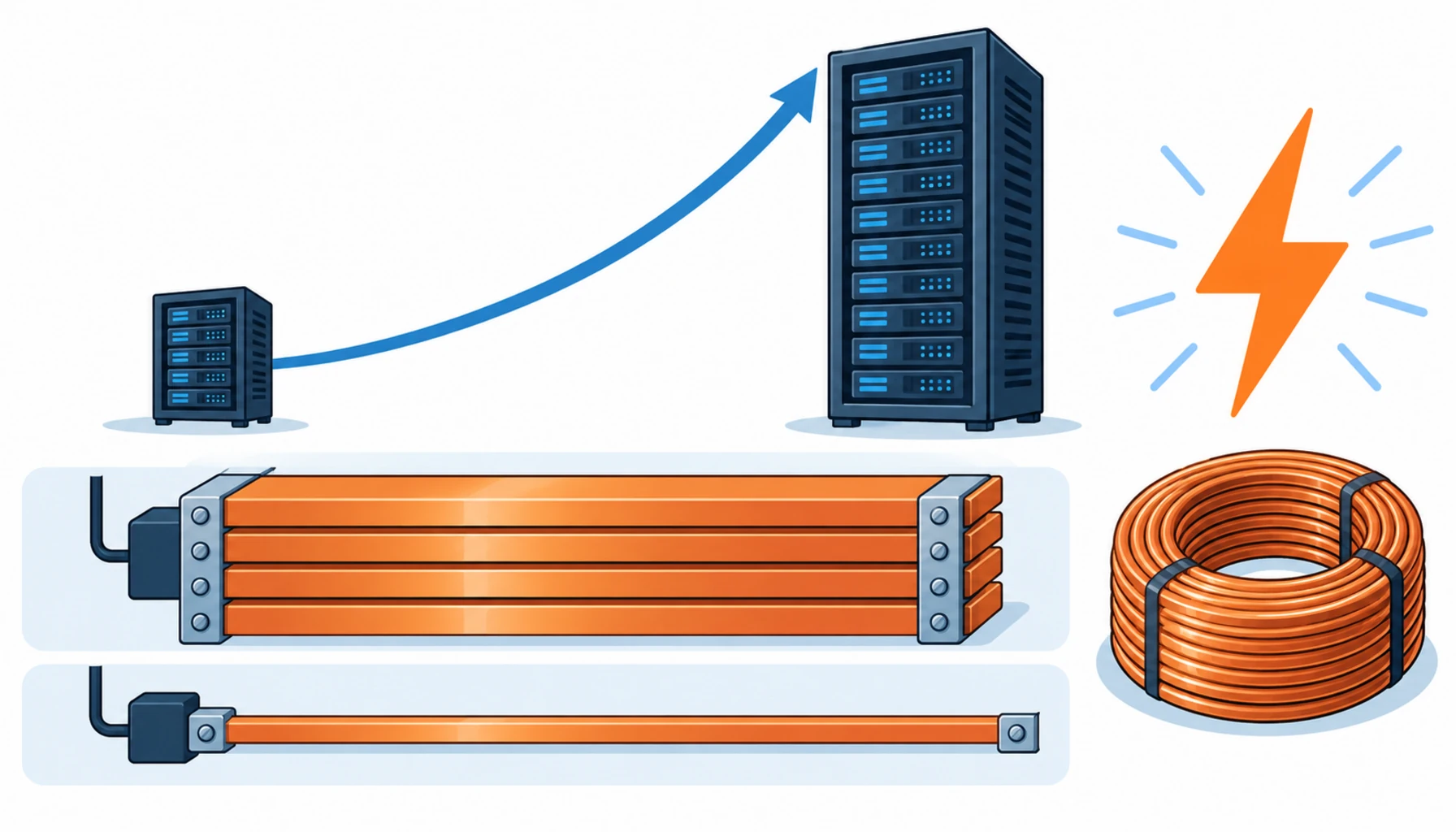
Quick Answer: A 1 MW rack needs roughly 18,500 amps at 54V DC and about 1,250 amps at 800V. That ratio decides how much copper lands in your schedule, and it is why the current figure, not the chip generation, is what forces a change in what you buy.
Ask why data centers are moving to 800V DC and you will hear about efficiency, conversion stages and total cost of ownership. All true, and all secondary to the reason that actually moves purchase orders. At some point you cannot physically fit enough copper behind a rack to carry the current, and where that point sits decides the voltage class written into your specification.
Introduction
Ten years ago a dense rack drew 10 to 15 kW and 54V DC distribution was comfortable. Today an AI training rack can pull 145 kW, and published roadmaps take the same rack to 330 kW, then 570 kW, then toward a megawatt. Current scales with power at fixed voltage, so the busbar, connectors and cables behind that rack have to scale with it too, except space does not scale, and neither does the cost of moving electrons through copper.
What follows is the arithmetic in plain terms: what the number of amps does to busbar and cable, where the practical ceiling sits, and what a 1 MW rack costs before anyone talks about power supply efficiency. The load side of the same arithmetic appears in our guide to UPS sizing for data centers, and the demand backdrop in data center power demand growth.
The Rack Power Curve and Where Your Spec Breaks
Each step in the curve changes the electrical problem, not just its size, which is why the thresholds below are the points where a cable or busway package has to be re-quoted rather than re-sized.
| Generation | Rack Power | Current at 54V DC | What It Does to Your Specification |
|---|---|---|---|
| Pre-AI dense rack | 10–15 kW | About 185–280 A | Ordinary rack PDUs and flexible cords; no design pressure and nothing to re-quote |
| Early accelerator rack | 30–40 kW | About 555–740 A | Wider busbar, monitored PDUs, more copper per row; the point where busway and cable start competing on price |
| Blackwell generation | About 145 kW | About 2,700 A | Heavy busbar and liquid cooling; conductor size stops being a standard catalogue item and becomes a project item |
| Vera Rubin NVL72 | About 330 kW | About 6,100 A | 54V becomes a rack-design constraint rather than a detail; quote the DC-fed alternative alongside the AC one |
| Rubin Ultra / Kyber | About 570 kW | About 10,500 A | Low voltage distribution effectively unbuildable; every serious offer will be a DC distribution package |
| Native 800V generation | Toward 1 MW | Above 18,000 A at 54V; about 1,250 A at 800V | Buy DC-rated busway, joints and protection, and put temperature rise evidence on the acceptance list |
What the Current Costs You in Copper and Money
Read the table as a procurement timeline rather than a history. Up to about 30 kW, 54V is fine and nobody speculates about it. Between 30 and 100 kW, the low voltage busbar starts dictating rack design, which is when conductor sizing becomes a commercial item. Above 100 kW, the current involved makes air-cooled busbar and conventional connectors impractical, and the power delivery architecture has to change rather than be scaled.
The Voltage Ladder as a Buying Decision
Take a 1 MW rack and compare the two approaches on current alone. At 54V it needs roughly 18,500 amps; at 800V, about 1,250 amps. The ratio is close to fifteen to one, and because loss scales with the square of current, the resistive loss in the distribution path falls by a factor of more than two hundred for the same conductor. That is not a marginal efficiency win, it is the difference between a design that works and one that cannot be built.
Copper volume follows the same logic. Conductor cross-section needed for a given current is roughly constant per ampere, so a fifteen-fold current reduction means a fifteen-fold reduction in copper cross-section for equal power, with the savings showing up as weight, cost, tray fill and the structural support that carries all of it. On a campus consuming hundreds of megawatts, that arithmetic repeats across every rack row in the building.
The counterweight belongs in the same comparison. 800V hardware costs more per unit today: conversion equipment, DC breakers and DC-rated connectors all carry a premium because volumes are low and designs are new. One published estimate puts first-stage retrofit hardware at roughly USD 400,000 to 500,000 per megawatt, recovered in three to five years through electricity savings alone at current industrial rates, before counting the copper, space and cooling savings. At high density the trade is obvious; below 100 kW per rack it usually is not, which is the subject of the next table.
Space, Cooling and the Cost Nobody Quotes
Voltage is not a single jump from 54V to 800V. There is a ladder, and the rung a project chooses sets cable ratings, breaker availability and connector selection, which makes it an electrical specification decision rather than an equipment purchase order. The table below frames the same options by what can actually be bought.
| Distribution Level | Typical Use | What You Can Buy Today | What to Specify If You Choose It | Verdict for a Project Energising Now |
|---|---|---|---|---|
| 48V / 54V DC | In-rack distribution from a shelf or PSU | Fully available, many sources, short lead times | DC-rated rack PDUs and flexible cords with the correct temperature class | The default below 100 kW per rack; nothing gained by over-specifying |
| ±400V DC | Transition architecture for new AI capacity | Volume shipments of power products from the second half of 2026 | Bipolar arrangement, protection design, and rating the layer for 800V | The practical buy for near-term AI capacity at high density |
| 800V DC | Rack, cluster or room-level distribution | Thin on breakers, busway joints and connectors, with long lead times | DC voltage class including transients, joint design, coordination study scope, test evidence | Specify the rating now and energise later; do not order the hardware early |
| 415/480V AC with in-rack conversion | Conventional halls and everything below 100 kW | Fully codified, cheapest to staff and service, wide supply base | Standard AC switchgear, PDU and cable schedule | Stay where you are unless density forces a change |
When Higher Voltage Is Not the Answer
The middle two rows are where most of the confusion sits in live tenders. Both are DC, both are quotable, and they are not interchangeable once the busway is made, which is why the voltage class belongs in the specification document rather than in a post-tender clarification.
RFQ Checklist: What to Send Your Cable and Busway Supplier
Busbar losses are only part of the hidden bill. At low voltage the distribution hardware occupies rack space that could hold compute, thickens trays that must be supported and fire-stopped, and forces cable routes that interfere with airflow in the densest part of the hall. Then there is the cooling load: every watt lost in a conductor inside the white space has to be removed by the cooling system, which means more capacity, more fan power and more of the same space problem.
Space is the constraint most often left out of comparisons because it is hard to price. But a row of racks that gives up position to busbar and power shelves produces less revenue per square metre, and where shell, land and power connection are fixed costs, that matters more than the difference between two conductor prices. The rack-level arrangement also decides how maintainable the row is, and the trade-offs behind putting power in the rack versus on the floor are set out in our note on rack-mounted versus floor-mounted PDU layouts.
Conclusion
Below roughly 100 kW per rack, moving up the voltage ladder is usually the wrong purchase. Conventional AC distribution with in-rack conversion is cheaper to build, the equipment is available from many sources with short lead times, and any competent electrician can work on it without new training or DC-rated test gear. A facility that will run general-purpose compute for the next decade should stay where it is.
Timing matters as much as density. A project energising next year at moderate density gains little from specifying DC distribution it cannot source competitively, and committing early to one DC voltage can lock out better options later. The pragmatic approach most operators are taking is to rate the distribution layer for the higher voltage while energising at the lower one, so the eventual move is a rack-level change rather than a rebuild.
Engineering depth decides the rest. Fault energy, insulation coordination and protection coordination all get harder as voltage rises, and a site without the people to design those systems is better served by proven architecture than by an ambitious one. Our note on why switchgear and transformer lead times broke down in 2026 is a reminder that the electrical supply chain, not the physics, is often what decides a schedule. The full procurement scope behind a voltage change is set out in our companion piece on procuring 800V DC data center power.