TIA-942 Certification Testing: What Your Commissioning Agent Must Prove Before Handover
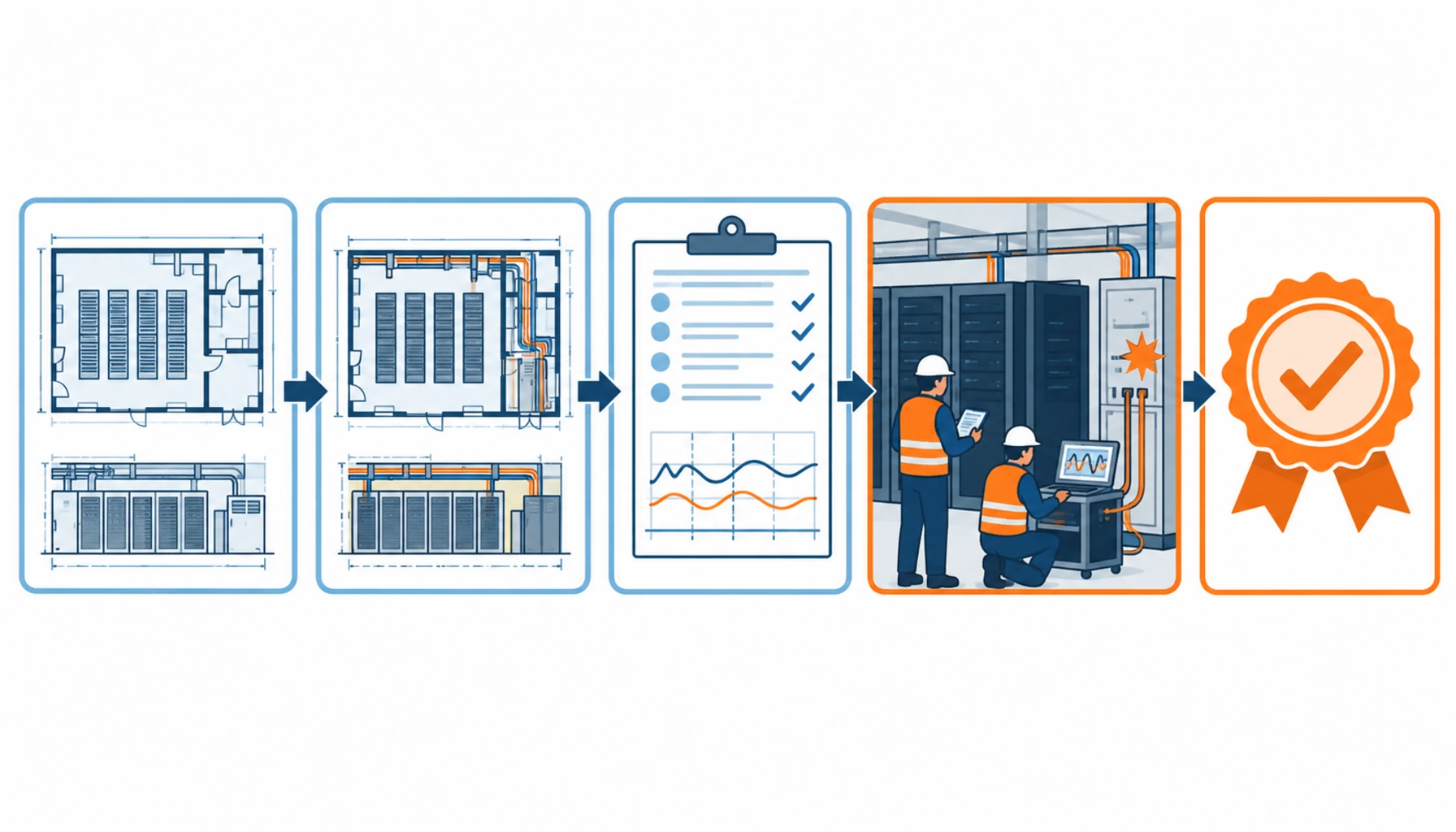
Quick Answer: Certification is not something a test produces. It is something an auditor grants on the basis of evidence, and the evidence set is defined by the standard rather than by the contractor. That means the purchase has three parts a buyer can control: the rating you target and the auditor you engage, named before design rather than after construction; the specific tests that generate the required records; and a contract structure in which those records are delivered before money moves. Projects that get certification right spend the same on testing as projects that struggle, and considerably less on remediation.
Certification is usually introduced to a data center project for a commercial reason rather than a technical one. A colocation provider needs it to win enterprise tenants, a bank needs it for internal sign-off, an operator needs it to demonstrate to its own board that the build matches the brief. Whatever the driver, the deliverable is a document set that a third party has examined, and the cost of producing that document set falls on the construction and commissioning budget.
Introduction
The awkward part is timing. The evidence an auditor wants is generated during construction and commissioning, and almost none of it can be recreated afterwards. Torque records, insulation test results, thermal images taken before the hall was energised, photographs of penetrations before they were sealed: each of these exists only if somebody decided in advance that it was required, and if the person doing the work knew to produce it in the right form. A project that starts thinking about certification at practical completion has already lost most of the evidence it needs.
So the procurement question is not whether to certify. It is which rating, which auditor, and which records, decided early enough that they cost production time rather than remediation time. The individual tests that feed the evidence set are covered elsewhere in this series, including insulation resistance and continuity testing and infrared thermography in commissioning.
What the Rating Actually Certifies
TIA-942 is a telecommunications infrastructure standard for data centers, and it assesses four areas: the telecommunications spaces and cabling, the architectural and structural provisions, the electrical system and the mechanical system. It classifies a facility on a scale from Rated-1 through Rated-4, where the higher ratings describe progressively greater capability to keep operating, moving from basic capacity through redundant components and concurrently maintainable design to fault tolerant design.
Two things about that structure matter commercially.
The rating is a property of the whole facility, not of a subsystem. A project can buy the highest-rated switchgear available and still fall short of a target rating because of a single point of failure in a route, a cooling path, or an access arrangement. That is why the rating target has to be set before equipment is selected: it changes what the electrical distribution has to be able to do, and therefore what you are specifying.
Certification is performed by accredited auditors rather than by the standards body itself. The standard is published by the Telecommunications Industry Association, and the audits are carried out by certification bodies working to it. The international family that grew out of the same work, the ISO/IEC 22237 series, is increasingly used where a project needs a standard with international recognition. Whichever route is chosen, the auditor’s accreditation and the scope of the engagement are part of what you are buying, and they should be confirmed before the engagement rather than assumed from a logo on a proposal.
The Evidence Set Is Defined Before You Build
The single most useful thing a project can do is obtain the required evidence list early and turn it into a schedule of deliverables attached to the construction contracts.
That list is not a mystery. An auditor working to a defined rating will need design documentation showing intent, as-built documentation showing what was built, test records showing that systems perform, redundancy verification showing that the design behaves as claimed under a fault, and maintenance documentation showing that the facility can be operated. Each of those has a producer and a date, and each is far cheaper to produce at the moment the work happens than in a retrospective exercise.
Two items on that list deserve attention from a buyer because they are usually under-specified in the contract. The first is redundancy verification, which requires deliberately introducing faults in a controlled way. The second is the as-built documentation set, which has to be in a format the auditor can work with, delivered in editable form, and reconciled against the design intent before the audit. Our note on cable labeling and documentation for handover covers the cabling half of that set, and the wider checklist is set out in our note on the data center cabling checklist for EPC projects.
The Decision Table: Evidence Paths Compared
The table compares the ways a project can obtain evidence, in the form a buyer can price. The last column is where the money is actually lost, because it describes what happens when the path chosen does not match the commercial reason the project wanted evidence in the first place.
| Evidence Path | What to Declare | Evidence You Receive | Cost and Lead Time Shape | Failure Mode If Chosen Wrong |
|---|---|---|---|---|
| Contractor self-certification | The record set required, in the record format, as a contractual deliverable | Contractor-issued records with no independent examination | Lowest cost; adds only administrative effort to work already being done | Useful internally, and not accepted by a tenant, a lender or an insurer as proof |
| Commissioning agent witnessing | The tests the agent will witness, and the point in each sequence where they attend | Signed witness records by an independent party per test | Moderate cost; programme depends on agent availability at test points | Tests performed before the agent attends, so the record is retrospective and weak |
| Certification audit against a rating | The target rating, the auditor and the accreditation scope, named before design | Certification statement plus the gap list from the audit | Highest cost; audit scheduling is a lead time item and gap remediation is open-ended | A gap found at audit stage that changes equipment, when remediation is most expensive |
| Tenant or lender specified audit | Whose standard, whose auditor, and which evidence format the third party requires | Records in the format the external party defined | Moderate to high; the format requirement is the cost driver, not the testing | Records produced in a format nobody asked for, and a second pass over everything |
| No formal evidence path | The residual risk you are accepting, written down rather than assumed | Operational records only | Cheapest during construction, most expensive at the first dispute | No ability to demonstrate performance to a tenant, an insurer or a future buyer |
Failure Mode Testing: The Part That Gets Dropped
If one item separates a certified facility from a documented one, it is controlled fault introduction.
A record showing that a system works in its normal state proves very little about a facility whose purpose is to keep operating when something fails. What demonstrates the claim is a scripted test in which a defined fault is introduced, the response is observed against a written expectation, and the result is recorded. Opening a breaker and confirming that the load transferred as designed is a five-minute test with a considerable amount of preparation behind it: the script has to be written, the risk assessed, the sequence agreed with operations, and the expected response defined precisely enough that the observation means something.
The reason this gets dropped is that it is the only part of commissioning that carries real operational risk, and it usually falls at the end of the programme when everyone is tired. Three procurement measures make it more likely to happen.
Write the fault scripts as deliverables. Require the test scripts to be submitted and approved before the test window, not produced on the day. A script that arrives the morning of the test is a script nobody has reviewed.
Attach the witness requirement to the sequence, not to the day. State that the failure mode tests will be witnessed, and that the witness attends the test itself. Where the witness requirement is expressed as a general obligation to be present at commissioning, it gets satisfied by attending a load bank run.
Make the records a payment milestone. This is the single most effective measure available to a buyer. Where the final payment is released on delivery of an accepted record set rather than on completion of the works, the documentation is produced as part of the job. Where it is a promise to follow, it competes with the next project and loses. The same principle applies to the earthing and bonding verification, covered in our note on grounding and bonding verification.
What to Freeze Before the Audit
| Item | What to State | Evidence to Attach | Cost of Leaving It Open |
|---|---|---|---|
| Target rating and scope | The rating being targeted, the areas it covers, and the date it is needed by | Written scope agreed with the auditor before design is frozen | Design changes after construction to reach a rating that was assumed rather than specified |
| Auditor and accreditation | The certification body, its accreditation, and who within it leads the engagement | Accreditation certificate and named lead auditor | An audit that the project's customers do not recognise, and a second audit to fix it |
| Evidence list | Every record required, with its producer, format and delivery date | Schedule of deliverables annexed to each construction contract | Records that exist in someone's head, or in a format the auditor cannot use |
| Fault test scripts | Which faults are introduced, and that each script is approved before the test window | Approved scripts with expected responses and risk assessment | Redundancy claimed from a drawing rather than demonstrated on the installation |
| Witness plan | Who witnesses which test, and at which point in the sequence | Signed witness records per test, dated | Tests completed before the witness arrived, and evidence that cannot be relied on |
| As-built reconciliation | That as-built documents are reconciled to design intent before the audit, in editable form | Reconciliation record listing every deviation and its disposition | An audit conducted against a documentation set that does not describe the facility |
| Payment linkage | The milestone at which the accepted record set releases payment | Contract clause and the acceptance criteria for the record set | Documentation chasing after practical completion, with no leverage left |
| Gap remediation budget | The allowance held for findings, and who carries the cost of each category of gap | Agreed allocation between design, supply and installation | An open-ended remediation bill, argued line by line while the hall sits idle |
When Certification Is Not Worth Buying
Certification has a commercial purpose, and where that purpose does not exist the money is better spent on the installation itself.
A single-tenant facility built for one owner’s own use. Where nobody outside the organisation needs the certificate, a well-executed commissioning programme with full records delivers most of the benefit at a fraction of the cost. The records still matter, because they are what any future audit would consume.
A hall that will be substantially rebuilt within a few years. Certification describes a facility as it stands. If a major expansion or reconfiguration is already planned, certifying the interim state buys a document with a short useful life. Better to build the evidence practice now and certify the final state.
Where the target rating exceeds what the site can support. Some sites cannot reach the higher ratings because of their incoming supply arrangement, their location, or the building they occupy. Targeting a rating the site cannot achieve converts a manageable commissioning programme into a redesign, and the honest answer is to certify at the rating the facility can actually reach.
Where there is no operational capability to maintain it. A rating assumes the facility is operated and maintained to the standard it was built to. Where the operating team does not exist yet, or does not have the maintenance regime in place, the certificate will be true on the day and progressively less true afterwards. The maintenance documentation requirements, which are part of the same evidence set, are frequently underestimated; the operational view of the cabling records is set out in our note on third-party commissioning agents.
RFQ Checklist
- Target rating and the standard version being applied, stated in writing before design is frozen
- Certification body, its accreditation, and the named lead auditor for the engagement
- Full evidence list, with producer, format and delivery date for every record
- Schedule of deliverables annexed to each construction contract, not held centrally
- Fault test scripts as approved deliverables, submitted before the test window
- Witness plan naming who attends which test, and at which step
- Test records required after each stage: insulation, continuity, thermal, torque, earthing, load bank
- As-built reconciliation process, with deviations listed and dispositioned before the audit
- Documentation in editable form, not scanned, including drawings, schedules and settings
- Payment milestone linked to acceptance of the record set, with the acceptance criteria written down
- Allowance for audit findings, with the cost split between design, supply and installation agreed in advance
- Maintenance and operating documentation included, since the rating assumes the facility is run to standard
Conclusion
TIA-942 certification is bought twice: once as testing, once as documentation. The testing is a known quantity that competent contractors deliver. The documentation is where projects lose time, because it depends on decisions taken before the work starts rather than on effort applied at the end. Three procurement measures carry most of the benefit: choose the rating and the auditor before design is frozen, put the fault test scripts and witness plan into the contract as deliverables, and release the final payment against an accepted record set.
Kexingyu Cable Group (KXYE) supplies the cable and distribution equipment that commissioning tests are performed on, including the WDZ-YJY, WDZN-YJY, BTTZ, BBTRZ, NG-A (BTLY), KVV and YJV ranges, the multi-purpose distribution cable used across submain routes, and the illuminated terminal control box and GGD power distribution cabinet at the far end of them, all from one factory group with copper price linkage available on project-scale orders. Send your single line diagram and the record set your auditor expects, and we will return the test data and certificates that populate it; the fastest route is a request for quotation.