Procuring Small Modular Reactors for Data Center Power: What a Buyer Can Actually Commit To
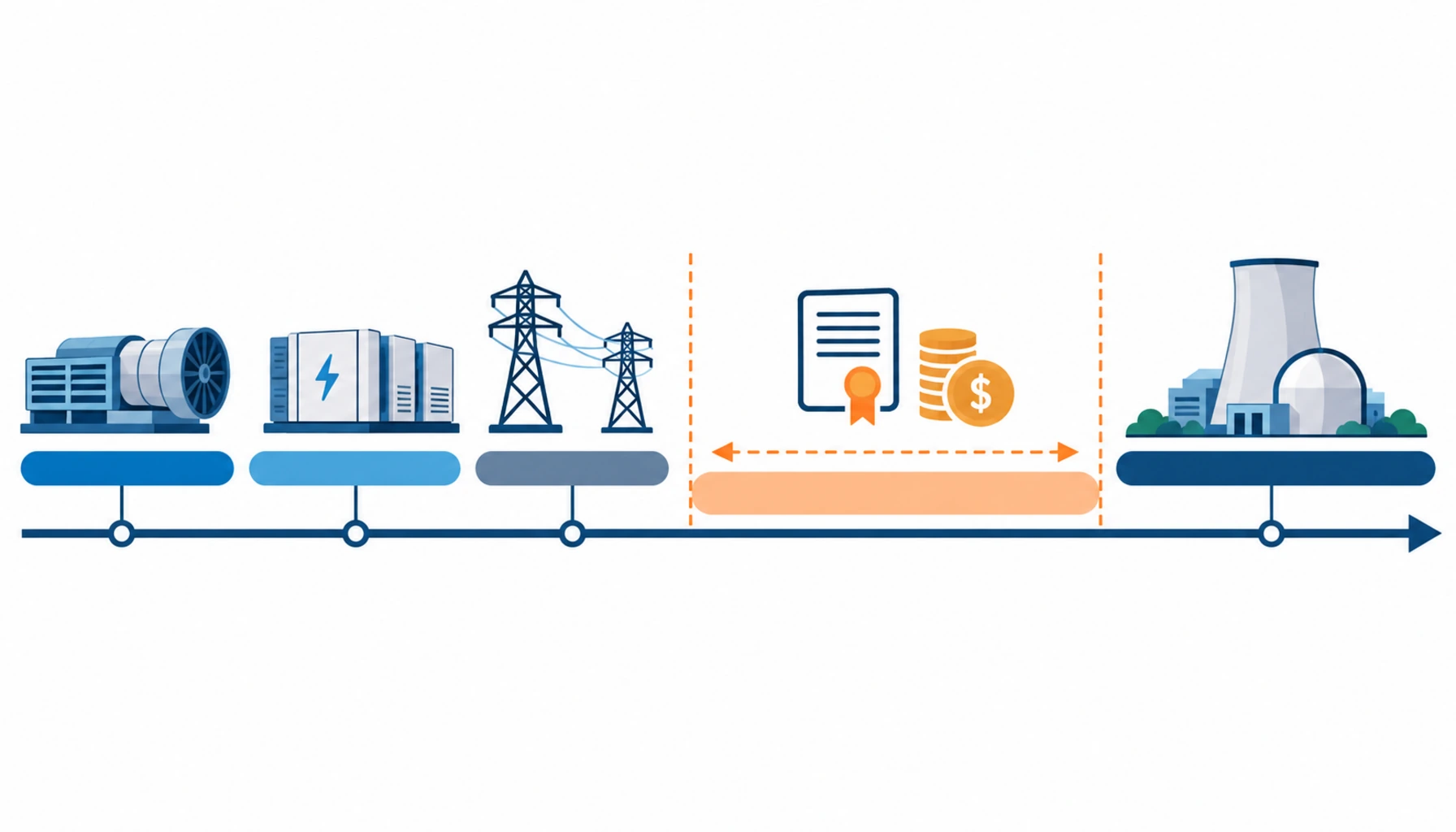
Quick Answer: No small modular reactor is supplying commercial data center load today, and none will within the procurement cycle of a campus being designed now. What is available is a set of agreements: a long term power purchase structure, a site reservation, an equity position or a conditional supply agreement with licensing milestones. A buyer who understands that is buying optionality on post 2030 capacity rather than generation. A buyer who reads a press release as a delivery date is buying schedule risk.
Introduction
Every large technology company now has a nuclear announcement, and the announcements are frequently reported as though capacity were being commissioned. The gap between an announcement and a megawatt delivered at a data hall is the subject of this note, because that gap is where a procurement decision has to be made and where it is usually made badly.
The demand pressure that created the interest is set out in our note on data center power demand growth. The practical response for a campus energising in the next three years is described in our notes on on-site gas turbines and fuel cell prime power, because those are the options that can be delivered in that window. Nuclear is a different horizon and a different kind of purchase.
What Is Actually Available to Buy
There is no catalogue of small modular reactors, no published price list and no standard delivery slot. What exists is four types of agreement, and they carry very different risk.
A long term power purchase structure. An agreement to buy power from a plant that does not yet exist, at a price formula and with milestones attached. This is the closest thing to a conventional purchase, and it is a financial instrument before it is an equipment order.
A site reservation or option. The developer holds land, a grid connection position or a licence application and grants the campus the right to take capacity from it later. The value is in the grid position as much as in the plant, because interconnection queues are the binding constraint in many markets.
An equity position. The campus invests in the developer rather than buying output, taking development risk in exchange for influence and a claim on future capacity. This transfers technology and licensing risk to the investor rather than sharing it.
A conditional equipment or service agreement. A contract for reactors or fuel services that becomes effective when licensing and financing conditions are met. The conditions are the substance of the agreement, and the equipment description is the least important clause in it.
The Decision Table: Structures Available Today
The four structures below are what a data center buyer is actually offered in 2026, whatever the announcement language says.
| Structure | What You Are Buying | What to Specify | Evidence You Should Receive | Risk Position |
|---|---|---|---|---|
| Long term purchase agreement | A right to capacity and energy from a future plant at an agreed price formula | Milestone schedule, price index, capacity factor assumption, termination triggers and credit support | Licensing schedule, financing plan, site control evidence and progress reporting rights | Limited capital exposure and no control over schedule; the price assumes the plant is built on time |
| Site and grid reservation | A position on land or in an interconnection queue, with a right to take capacity later | Reservation term, extension rights, capacity reserved, and the assignment terms if the campus is sold | Evidence of site control and the interconnection position, plus a status report obligation | Small money at risk and a real asset if the queue position appreciates; no power if the project stops |
| Equity participation | An ownership interest in the developer, with a claim on future capacity | Dilution terms, governance rights, capacity offtake arrangements and exit mechanics | Financial model, technology readiness evidence and an independent technical review | Development, licensing and financing risk retained by the investor rather than shared with the developer |
| Conditional equipment order | Reactors or fuel services supplied once conditions are met | The conditions themselves, the long stop date, and what happens if licensing slips beyond it | Design status, supply chain position and the manufacturing slot terms | Money committed to a schedule that depends on regulators and financing outside the buyer's control |
What to Put in the Agreement
Because the buyer is underwriting a schedule rather than ordering equipment, the commercial terms carry the value.
Milestones with consequences. Licensing submissions, financing close, construction start and fuel load dates, each with a date, evidence and a consequence for missing it. A milestone without a consequence is a forecast.
Price formula and indexation. What the price is indexed to, whether it adjusts with capital cost, and what happens if the project is completed late. A fixed price with no indexation is only favourable if the developer can carry the overrun risk, which is the question to ask.
Capacity and availability assumptions. The capacity factor the price depends on, and the position if actual availability is lower. Nuclear plants have high availability in operation, but the assumption should be explicit because it is a pricing input.
Termination and step-in rights. What happens if the project is cancelled, delayed beyond a long stop date, or the developer fails. Where the campus has a reservation in a queue, the right to keep or assign that position can be worth more than the deposit.
Reporting and access. The right to receive progress information and, in a larger position, to inspect the programme. Without it the buyer learns about slippage from the trade press.
Comparing Nuclear Against What Can Be Delivered
The useful comparison is not nuclear against gas on cost. It is nuclear against the alternatives on the two dimensions that decide a campus programme: when power arrives and what it costs to be wrong.
Timing. Gas turbines and fuel cells can be contracted for delivery within the current planning cycle, subject to fuel and permits. Grid capacity depends on the queue. Nuclear depends on licensing and financing, and it is the only one of the four where the buyer has no lever to pull.
Optionality cost. A reservation or a purchase agreement costs comparatively little now and holds a position. The expensive mistake is not signing too early, it is designing a campus whose capacity case depends on a plant that does not yet have a licence.
Firmness of the fuel. Nuclear fuel supply is a contracted chain rather than a pipeline, and the arrangements are made at project level. For a buyer taking capacity from a plant rather than owning it, fuel risk sits with the operator and should be confirmed in the agreement rather than assumed.
The interface that does not change. Whatever generates the power, the campus still buys switchgear, transformers, cable and protection to take it in. That equipment has its own lead time and is not improved by waiting for a reactor. Our note on utility grid expansion equipment covers the same interface from the network side.
What to Freeze Before Signing
| Item | What to State | Evidence to Attach | Cost of Leaving It Open |
|---|---|---|---|
| Capacity claimed and its date | The megawatts, the year they are assumed to arrive, and the basis for that year | A licensing and construction schedule with the assumptions stated | A campus capacity case that depends on a date nobody has committed to |
| Milestone schedule | Each milestone with date, evidence and consequence | A schedule signed by the developer, not an indicative plan | Slippage absorbed by the buyer because there is no defined event to trigger remedies |
| Price formula | Indexation, escalation and the treatment of capital cost overrun | A worked example at three different completion dates | A price that assumes an on time completion the project cannot deliver |
| Availability assumption | The capacity factor the price depends on, and the position if it is not met | Operating assumptions with the source and the comparable plant data | A pricing basis that disappears when actual availability is known |
| Licensing position | Which regulator, which application stage, and who carries the cost of delay | Application records and correspondence with the regulator | Delay costs transferred to the buyer through the price rather than stated |
| Grid and site position | Who holds the interconnection queue position and the land, and whether it survives a change of owner | Queue and site documentation, with assignment terms | A reservation that cannot be assigned, or is lost with a corporate transaction |
| Termination and step-in | Long stop date, cancellation consequences and the buyer's rights on developer failure | Termination clauses drafted against the scenarios, not in general terms | A deposit lost with no recoverable asset when the project stops |
| Reporting rights | Frequency and content of progress reporting, plus inspection rights where material | A reporting schedule and a named contact with obligations | Discovering a schedule slip from an announcement rather than from the counterparty |
When Nuclear Is Not the Answer
Where the campus energises before 2030. No amount of contracting brings a licensed reactor online faster than the licensing process allows. A campus with a nearer date needs capacity that exists or can be built, and nuclear capacity belongs in a later phase of the masterplan.
Where the capacity case depends on it. If the design assumes the reactor arrives, the design has a single point of failure outside the buyer’s control. Nuclear capacity should be upside in the model, not a line the model needs to balance.
Where the counterparty is the technology. Some agreements are with a developer whose value is a design rather than a licence and a funded programme. The diligence question is whether the counterparty can survive a schedule slip of several years, because that is the normal outcome in this sector rather than the exception.
Where the grid connection has not been considered separately. A reactor needs a connection as much as a data center does, and the queue position may be the scarcest asset in the transaction. Where that has not been examined, the agreement is being signed on the wrong asset. For campuses where the decision is closer, our note on generator and storage hybrid systems covers the arrangement that bridges the period in between.
RFQ Checklist
- Capacity and the assumed delivery year stated, with the licensing basis behind it
- Milestone schedule with dates, evidence and consequences for each milestone
- Price formula tested at early, on time and late completion dates
- Capacity factor assumption stated, with the position if actual availability is lower
- Regulator, application stage and delay cost responsibility identified
- Grid queue and land positions documented, with assignment terms
- Long stop date, cancellation consequences and step-in rights defined
- Progress reporting and inspection rights written into the agreement
- Credit support or security required from the developer, sized to the delay scenario
- Capacity case in the campus design does not depend on the plant arriving
- Independent technical review completed before signature, not after
- Interface design for taking the power into the campus progressed in parallel
Conclusion
Nuclear capacity is the only power purchase on a data center campus where the buyer cannot influence the schedule by spending more, working harder or choosing a different supplier. That does not make it a bad purchase. It makes it a purchase of a position rather than a supply, and it should be priced, papered and modelled as one. The campus that treats a reactor announcement as a capacity line in a design document is the campus that will be buying gas turbines in a hurry two years later.
Kexingyu Cable Group (KXYE) supplies the equipment that receives the power whichever source eventually delivers it, including the medium voltage and low voltage switchgear, the transformers and substation equipment, and the cable and terminations for the incoming routes, from one factory group with copper price linkage on project-scale orders. Where a campus is planning a nuclear phase alongside nearer term generation, send the interface arrangement and the capacity stepping you intend to use, and we will return the ratings and records that let each stage be energised independently of the one before it; the fastest route is a request for quotation.