Procuring Fuel Cells and SOFC Systems for Data Center Prime Power: Output, Fuel and Service Terms
Quick Answer: A solid oxide fuel cell plant is not one product. It is modules, fuel treatment, power conversion, thermal management and a long term service agreement, and the modules are usually the easiest of the five to buy. The fuel specification decides whether the plant runs at its rated output, and the stack degradation rate decides what it costs in year five. Both belong in the enquiry, along with the grid code certificate for the inverters.
Introduction
Fuel cells have moved from demonstration projects to a realistic option for data center capacity, for reasons that are procurement rather than environmental. They are manufactured as modules rather than built as projects, they emit very little nitrogen oxide because they do not combust, they are quiet enough to sit near occupied buildings, and their delivery does not compete for the same production slots as large gas turbines.
What they are not is simple. A fuel cell installation has a fuel treatment requirement that most buyers underestimate, a degradation profile that shapes the operating cost, and a power conversion stage that has to meet grid code. Our note on critical power backup requirements sets out where such a plant sits in the overall scheme, and our note on behind the meter generation covers the approval path.
What a Fuel Cell Plant Actually Contains
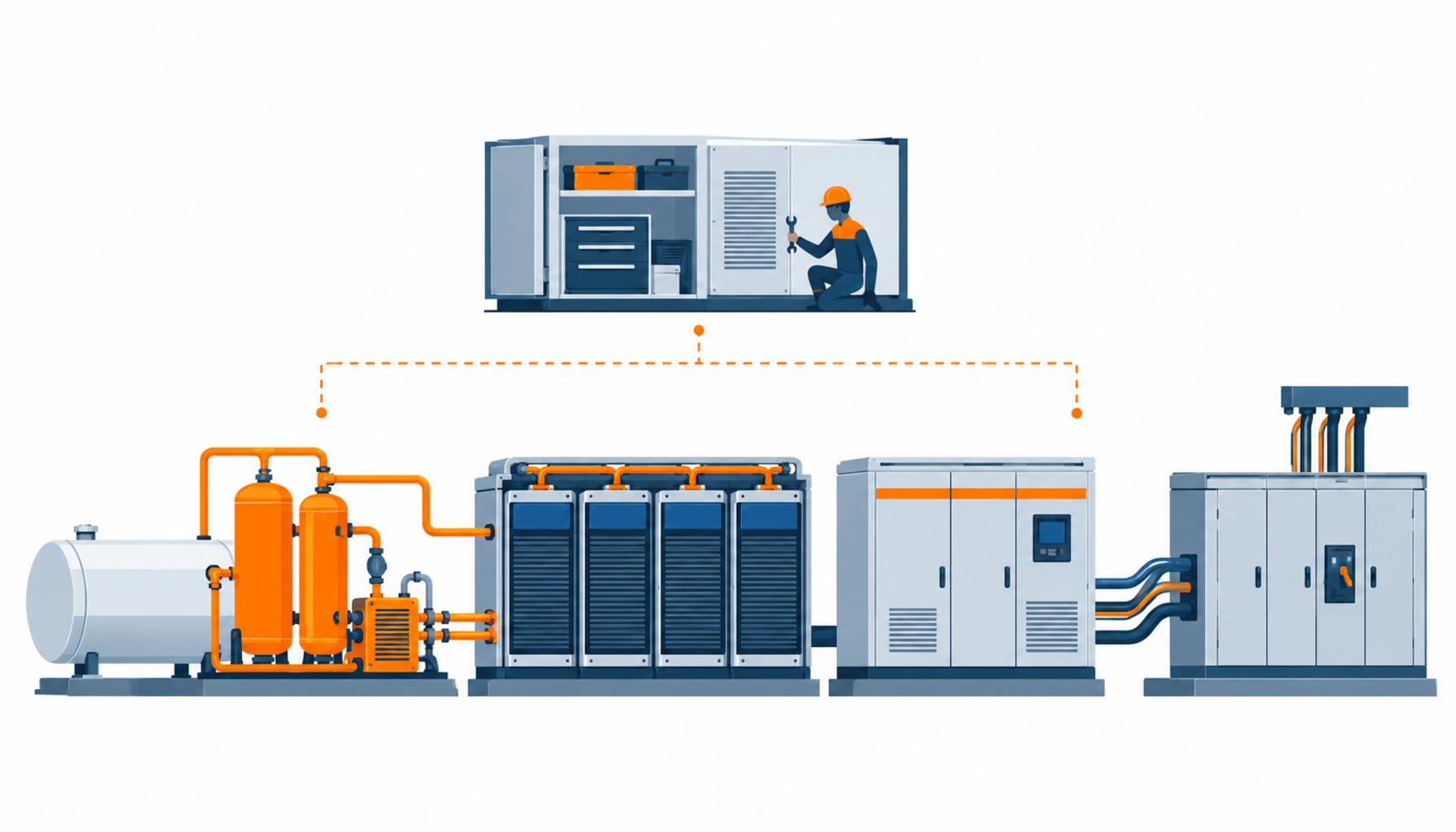
The purchase breaks into five parts, and the cost balance between them is not what buyers expect.
Modules. The fuel cell units themselves, usually in the hundreds of kilowatts to low megawatt class, arranged in groups to reach the plant rating. Module count determines how much output is lost when one unit is out, so the redundancy step is a purchasing decision.
Fuel treatment. Solid oxide stacks are sensitive to sulphur and to certain hydrocarbons, so a desulfurisation stage is normally required upstream. This is a real piece of equipment with its own consumables, and it is frequently left out of a first enquiry and added as a variation.
Power conversion. Direct current from the stacks is converted and synchronised through inverters, which means the plant is subject to the same grid code and certification requirements as a solar or storage installation. Our note on inverter grid code compliance covers what that certification involves.
Thermal management. Heat recovery equipment where the site can use the heat, and the cooling arrangement where it cannot. Efficiency claims should be read carefully, because electrical efficiency and combined efficiency are different figures and only one of them helps a campus.
Service and replacements. Stack replacement intervals, module exchange arrangements, spares holding and the response terms. For a prime power plant this is not a maintenance contract, it is part of the plant’s cost of ownership.
The Decision Table: Fuel Cell Configurations Compared
The three configurations below are the ones that appear in data center enquiries today.
| Configuration | What You Are Buying | What to Specify | Evidence You Should Receive | Cost and Operating Shape |
|---|---|---|---|---|
| Grid parallel base load | Modules running continuously alongside the utility supply, with fuel treatment, inverters and a service agreement | Rated output at site conditions, electrical efficiency, fuel specification, degradation rate and inverter certification | Performance test records, grid code certificate, fuel tolerance statement, degradation curve with the basis | Highest capital cost per megawatt of the on-site options; lowest emissions and a firm maintenance calendar |
| Islanded prime power | The same plant plus black start, island control and the protection settings for a mode without a grid reference | Load following range, ramp rate, the storage needed to cover the ramp limit, and the island protection scheme | Island mode test records, ramp rate measurement, storage interface test | Removes the dependence on the grid queue; ramp rate is slow, so storage or load management has to cover the gap |
| Backup only | A smaller fuel cell plant used instead of diesel generators for standby duty | Start time from cold, load acceptance step, fuel availability during a wide area event, and annual run expectation | Load acceptance test records, start time measurement, fuel supply evidence for outage conditions | Lowest capital cost and the shortest fuel endurance; the fuel supply is the limiting factor in a long event |
Specifying the Fuel
Fuel is where fuel cell projects fail commercially, and it fails in three ways.
Sulphur and contaminant limits. The stack has a tolerance, usually expressed in parts per billion rather than parts per million, and it should be stated with the measurement standard. Where the pipeline gas exceeds it at any point in the year, the treatment plant has to be sized for the worst case rather than the average.
Hydrogen blending. Many solid oxide systems accept a proportion of hydrogen in the fuel, and the acceptable proportion is a specification value rather than a general claim. A plant bought on a hydrogen blend assumption that the eventual supply cannot deliver is a plant running below its rated output.
Pressure and flow stability. The supply pressure at the plant boundary, the flow range the machine can follow, and what happens during upsets. Where the plant is expected to carry critical load, the fuel arrangement needs the same attention as the electrical redundancy.
Our note on energy storage backup for data centers covers the pairing that compensates for the slow ramp, and our note on commercial and utility scale storage explains where such storage sits commercially.
What Determines the Operating Cost
Degradation rate. Stacks lose output over time, and the rate is quoted in percent per thousand hours. The figure should come with its test basis and the conditions it was measured under, because a degradation rate measured on a clean reference fuel will not be reproduced on site gas.
Replacement interval and cost. When stacks are expected to be replaced and what a replacement costs, expressed as a cost per kilowatt per year rather than a single price. That number is the honest way to compare two fuel cell offers with different capital costs.
Module exchange method. How a module is removed and replaced, what access and lifting equipment is needed, and how long the plant is down. For a prime power installation this determines whether a failure is an inconvenience or a capacity shortfall.
Electrical efficiency measured correctly. Efficiency at the load the site will actually run, on the fuel the site will actually burn. A peak figure at full load on reference gas is a marketing number, not an operating number.
What to Freeze Before the Order
| Item | What to State | Evidence to Attach | Cost of Leaving It Open |
|---|---|---|---|
| Plant role and rating | Prime, base load or standby, with the megawatts credited to it in the campus capacity case | A generation and load balance with the grid contribution shown | Capacity credited twice, once to the utility and once to the fuel cell plant |
| Fuel specification | Composition, sulphur limit, pressure and the hydrogen proportion tolerated | A fuel analysis from the actual supply point, with the seasonal range | A treatment plant sized on average gas, failing on the worst week of the year |
| Electrical efficiency basis | Efficiency at the intended operating load on the specified fuel, at site conditions | A performance guarantee table with the correction method | A shortfall against a claim made at reference conditions and full load |
| Degradation and replacement | Degradation rate with basis, replacement interval and cost per kilowatt per year | Test data behind the degradation figure, and a replacement price schedule | An operating cost discovered in year three that was never in the business case |
| Redundancy step | How many modules can be out with the plant still meeting its committed output | The module arrangement drawing, with the N-1 case stated | An output shortfall whenever a module is exchanged, on a plant sold as firm |
| Ramp rate and storage | The ramp rate, and the storage or load management that covers it | A dynamic study or a documented operating procedure | A trip on the surrounding network that the plant cannot follow, despite being the backup |
| Grid code and certification | The certification standard the inverters must meet, including any update level | A certificate issued for the product and firmware level being supplied | Equipment that cannot be connected until the certificate is reissued |
| Service and spares | Response time, local spares holding, module exchange method and downtime allowed | A service agreement with response and availability terms | A plant standing idle while a spare travels from another continent |
When Fuel Cells Are Not the Answer
Where the site needs fast load following. Solid oxide systems ramp slowly by the standards of a data hall load. Where the plant has to absorb rapid swings without support, storage becomes mandatory rather than optional, and the business case changes.
Where the fuel quality cannot be guaranteed. A plant behind a gas supply with variable sulphur content needs treatment sized for the worst case, and that cost belongs in the comparison. Where the treatment plant is treated as an accessory, the project is being judged on an incomplete number.
Where the supplier’s service network does not reach the site. Fuel cell plants live or die on stack replacement logistics. A supplier without local support and a local spares position is a risk that no warranty wording removes.
Where a twenty year life is being assumed without evidence. Stack replacement is a real recurring cost, and the evidence behind the degradation and replacement figures should be reviewed rather than accepted. Where the numbers are projections rather than field data, the case should be tested against a higher replacement rate. The high voltage backup battery system is the equipment that bridges slow ramp generation on a critical site.
RFQ Checklist
- Plant role and the megawatts credited to it stated, with no double counting against the utility supply
- Rated output and electrical efficiency guaranteed at site conditions on the specified fuel
- Fuel composition, sulphur limit and hydrogen tolerance stated with the analysis attached
- Fuel treatment equipment included in the scope, not offered separately
- Degradation rate with its test basis, plus replacement interval and cost per kilowatt per year
- Module count and the N-1 step that the plant still meets its commitment with
- Ramp rate stated, with the storage or load management that covers the difference
- Inverter grid code certificate issued for the product and firmware supplied
- Black start and island mode specified with the test method, where those modes are required
- Service response time, local spares holding and module exchange method agreed in writing
- Noise and emissions values stated as specification figures, with the measurement standard
- Witness points and performance test procedures agreed before manufacture
Conclusion
A fuel cell plant is bought as a system rather than a machine, and the parts that decide its economics are the fuel treatment upstream of it and the stack replacement schedule inside it. Both are known quantities at the enquiry stage, and both are easy to leave out of a comparison that only looks at capital cost per megawatt. The buyers who get this right specify the fuel, the degradation rate and the service terms at the same time as the modules.
Kexingyu Cable Group (KXYE) supplies the electrical equipment that surrounds a fuel cell installation, including the medium voltage switchgear, the cable and terminations for the generation connection, and the energy storage systems used to cover ramp limits and ride through disturbances, from one factory group with copper price linkage on project-scale orders. Send the plant rating and the operating modes you need it to support, and we will return the connection ratings, the protection arrangement and the records that let the plant be commissioned against the grid; the fastest route is a request for quotation.