Procuring Cable and Equipment for Tropical Data Centers: Humidity, Condensation and Corrosion
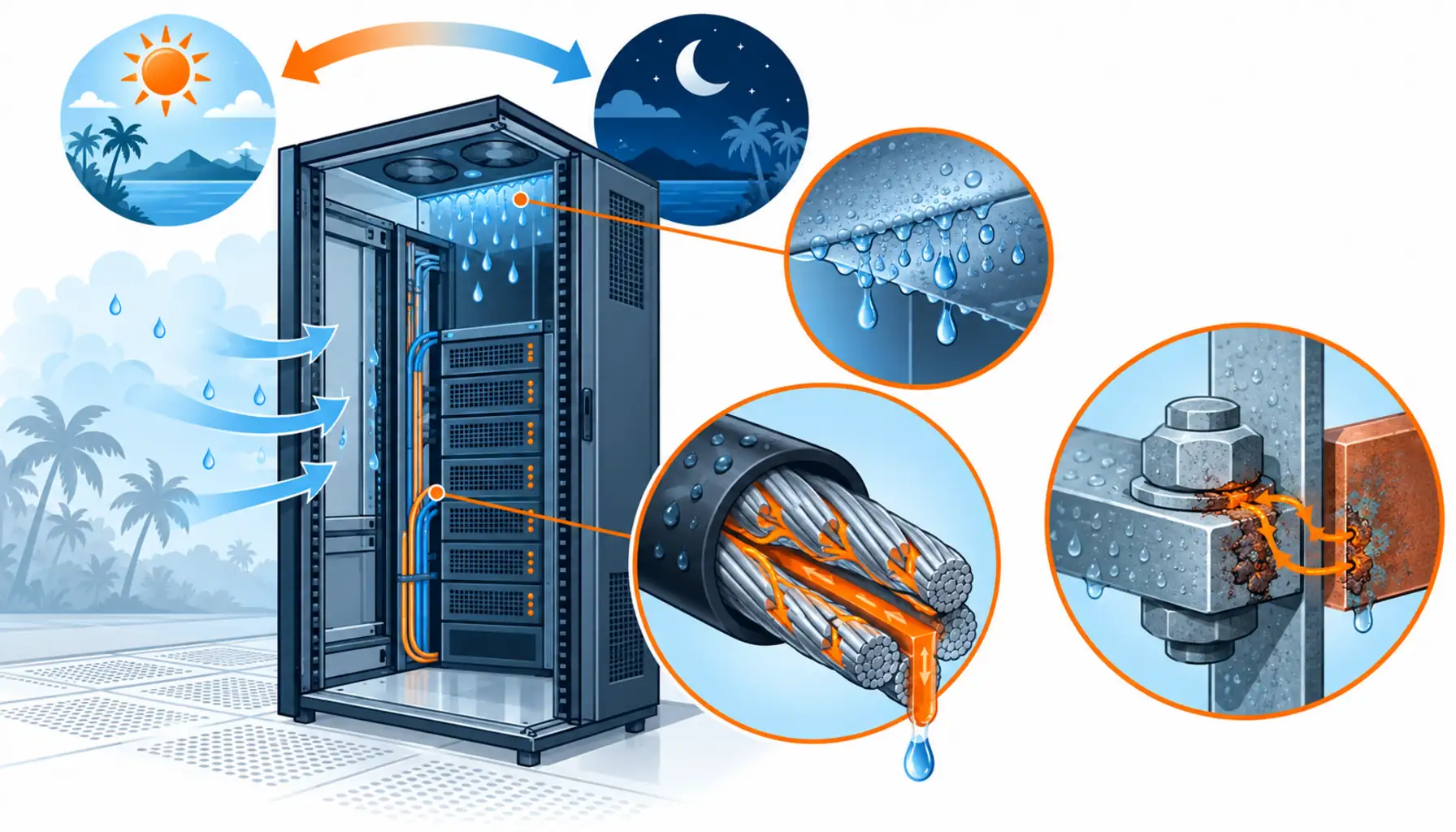
Quick Answer: A tropical site attacks a power installation twice. Outside, humidity and chloride in the air corrode every fastener, support and enclosure. Inside, the daily temperature cycle draws moist air into anything that breathes and condenses it on the coldest surface. Both are specification inputs, and the item buyers most often leave out is the water blocking and end sealing on the cable itself.
Introduction
Data center projects in Southeast Asia run into a set of problems that northern European specifications do not describe. The air is warm and close to saturated for much of the year, the coast is often within a few kilometres, and the corrosion rate on exposed steel is several times what a temperate site would see.
The equipment exists for these conditions, and the regional sourcing picture is covered in our notes on Southeast Asia data center power and on Singapore data center cable. What this note deals with is the mechanism: where moisture actually gets in, what corrosion does to a specification, and which items belong in the order rather than in a maintenance plan.
What Humidity Actually Does to an Installation
Four mechanisms run in parallel, and they need different answers.
Breathing. An enclosure that is not sealed heats up during the day and cools at night, drawing in moist air as it contracts. The water arrives as vapour and leaves as liquid on the inside of the coldest surface. This is why an outdoor cabinet with a high ingress protection rating still collects water, and why a pressure equalising device is a design item rather than an accessory.
Capillary ingress at the cable end. A cable is not a sealed pipe. Where the end is not sealed, water travels along the interstices between strands and fills the core over time. The damage appears months later and far from the point of entry, which is what makes it expensive.
Atmospheric corrosion. Chloride from sea air and sulphur compounds from industry accelerate the corrosion of galvanised steel, aluminium and fasteners. The rate depends on the exposure class, and the difference between an inland site and a coastal one is large enough to change the material selection.
Galvanic corrosion at joints. Where dissimilar metals are in contact in a wet environment, the less noble one corrodes. This is a detailing problem, and it is resolved by specifying the joint rather than by choosing a material for the whole assembly.
Biological growth belongs on the same list. In sustained high humidity, mould grows on non-metallic surfaces and on dust films, which is an insulation and a hygiene issue rather than a structural one, but it appears in inspection reports and it has to be designed for.
The Decision Table: Four Specification Responses and What Each One Costs
The four responses below are cumulative rather than exclusive. Most tropical projects need the first two, and the fourth is a decision about how much of the problem to design out.
| Response | What You Are Buying | What to Specify | Evidence You Should Receive | Cost and Risk Shape |
|---|---|---|---|---|
| Water blocked cable and sealed ends | Cable with longitudinal and radial water blocking, plus a sealing system for every termination and joint | Water blocking construction, end sealing method and the accessories that match it | Type test data for the water blocking construction, plus the sealing procedure | Modest premium on the cable, and it removes a failure that is otherwise discovered years later |
| Corrosion classified metalwork | Supports, trays, fasteners and enclosures selected against a stated exposure class | The corrosion category, coating thickness, stainless grade and the fasteners to be used | Coating thickness records, salt spray test data and material certificates | Higher material cost; the alternative is replacement work in an operating hall |
| Enclosure climate control | Heaters, breathers, pressure equalising devices or air conditioning for enclosures | Ingress protection, condensation control method and the duty cycle the enclosure sees | Enclosure thermal calculation, IP certification and device specification | Adds components and parasitic load, but it is the only answer for cabinets that breathe |
| Route the problem away | Indoor or conditioned routing, sealed ducts and terminations inside the building envelope | Exposed route length, sealing at the envelope penetration and the rating of each segment | Route drawings showing exposure and a penetration sealing detail | Requires building area and layout discipline; usually the cheapest lifetime answer where it fits |
What Each Response Changes in the Order
Four items move from general good practice into the specification.
Water blocking becomes a construction requirement. A cable described as suitable for wet locations is not the same as a cable with water blocking along its length. The construction should be named, and the accessories that terminate it should come from a system that has been tested with it. The range built for wet and corrosive routes is described in our note on water blocking cable.
Corrosion class becomes a number. Coating thickness and stainless grade should be stated against a defined exposure category rather than described as heavy duty. Where the site is coastal, the grade that works inland may be inadequate, and the difference is a material certificate rather than an opinion. Ranges selected for corrosive environments are described in our note on corrosion resistant cable.
Enclosure condensation becomes a designed function. Heaters, breathers and pressure equalising devices are not accessories to be added if the cabinet mists up; they are part of the enclosure specification, with a duty cycle and a power supply. Where they are omitted, the water that condenses inside will find the terminations.
Terminations and glands become a system. The cable end is where most moisture damage starts, and the gland, the sealing compound and the termination have to be selected together. Specifying them from three catalogues produces three components that fit mechanically and do not seal. Our note on data center cable selection covers how the route and the environment feed back into these choices for the in-building segments.
Where Tropical Projects Fail
Water blocking bought as an option rather than a requirement. Where the specification is silent, the supplier offers what is standard, and the standard product is usually not water blocked. The failure appears as a low insulation resistance reading a year or two after energisation, and by then the route is in service.
Coating specified by description. Heavy duty galvanising means different thicknesses to different suppliers. A stated coating mass or thickness with an inspection record is a requirement; a description is a hope.
Condensation treated as a maintenance item. Wiping a cabinet door is not a control measure. Where the enclosure is not specified to manage condensation, the maintenance team will be doing it forever, with a towel and no effect on the terminations at the back.
Dissimilar metals left to the installer. The joint between a stainless support and a galvanised tray is where galvanic corrosion starts, and the detail is decided by whoever is on site unless the specification says otherwise. Our note on GGD power distribution cabinets covers the enclosure side of a distribution board specified for a damp environment.
What to Freeze Before the Order
| Item | What to State | Evidence to Attach | Cost of Leaving It Open |
|---|---|---|---|
| Corrosion category | The exposure class for each location, distinguished between coastal, industrial and inland | A site classification with distance to the coast recorded | Inland material installed on a coastal site, with replacement work in an operating hall |
| Coating and grade | Coating mass or thickness for steelwork, and the stainless grade where stainless is used | Coating thickness records and material certificates | Fasteners and supports that corrode first, at heights that are awkward to reach |
| Water blocking construction | Longitudinal and radial water blocking, named as a construction and not a property | Type test data for the blocking construction | Water travel along the core, discovered as a low insulation reading long after energisation |
| End sealing system | The gland, sealing compound and termination as a matched system | A sealing procedure and the accessories qualified with the cable | Three components that fit together and do not seal, at every cable end on site |
| Enclosure condensation control | Ingress protection, breathing device or heater, and the power supply for each | Enclosure thermal and humidity calculation | Water on the inside of every outdoor cabinet, finding the terminations |
| Dissimilar metal joints | Where different metals meet, and the barrier or washer selected for each joint | Detailing drawings showing the separation method | Galvanic corrosion at joints, blamed on the material rather than the detail |
| Insulation resistance baseline | The test method, temperature and the acceptance value for a damp climate | Baseline test records taken before and after energisation | A later reading that cannot be judged because there is nothing to compare it with |
| Maintenance regime | Inspection intervals, coating checks and the cleaning that the design assumes | An inspection plan naming what is checked and at what interval | A design that depends on maintenance nobody has been asked to perform |
When Corrosion Protection Is Not the Answer
Where the exposure class has not been established. Buying the most corrosion resistant material available everywhere is a way of avoiding the analysis, and it costs more than the analysis would. The category per location is the input that makes the other decisions reasonable.
Where a protective coating is used to substitute for drainage. Water that cannot drain will find a way through a coating eventually. Detailing for drainage and for cleaning comes first, and the coating protects a detail that already works.
Where the indoor environment is assumed to be dry. A conditioned data hall is dry in operation and humid during construction, and the construction period is when the cable ends are open and the terminations are being made. Moisture introduced then stays in the installation.
Where the answer is a dehumidifier rather than a specification. Adding dehumidification to a room is a legitimate design choice, but it is a lifetime operating cost and it does not protect cable cores that have already taken water. The cable and enclosure specification has to stand on its own before the building services are used to compensate for it.
RFQ Checklist
- Corrosion exposure category stated for each location, with distance to the coast recorded
- Coating mass or thickness given as a number, with inspection records required
- Stainless grade stated where stainless is used, with material certificates
- Fastener material and grade specified, not left to the installer
- Water blocking construction named for cable on wet or buried routes
- End sealing system specified as a matched set with the cable and the termination
- Enclosure ingress protection and condensation control stated, with a power supply allocated
- Dissimilar metal joints detailed, with the separation method shown on drawings
- Baseline insulation resistance recorded, with the test temperature noted
- Salt spray or equivalent test data requested for coated components in coastal locations
- Drainage and cleaning access designed into outdoor assemblies
- Inspection intervals and coating checks carried into the operations plan
Conclusion
Tropical conditions do not fail an installation quickly. They work on it steadily, from the outside through corrosion and from the inside through condensation, and the failures that result appear years later in places that are hard to reach. The defence is a specification that names the exposure class, the water blocking construction and the sealing system, and a maintenance regime that the design assumes rather than hopes for.
Kexingyu Cable Group (KXYE) supplies cable and distribution equipment for humid and corrosive sites, including the WDZ-YJY, WDZN-YJY, BTTZ, NG-A (BTLY), KVV and YJV ranges, the waterproof cable range used on wet routes, and the dual power ATS cabinet used on transfer duties, all from one factory group with copper price linkage available on project-scale orders. Send the exposure class, the route conditions and the sealing requirements, and we will return the constructions, the accessory system and the test records that support them; the fastest route is a request for quotation.