Domestic Substitution for Imported Robot Cable: A Qualification Path That Holds Up
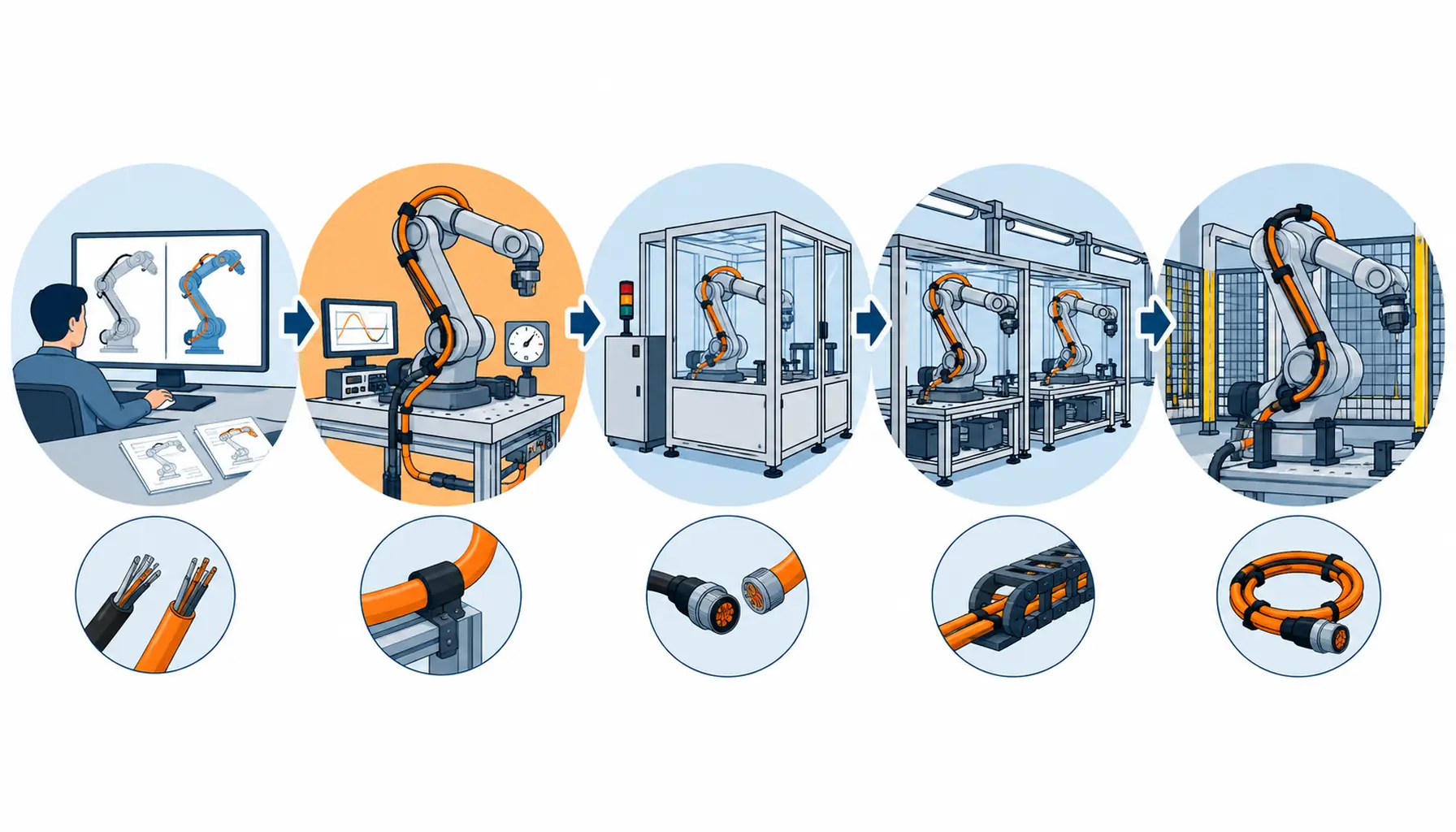
Quick Answer: Substituting an imported robot cable with a domestic source is a qualification exercise, not a purchase. Run it in stages, desktop comparison, sample qualification, parallel running, staged switchover, and the substitution lands with lower cost and shorter lead time. Skip stages and you inherit the original cable’s failures plus new ones of your own making.
Introduction
The supply base has changed faster than most qualification procedures have. MIR, the industrial automation research house, has tracked the domestic share of robot cable-type components in China rising toward roughly a third of new demand, and the domestic suppliers now shipping robot cable run from excellent to optimistic. That spread is exactly why the buyer’s method matters more than the buyer’s conclusion: the same staged qualification that admits a strong supplier will expose a weak one, in both cases before the fleet is committed.
This guide sets out the path for the person who owns the switch: what to compare on paper, what to prove on samples, how to run both cables without upsetting production, and when to make the change permanent. The commercial prize is real, cost and lead time above all, but the guide is organised around the failure modes of the substitution process itself, because those are what actually cost plants money.
Stage One: The Desktop Comparison
Start with documents, and be suspicious of any column that fills itself in. The candidate’s construction data, conductor stranding, insulation and jacket compounds, shield coverage, bend radius, cycle rating, torsion rating, temperature band, gets set against the incumbent’s datasheet line by line, and against the duty the incumbent actually survives, not the duty the drawing claims. Where the incumbent’s real duty has never been measured, the substitution programme is a good excuse to measure it, because the comparison needs something honest to compare against. The reading of what the incumbent’s duty looks like is covered in our note on robot cable failure modes.
Certificates come next, checked for currency and scope rather than existence: the landscape is set out in our note on robot cable certification. Two documents deserve particular attention in substitution projects. The first is the cycle rating’s test method, because a figure earned on a generous radius says nothing about your tighter one. The second is the traceability statement, because a supplier who cannot name the compound batch in a year will not be able to support a field investigation either.
Stage Two: Sample Qualification
Samples convert paper claims into measured behaviour, and the discipline is to test the candidate against the incumbent under identical conditions: same rig, same radii, same duty profile, same termination hardware. The mechanics of a proper sample build and bench test are set out in our notes on robot cable sample testing and the cable sample approval process. Flex cycling at the real radius, torsion at the real angle where the joint twists, and the electrical suite at the working voltage, all run side by side, produce a comparison chart that ends arguments before they start.
Insist on raw logs rather than verdicts. A candidate that fails at 60 percent of the incumbent’s cycle count is not necessarily disqualified, it may be correctly priced for a lighter duty, but a candidate whose report hides the count behind the word passed is disqualified from trust, and trust is the currency the later stages run on.
The Decision Table: Substitution Stages and What Each One Proves
| Stage | Evidence to produce | Typical duration | Decision it supports | Cost of skipping |
|---|---|---|---|---|
| Desktop comparison | Line-by-line data against incumbent and real duty | 1-2 weeks | Whether samples are worth the bench time | Bench spent on a paper mismatch |
| Sample qualification | Side-by-side bench results, raw logs | 4-8 weeks | Whether the candidate meets the duty | A fleet running on marketing data |
| Pilot installation | One or two axes in production, logged | 1-3 months | Whether the harness integrates, dresses and survives | Integration faults discovered fleet-wide |
| Parallel sourcing | Both suppliers delivering, quality tracked | 2-6 months | Whether the candidate sustains volume | Capacity and consistency unknown at scale |
| Staged switchover | Fleet conversion by cell, with inspection | Per plan | Whether the switch completes cleanly | A single-point cutover gamble |
Stage Three: Pilot, Parallel and the Point of No Return
The stages overlap where planning allows: the pilot for cell two can begin while the pilot for cell one is in its second month, and parallel sourcing runs behind the whole tail. What cannot overlap is evidence. Each stage’s decision uses the previous stage’s data, and a programme that compresses the schedule by compressing the evidence has merely moved the cost from calendar to risk.
What the Switch Actually Saves, and When
The pilot answers the questions no bench can: how the harness dresses on the actual robot, whether the service loop lands where the mechanic’s hands are, how the jacket reads after a month of the cell’s real washdown or swarf. Choose two axes with high duty and good instrumentation, log them, and inspect at the intervals our note on in-service cable testing recommends. A pilot on the gentlest axis in the plant proves nothing; a pilot on the axis that killed the incumbent proves everything.
Parallel sourcing, holding both suppliers in delivery, is the stage most programmes cut and most programmes regret. It costs little beyond attention, and it answers the questions that only volume asks: can the candidate hold consistency across lots, absorb a rush order, and support a claim at speed. The consistency discipline that volume demands is set out in our note on production consistency, and it applies to substitution exactly as it applies to scale-up. Only after both suppliers have shipped for a quarter does the switchover begin, and it proceeds by cell, with the incumbent’s part numbers retained in the system until the last conversion is inspected.
Write the switchover plan as a checklist per cell, because conversion is where haste concentrates. Harness drawing, termination hardware, spare stock, inspection record, sign-off: five lines per cell, and the last cell’s sign-off is the only ceremony the programme needs.
Before the Switch: What to Freeze
The savings arrive in three tranches, and knowing which tranche pays for which stage keeps the programme funded. Unit price lands immediately on every harness bought after the sample stage clears, and on robot cable that spread is rarely trivial. Lead time lands almost as fast, and for plants that have waited eight weeks for an imported harness, a domestic week or two is worth more than the unit price, because a shorter lead time shrinks the spare shelf the plant must otherwise hold against every failure. The third tranche is engineering attention: a supplier in the same time zone, speaking the plant’s language of drawings and deadlines, turns a week of trans-ocean email into an afternoon call.
Set the arithmetic out before the programme starts, honestly. The qualification costs bench time, pilot attention and a quarter of parallel sourcing, and the savings have to clear that bar over a horizon the plant actually plans on. For a large fleet the bar clears in a year; for a small one it may not clear at all, and recognising that before the bench work is respect for everyone’s time.
Where the horizon is uncertain, the staged path still pays, because each stage’s evidence has standalone value. The desktop comparison produces the duty baseline the plant needed anyway. The sample programme produces bench data on the incumbent it never had. The pilot produces an inspected, logged harness on the fleet’s hardest axis. A substitution that stops half-way still leaves the plant measurably better specified than it started, which is why the staged path remains the default even when the final switch stays open.
When Substitution Is Not the Answer
| Item | What to state | Evidence to attach | Cost of leaving it open |
|---|---|---|---|
| Real duty baseline | Measured cycles, radii and twist of the incumbent | Logged duty data | Comparison against a fantasy drawing |
| Acceptance criteria | Bench pass thresholds, agreed in writing | A one-page protocol | Results argued after the run |
| Test method disclosure | Rig geometry and parameters in every report | Raw logs on file | Uncomparable numbers |
| Pilot selection | High-duty, well-instrumented axes | A pilot plan | A pilot that proves nothing |
| Inspection interval | Pilot check schedule with measures | A trend sheet | Failures found after switchover |
| Parallel period | Minimum months both suppliers ship | A sourcing policy | Capacity risk discovered at volume |
| Consistency checks | Lot-level tests during parallel | Inspection records | Sample quality, production variance |
| Rollback rule | What finding reverts the switch | A written trigger | Improvised retreats at the worst hour |
| Spares coverage | Which part numbers stocked during transition | A stocked-items list | A hybrid fleet with missing spares |
| Second source end state | Whether the incumbent stays qualified | A sourcing decision note | Single-source risk rebuilt quietly |
RFQ Checklist
When the incumbent is failing for duty reasons. If the imported cable is failing on the axis, substituting a domestic one inherits a duty the specification never matched, and the new harness will fail too, with the supplier blamed for the duty. Fix the specification first; the substitution then qualifies against something fair, along the lines of our note on second-source qualification.
When volumes cannot sustain two suppliers. A plant buying six harnesses a year gains little from parallel sourcing economics and loses the incumbent’s goodwill by asking for it. The staged path still works, but the parallel stage shrinks to batch acceptance, and the honest end state is one qualified supplier with the other’s file kept warm.
When the duty sits outside both datasheets. Exotic radii, compound torsion, extreme temperatures: when neither incumbent nor candidate has data at the duty, the substitution becomes a custom development, not a substitution, and the project carries development risk on top of sourcing risk. Recognise it early and resource it as such, or wait for a standard construction to reach the duty.
When the saving is smaller than the qualification. The staged path costs bench time, pilot attention and management focus. Where the incumbent’s price and lead time are already acceptable, the honest arithmetic says keep buying and revisit when either changes, as our note on robot cable pricing makes concrete.
Conclusion
- Measured duty profile of the incumbent attached, cycles, radii and twist included
- Line-by-line construction comparison required against the incumbent’s datasheet
- Cycle and torsion ratings demanded with test method and rig description
- Side-by-side sample testing specified, identical rig and termination hardware
- Raw logs and compound batch traceability required in every report
- Pilot axes selected for high duty, with inspection intervals agreed
- Parallel sourcing period and lot-level consistency checks written into the plan
- Rollback triggers defined before the switchover begins
- Spares coverage for both part numbers during the transition period
- Certificates verified for currency and scope, not just collected