Underground Lighting and Communications Cable: Sourcing Checklist
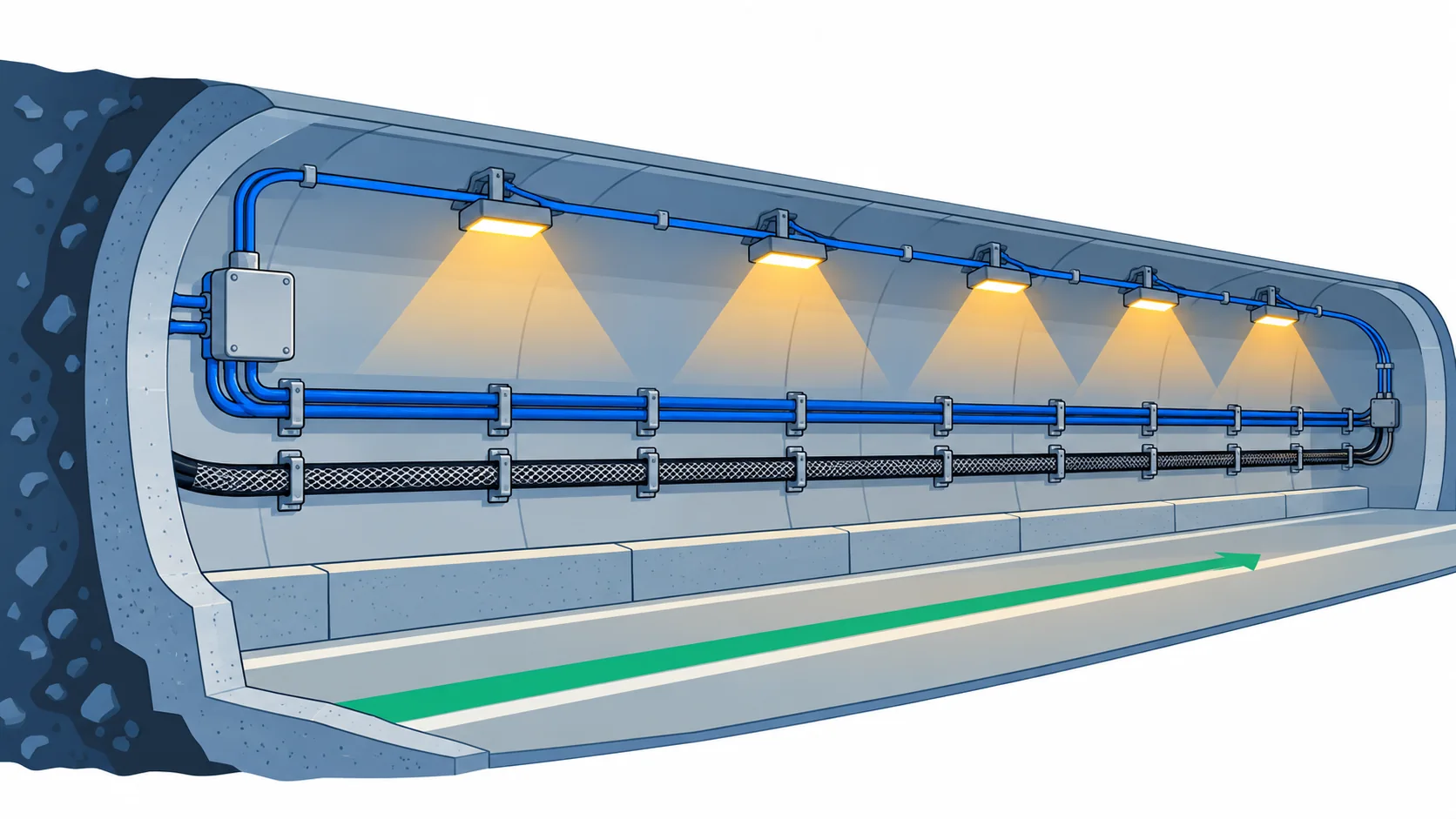
Quick Answer: Lighting and communications cable underground is a small line item that can stop a roadway when it fails. The circuits are long, the environment is wet and dusty, and the cable is usually run where people have to escape from a fire. This guide covers the voltage drop, screening, low smoke zero halogen and support requirements for these circuits, the evidence to demand, and the checklist to source against.
Introduction
On a mining project, lighting and communications cable is bought almost as an afterthought. It is a small fraction of the electrical spend, it arrives late in the programme, and it is often added to the main cable order as a few extra drums.
That habit is expensive in a specific way. These circuits reach further than a power feeder into the same roadway, they are installed where people work and walk, and a failure takes out the lighting a shift is working under or the monitoring a shift is relying on. Sourcing them properly costs a fraction of the power cable and removes a class of problem that is hard to trace after installation. The circuits sit in the same roadway as the feeders and the services covered in our note on the mining power equipment package.
Lighting Circuits Underground
Roadway lighting is a long, distributed load, and that shape creates its own cable requirements.
Voltage drop, not current. The total current of a lighting run is modest, but the run is long and the load is spread along it. Luminaires at the far end see a lower voltage than those near the source, and the visible result is dimmer light exactly where the last fittings are. Sizing lighting cable on current alone produces a circuit that works on paper and disappoints in the roadway.
Distributed taps. Lights are tapped at intervals, so the cable is terminated many times rather than once. Each tap is a point where moisture can enter, which pushes the specification toward a construction with adequate sheath thickness and a termination method suited to the environment.
Continuous operation and temperature. Lighting runs often operate for a whole shift, so the cable sits at its running temperature for longer than an intermittent load of the same rating. Steady-state derating matters more here than peak current.
Impact and support. Cable on a roadway bracket is exposed to rock fall, machine clearance and washdown. Supports, spacing and bend radius are part of the specification because they decide whether the cable survives its first year.
Communications and Monitoring Circuits
The communications side has the opposite problem: low current and a signal that has to survive a noisy environment.
Screening. Communications and monitoring circuits run beside drives, feeders and other cables for their whole length. Screened constructions, with a bonding arrangement that is actually designed, are the difference between a signal that works and a fault that only appears when a nearby machine starts.
Separation. Physical separation from power runs is part of the cable specification, because it decides the screening requirement and the routing allowance. Our note on structured cabling standards explains how the separation and screening rules are written for building networks, and the same logic applies underground.
Loop and interface protection. Where a monitoring circuit leaves the roadway and reaches a surface system, the interface is a point where currents can be introduced into the cable. The specification should state the protection arrangement rather than leaving it to commissioning.
Low Smoke Zero Halogen and the Escape Route
Where cable runs in a roadway people have to leave in an emergency, the material behaviour matters as much as the electrical performance.
What LSZH buys. A halogen-free construction releases less corrosive and toxic gas when it burns, and produces less dense smoke. In a confined roadway that is a safety requirement, because visibility and air quality are what allow people to get out.
Where it is required. Escape routes, and circuits that have to keep working while people are leaving. The requirement is usually written into the mine’s standard rather than left to the buyer, so it belongs in the specification as a stated condition.
What it does not replace. Low smoke zero halogen is not the same as circuit integrity, and it is not the same as flame retardance. Our note on LSZH versus fire retardant cable sets out where the two overlap and where they diverge, and our selection of fire-resistant cable constructions covers the circuits that have to keep working.
The table below maps the circuits found in a typical roadway against what to specify, what to demand as evidence, and how each one usually fails.
| Circuit | Duty on Site | What to Specify | Evidence to Demand | Cost and Lead-Time Driver | How It Fails |
|---|---|---|---|---|---|
| Roadway lighting feeder | Long distributed run, tapped at every luminaire, continuous operation | Voltage drop calculation, steady-state derating, sheath for washdown, support and bend radius | Voltage drop figure at the far end, derated current, sheath data | Copper to hold voltage at the end of the run drives the cost | Dim light at the last fittings, moisture at the taps, impact damage at brackets |
| Communications and data circuit | Runs the length of the roadway beside drives and feeders | Screened construction, coverage per pair, bonding arrangement, separation from power runs | Screen concept drawing, coverage figures, separation as installed | Screening and a second drum add cost to a small order | Noise that appears when a nearby machine starts, earth loops through screens |
| Monitoring and sensor loop | Fixed, low current, expected to report continuously | Screened pair count, protection at the surface interface, continuity requirement | Loop continuity data, interface protection arrangement | Small unit cost; the requirement is usually in the scheme rather than the cable | A circuit that reads healthy until it is needed, faults at the interface |
| Escape route and emergency circuit | Required to keep working while people leave | LSZH construction and, where required, fire survival performance | Halogen and smoke data, fire survival report where applicable | Halogen-free compound adds cost and lead time | Cost paid for the wrong property, or a safety requirement missed |
| Supports, glands and terminations | Assembled in the roadway, wet and dusty | Bracket spacing and material, gland type and IP rating, bend radius at each change of direction | Dimensions and IP ratings checked against the cable datasheet | Cheap against the labour of a re-termination | Damage at tight bends, ingress into taps, repeat faults at one bracket |
The Sourcing Checklist
These circuits are usually bought together, and a checklist keeps the small items from being lost behind the power cable.
Lighting feeder: sized on voltage drop at the far end rather than on total current, with the derated current stated for continuous operation.
Communications cable: screened, with the coverage and bonding arrangement written down, and separation from power runs recorded as installed.
Monitoring cable: pair count and screening to suit the signal, plus the interface protection at the surface end.
Escape route and emergency circuits: LSZH where the mine’s standard requires it, and fire survival performance stated explicitly where the circuit has to keep working.
Accessories as one order: glands, brackets, junction boxes and terminations compatible with the cable construction, rather than sourced separately once the drums arrive.
Control and monitoring cores that share a route with power are where screening pays for itself. The shielded constructions that suit this duty are described in the shielded control cable range.
Installation: Supports, Bend Radius and Terminations
Most lighting and communications cable failures are installation faults rather than cable faults, and they are worth specifying against.
Supports and spacing. Brackets spaced for the cable’s mass and the roadway’s vibration, with a material that survives the seepage. Cable sagging between widely spaced brackets is damaged by machine clearance long before it fails electrically.
Bend radius. Each change of direction at a bracket or a junction is a bend, and the tightest of them is the figure the cable has to be rated for. Our note on cable minimum bend radius explains where suppliers quote that number optimistically.
Terminations. Glands rated for the same ingress protection as the enclosure, and a termination method suited to a cable that will be tapped many times. The number of taps on a lighting run is what makes termination quality matter more here than on a feeder.
What to Freeze Before the Order Goes Out
These five items are cheap at specification stage and expensive once the roadway is being wired.
| Decision | What to State | Evidence to Attach | Cost of Leaving It Open |
|---|---|---|---|
| Voltage drop at the far end | Route length, luminaire loading and the acceptable end voltage | The lighting circuit calculation | Dim light at the last fittings on every shift |
| Screening and separation | Coverage per pair, bonding points and the separation from power runs | A screening concept drawing and the installed separation | Noise that only appears when a nearby machine starts |
| LSZH and fire survival | Which circuits require LSZH, and which require fire survival | Halogen and smoke data, fire survival report where applicable | A safety requirement missed, or cost paid for the wrong property |
| Supports and bend radius | Bracket spacing and material, and the tightest bend on the route | Dimensions checked against the cable datasheet | Sheath damage at a bracket before the cable is a year old |
| Accessories in the same order | Glands, boxes and terminations compatible with the construction | A packing list covering cable and accessories together | Taps without the right glands, found during installation |
Incoming Inspection
Against the drum, before anything is cut. Count drums against the packing list, verify the marked lengths and photograph the markings, including the construction code and drum number.
Electrical checks. Conductor resistance and continuity, insulation resistance, and screen continuity and coverage on the communications lengths. A screen that is continuous at one end and floating at the other defeats the design it was bought for.
Dimensional and accessory checks. Sheath thickness and diameter on a cut sample, and the glands, boxes and brackets checked against the cable construction before installation begins rather than during it.
When the Standard Cable Is Not the Answer
When the circuit is sized on current alone. A lighting run that satisfies current but not voltage drop produces dim light at the far end of the roadway, and no amount of maintenance fixes a cable that was never large enough. Size on the end voltage.
When an unscreened cable is used beside drives. The saving on the small order becomes an intermittent fault on the monitoring circuit, and the fault appears when a machine starts rather than when the cable is installed. Screening is cheaper than the fault-finding.
When LSZH is assumed to include fire survival. They are different properties. A circuit that has to keep working while people leave needs the fire survival requirement stated, not inferred from a material description.
When the failure is a bracket or a tap. Damage concentrated at one support or one joint is an installation fault. Our note on cable damage wear patterns is written to separate a mechanical fault from a cable fault before a heavier drum is bought.
When price is the only variable asked about. On a small order the difference between a screened LSZH construction and a general-purpose one is a rounding error against the cost of re-terminating a roadway. The currency of that mistake is a shift working without light.
RFQ Checklist
- Lighting feeder sized on voltage drop at the far end, with the derated current stated
- Luminaire spacing and tap count, so termination quality can be specified
- Communications cable screening, coverage per pair and bonding arrangement
- Separation from power and drive runs, recorded as installed
- Monitoring loop pair count, plus interface protection at the surface end
- LSZH requirement stated per circuit, and fire survival stated where it applies
- Bracket spacing and material, with the tightest bend radius on the route
- Gland type and IP rating for each enclosure, matching the cable construction
- Sheath grade for washdown, dust and seepage
- Drum lengths against the roadway sections, and any planned joint positions
- Accessories ordered with the cable, not separately
- Tests to be witnessed, records per drum, and the copper basis with its validity window
Conclusion
Lighting and communications cable is a small order with an outsized effect on a shift, and it rewards the same discipline as the power cable it runs beside. Size the lighting on end voltage, screen the circuits that share a route with drives, state the LSZH and fire survival requirements separately, and buy the accessories with the cable rather than after it.
Kexingyu Cable Group (KXYE) has supplied electrical cable from Quanzhou since 1996, including the screened, halogen-free and fire-resistant constructions that roadway lighting and communications call for, along with the glands and accessories that go with them. Send us the roadway layout with the circuit list, the run lengths, the screening and LSZH requirements and the site conditions, and we will come back with the constructions, the evidence that applies to each, and a delivery plan against your programme. The fastest route is a request for quotation.