TIA-568 and ISO/IEC 11801: Structured Cabling Standards Explained
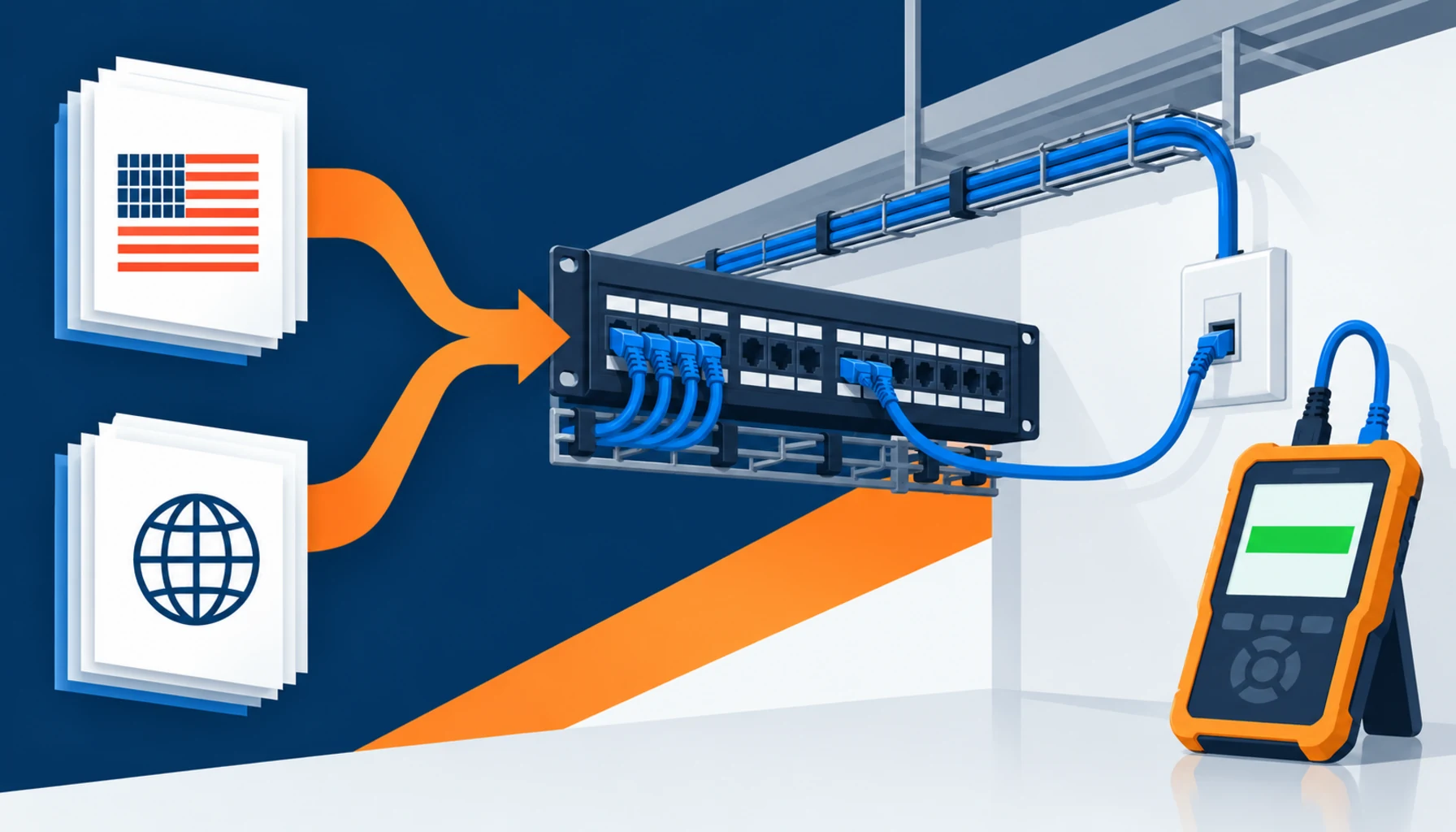
Quick Answer: TIA-568 and ISO/IEC 11801 are the twin rulebooks of structured cabling — one North American, one international. They define the categories and classes, the channel geometry and the test limits every link must pass.
Every “the link passed” in structured cabling is shorthand for a longer sentence: the link passed the limits of a named standard at a named class or category, measured over a defined geometry, with a tester configured to match. TIA-568 and ISO/IEC 11801 are where that sentence’s vocabulary comes from — the twin standards families that define what Cat6A and Class EA are, how far a channel may run, which tests a link must survive, and what the test report must say. Buyers meet them at their most consequential moments: writing a specification that a supplier can actually comply with, reading a datasheet whose category claim needs a standard behind it, and reviewing an acceptance test whose pass line means something only when the standard is named. The two families overlap heavily but differ in organization and in some limits, and a specification that names its standard — rather than assuming the reader will know — is the difference between a testable requirement and a marketing adjective. This guide explains what each family specifies, how their vocabularies map, and what to demand on paper.
Introduction
The two standards answer the same need from two hemispheres. TIA-568, issued by the Telecommunications Industry Association in North America, is the structured cabling rulebook behind the category vocabulary — Cat5e, Cat6, Cat6A, Cat8 — and the commercial building cabling practice most of the world’s projects quote. ISO/IEC 11801, the international standard from ISO and IEC jointly, organizes the same engineering into a class vocabulary — Class D, E, EA, F, FA, I and II — with editions that add the generic cabling for premises across a wider international audience. They are convergent documents: a Cat6A channel under TIA-568 and a Class EA channel under ISO 11801 are engineered to the same performance envelope, and the test instruments carry both limit sets. The differences are real but manageable — naming, some organizational structure, a few limit details — and the practical skill is matching vocabularies and knowing which standard a project’s contract and code actually reference. Buyers of power cable already live with this twin-world pattern, where the IEC, GB and BS standards landscape plays the same role for medium voltage; structured cabling’s twin is simply TIA versus ISO. The map:
What the Standards Actually Specify
Both families do four jobs, and a buyer who knows the four can read either. Topology and geometry: the channel model — the maximum horizontal run, the number of connectors, the equipment-cord allowances — with the 90-meter permanent link plus 10-meter patching model as the shared backbone of horizontal cabling. Component performance: the transmission parameters per category or class — insertion loss, NEXT and its powersums, return loss, and the higher-frequency parameters each generation adds — specified as limits across frequency. Test methodology: how a link is measured — permanent link versus channel configuration, tester calibration, reference setting — so that “passed” is reproducible between crews. Administration: labeling and documentation practice, the unglamorous layer that makes a cabling plant maintainable for decades. Around the core documents sit the satellite standards each family maintains — TIA’s addenda for data centers (TIA-942’s cabling sections) and ISO’s data center edition (ISO/IEC 22237 and related documents) — but the four jobs above are the substance a specification actually consumes.
| Performance Tier | TIA Category | ISO/IEC Class |
|---|---|---|
| 100 MHz, 1G | Cat5e | Class D |
| 250 MHz, 1G+ | Cat6 | Class E |
| 500 MHz, 10G | Cat6A | Class EA |
| 600 MHz, legacy shielded | Cat7 | Class F |
| 1000 MHz | Cat7A | Class FA |
| 2000 MHz, 25/40G short reach | Cat8 | Class I / II |
Permanent Link versus Channel: The Test That Decides Acceptance
The single most consequential specification choice in the standards is the test geometry. A permanent link test measures the fixed cabling — from the patch panel’s termination to the work-area outlet — excluding the patch cords, which are tested as components separately. A channel test measures the complete end-to-end path including the equipment cords a user will actually operate. The two have different limits — the channel’s extra connections cost headroom — and a test report that does not name which geometry was measured is incomplete, because a link that passes as a channel may fail as a permanent link with the same hardware or vice versa under different cords. The specification should name the geometry per tier, the tester configuration should match it, and the acceptance report should state standard, category or class, geometry and margin per link — the reporting discipline that mirrors power-side acceptance, where the certification checklist at the power cable certifications checklist insists on the same named-evidence structure. Margin deserves a line of its own: a link that passes with 0.1 dB of headroom is a failure waiting for a re-termination, and most specifications set a margin floor above the raw pass line for exactly that reason.
Writing the Standard into the Specification
A testable cabling specification names its standard at every layer where ambiguity breeds. The component layer: cable, connectors and patching claimed to a category or class — verified not by jacket print but by component compliance evidence, the same verification chain that governs electrical exports in the China equipment certification checklist. The design layer: topology, run lengths and connector counts per the standard’s geometry, so the design does not spend performance the standard never granted. The test layer: standard and edition named, permanent link or channel per tier, margin floors stated, tester model and calibration current. The reporting layer: the acceptance deliverable defined as per-link results with margins archived, not a signature on a summary. Read at the datasheet level, the same discipline applies — the category claim is a testable sentence only when its standard and geometry are attached, per the datasheet reading guide; and at the facility layer, the structured cabling requirements slot into the broader electrical acceptance frame that the industrial power distribution checklist organizes. The full cable plan these standards govern is mapped in the data center power hub.
When "Meets Standards" Is Not the Answer
The phrase “meets TIA-568” on a quotation is a claim, not evidence, and three habits turn it into one. Ask which edition: standards evolve, and a category claim from an older edition may lack the parameters a current tester measures. Ask component or link: component compliance and link performance are different proofs — a link built from compliant components still fails if the workmanship is poor, so the acceptance test is on links, not boxes. Ask for the margin report: a pass with no margins recorded is a claim; margins archived per link are evidence. The deeper point is the one this guide opened with: standards make performance testable, but only when the documents name them — the standard, the edition, the class, the geometry. A specification that does that work converts the twin rulebooks from vocabulary into protection; one that doesn’t has bought nothing but adjectives wearing a standards body’s initials.
| Line | Requirement | Why It Matters |
|---|---|---|
| Standard and edition | Named, e.g. TIA-568.2-D or ISO 11801-1 | Limits differ between editions |
| Category / class | Stated per link | The vocabulary must match the spec |
| Geometry | Permanent link or channel named | Different limits, different meaning |
| Margins | Per link, per parameter | Bare passes are latent failures |
| Tester identity | Model and calibration date | Reproducibility between crews |
| Archive | Per-link results retained | Baseline for decades of moves |
RFQ Checklist: Standards Lines for the RFQ
Put the standards in writing:
- Standard and edition named per project section
- Category or class stated per cable and component
- Test geometry per tier: permanent link or channel
- Margin floor above the pass line, stated
- Tester model and calibration required at acceptance
- Per-link results archived as the acceptance deliverable
- Component compliance evidence per supplier
Conclusion
TIA-568 and ISO/IEC 11801 are the shared grammar of structured cabling: they define the geometry, the component limits, the test method and the documentation that make a link’s performance a testable fact. A specification that names the standard, the class, the geometry and the margin floor turns both rulebooks into protection — and every “passed” on the acceptance report into a sentence with evidence behind it.
Kexingyu Cable Group (KXYE) manufactures its structured cabling to the named standards: category and class claims backed by component compliance evidence, test parameters stated per frequency, and documentation written so every acceptance report can name its standard with confidence.