Specifying Shearer Cable and Continuous Miner Trailing for the Cutting Face
Quick Answer: Shearer cable is the hardest working cable on a mine. It is dragged at random rather than on a fixed path, bent at a tight handler loop several times a minute, sprayed with water, and expected to carry an earth continuity monitoring circuit that the machine’s protection depends on. Buy it as a system of three segments, not as one length of flexible cable.
Introduction
Most mine cable is bought against a predictable movement. A haul truck travels a route, a conveyor runs at a fixed speed, a feeder never moves at all. Face cable is different. A shearer or a continuous miner moves wherever the seam and the operator take it, so the cable behind it is dragged and laid down in a pattern that changes every shift.
That randomness is what makes the duty expensive. The cable cannot be qualified against a known path, so it has to be bought with enough flexibility and enough mechanical protection to survive the worst day rather than the average one. Sites that plan for the average replace face cable several times as often, and each replacement is a production stop.
What Makes the Face Duty Different
Dragging is random, not repetitive. The cable is pulled over broken coal and stone, sometimes over itself, sometimes around a corner. Abrasion on a face cable is not a slow controlled wear but a series of unpredictable events, and the sheath that survives it is chosen for toughness rather than for smoothness.
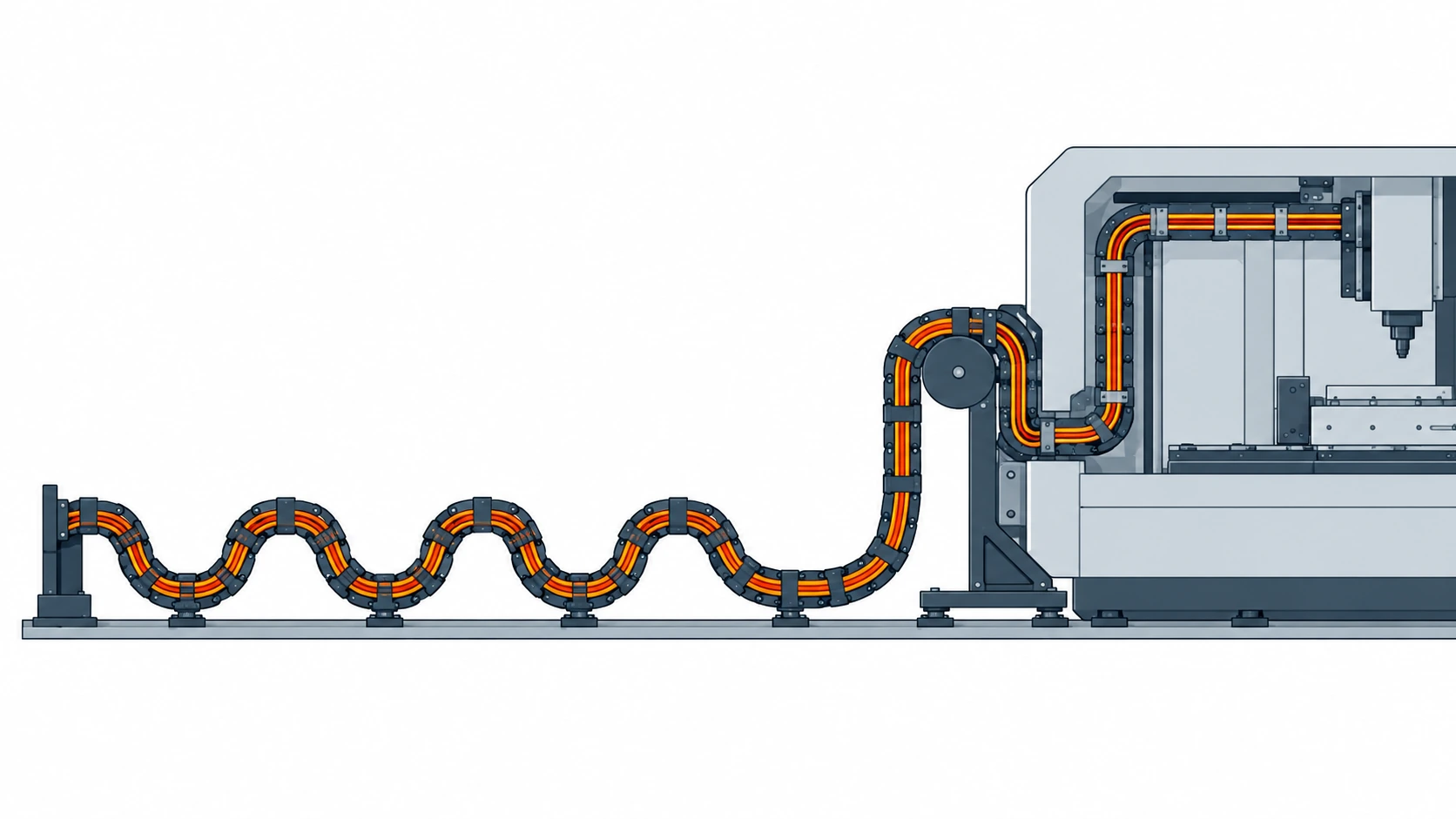
Bending is tight and frequent. The handler loop at the machine is the tightest bend on the face, and it is worked every time the machine moves. That single point accounts for a large share of face cable failures. Our note on cable minimum bend radius explains why the figure at the handler matters more than the figure in a catalogue.
Water and dust are constant. Dust suppression sprays the cable whether or not it is damaged, so any cut or score in the sheath becomes an entry point quickly. Face cable that has been dragged for a few shifts will have surface damage, and the construction has to tolerate that without letting water reach the insulation.
The cable carries safety functions. Face machines use earth continuity monitoring as part of their protection, which means the cable carries a pilot or monitoring core that is as important as the power conductors. A cable bought on power rating alone can be electrically adequate and still unsuitable.
The Three Segments of a Machine Cable System
A face machine is not one cable. Splitting the purchase into these three segments makes the specification honest and the spares list useful.
| Segment | Duty | What to Specify | Evidence to Demand | Cost and Lead Time | How It Fails |
|---|---|---|---|---|---|
| Face trailing length | Dragged at random over coal and stone, sprayed with water | Class 6 flexible conductor, tough sheath, pilot core for monitoring | Flex and abrasion data at the declared radius and cycle count | Highest cable cost on the machine; made to order | Sheath worn through, water ingress, then an earth fault |
| Handler loop | Bent tight and worked every machine move | Construction qualified at the handler radius, with strain relief | Flex test result at the actual handler radius | Same cable as the trailing length, but the whole life hinges on it | Core fatigue at the loop and a broken conductor or pilot |
| In-machine harness | Fixed inside the machine, hot, oily, congested | Heat and oil resistant construction, screened where the drives need it | Temperature and oil resistance results | Lower cable cost, higher access cost to replace | Brittle insulation from heat, then a fault inside a machine |
Bending, Water and the Handler
The handler is where most of the engineering value in a face cable purchase sits, and it is the part most often left to the machine supplier.
Measure the handler radius, then buy to it. The radius at the machine end is set by the geometry of the handler and the coupler, not by the cable. It can be tighter than anyone expects. A construction qualified at a generous radius will fail at a tight one, and the catalogue figure for minimum bend radius is not a substitute for a measurement on the machine.
Give the cable somewhere to go. A handler that holds the cable in a controlled loop and lets it straighten before it is dragged is doing the same job as a well-designed entry on a trailing machine. Where the loop is left to form itself, the cable will find the tightest possible path, and it will find it repeatedly.
Water goes in at the damage. On a face, the sheath will be scored within the first few shifts. That is expected, and it is why a water blocking construction or a sheath thick enough to keep the screen covered is worth the cost. Once water reaches the screen, the earth continuity monitoring circuit starts giving false indications, and the machine stops for a reason that looks like a protection fault rather than a cable fault.
Class 6 stranding is not a luxury on the face. Fine stranding is what allows the conductor to survive repeated bending without work hardening and cracking. The difference between conductor classes and what each one is qualified for is set out in our note on conductor classes, and the practical case for the finest class is described in our note on class 6 conductor flex.
Earth Continuity Monitoring and the Pilot Core
Face machines rely on an earth continuity monitoring circuit, and that circuit runs through the cable. The practical consequences for the buyer are threefold.
The pilot core is a functional part, not a spare. It has to be specified, terminated and tested like a power conductor. Where the monitoring scheme uses a separate pilot core, its size and its continuity requirement belong in the enquiry, not in a note added after award.
Screen and pilot arrangements must match the machine. Different machines use different schemes, and the cable has to match the one on the machine rather than a general standard. Where the mine runs several machine types, the cable schedule should record which scheme each cable supports.
The earth path is a system, not a cable. A monitoring circuit depends on the cable screen or pilot, the coupler and the machine’s own bonding. Our note on grounding for moving cable is written for that chain, and it is worth reading before a monitoring scheme is blamed on the cable.
What to Freeze Before the RFQ Goes Out
| Decision | What to State | Evidence to Attach | Cost of Leaving It Open |
|---|---|---|---|
| Segments | Trailing length, handler loop and in-machine harness as separate lines | A machine cable schedule with lengths per segment | One flexible length bought for three different duties |
| Handler radius | The measured radius at the handler, at the worst point | Measurement on the machine, not the drawing | Core fatigue and repeat failures at the loop |
| Conductor class | Class 6 for the moving segments, with the standard named | Flex test data at the declared radius and cycles | A stiff conductor that cracks within a season |
| Monitoring scheme | Earth continuity arrangement and pilot core details | A machine drawing showing the monitoring circuit | A cable that fits the machine electrically and not functionally |
| Coupler and ends | Coupler type, rating and the mating half on the machine | Coupler drawing plus a mating check before delivery | A cable that arrives unable to connect |
| Repair strategy | Which segments are repaired and which are replaced | A written rule and the kits held to support it | A stalled machine waiting for a decision |
Lead Time and Cost Structure
Face cable is usually made to order, and it is the least forgiving product to be late. A shearer or a continuous miner without its trailing cable is a stopped production unit, and the cost of the wait is measured in tonnes rather than in hours.
The flexible conductor drives the price. Class 6 stranding is more expensive to make than standard stranding and it takes longer, because the conductor has to be built up in stages and the finished cable has to be handled carefully. That premium is unavoidable on the moving segments and pointless on the in-machine harness.
Sheath compound and pilot core add a step. Where the construction includes a pilot core and a tough sheath, the cable is a made to order item rather than a stock product. Confirm the coupler details before the order is placed, because a coupler sourced separately after the cable is made can add weeks by itself.
Buy the spare with the machine. The only time a face cable is cheap and certain to match is when it is bought with the machine or with the original order. Sites that wait until the first failure pay more and wait longer. Where the machine is new, asking for the trailing cable and the spare to be supplied together should be part of the procurement, not an afterthought. The high flex cable supply note explains what a supplier needs in order to quote a face construction properly.
Repair, Jointing and Downtime at the Face
A face cable will be damaged, and the only question is how quickly the machine can be back. Three decisions made in advance decide that.
Decide which damage is repairable. A local score in the sheath is a repair sleeve job. A damaged conductor or a damaged pilot core is not. Writing that rule down stops a crew from attempting a repair that will fail on the next move, and it stops a cable being replaced when a sleeve would have done.
Hold the right couplers and ends. Face cable failure often happens at the coupler rather than in the middle of the length. Holding a spare coupler of the correct type, with its mating half, is the cheapest insurance on the machine.
Do not joint the moving length. A joint in a face trailing cable is stiffer than the cable and will fail at the joint. Where a length is too short to reach, the correct answer is a replacement length or a properly designed extension, not a joint in the dragged section. Face cable repair practice is closer to the trailling duty described in our note on reeling duty constructions than to fixed installation work.
When a Heavier Cable Is Not the Answer
When the failures are all at the handler. If every failure is at the same point, the handler geometry is the problem. A heavier construction postpones the failure; correcting the loop and the radius removes it.
When the machine is being driven past its cable’s design. A cable qualified for one machine type being used on a machine with a tighter handler is a specification mismatch. Re-qualify the cable for the actual machine rather than buying a tougher one and hoping.
When the site wants maximum flexibility everywhere. The in-machine harness does not need class 6 stranding, and paying for it there buys nothing but cost. Match the construction to the segment.
When the cable is being blamed for a monitoring fault. Earth continuity faults are as often a coupler, a bond or a relay setting as a cable. Test the chain before ordering a replacement, because a new cable on a bad circuit fails the same way.
When the spare is being bought on price. A face cable bought from a supplier who has not been given the handler radius and the monitoring scheme is a cable built to a generic specification. On the face, the generic answer is the expensive one.
RFQ Checklist
- Machine type and the three segments listed separately with their lengths
- Measured handler radius, plus the tightest bend anywhere on the trailing path
- Conductor class per segment, with the standard referenced
- Expected movement and the flex qualification required
- Earth continuity monitoring scheme and pilot core arrangement
- Screen type and bonding arrangement, with the earth return route
- Sheath compound matched to face abrasion, water spray and dust
- Water blocking where the sheath is expected to be scored in service
- Coupler type, rating and mating half, verified against the machine
- Working lengths, plus slack at the machine and at the gate end box
- Repair rule and the sleeves, kits and couplers held to support it
- Spare length and spare coupler bought with the original order
- Test evidence at the declared radius and cycle count, before award
Conclusion
Shearer cable and continuous miner trailing cable should be bought as a machine system of three segments, each against its own duty. Measure the handler, match the monitoring scheme, specify class 6 stranding where the cable actually moves, and buy the spare at the same time as the machine.
Kexingyu Cable Group (KXYE) has supplied electrical cable from Quanzhou since 1996, including the fine stranded, screened and tough sheathed constructions that face machines need, along with the couplers and ends that match them. Send the machine type, the handler radius, the monitoring scheme and the working lengths, and we will come back with the constructions for each segment, the flex and abrasion evidence that applies, and a delivery plan that keeps the machine cutting. The fastest route is a request for quotation.