Preventing Cable Damage on Site: Controls That Cut Rework
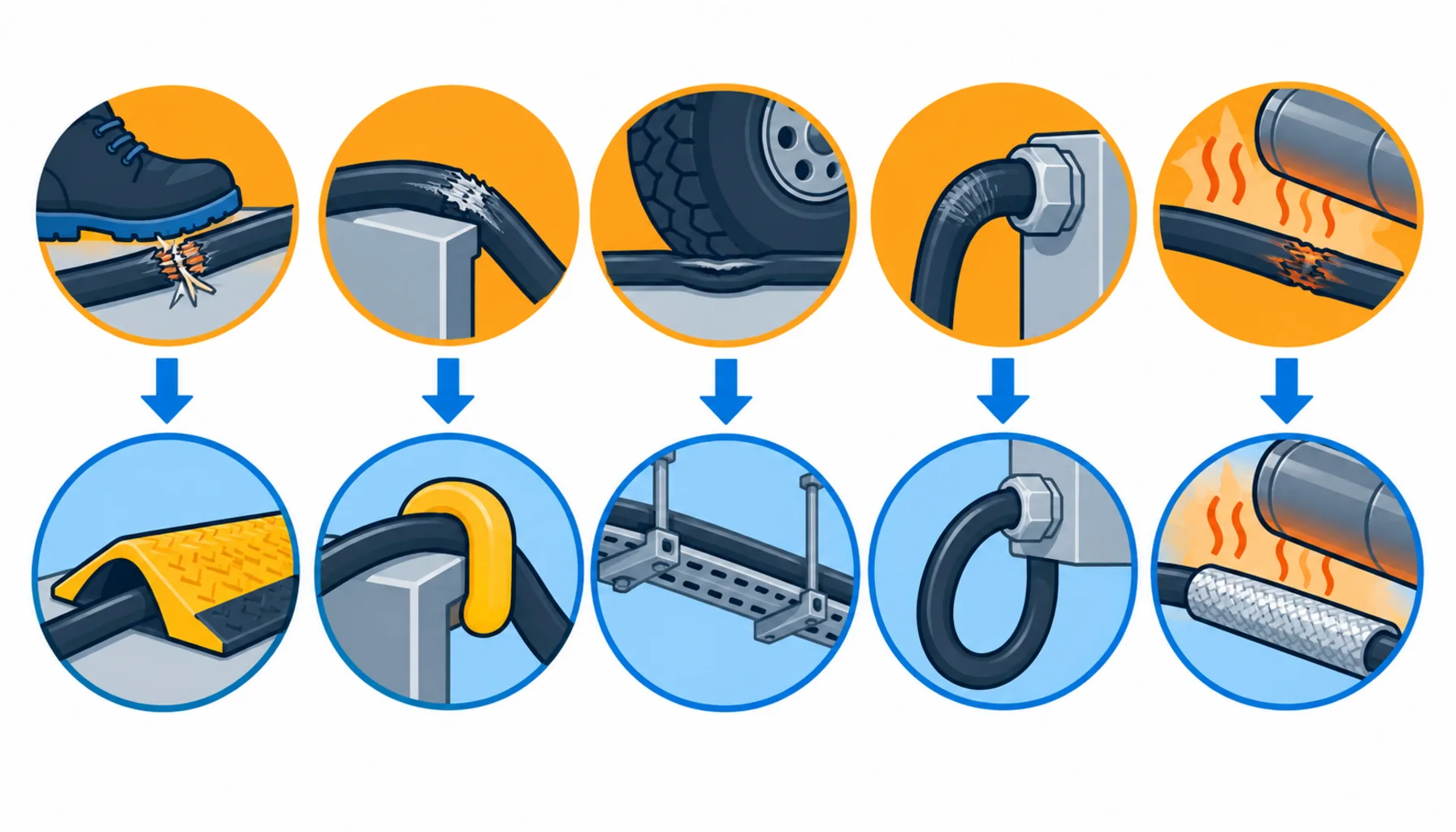
Quick Answer: Site cable damage is not random. Cable is cut where it crosses traffic, abraded where it drags over edges, crushed where it lies under plant, and flex-failed where it bends sharply at machines. Each pattern has a control that costs less than the repairs it removes: hang the crossings, protect the edges, ramp the vehicle routes, and loop the machine connections. Buy the hardware for those controls once, and the replacement budget shrinks by half.
Introduction
Walk any busy site and count the cable runs lying on the ground, then ask which of them will survive the week. The answer is known in advance: the ones crossing walkways get kicked and cut, the ones over steel edges wear through, the ones under traffic get crushed, and the ones bolted tight to machines fatigue at the gland.
The procurement instinct is to buy tougher cable, and sometimes that helps. But most damage is a routing problem wearing a cable costume, and the durable fix is controls: hardware and habits that keep cable out of the way or give it a protected path. This guide reads the damage patterns, matches each to its control, and puts the economics in front of the buying decision.
The Damage Census: Five Patterns, Five Causes
Site cable damage falls into a small number of patterns, and reading them correctly is the first control. Reading the failed cable’s wound tells you which control was missing; our note on cable damage and wear patterns covers the diagnostic detail. For the buyer, the census simplifies to five.
Cuts at crossings. Cable laid across walkways and vehicle routes takes traffic directly, and a kicked coupler or a tracked wheel finishes what the foot traffic started. The control is separation: overhead crossings, ramps, or ducts, chosen once per crossing type.
Abrasion at edges. Cable dragged over steelwork, scaffold tube and concrete edges wears its sheath through in weeks. The control is edge protection at the contact points, or routing that removes the contact, and both cost less than the jacket replacements they replace.
Crushing under load. Cable under stored materials and plant traffic gets flattened, and the conductor damage inside is invisible until the circuit fails. The control is route discipline: cable above the traffic plane or in protected channels, never under the stack.
Flex fatigue at machines. Connections pulled tight to a moving machine bend at the gland until the strands break. The control is the service loop: slack, supported, flexing in one designed place.
Heat and chemical attack. Cable resting on hot work or lying in oil and fuel spillage ages out of position. The control is routing again, plus compound selection where the exposure is permanent.
Controls That Cost Less Than the Damage
Every pattern above has a hardware answer that is bought once and works for the programme. None of it is expensive relative to the labour and downtime of repeated repair.
Crossing hardware. Ramps for vehicle routes, bridges and hangers for walkways, and ducts where the run is permanent. Price the site’s crossing types at setup, buy the count, and make the ramp the default so laying cable bare across a route becomes the exception needing a reason.
Edge protection and hangers. Insulated hooks and edge strips at every steel contact point on the permanent routes. Hooks cost a fraction of a jacket repair, and they make the correct route the fastest route, which is the only discipline that survives a schedule.
Machine connection kits. Standard service loops: a metre of slack, a support, and a clamp beyond the machine’s motion. Write the loop into the installation standard and buy the support hardware with the cable order, because a loop without a support migrates back to the tight position within a week.
The right construction where exposure is permanent. Where the damage source cannot be routed away, the compound earns its keep: abrasion-resistant sheaths at the chronic contact points, covered in our note on abrasion-resistant jackets, and the compound comparison in our note on cable sheath materials. For runs where crushing is the credible threat, armour or steel protection beats any jacket, and our note on armoured versus unarmoured cable draws that line.
| Damage Pattern | Where It Happens | Control | Hardware to Buy | Cost of the Control | Cost of Doing Nothing |
|---|---|---|---|---|---|
| Cuts at crossings | Walkways, vehicle routes, work zones | Separation from traffic | Ramps, bridges, ducts, overhead hangers | One-time hardware per crossing type | Weekly cuts, daily repairs, tripping hazards |
| Abrasion at edges | Steelwork, scaffold, concrete edges | Remove or cushion the contact | Insulated hooks, edge strips, guide frames | Pennies per contact point | Jackets worn through in weeks, exposed cores |
| Crushing under load | Storage areas, plant routes | Route above the traffic plane | Overhead supports, protected channels, markers | Installation labour only | Invisible conductor damage, sudden circuit loss |
| Flex fatigue at machines | Glands and entries on moving equipment | Designed service loop | Loop supports, clamps, fine-stranded moving sections | Small hardware with the cable order | Strand breakage at the gland, repeat terminations |
| Heat and chemical attack | Hot work zones, spillage areas | Routing plus compound selection | Heat or oil-rated constructions at the chronic spots | Compound premium on a short length | Hardened, swollen jackets replaced every season |
What to Buy Instead of Replacing
The prevention budget competes with a replacement budget, and the comparison is rarely made honestly. A site replacing cable every month pays three times: the cable, the labour to swap it, and the downtime while the circuit is dead. The controls above remove the first two and most of the third.
The honest starting point is a damage audit: walk the site, log every damaged run and its location, and sort the failures into the five patterns. Two thirds of the list will concentrate at a handful of crossings and edges, and that concentration is the shopping list. Buy the crossing and edge hardware for those points first, and the replacement list shortens immediately.
Where replacement is genuinely needed, buy for the duty that killed the old run. A crossing run that died of abrasion gets a heavier sheath and a ramp; a machine connection that died of fatigue gets a fine-stranded moving section and a proper loop; a run under storage gets a new route rather than a new jacket. For runs that move too often for fixed protection, flat weather-resistant constructions such as our weather-resistant flat cable resist the twisting that round cords suffer on repositioning. Replacing like for like re-runs the failure on schedule. The discipline sounds obvious and is rare, because replacement decisions are made under time pressure by whoever is nearest the store, and the standard that says “replace for the cause, not for the shape” is what keeps the pattern from repeating. Write the rule down, and let the damage census police it.
Inspection and the Repair Discipline
Prevention needs a feedback loop, and the loop is inspection with consequences.
The weekly walk. A supervisor walks the cable routes weekly, at working pace, and logs damage, missing hardware and new hazards. Fifteen minutes a week finds the cut jacket before it becomes the exposed conductor, and it keeps the control hardware in place, because hardware migrates when nobody checks.
Repair rules. Damaged runs get repaired to a standard or retired: proper splices and heat shrink for sheath cuts, no taped joints on power circuits, and any run with damaged insulation tested before returning to service; our note on insulation resistance testing gives the measurement. The repair record closes the loop, because repeated failures at one point name the missing control.
The census as a budget tool. Quarterly, sort the damage log into patterns and let it set the next controls order. The census turns prevention from a virtue into a budget line, and sites that run it spend measurably less per year on cable than sites that buy whatever failed that morning. Where an independent view is needed for audits or disputes, our note on third-party cable inspection covers the engagement.
What to Freeze Before the Order
| Decision | What to State | Evidence to Attach | Cost of Leaving It Open |
|---|---|---|---|
| Crossing inventory | Every crossing typed and hardware assigned | A crossing schedule with the site plan | Improvised bare crossings and the weekly cut |
| Edge protection | Hook and strip standard for all steel contacts | A one-page routing standard | Chronic abrasion at the same dozen points |
| Machine loops | Loop length, support and clamp standard | Loop detail in the installation scope | Fatigue failures at every gland on site |
| Compound selection | Abrasion, heat or oil-rated builds at chronic points | Compound data per position | Seasonal jacket replacement at the same spots |
| Repair standard | Splice, testing and retirement rules | A repair standard with test requirements | Taped joints becoming the site's normal |
| Damage census | Weekly walk, quarterly pattern review | Log template and review date | Prevention funded by emergency, forever |
Cost Structure: The Prevention Ledger
Prevention hardware is cheap and lumpy: a few hundred in ramps, hooks and supports at site setup, and a modest annual top-up. Replacement is the opposite: small amounts, continuously, forever, plus the labour and downtime that never appears on the cable invoice. Sites that price both honestly find the prevention case overwhelming, which is why the mature contractors write the controls into the site setup budget before the first cable is bought.
The ledger also changes what the cable order looks like. Cable bought for a protected site is standard stock product, bought in planned lengths, in calm conditions, at good prices. Cable bought for an unprotected site is bought in short emergency lengths at whatever the local counter charges, and the premium on emergency buying alone often exceeds the cost of the controls. Reeling and crane applications, where the cable is the moving part, are the one place where the premium construction is unavoidable; our cable reel and crane cable note covers that duty, which sits beyond site protection controls. The same ledger logic applies at project close: a site that protected its cable hands back drums that are worth something, and the residual value alone often pays for the season’s hooks and ramps.
When Damage Prevention Controls Are Not the Answer
When the cable is simply wrong for the duty. A flexing duty fed with fixed-installation cable will fail however well it is routed; fix the construction first.
When the damage is electrical. Overheating from overload looks like damage but comes from sizing, and no ramp fixes it. Test the circuit before blaming the route.
When the schedule is the enemy. Controls that nobody reinstalls after a layout change decay in weeks; the walk and the standard are part of the hardware, and skipping them is skipping the prevention.
When the site is winding down. Late-project sites strip controls as areas close; the risk shifts to demolition, and the demolition phase deserves its own short cable plan rather than the construction one stretched thin.
RFQ Checklist
- Crossing schedule: every crossing typed with hardware assigned
- Edge protection standard and hardware count for the site plan
- Machine service loop standard written into the installation scope
- Compound upgrades named for chronic heat, oil and abrasion points
- Fine-stranded moving sections for machine connections
- Repair standard with splice, test and retirement rules
- Damage log template and quarterly review date
- Stock lengths planned to real runs, reducing joints
- Spares as complete tagged sets for the critical circuits
- Controls hardware priced with the cable, not after the first failure
- Residual drum value counted at project close
Conclusion
Site cable damage is a short list of patterns with a short list of controls, and every control costs less than the damage it prevents. Inventory the crossings, protect the edges, loop the machines, fund the census, and buy replacement cable for the duty that killed the last run. The controls are hardware, but they only work as habits, so give them an owner and a weekly walk. The replacement budget shrinks, the repair queue empties, and the cable order becomes a calm line item instead of a weekly emergency.
Kexingyu Cable Group (KXYE) has manufactured cable in Quanzhou since 1996, supplying abrasion, heat and oil-rated constructions alongside standard site cable, with the declarations that let a buyer match construction to duty. Send us your damage census, and we will come back with the constructions for the runs you keep replacing. The fastest route is a request for quotation.