Building Cable Handover: Documentation and Acceptance Without a Last-Minute Scramble
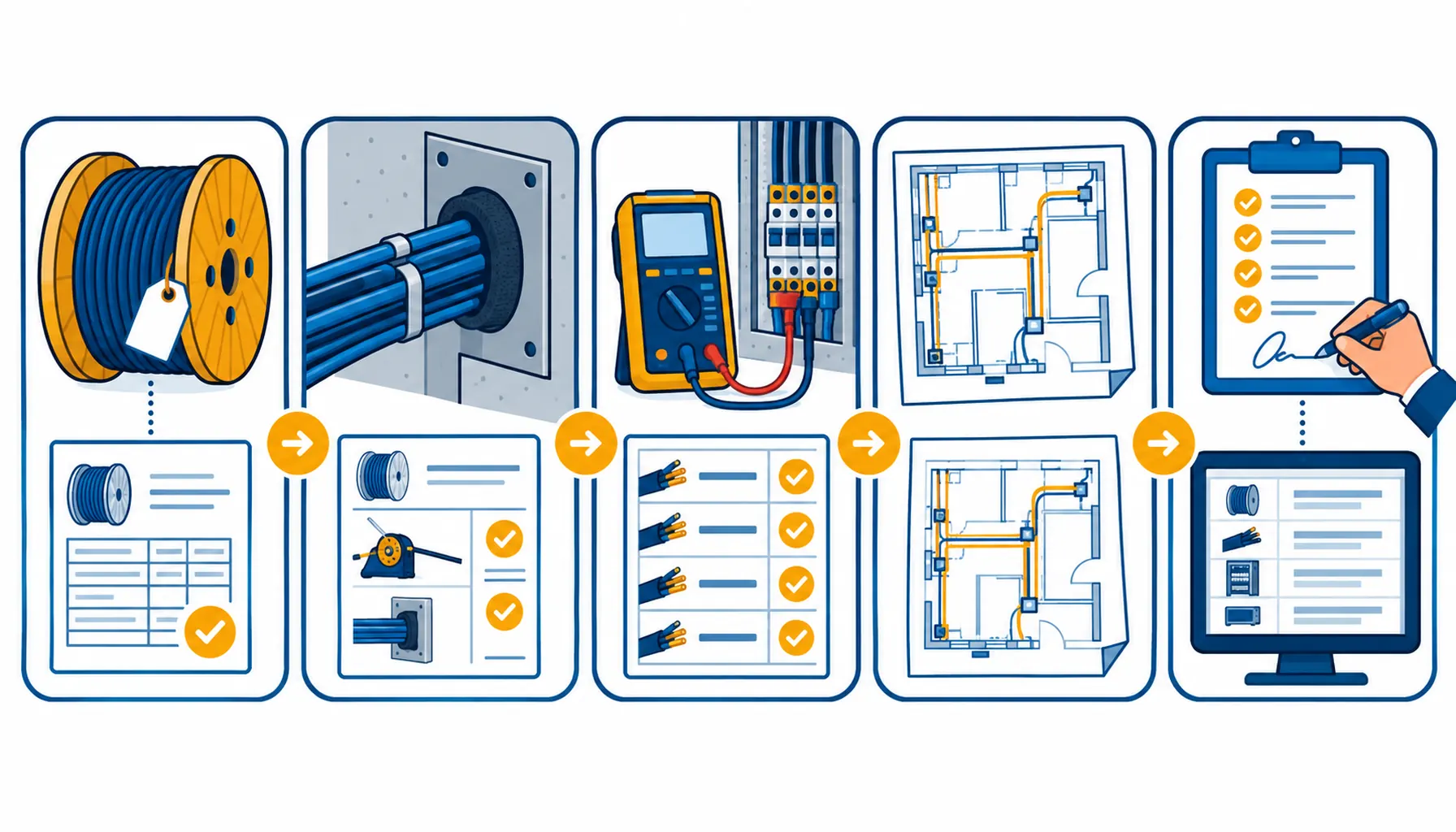
Quick Answer: Cable handover goes wrong for one reason: the documentation is put together at the end rather than specified at the beginning. Every cable package can produce a complete record at handover, but only if the record was asked for at order stage, named in the contract and priced. Specified that way, acceptance becomes a formality. Left to practical completion, it becomes a negotiation in which the contractor has no leverage and the client has no certainty.
Introduction
Cable is one of the few packages in a building that leaves no visible trace of how well it was made. It is inside walls, above ceilings and behind panels, and the only evidence of what was installed is the paperwork. That makes the handover pack the product as far as the client’s maintenance team is concerned.
Most handover disputes have the same shape: a certificate arrives without the batch reference, the test results do not cover the circuit that failed later, and nobody can say which cable is behind a particular panel. This guide sets out what a complete pack contains and how to buy it so that it arrives complete.
Why Cable Documentation Fails
It is treated as an output rather than a deliverable. Documentation is usually written into the contract as an obligation but not as a priced line with a date. Anything not priced and dated gets done last, and anything done last is done by whoever is still on site.
The records are assembled after the cable has left the factory. Batch references, drum identification and factory test reports are created during manufacture. Reconstructing them months later means matching drawings against delivery notes and hoping the references line up.
Installation records are treated as site paperwork. Pull records, penetration installations, torque and continuity checks are recorded by the installer, if at all, and rarely in a form that matches the client’s asset register. Our note on cable labelling and documentation covers the identification convention that makes these records usable.
Nobody agrees what acceptance means. If the contract does not say which tests the client will witness, which records must be delivered with the goods and which at completion, then acceptance becomes a matter of opinion at the least convenient moment.
What a Complete Cable Handover Pack Contains
| Record group | What It Contains | When It Should Arrive | What It Fails On |
|---|---|---|---|
| Construction and conformity | Declaration naming the exact construction supplied, dimensional records, certification for the destination market, and the approval correspondence | Before manufacture is released, with the batch documentation to follow | A declaration that names a family rather than the construction on the drum |
| Factory test and batch records | Routine tests per drum, type test reports, batch references and any witnessed test certificates | With the goods, matched at goods-in | Test reports that reference a batch which is not the one delivered |
| Installation records | Pull records with the tension and sidewall figures, support and cleat schedules, bend radius checks, penetration installation records and photographs | Progressively during installation, finalised at completion | Records that exist for the easy areas and not for the concealed ones |
| Test and commissioning results | Insulation resistance, continuity, phase rotation, protective conductor continuity, screen continuity and functional test results per circuit | Per system as commissioning completes, not all at handover | A certificate covering a sample of circuits rather than the schedule |
| As-built and asset records | Updated circuit schedules, containment and penetration drawings, labelling convention, spares schedule and the boundary of what was supplied | At completion, with the drawing marked up as work proceeds | Drawings that reflect the design rather than what was built |
| Warranty and maintenance | Warranty terms with the start date defined, inspection and replacement guidance, spare availability and the contact route for replacement | At completion, with the terms agreed at order stage | Warranty start date disputes, and spares that are no longer made when needed |
Build the Pack at Order Stage, Not at Completion
Everything in the pack is easier to produce if it is requested at the point of order, and almost impossible to produce convincingly afterwards.
Make the documentation schedule a contract deliverable. List the records, name the format, state the reference convention and attach a date to each group. A documentation schedule agreed at order stage turns handover into a checklist. Our notes on cable factory testing and on third-party cable inspection cover what the factory stage normally produces and when a third party is worth using.
Define who signs what. A pack that is complete but unsigned is not accepted by most clients. Name the counterparties for each group at order stage: the manufacturer for the construction and test records, the installer for the installation records, the commissioning engineer for the test results, and the client’s representative for acceptance. Where an independent agent is engaged, agree at the start which items they inspect and what they issue; our note on third-party commissioning agents covers how that role is normally defined.
Separate factory acceptance from site acceptance. Factory and site acceptance test the two different things, and mixing them in one document is a common cause of disputes about which failures are the manufacturer’s. Our note on factory versus site acceptance testing sets out the split.
Price it. Documentation, batch traceability, extra test certificates and labelling are work. A supplier who is not paid for them will produce the minimum, and the minimum is usually what fails the audit two years later.
The Records That Get Challenged
Four items account for most of the arguments at handover.
Test results that cover a sample rather than the installation. Insulation resistance and continuity results should cover every circuit in the schedule rather than a representative sample. A sample certificate is the single most common reason a client refuses to accept a completed package, and the work involved in retesting everything is far greater than testing it properly in the first place. Our note on insulation resistance testing covers what the results should include and how dormant or damp installations distort them.
Screen and protective conductor continuity on systems where it matters. Where screening has been specified for control or data circuits, the continuity and termination convention are part of the acceptance, and they cannot be verified afterwards without opening every panel.
Penetration records. Every fire compartment penetration needs its installation recorded against an approved detail. Missing records for a handful of concealed penetrations can hold up a whole floor’s sign-off, and reopening them to inspect is expensive.
Identification that matches the asset register. A pack that uses the contractor’s own labelling convention and does not map it to the client’s asset numbering creates work that outlasts the project. Agree the convention before installation starts, not at handover.
Baseline records for later comparison. The results taken at handover become the baseline for every later condition assessment. Our note on in service cable testing covers how those results are used, and a package with no baseline is a package that will be replaced on suspicion rather than on evidence.
What to Freeze Before the Order
| Decision | What to State | Evidence to Attach | Cost of Leaving It Open |
|---|---|---|---|
| Documentation schedule | The records required, their format, reference convention and delivery date | A schedule attached to the order as a deliverable | A pack assembled at completion from whatever can be found |
| Traceability convention | How drums, lengths and circuits are identified and mapped to the client's numbering | A labelling standard agreed before installation | A pack that is complete but unusable against the asset register |
| Test scope | Whether tests cover every circuit or a sample, and which tests are witnessed | A test and inspection plan agreed at order stage | Retesting a whole building after the client refuses a sample certificate |
| Installation records | The pull, support, bend and penetration records that must be completed as work proceeds | A record template issued with the order | Concealed records that can only be produced by opening finished work |
| Acceptance criteria and signatories | What acceptance means, who signs each group, and the process if an item fails | An acceptance plan naming the signatories | A handover that drags on while the retention is withheld |
| Warranty terms | Warranty period, what it covers and the date it starts from | Written terms agreed at order stage | A dispute about whether the period began on delivery or on practical completion |
| Spares and replacement availability | The spare items handed over and the availability of replacements afterwards | A spares schedule and a stated support arrangement | A replacement that cannot be matched when the first circuit fails |
The Sequence, from Goods-In to Practical Completion
At goods-in. Match the drums against the delivery documentation, check the batch references against the test reports and confirm the identification. This takes an hour and resolves the traceability question while the supplier still has an interest in answering. A mismatch found here is a delivery note; the same mismatch found at handover is a claim.
During installation. Complete the records that cannot be recovered later: pull tension and sidewall figures, bend radius at each termination, support spacing, and each penetration photographed against its approved detail. Every one of these is invisible once the work is closed up, and every one of them is the item an inspector will ask for. Issue the record templates with the order so the installer is filling in the document you will actually accept.
Before practical completion. Test the full circuit schedule, map the results onto the asset register, update the drawings to what was built rather than what was designed, and deliver the spares and the warranty terms. Staging the acceptance by floor or by system spreads the load and catches gaps while there is still access, which is far cheaper than a single end-of-project exercise.
At practical completion. Acceptance should then be a signature on a documented checklist rather than a negotiation. Any item that fails is recorded against a defined remedy and a date, and the retention position is clear from the contract. That is what a documentation schedule agreed at order stage buys you.
When a Documentation Package Is Not the Answer
When paperwork is being bought instead of installation quality. A complete pack does not compensate for a poorly installed cable. The records exist to prove good work, not to substitute for it.
When a sample test certificate is accepted on a large package. On a building with hundreds of circuits, a sample tells you very little about the circuits that were rushed. Scope the testing to the schedule and pay for it at order stage.
When the client’s asset numbering is left until handover. Mapping a completed installation to an asset register after the fact is slower than doing it as the work proceeds, and it is almost always done badly.
When a full third-party inspection is applied to a simple package. Independent inspection earns its cost where the cable cannot be replaced or where the assurance regime demands it. On an ordinary building package, spending that money on complete circuit testing and better labelling usually buys more.
RFQ Checklist
- Documentation schedule listing every record group, its format and its delivery date
- Construction declaration naming the exact construction supplied, not a product family
- Factory routine and type test reports referenced to the batch actually delivered
- Witnessed test arrangement, with the inspection dates agreed at order stage
- Labelling convention mapped to the client’s asset numbering
- Pull, support, bend radius and penetration record templates issued with the order
- Test scope confirming whether results cover every circuit or a defined sample
- Acceptance plan naming the signatories for each record group
- Warranty terms with the period and the start date defined in writing
- Spares schedule and the stated availability of replacement items
- Certification documents for the destination market, listed and dated
Conclusion
Cable handover is a procurement decision made months earlier. Specify the documentation schedule as a priced deliverable, agree the labelling convention before the first drum arrives, scope the testing to the full circuit schedule, and name the people who will sign each group. The rest is bookkeeping. Leave it to practical completion and a package that was installed correctly will still be argued about for months.
Kexingyu Cable Group (KXYE) has manufactured cable in Quanzhou since 1996, supplying building wire, fire-rated, armoured and control constructions with construction declarations, batch-referenced test reports and identification that maps cleanly onto a client’s asset register. Send us the documentation schedule with the order, and we will come back with the records, the marking convention and the replacement support you will want two years from now. A request for quotation is the fastest route.