Wholesale Cable Orders from China: MOQ, Drum Lengths and Quality Inspection
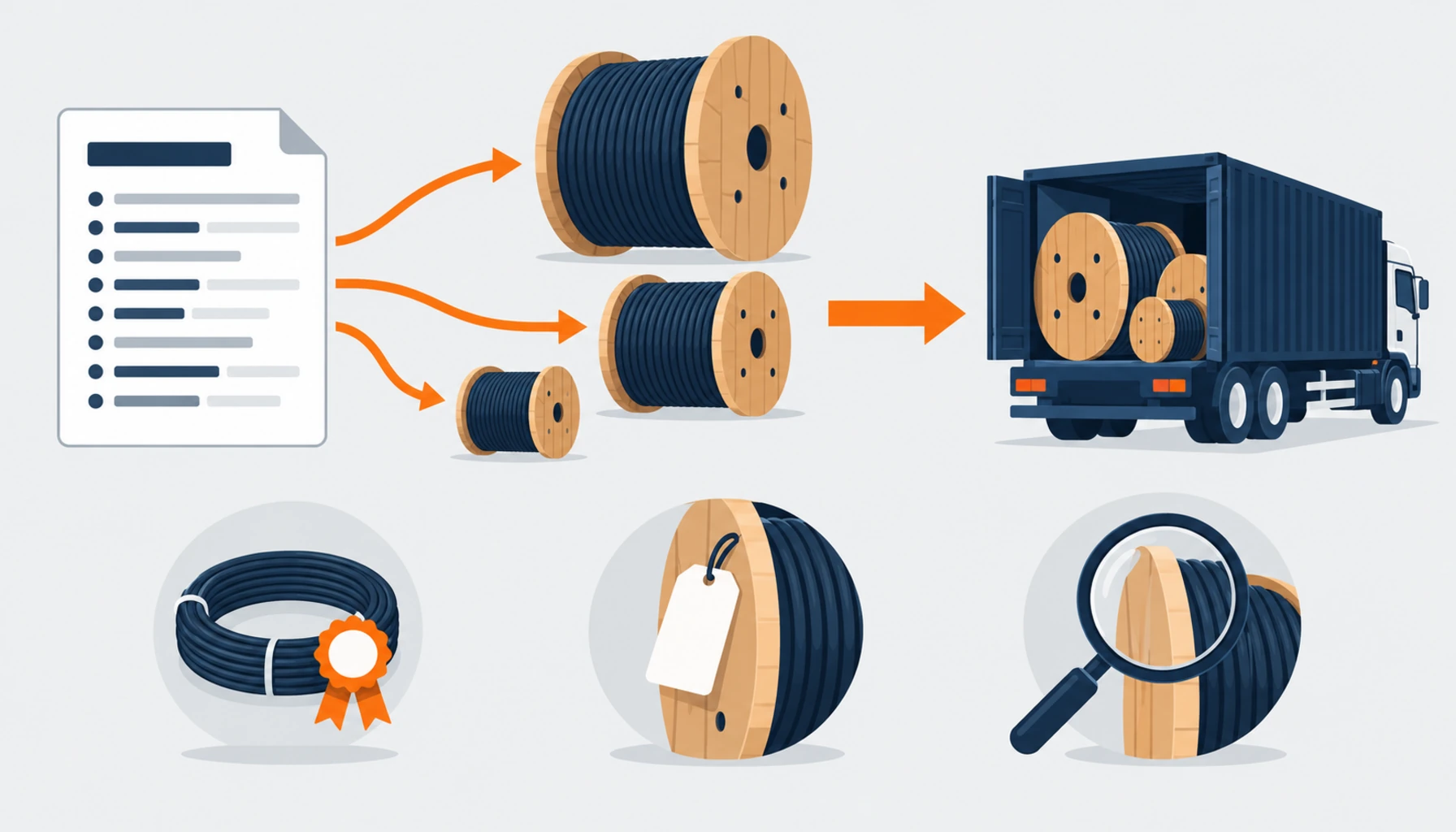
Quick Answer: A wholesale cable order from China is an organization problem before it is a purchasing problem. The order works when every specification in it has its own confirmed MOQ, its own sample reference and its own drum plan, and when the factory inspection reads against a sheet rather than against a conversation. Buyers who consolidate many specifications into one shipment save freight and lose order control in equal measure, unless the order documents carry the difference. This guide walks the wholesale order from the SKU sheet through MOQ confirmation, drum planning, labeling, factory inspection and the traceability records that decide whether the second order is faster than the first.
Introduction
A single-specification order tests a supplier’s product. A mixed wholesale order, thirty SKUs across power, control and building wire consolidated into one shipment, tests the supplier’s order management, and it fails in ways the single order never does: a specification produced against the wrong sample, a drum count that does not reconcile, a label batch that cannot be traced after the goods leave the factory. The failure is rarely in the cable itself. It is in the assumption that many small orders behave like one big one.
This guide is for importers, distributors and project buyers placing bulk cable orders with Chinese manufacturers, including orders bound for the Central Asian market. It covers the SKU sheet that holds the order together, MOQ confirmation per specification, sample-to-batch consistency, drum length planning, labeling, factory inspection and the repeat-order records that compound across a trading relationship. Where your order leans on standard constructions, our building wire and control cable ranges show the specification families a wholesale order typically draws from.
Build the SKU Sheet Before Anything Else
The SKU sheet is the order’s constitution. One row per specification: product family, construction, standard, conductor size, color or core count, voltage rating, quantity, drum length and packaging. Attached to the inquiry, it forces the supplier to quote line by line, so the quotation can become an order without a translation layer. Orders negotiated in prose get produced in prose, and prose has no tolerance column.
What the factory needs in the enquiry to quote that sheet line by line is in our guide to requesting a cable quotation from a Chinese factory.
Consolidate deliberately, not maximally. Every additional specification in a shipment multiplies the MOQ conversations, the drum types and the inspection workload. The freight saving of one consolidated container is real, but so is the coordination cost, and the two cross somewhere between ten and twenty SKUs depending on the factory. Grouping by production family, all the building wire together, all the control constructions together, keeps the factory’s runs coherent and the inspection samples comparable.
Confirm MOQ Per Specification, Not Per Order
The order MOQ is not the specification MOQ. A factory may accept the order as a whole while each specification inside it carries its own minimum run, driven by extruder changeovers, drum sizes and color changes. Confirming the aggregate and assuming the split is how buyers end up with a shipment that is short on half its lines. The per-specification MOQ belongs on the SKU sheet, agreed in writing before confirmation.
MOQ is a production fact, not a negotiating position. Minimum runs reflect what a line can produce and change over economically, and the numbers vary by construction, color and drum type. Where your quantity sits below a specification’s MOQ, the honest options are a longer-run order shared with a future shipment, a substitute construction from stock, or paying the short-run cost explicitly. The mechanics of how minimums and production slots interact are set out in our note on MOQ and lead time.
Mixed orders fail at the smallest line. The freight, the documents and the delivery date are shared by every specification in the container, so one line stuck below its MOQ holds the whole shipment. Firming the long-run lines first and resolving the short ones before the production slot is booked keeps a consolidated order from becoming a consolidated delay.
Use Samples to Anchor the Batch, Not to Replace It
A sample approval is a reference, not a guarantee. The sample proves the factory can produce the specification; the batch proves the factory can repeat it. Between the two sit the process controls that wholesale buyers rarely see, which is why the sample should be sealed, referenced in the order, and produced on the same production route as the batch.
Ask what the sample was made on. A sample drawn from a standard production run of the same construction is worth several of one made specially. Where a specification is new to the factory, the first production meters of the batch should be compared against the approved sample, and the comparison recorded. The approval workflow that makes this routine, from sample submission through sealed reference to batch comparison, is set out in our note on the sample approval process.
Consistency is measurable, so measure it. Insulation thickness, conductor resistance, sheath diameter and print spacing all vary within tolerance in any production run. The question a wholesale buyer asks is not whether variation exists but whether it stays inside the declared tolerance across the batch, and the routine test data, read against the standard’s limits, is the evidence.
Plan Drum Lengths and Counts Against the Order Sheet
Drum length is a specification like any other. The length per drum decides the jointing plan on site, the handling equipment and the freight utilization, and it should be written per line on the SKU sheet rather than left to the factory’s convenience. Standard drum lengths differ by product family, and where your installation plan needs specific lengths, the requirement is confirmed at order stage, not negotiated at loading. The trade-off between drum length and site jointing is set out in our note on drum length and jointing strategy.
Counts must reconcile three ways. The SKU sheet’s quantities, the factory’s packing list and the drums physically loaded should agree, drum by drum, at the factory gate. A mixed order is where counts drift, because partial drums, remnant lengths and make-weight drums appear when specifications run out mid-length. Decide in advance whether remnant lengths are acceptable per line, and in what minimum length.
Length tolerance is part of the quantity agreement. Ordered lengths are produced to a tolerance, and the tolerance differs between standard drum lengths and cut lengths. Writing the accepted tolerance per line, and the evidence for it on the drum label, closes the gap between ordered meters and delivered meters before it opens. The tolerance mechanics are covered in our note on ordered length and drum tolerance.
Fix Labeling Before the Drums Are Built
Labels are data infrastructure, not decoration. In a thirty-SKU shipment, the label is what connects a drum in a warehouse in Almaty or Tashkent to a row on the order sheet and a test report in the document set. Drum number, specification reference, batch identifier, length and destination should be agreed as content and format at order stage, because marking agreed at loading is marking done from memory.
Batch identifiers must survive the mix. Where several specifications ship together, each drum label needs enough to place it unambiguously: the SKU row, the production batch and the drum sequence. Labels that carry only the product name collapse under mixing, and the traceability chain the whole inspection effort depends on breaks at the first warehouse move. The marking and traceability practices that hold a mixed order together are set out in our note on cable marking and traceability.
Language and durability are destination decisions. Export labels that smudge in transit or that only a Chinese speaker can read are labels that fail at the moment they are needed. Confirm the label material, the print method and the language per destination market as part of the order documents.
Inspect at the Factory, Not at the Border
Factory inspection is where a wholesale order is won or lost. Once the drums are stuffed and sealed, the buyer’s options shrink to paperwork and claims; before loading, the buyer can check drum counts, label content, sample comparisons and the routine test data against the SKU sheet, line by line.
The inspection works from the SKU sheet, not from a checklist of generic points. Each line carries its own acceptance evidence: the approved sample reference, the routine test data, the drum lengths, the label content. An inspector reading the sheet can cover a mixed order in a day; an inspector reading a generic checklist will average the order and miss exactly the lines that needed attention. Where you cannot send your own people, the arrangements are set out in our note on third-party inspection.
Documents complete the inspection. Type reports answer the specification question for each family in the order, and their scope, the construction, standard and date they name, should be checked against the SKU sheet before confirmation, not at the loading dock. Reading a report against the line it is supposed to support is a skill with a method, set out in our note on the type test report review.
Keep Batch Traceability Across the Whole Order
Traceability is the wholesale order’s memory. Drum number to batch, batch to SKU row, SKU row to test data and approved sample: the chain that lets one drum be investigated without questioning the shipment. The chain costs the factory little when it is specified in the order documents.
Claims are where the chain pays. A defect found on one drum of a mixed shipment raises the question every buyer dreads: how far does it reach? With batch traceability, the answer is a document pull, the drums sharing the batch, their reports, a decision. Without it, the answer is an argument about an ocean of anonymous cable.
Repeat orders run on the records of the first one. The SKU sheet, the confirmed MOQs, the sealed samples, the inspection findings and the claims file become the baseline the next order starts from. Buyers who maintain this file reorder in days where others re-negotiate in weeks, and the file, not the relationship, is what makes the difference.
The Wholesale Order Template: SKU, Quantity, Packaging and Evidence
The table is the working template for a mixed wholesale order: one row per specification, with the packaging decision and the acceptance evidence named before confirmation. It is the sheet the factory quotes against, the inspector reads against and the warehouse receives against.
| SKU / Specification | Quantity and MOQ Status | Drum Length and Packaging | Acceptance Evidence |
|---|---|---|---|
| Product family, construction, standard, conductor size, cores or color, voltage rating, SKU code | Order quantity per line; per-specification MOQ confirmed in writing; row status firm or indicative | Standard or cut length per drum; drum type; remnant lengths accepted or not, with minimum length | Approved sample reference sealed and dated; routine test data per batch tied to drum numbers |
| Building wire lines: solid or stranded conductor, insulation color set, coil or drum format | Coil quantities per color; color change MOQs confirmed; firm before the production slot is booked | Coil lengths and coils per carton or pallet; pallet wrapping and stacking limit stated | Conductor resistance and insulation results per batch; label artwork copy in the order file |
| Control and instrumentation lines: core or pair counts, screening, sheath type | Per-construction MOQ confirmed; screen and sheath variants each carry their own minimum | Drum length per line; flange protection and cable-end sealing specified for the route | Routine electrical tests per drum; screening continuity evidence where specified |
| Power cable lines: insulation type, armoring, sheath | MOQ per voltage and construction confirmed; deviations from standard construction recorded | Drum lengths matched to the installation plan; drum numbers agreed as content | Batch reports per drum; type report for the family naming construction, standard and date |
| Every line | Aggregate reconciled: sum of firm lines equals the confirmed order quantity | Total drum count reconciles sheet, packing list and physical load at the factory gate | Label content, language and durability agreed; marking readable after transit |
Cost and Lead Time in Wholesale Orders
Consolidation saves freight and spends coordination. One container of thirty SKUs costs less to ship than three containers of ten, and costs more to plan, inspect and reconcile. The net favors consolidation for experienced buyers with a working SKU sheet and penalizes it for first orders, because every process that is not yet written down gets tested thirty times instead of ten.
Lead time follows the longest line, not the average. A mixed shipment ships when its last specification finishes production, so the order’s lead time is set by the line with the longest run, the slowest color change or the tightest MOQ negotiation. Sequencing production and resolving short lines before slot booking are the levers the buyer actually holds.
Short-run costs should be priced, not absorbed. Where a line sits below MOQ, the factory may accept it at a short-run surcharge, produce it on the next compatible run, or substitute a stock construction. Each option has a different cost and a different calendar, and the choice belongs in the order documents rather than in a verbal accommodation that resurfaces at loading.
The second order is where wholesale economics arrive. MOQs already confirmed, samples already sealed, label artwork already approved: the repeat order inherits all of it, and its lead time compresses accordingly.
| Stage | Check | Evidence Produced |
|---|---|---|
| Sample stage, before production | Sample produced on the same route as the intended batch; construction against the SKU row; sealed reference created | Sealed sample record, dated and referenced in the order |
| Production start | First production meters compared against the sealed sample; color and construction verified per line | First-article comparison note per specification |
| In production | Routine tests per batch: conductor resistance, withstand, insulation thickness; results tied to batch and drum numbers | Routine test reports per batch, readable against the SKU sheet |
| Pre-shipment | Drum counts reconcile sheet, packing list and load; label content per the agreed artwork; drum condition and end sealing | Inspection report listing findings per line, with photographs |
| Document check | Type reports for each family checked for scope, construction, standard and date against the SKU rows | Document set accepted before loading |
| After delivery | Batch traceability exercised: any drum traced to batch, report and sample through the label | Claims file and repeat-order records updated with the outcome |
When a Wholesale Order Template Is Not the Answer
When the order is one specification in volume. A single construction on a single drum type needs a purchase order and a test report, not a SKU sheet. The template earns its keep where mixing multiplies the failure modes.
When you are buying from stock, not from production. Distributor stock of standard constructions is verified at receipt, and the MOQ conversation does not apply. Reserve the template for orders that enter the factory’s production plan.
When the specification is still being decided. A SKU sheet frozen too early becomes a change-order engine. Keep lines indicative until each one is genuinely firm, and do not book the production slot until the sheet is.
When the supplier cannot evidence batch data. A factory that cannot tie routine tests to drum numbers cannot support the traceability a mixed order depends on, whatever its price. The inspection regime in this guide assumes evidence exists to inspect.
RFQ Checklist
- SKU sheet attached to the inquiry: one row per specification, with construction, standard, quantity and drum length
- Per-specification MOQ confirmed in writing, not assumed from the order total
- Short lines resolved explicitly: surcharge, deferred run or substitution, priced in the documents
- Samples sealed and referenced in the order, produced on the same route as the batch
- Drum lengths and remnant-length policy agreed per line against the installation plan
- Label content, language, material and artwork agreed before drums are built
- Factory inspection briefed against the SKU sheet, with drum count reconciliation at the gate
- Routine test data per batch tied to drum numbers; type reports scoped per family
- Batch traceability chain specified: drum to batch to SKU row to report and sample
- Order file maintained as the baseline for repeat orders
Conclusion
A wholesale cable order from China rewards the buyer who treats it as a system: per-specification MOQs confirmed rather than assumed, samples that anchor batches, drum plans that reconcile three ways, labels built for the destination, and an inspection that reads the SKU sheet. None of these is difficult alone. Together they are the difference between a shipment that lands as ordered and one that lands as a negotiation.
When the order carries many specifications into Kyrgyzstan, our guide to executing bulk cable orders in Kyrgyzstan takes the same template through the shipment.
Kexingyu Cable Group (KXYE) manufactures power, control and building wire constructions in Quanzhou and supplies wholesale orders across Central Asia on SKU-sheet terms: confirmed per-line MOQs, sealed samples, agreed drum plans and drum-level test records. Send us your specification list, quantities and destination, or upload your BOQ, and we will quote it line by line. A request for quotation is the fastest route to start.