Bulk Cable Orders for Kyrgyzstan: Mixed Specifications, Drum Planning and Inspection
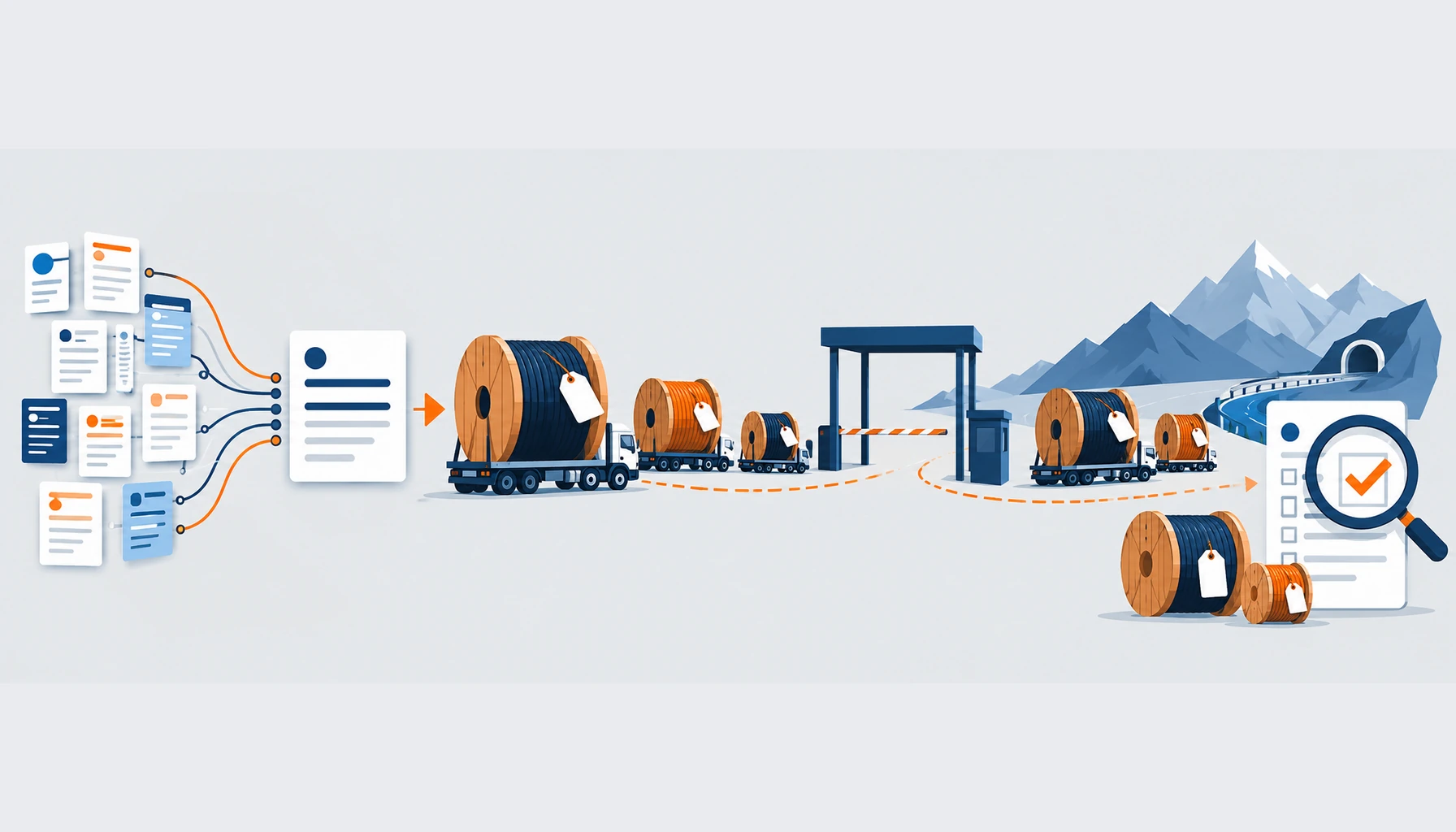
Quick Answer: A bulk cable order into Kyrgyzstan rarely fails on cable; it fails on arithmetic. Mixed specifications multiply the places where a shipment can drift: a line under its MOQ, a drum split that ignores the site plan, a label that cannot be matched to a report, a count that reconciles nowhere. The order works when the specification list is consolidated before quoting, every line’s MOQ is confirmed, drums are planned and labelled per line, the route’s handling is designed, and a pre-shipment count and test review reconciles the shipment against the order sheet. This guide follows that execution path end to end.
Introduction
Kyrgyz projects buy cable the way the mountains build roads: many short requirements, few long ones. A single order carries power and control constructions, a range of sections, a spread of drum lengths, and a delivery that must thread through border crossings and mountain logistics to sites where storage is a yard and handling is whatever the crane and the slope allow. The supplier selection that decides who is worth asking is covered by the Kyrgyzstan checklist in this series; this guide starts where that one ends, at the execution of a mixed bulk order.
This guide is for project buyers, importers and EPC purchasers running bulk cable orders with many specifications into Kyrgyzstan, including orders sourced from Chinese manufacturers. It covers consolidating the specification list, confirming MOQ per specification, planning drums and their labels, designing for the destination and its handling, the pre-shipment count and test review, handling quantity differences, and the records that turn a first order into a routine. The general wholesale order template these steps build on is set out in our wholesale order guide, and the enquiry structure that starts any cable RFQ is set out in our industrial cable RFQ checklist.
Consolidate the Specification List Before Quoting
Consolidation is a technical exercise, not an arithmetic one. Specifications that differ only in a detail the site does not care about, a sheath colour, a length within the same drum format, can often merge into one production line with a labelling difference, and each merge removes a MOQ negotiation, a sample round and an inspection line. The consolidation review sits with the engineer who knows which differences the installation actually consumes, not with the spreadsheet alone.
The consolidated list is what the factory quotes. One row per specification with quantity, drum format and destination use attached, structured exactly as the RFQ checklist prescribes. A quotation that answers the list line by line can become an order without translation; a quotation that answers “similar to your list” produces a shipment that is similar too.
Flag the long-lead lines early. In every mixed list, a few specifications carry the calendar, the armouring that runs on one line, the colour that runs on another. Identifying them at consolidation lets the order sequence around them, and lets the buyer decide consciously whether a marginal line is worth the shipment’s critical path.
Confirm MOQ Per Specification, and Resolve the Short Lines
Every line carries its own minimum run. The order’s aggregate MOQ is a fiction until each specification’s minimum is confirmed, because changeovers, drum sizes and colour runs set the real floors. The confirmation belongs in writing on the order sheet, per line, before the production slot is booked; the mechanics of how minimums and slots interact are set out in our note on MOQ and lead time.
Short lines have three honest outcomes. The line joins a longer run scheduled for a later shipment, the specification substitutes to a stock construction that meets the requirement, or the short-run cost is paid explicitly and priced into the line. Each outcome has a different calendar and a different cost, and the choice is made deliberately at order stage, not discovered at loading.
One unresolved line holds the whole shipment. Mixed orders ship together, so a line stuck below its MOQ delays the container, and the delay compounds through border crossings and site schedules. The discipline is sequencing: firm the long lines, resolve the short ones, and only then commit the production slot and the freight.
Plan Drums and Labels Line by Line
The drum plan translates the order into site reality. Each specification’s lengths are split against the installation plan, pull lengths, jointing positions and the handling equipment at the destination decide the split, and the available drum lengths decide what is possible. The trade-off is set out in our note on drum length and jointing strategy, and the tolerance around ordered lengths is covered in our note on ordered length and drum tolerance.
Labels are the mixed order’s filing system. In a shipment of many specifications, every drum label must place its drum unambiguously: specification reference, batch, drum number, length and destination. The label content and format are agreed at order stage, and the traceability practices that keep the chain from factory to site are set out in our note on cable marking and traceability. Labels that identify only the product family collapse the moment two families share a truck.
Remnant policy is a drum-plan decision. Part-used lengths and make-weight drums appear when lines run out mid-length, and the order states in advance whether remnants are accepted per line, with what minimum length and marking. Deciding at unloading is deciding badly.
Design for the Destination and Its Handling
The route into Kyrgyzstan imposes its own specification. Long road legs, border transits and mountain delivery all add handovers, and the drums that arrive are the ones packed for that journey: drum type, flange and cable-end protection, and loading arrangement designed for the transhipment points. Export packaging practice is set out in our note on export drum packaging, and the sea or rail leg’s specifics are covered in our note on cable sea freight.
Handling at the site is part of the plan, not the site’s problem. Drum weights, available lifting equipment and the last kilometre’s surface decide what arrives usable. The order should carry the destination’s handling reality, and the drum plan should respect it, because a drum that cannot be moved at the site is a drum that gets dropped.
Shipment identity is designed, then verified. Drum numbers that survive reloading, packing lists that reconcile drum by drum, labels that match the documents: identity across a multi-leg route is an outcome of the packaging and marking requirements. The verification that it worked is the pre-shipment check, and the confirmation that it survived is the receipt check.
Reconcile the Shipment Before It Leaves the Factory
The pre-shipment review is a count and a document read. Drum counts reconciled against the order sheet and the packing list, physical load against both, label content against the agreed artwork, and the routine test data read against each specification. On a mixed order this is a day’s work at the factory and the cheapest quality step in the chain; the same findings at the border cost weeks.
Batch evidence is reviewed per line, not per shipment. Each specification’s routine tests are tied to its drums and read against its requirements, and gaps are classified before shipment, administrative where a document trails, substantive where evidence does not exist. Where the buyer cannot attend, the arrangements for appointing an inspector and briefing them against the order sheet are set out in our note on third-party cable inspection.
The review produces the shipment’s baseline file. The reconciled packing list, the per-line test reports and the inspection findings become the documents the receipt check works from, and the file the next order inherits. Shipping without it means recreating it later from memory, badly.
Handle Quantity Differences Without Inventing Answers
Lengths are produced to tolerance, so differences are expected and bounded. The order’s accepted tolerances per line define the band within which a delivered length is compliant, and the receipt check reads delivered metres against that band. Outside the band, the difference is a finding with evidence, the drum label, the metre marking and the packing list, not an argument.
Shortfalls are classified at receipt, with the drums present. Count shortfalls, length shortfalls and condition losses are different problems with different routes, and all three are cheapest to establish at unloading, photographed and noted on the delivery document. The receipt check discipline follows the acceptance practices set out in our note on site inspection and replacement criteria.
Every difference lands in the file. Findings, classifications and outcomes recorded against the line and drum they affect, and the file updated as claims close. The records are what turn a messy first shipment into a routine second one, and what give the buyer’s next negotiation its facts.
The Mixed Order Execution Table
The table is the working sheet for executing a mixed bulk order into Kyrgyzstan: each stage, what is done, and the evidence it produces.
| Stage | Action | Evidence Produced |
|---|---|---|
| Consolidation | Specification list reviewed with engineering; mergeable lines merged; long-lead lines flagged | Consolidated order sheet, one row per specification, with quantities and drum formats |
| MOQ confirmation | Per-line minimums confirmed in writing; short lines resolved by deferral, substitution or priced short run | Order sheet with MOQ status per line; short-line decisions recorded |
| Drum planning | Lengths split against the installation plan; remnant policy set; label content and format agreed | Drum schedule per line; agreed label artwork; tolerance statement |
| Route design | Packaging and protection specified for the legs and transhipments; site handling reality carried into the plan | Packaging specification; handling notes in the delivery documents |
| Pre-shipment review | Counts reconciled three ways; labels checked; routine test data read per line; gaps classified | Reconciled packing list; per-line test reports; inspection findings |
| Receipt | Counts, lengths and condition checked at unloading against the baseline file; differences classified | Receipt record with photographs; claims file entries; updated order records |
Cost and Lead Time in Mixed Bulk Orders
Consolidation buys freight and spends coordination. Fewer, fuller shipments cut the per-metre logistics cost, and multiply the coordination cost per specification. The net favours consolidation for buyers with the order sheet discipline this guide describes, and penalizes those without it, because every unwritten process is tested once per line.
Lead time belongs to the longest line and the slowest border. The shipment completes when its last specification finishes and its documents clear, and the order’s calendar is built from those two facts. Sequencing production around long-lead lines and preparing the transport documents during production, not after loading, are the schedule levers the buyer holds.
Phased deliveries trade calendar for working capital. Where the site programme consumes specifications in sequence, phased shipments let each phase’s cable arrive as needed, at the price of more shipments to coordinate. The choice is a programme decision, made with the drum plan open, because phase boundaries that cut through a drum’s specification create remnants the plan must absorb.
Repeat orders inherit the file. Confirmed MOQs, the drum schedule, label artwork, inspection findings and closed claims become the baseline the next order starts from, and its coordination cost falls accordingly. This compounding is why the file is kept with the same care as the cable.
| Difference Type | How It Is Established | Route to Resolution |
|---|---|---|
| Length within tolerance | Delivered metres read against the line's accepted tolerance on the order sheet | No action; recorded in the receipt file as compliant |
| Length outside tolerance | Metre marking and drum label checked against the tolerance statement | Finding with evidence; claim through the route agreed in the order documents |
| Count shortfall | Drum count at unloading against the reconciled packing list, photographed | Immediate note on the delivery document; claim per the agreed route and window |
| Condition loss in transit | Visual check at unloading; drum and end condition photographed | Classification and claim; repair, replacement or credit per the order's outcomes |
| Document gap | Per-line review of routine reports against the drum list before unloading | Administrative gaps closed by deadline; substantive gaps treated as nonconformance |
When a Mixed Bulk Order Is Not the Answer
When the requirements are genuinely one specification. A single construction in volume ships as a single line with a purchase order and a batch report; the mixed order machinery earns nothing there.
When the site programme cannot absorb consolidation. If phases need cable at intervals the consolidated shipment cannot serve, phased smaller orders or local stock serve the programme better than one efficient container that arrives too early for half its lines.
When the buyer cannot staff the discipline. Mixed orders run on the order sheet, the drum schedule and the pre-shipment review, and a buyer who cannot resource those is better served by fewer, simpler orders while the discipline is built.
When the supplier cannot evidence per-line batches. A factory that reports per shipment rather than per specification and drum cannot support the traceability a mixed order depends on, and the honest response is to simplify the order, not to lower the standard.
RFQ Checklist
- Consolidated specification sheet, one row per specification, reviewed with engineering
- Long-lead lines flagged at consolidation and the schedule sequenced around them
- Per-specification MOQ confirmed in writing; short lines resolved by deferral, substitution or priced short run
- Drum plan per line against the installation plan, with remnant policy and tolerances stated
- Label content and format agreed: specification reference, batch, drum number, length, destination
- Packaging and protection specified for every leg and transhipment on the route
- Site handling reality carried into the drum plan and delivery documents
- Pre-shipment reconciliation: counts three ways, labels against artwork, routine reports per line
- Receipt checks at unloading with photographs; differences classified against the tolerance statement
- Order file maintained as the baseline for the next order
Conclusion
A mixed bulk cable order into Kyrgyzstan is an arithmetic project with a delivery at the end: specifications consolidated before quoting, minimums confirmed per line, drums planned and labelled so every drum answers to a document, a route designed for its handovers, a pre-shipment reconciliation that catches drift at the factory, and a receipt check that closes the loop. Run that way, the shipment lands as ordered and the second order is routine. Run casually, the same shipment lands as a negotiation held in a mountain yard.
Kexingyu Cable Group (KXYE) manufactures power, control and specialty constructions in Quanzhou and runs mixed bulk orders for Kyrgyz projects on sheet terms: line-by-line MOQ confirmation, drum schedules against the installation plan, per-line batch reports and reconciliation at the factory gate. Send us your specification list, quantities and destination, or upload your BOQ, and we will quote and execute it line by line. A request for quotation is the fastest route to start.