Shipping Cables by Sea: Drum Sizes, Container Loading and Insurance
Quick Answer: Sea freight is where cable projects quietly win or lose money: drum sizing decides container yield, loading decides damage risk, and the insurance term decides who pays when the ocean misbehaves.
Cable is one of the least freight-friendly products in the electrical trade. It is heavy, it ships wound on rigid drums that cannot fill a rectangular container, and a single damaged flange can cost more than the freight saved by packing carelessly. Yet sea freight is where many project margins quietly settle: two suppliers quoting the same cable per meter can land it at noticeably different total costs, purely because one planned the drums for the container and the other did not. Add the insurance question — who is covered, for what, and between which exact points of the journey — and the freight layer becomes a procurement decision in its own right, not a footnote after the price. This guide walks the three pieces: how drum sizes are chosen, how containers are actually loaded, and how marine insurance attaches to a cable shipment.
Introduction
The freight layer rewards buyers who treat it as part of the product. The incoterm already decides the frame — who books the vessel, who clears customs, where risk transfers — and that allocation is mapped in FOB vs CIF for power equipment; what this guide adds is the cable-specific physics inside that frame: drums that must match container dimensions, weights that must respect road limits on both ends, and stowage that protects flanges and drum boards across weeks of ocean motion. The coordination dividend is real here too: when cable ships alongside the switchgear and transformers it serves, planned through one-stop power equipment sourcing, container space is planned once for the whole consignment instead of negotiated product by product — and the drum that would have sailed half-empty sails full.
Drum Sizes: The First Freight Decision
The drum is packaging, protection and freight cost in one object. Steel-reel drums with wooden lagging carry power cable; smaller types travel on wooden reels; and the two variables that matter are drum diameter — which sets the minimum bending radius the cable tolerates on the reel — and drum width and flange height, which set how many meters fit per drum. Bigger drums mean fewer units, faster site handling and less repeated setup at the pulling end, but they can strangle container yield: a drum too wide for the container door or too tall to stack wastes the rectangular space cable is always fighting against. Drum length is also a negotiation: longer lengths per drum mean fewer joints on site, while shorter ones distribute risk — one damaged drum is a smaller loss — and match the pulling equipment some sites actually own. The right answer is project-specific, which is why the drum schedule belongs in the order confirmation, not in whoever’s habit. The re-export detail worth catching: drums must match the destination’s road and handling limits too, or the last kilometer undoes the ocean leg.
Container Loading: Space, Weight and Damage
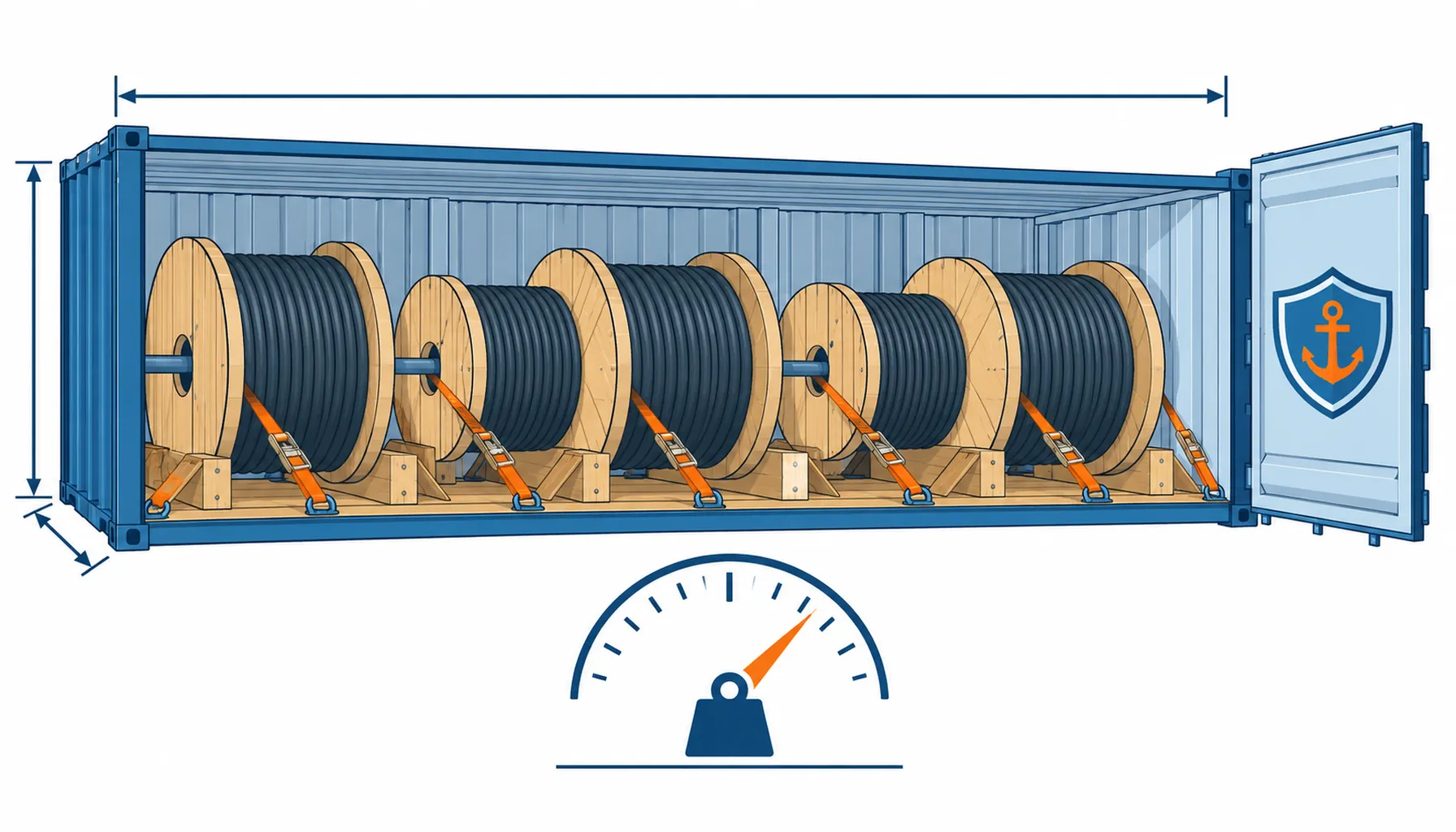
Standard containers come in known internal boxes — roughly 6-meter and 12-meter lengths in the common 20-foot and 40-foot family, with the high-cube variant adding internal height — and cable drums load in patterns that respect three limits at once. Space: drums are loaded eye-to-eye or stacked on skids according to their diameter and width, and a well-planned pattern fills the cube; a badly planned one leaves the top third of the container empty while the freight bill charges for all of it. Weight: copper-heavy consignments hit the payload ceiling before they hit the volume ceiling, and they must also respect the road weight limits at both the origin and destination ends — a container legally loaded for the port can still be illegal for the truck. Damage: drums are chocked, braced and lashed so neither flanges nor boards shift in heavy weather; worst practices — drums loose on the floor, flanges bearing the container wall, no dunnage between tiers — are how cable arrives scuffed, flattened or off-reel. Photos at stuffing and unstuffing, plus drum condition noted on delivery documents, keep the damage question answerable while it is still a claim instead of a dispute.
| Decision | What It Affects | Watchpoint |
|---|---|---|
| Drum diameter | Minimum bending radius on the reel | Drum too small for the construction |
| Meters per drum | Joints on site, risk per unit | Lengths mismatched to pulling equipment |
| Container pattern | Cube utilization, freight per meter | Top third sailing empty |
| Weight limits | Payload and road legality both ends | Port-legal, road-illegal at delivery |
| Chocking and lashing | Damage risk across the ocean leg | Drums loose, flanges bearing walls |
| Stuffing photos | Claim evidence if damage occurs | No record until it is a dispute |
Marine Insurance: Who Is Covered, and Where It Bites
Insurance follows the incoterm’s allocation of risk, and the boundary it draws shapes everything else. Under FOB terms, the buyer’s risk begins when the goods pass the ship’s rail at the origin port — so the buyer arranges cargo insurance covering the ocean leg and, if wanted, the inland legs at each end. Under CIF terms the seller buys the insurance — but only to the minimum cover the term requires, only in the buyer-protected currency of the contract, and the risk still transfers at the origin port, meaning the seller’s policy may protect less than the buyer assumes. The cover worth specifying for cable is all-risk marine cargo insurance, which responds to the damages drums actually suffer — shifting, water, handling — subject to the policy’s exclusions; and the claim mechanics live in the documents: clean bills of lading, stuffing photos, drum condition on the delivery receipt, and notification inside the policy’s window. General average — the ancient rule that makes cargo owners share salvage costs when a vessel sacrifices property to save the voyage — is worth knowing because uninsured cargo owners still owe their share; it is one of the few ocean surprises that reaches buyers who thought the cargo arrived fine. The failure pattern repeats across the trade, per international sourcing mistakes: the freight term got read as a price choice when it was really a risk choice.
When the Cheapest Freight Quote Is Not the Answer
Two cautions finish the layer. The first is the lowest-freight illusion: a cheaper ocean rate on a worse drum plan — more drums, poorer yield, an extra transshipment — lands more cost per installed meter than the expensive rate with a good plan, and the freight quote never shows the comparison; the drum schedule and the stuffing plan are where that money hides. The second is the uninsured gap: buyers who skip cover because “the factory said it is fine” hold the entire ocean risk personally, and drums do fall, shift and swim. The premium barely registers in the project budget; the loss it answers would not be so easy to shrug off. Buyers who fix the drum schedule at order confirmation, demand the stuffing plan and photos as deliverables, and read the insurance boundary against the incoterm — documented per the supplier checklist habit of asking for evidence — turn sea freight from cable’s weakest link into a planned stage. To price a consignment with the freight layer explicit, the RFQ page accepts drum schedules alongside the cable list.
| Term | Who Buys Insurance | Risk Transfer Point |
|---|---|---|
| FOB | Buyer arranges ocean cover | Ship's rail at origin port |
| CIF | Seller buys, minimum cover | Still at origin — cover may lag risk |
| EXW | Buyer arranges everything | At the factory gate |
| DAP | Seller to named place | At arrival, before unloading |
RFQ Checklist: Sea Freight Lines for the RFQ
Put the market’s questions in writing:
- Drum schedule proposed — diameter, width, meters per drum
- Drum plan matched to container type and destination road limits
- Container utilization and stuffing pattern stated in the quote
- Chocking, lashing and dunnage method described
- Insurance cover named with the incoterm boundary made explicit
- Stuffing and unstuffing photos as delivery deliverables
- Claim procedure and notification window stated
Conclusion
Sea freight decides cable’s landed cost and its condition at the tray, and both are set by choices made at order time: the drum schedule that fits the container, the loading plan that respects space, weight and flanges, and the insurance boundary that matches the incoterm. The ocean leg only becomes cable’s weakest link when nobody planned it.
Kexingyu Cable Group (KXYE) plans the freight layer as part of the product: drum schedules engineered for container yield and site handling, chocking and lashing to plan with photo records, all-risk cover boundaries stated against the incoterm — cable that arrives as it left the drum, with the freight cost designed in from the start instead of discovered at the port.