
Buying Oil and Gas Cable for Kazakhstan and Turkmenistan: Fields, Pipelines and Refineries
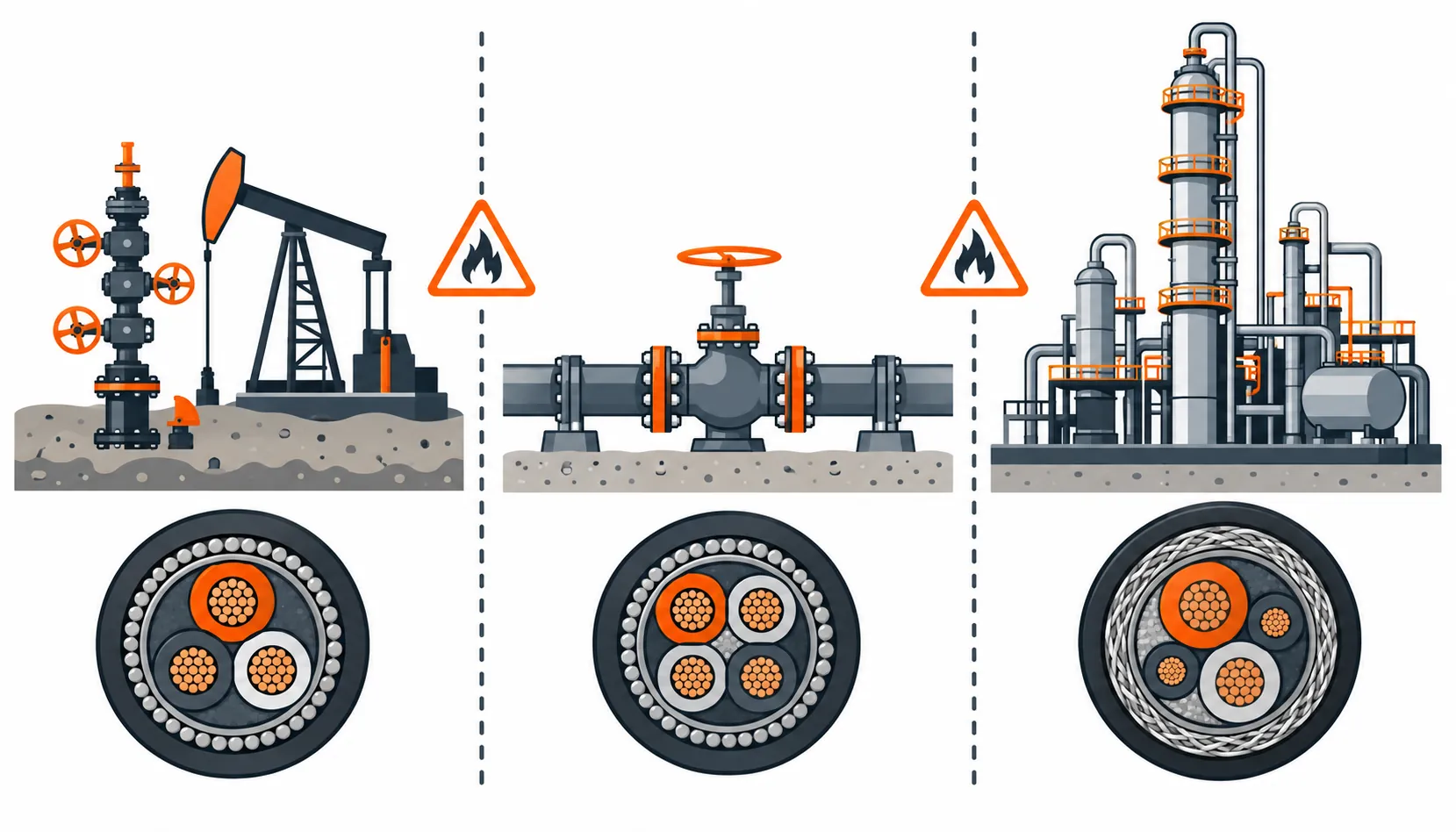
Quick Answer: Cable for oil and gas work is bought by duty zone, not by site. Split the order into field and pumping loads, pipeline stations and instrumentation, and process units with hydrocarbon contact, then specify each zone’s sheath, screen, armour and fire performance separately. Prove oil resistance with a test rather than a description, name the fire test the process area requires, and settle the gland and earth continuity details before the cable is ordered. A single “oil and gas cable” line in an enquiry produces a general-purpose cable priced as a special one.
Introduction
Oil and gas projects in Kazakhstan and Turkmenistan buy cable across three quite different environments, usually under one purchase package. A gathering line pump, a pipeline block valve station and a refinery process unit have little in common except the owner, and the cable that suits one of them is often the wrong answer for the other two. Package-level buying then compresses the differences into a single specification, and the differences reappear at inspection.
This guide is for EPC buyers, owner’s procurement teams and distributors supplying cable into oil and gas work in the two countries. It covers the duty zones worth separating, what oil resistance means in a test rather than in a brochure, the screen and fire requirements that follow from drives and process areas, and the gland and earthing details that decide whether an installation passes. Supplier screening for the region is in our Turkmenistan supplier checklist.
Map the Cable by Duty Zone, Not by Site
Field and pumping loads are mechanical duty. Motors on skids, pumps that switch often and cables that are dragged during maintenance all ask for a robust sheath, a flexible conductor class where the run moves, and armour where vehicles cross. Hydrocarbon contact here is occasional spillage rather than continuous immersion.
Pipeline stations are instrumentation-heavy and quiet. Block valve stations, metering skids and compressor stations run on small control and instrument circuits, with a handful of larger feeds. The cable risk is signal integrity and earth continuity, not mechanical abuse, and the specification that matters is screening, pair construction and the shield’s earthing at one end.
Process units combine both, plus heat and fire risk. A refinery or gas chemical unit has drive cables, instrument cables and emergency circuits in the same tray, with hydrocarbon contact possible at the pump rows and a fire case the design has to assume. That is where the sheath compound, the fire test and the circuit separation earn their cost.
Drilling and wellpad work is its own third case inside the field zone. Rig power cable is dragged, flexed and exposed to drilling fluid as well as hydrocarbon, and it is usually bought as a specific construction such as a drilling platform power cable rather than as site power cable. Where the load is a fixed feeder inside a wellpad building instead, a non-shielded petroleum construction such as XHHW-2 petroleum cable may be the simpler answer, and the two should not be swapped on price.
What Oil Resistance Actually Means
It is a measured property with a test behind it. Oil resistance is assessed by immersing a specimen in a specified oil at a specified temperature for a specified time and measuring the change in tensile strength, elongation and mass. A compound that passes one oil at one temperature is not automatically resistant to the hydrocarbon mix on your site.
Ask which oil, which temperature and which acceptance criteria. The oil resistance test in the IEC 60811 series defines the method, and the oil and conditions are chosen by the application. An offer that says “oil resistant” without those three answers is a claim, and the difference between a claim and a test result is what an inspector asks for. The test itself is described in our note on cable oil resistance testing.
Continuous contact needs a different construction, not a better compound. Where a cable sits in a sump, a drainage channel or a tank bund, the exposure is immersion rather than splash, and the answer is usually a metallic barrier or a sheath chosen for the specific medium. The selection logic across chemical exposures is set out in our note on chemical exposure and cable selection.
Screens, Drives and Instrument Circuits
Variable speed drives need a screened cable and a defined earthing method. A drive feeder without a screen, or with a screen earthed at both ends and no regard for circulating current, puts noise onto every instrument pair in the same tray. The cable specification has to state the screen type, the coverage and the earthing arrangement the installation will use.
Instrument circuits are a pair construction question. Individual and overall screens, pair twisting and the way the shield is bonded decide whether a 4 to 20 milliamp signal survives a plant full of drives. Where the plant also carries thermocouple circuits, the compensation wire is a separate purchase with its own limits, such as the lead-sheathed construction used where solvent contact is expected in lead-sheathed armoured thermocouple cable.
Oil and Gas Cable Options by Duty
The table sets out the four families that cover most of an oil and gas package, with what each one commits the buyer to.
| Option | What to Declare | Evidence to Ask For | Cost and Lead Time | Risk If Left Open |
|---|---|---|---|---|
| Armoured power cable, PVC or PE sheath, field and pumping duty | Armour type, sheath compound, conductor class, screen where drives are used | Oil resistance result with oil and conditions named | Standard construction, widest supply, shortest slots | General-purpose sheath accepted as oil resistant |
| Screened drive cable for pumps and compressors | Screen type and coverage, core arrangement, earthing method | Screen and coverage data; transfer impedance where offered | Higher per metre, longer slot on special cores | Noise on instrument pairs traced back to an unscreened feeder |
| Instrument and control cable, individually and overall screened | Pair construction, screen arrangement, bonding at one end | Pair and screen details in the offer; continuity records | Moderate cost, many small quantities | Shield earthed at both ends, signal drift under load |
| Lead-sheathed or metallic barrier construction for continuous contact | The medium, the temperature, the barrier material and thickness | Immersions test or barrier specification | Highest cost, few sources, long lead time | Splash-rated cable installed in a sump |
| Fire-resistant cable for emergency and shutdown circuits | The fire test cited, the duration, the circuit it protects | Test report naming the construction and the duration | Premium price, longest slot in the package | Fire test claimed but never evidenced for the build |
Fire Performance in Process Areas
Flame propagation and fire survival are two different requirements. Flame propagation limits how far a fire travels along a tray; fire survival keeps a circuit working for a stated time. Emergency shutdown, fire pump and emergency lighting circuits need the second, and the test that proves it has to be named, with the duration and the construction it was run on.
Circuit separation is part of the cable order. Where the design separates power, control and emergency circuits into different trays or compartments, the quantities per route change, and the drum plan has to follow. Ordering one total length for all circuits and splitting it on site is how a fire-rated circuit ends up in the wrong tray.
Declare the flame class as a testable claim. The categories are defined by test, so the enquiry should name the category and the standard edition, and the offer should return a report for the construction rather than a logo. The declaration logic is set out in our note on flame rating declaration and testing.
Hazardous Areas, Glands and Earth Continuity
The cable is only part of the barrier. An armoured cable entering a hazardous area relies on a certified gland and a sealing arrangement to keep the enclosure’s protection intact. The gland is sized on the cable’s outer diameter and armour, so the cable construction and the gland schedule have to be bought together.
Earth continuity depends on how the armour is terminated. Armour provides the CPC in many tray and gland systems, and its continuity is a measured value, not an assumption. Ask for the gland type and the armour clamp arrangement in the offer, and include continuity resistance in the commissioning checks.
Terminations in a process unit are a craft detail. Heat-shrink or cold-applied kits have to suit the sheath material, and a kit designed for PVC may not seal on PE. The selection logic across joints and terminations is in our note on joints and terminations.
Cold, Vibration and Cross-Border Reality
Winter installation limits the sheath. A PVC sheath installed at minus twenty degrees cracks at the bend, and the low-temperature limit belongs in the enquiry for any route built outside the construction season. Where the schedule cannot avoid winter, the sheath compound is a specification decision, not a preference.
Skid-mounted equipment vibrates the cable, not just the motor. A pump on a skid moves the cable entry continuously, and a rigid connection at the gland is where the conductor strands break first. Flexible conduit or a loop at the entry costs little at installation and saves a callout later.
Two countries, two customs realities. The same cable can clear at different speeds depending on which side of the border the project sits and which documents travel with the drums. Building the document set into the order, rather than producing it after the goods are ready, is the difference between a planned delivery and a demurrage bill. Turkmenistan and Kazakhstan enquiries are answered against the same technical sheet in our oil resistant cable range.
Oil and Gas Order Freeze List
These are the fields to settle and write into the order before it is placed.
| Item to Freeze | How to Write It Into the Order | Evidence to Attach | Cost of Leaving It Blank |
|---|---|---|---|
| Duty zone per line | Field, station or process unit marked on every schedule line | Schedule with zone column completed | One general cable bought for three different duties |
| Hydrocarbon exposure | Splash or continuous contact, medium named, temperature | Oil resistance or immersion result | Sheath swelling or hardening within a season |
| Screen and coverage | Screen type, coverage percentage, earthing arrangement | Screen data plus the installation earthing note | Drive noise on instrument circuits, signal faults |
| Fire test and duration | Category and standard edition, survival time where required | Report naming the construction and duration | Emergency circuit that fails the fire case |
| Gland and armour interface | Gland type, size range, armour clamp method | Gland certificate plus cable diameter | Glands that do not fit, hazardous area non-compliance |
| Low-temperature limit | Installation temperature stated, sheath compound chosen for it | Cold bend or impact result | Cracked sheath on the first winter pull |
| Document set for customs | Documents listed in the order, produced before shipment | Sample set approved at order stage | Drums held at the border, project idle |
When an Oil-Resistant Cable Is Not the Answer
When the exposure is immersion rather than splash. A sump, bund or drainage channel is a continuous contact case, and an oil-resistant sheath is the wrong tool. The right answer is a barrier construction or a change of route, and the second is usually cheaper.
When heat, not hydrocarbon, is the dominant stress. Cable near a furnace, a flare line or a steam trace sees temperature first. Buying a more oil-resistant compound does nothing for a sheath that is being cooked, and the specification has to follow the dominant stress rather than the project’s name.
When the plant standard fixes the product. Where the owner’s specification names a construction, a family or a standard, offering an alternative on price is a technical rejection in waiting. Deviations are proposed with evidence, in writing, before the bid, not after the order.
When the fire requirement is assumed rather than read. Fire survival applies to specific circuits for a specific duration. Applying it to the whole package inflates the cost; omitting it where the design requires it produces a plant that fails its own safety case.
RFQ Checklist
- Duty zone marked per schedule line: field, station or process unit
- Hydrocarbon exposure described as splash or continuous, with the medium named
- Oil resistance test result required, with oil, temperature and acceptance criteria
- Screen type, coverage and earthing arrangement stated for every drive circuit
- Instrument pair construction and shield bonding method confirmed
- Fire test category, standard edition and duration named where survival is required
- Armour type and gland interface quoted together, with the armour clamp method
- Low-temperature installation limit stated for the route and season
- Earth continuity resistance included in the commissioning checks
- Document set for cross-border clearance listed and approved before shipment
- Drum lengths, marking and receiving conditions confirmed with the site
Conclusion
Oil and gas cable buying is a zoning exercise before it is a materials exercise. Field loads, station instrumentation and process units each need a different sheath, screen and fire answer, and a package bought as one line will be right for one zone and wrong for the others. The four fields that prevent most of it are the zone, the exposure, the screen and the fire test, and all four are cheap to write down.
Kexingyu Cable Group (KXYE) manufactures armoured power, screened drive, control and instrument cable in Quanzhou, including oil resistant and lead-sheathed constructions, and quotes Kazakhstan and Turkmenistan enquiries against the duty zone and exposure as written. Send your cable schedule with the zone column completed, the medium and the destination. A request for quotation is the fastest route to start.
Recent Posts
Измерительные и контрольные кабели для Казахстана: решение для промышленных закупщиков, подрядчиков и дистрибьюторов
Измерительные и контрольные кабели для Казахстана: решение для промышленных закупщиков, подрядчиков и дистрибьюторов Коротко о главном: кабель управления передаёт команды и сигналы переключения — пуск
Dây dẫn xây dựng BV/BVR cho Việt Nam: Giải pháp cho nhà phân phối, nhà thầu và đơn vị thu mua
Dây dẫn xây dựng BV/BVR cho Việt Nam: Giải pháp cho nhà phân phối, nhà thầu và đơn vị thu mua Trả lời nhanh: Với