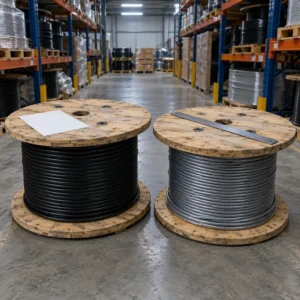
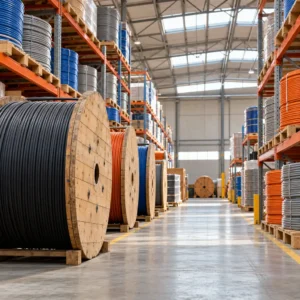
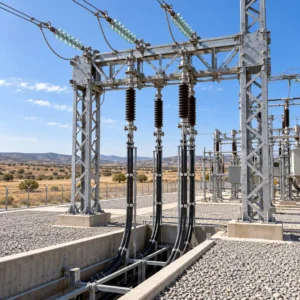
Sourcing Cable for Central Asia: A Ten-Year View for Importers and EPCs
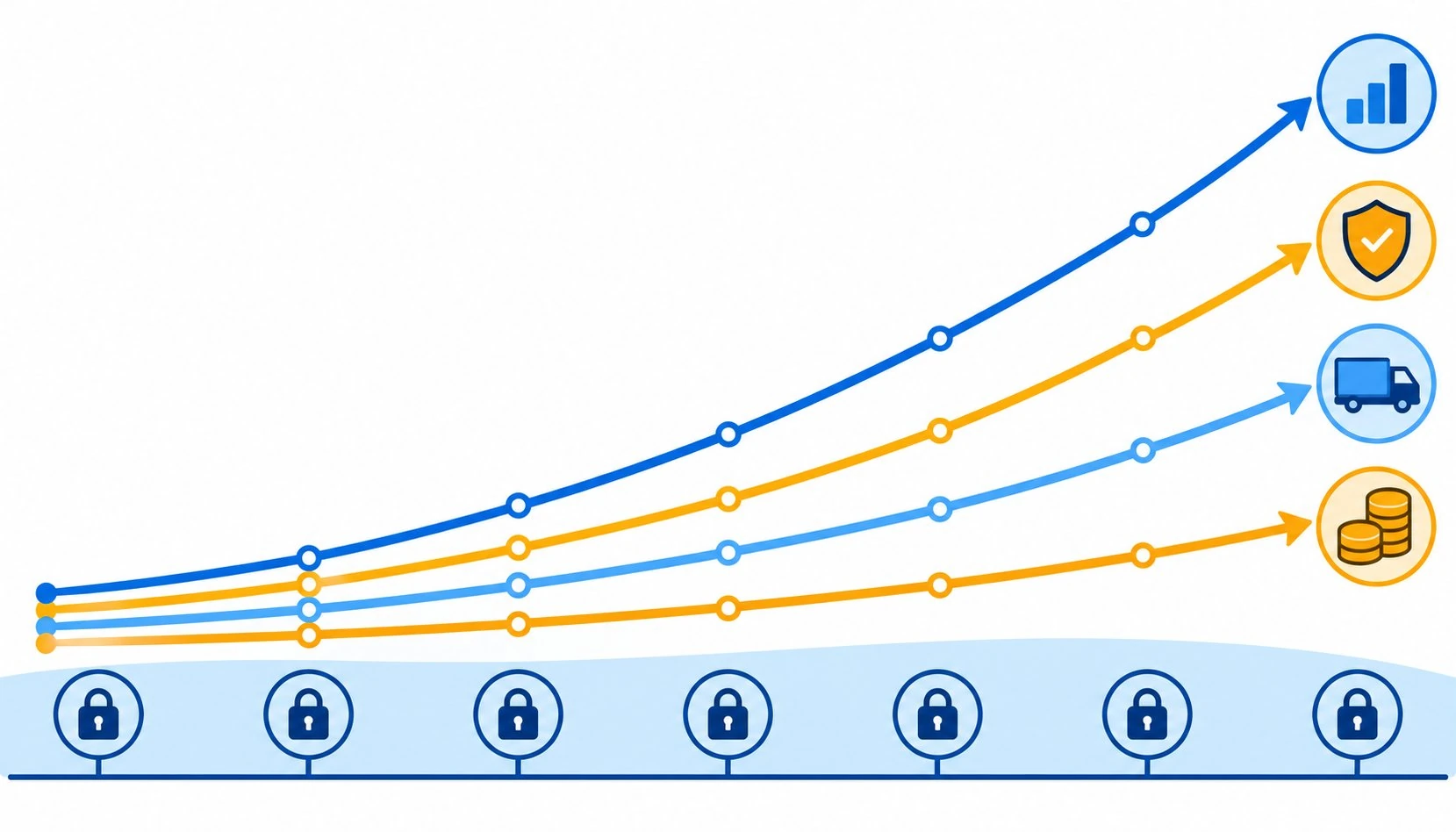
Quick Answer: Ten years of sourcing cable in Central Asia reward the buyer who plans on curves, not on projects. Demand keeps compounding across grid, mining, renewables and industry. Standards converge without ever fully merging. The rail spine holds while capacity around it grows. Payment instruments broaden, and copper keeps moving. Freeze the decisions that hold across all four curves, and the decade gets cheaper every year.
Introduction
This page closes our Central Asia series with the long view: the four curves that will shape cable sourcing across the region for the next decade, what holds steady underneath them, and the decisions worth freezing early because they pay in every year that follows. It is written for importers building a supplier base and for EPCs buying across several markets at once.
The working details sit in the rest of the series. The regional buying context is gathered in our Central Asian cable buying hub, and each curve below has its own dedicated pages. Here we stay with the decade: what changes, what does not, and what a buyer should decide once instead of five times.
Why a Decade Is the Right Frame
Cable buying in this region is lumpy at the project level and remarkably steady at the regional level. A tender slips, a border queue clears, a mine expansion waits on financing, and the year looks chaotic from inside any single order. Zoom out to ten years and the noise averages out: the region has been adding generation, transmission, mining capacity and built space continuously, and the cable that connects all of it has to come from somewhere.
The frame matters because sourcing decisions have different half-lives. A drum length decision dies with the order. A copper basis clause lives for a year. A supplier relationship, a document checklist per country and a testing discipline live for a decade, and those are the assets this page is about. Our note on industrial cable procurement over ten years makes the same argument for site owners in general; this page keeps the frame but stays with the region, where borders, standards and payment rails add curves that site owners elsewhere never see.
The practical claim is simple. Buyers who treat Central Asia as a series of one-off purchases pay setup costs every time. Buyers who build for the decade pay once and collect the discount in every order after.
Curve One: Demand Keeps Compounding
The first curve is volume. Grid reinforcement, mining expansion, irrigation and pumping upgrades, greenhouse construction, telecom buildout and backup power all draw on the same cable families, and none of them is a fad. The mix shifts year to year: a renewables push lifts solar and collection cabling, a mining cycle lifts reeling and feeder cable, a construction wave lifts building wire. The base layer underneath, LV distribution and connection hardware, grows with all of them at once.
For sourcing, the consequence is that capacity, not price discovery, becomes the binding constraint in good years. The buyers who hold framework positions and planned intake get allocations when lines are full; the buyers who arrive with a sudden BOQ wait behind them. The wholesale mechanics of ordering at volume, from MOQ to drum planning, reward the buyer who arrives early with a forecast.
The decade lesson is to buy demand curves, not projects. A forecast that aggregates five countries is smoother than any one of them, and smoothness is exactly what factories price kindly.
Curve Two: Standards Converge Without Merging
The second curve is normative. Across the region, specifications increasingly carry IEC references alongside the traditional GOST-inherited positions, and projects financed internationally insist on it. The direction is one-way: every year, more tenders name IEC 60502 for LV and MV construction, IEC 60228 for conductors, and the flame and smoke test families by their IEC numbers. Convergence, though, is not merger, and the GOST vocabulary still decides acceptance in state frameworks.
The sourcing consequence is that every RFQ should speak both languages for the whole decade, even as the balance shifts. Write the IEC reference as the construction base, name the local requirement explicitly, and demand evidence against both: type-test reports to the IEC numbers, declarations to the national position. Import requirements sit unevenly from border to border, and the region is no exception: each market keeps its own paperwork, and each paperwork has its own pace.
The buyers who lose years on this curve are the ones who assumed convergence meant either standard alone would do. It never has, and the evidence file is where the assumption fails, at customs or at acceptance.
Curve Three: Logistics Holds Its Spine, Grows Its Muscle
The third curve is physical. The rail corridors through the two principal gateways have carried the region’s cable for years, and over a decade they gain capacity, branch lines and alternative routings, while winter, border friction and transshipment queues remain exactly as annoying as ever. Sea plus rail hybrids widen the option set for full-container volumes. What does not change is the shape of the problem: long transit, multiple handoffs, and arrival condition that depends entirely on packing discipline.
Sourcing therefore treats logistics as a design input, not a footnote. Drum lengths chosen for the rail spine, packing specified for transit rather than the warehouse, and delivery schedules that respect seasonal windows are decade-level decisions that pay on every order. Buyers who relearn them project by project pay the tuition each time.
Over ten years the practical gains come from redundancy: a primary route with a named alternative, buffer held where the programme can use it, and documentation that moves with the drums instead of behind them. None of that is new; all of it compounds.
Curve Four: Money Broadens Its Instruments
The fourth curve is financial. Payment practice in the region has historically leaned on advances and documentary simplicity, and over a decade the menu broadens: letters of credit appear where international financing sits behind the project, staged TT becomes standard for repeat importers, and escrow-style arrangements surface in cautious first trades. The direction is towards instruments, but the pace differs by country and by counterparty generation.
What does not broaden is the arithmetic underneath. Copper remains the dominant cost driver, and quotes without a named basis cannot be compared across weeks, let alone years. The mechanics are set out in our note on copper basis and price locking, and the instrument options are compared in our note on payment terms for international cable orders. Together they are the financial freeze list of this page.
The decade lesson is to standardise the money layer once: a basis clause, a validity window, an instrument per order stage, agreed with the supplier and reused verbatim in every RFQ. Finance friction is a choice, and most buyers choose it accidentally.
What Holds Steady Under the Curves
Underneath all four curves, the things that hold steady are the things worth investing in. Construction classes, conductor stranding, test names and evidence structures do not change with the market. A factory that can produce a type-test report today will need the same discipline in ten years. A document checklist per country goes stale only at the speed of regulation, which is slow enough to plan around.
This steadiness is why evidence discipline compounds. Third-party pre-shipment inspection, sample approval before mass production, an indexed file per order: these practices cost the same in year one and year ten, and their value grows with every audit, claim and tender they answer. The mechanics are set out in our note on third-party cable inspection, and they are the closest thing the trade has to a constant.
Buyers sometimes mistake steadiness for stagnation and skip it in favour of chasing the curves. The curves reward everyone eventually. The discipline is what separates the two buyers standing in the same queue.
Five Markets That Stay Different
The decade will not merge the five markets, so sourcing should not pretend it will. Kazakhstan concentrates volume and formalises fastest. Uzbekistan carries the largest construction pipeline and its own import paperwork. Kyrgyzstan and Tajikistan buy in smaller, mixed lots where drum planning and document precision decide the deal. Turkmenistan remains the most particular about both. The country guides, starting with Kazakhstan, Kyrgyzstan and Turkmenistan, each hold their own checklist, and the differences among them are permanent features, not transition noise.
For a decade-scale buyer this argues for one programme with five country profiles, not five parallel universes. Specifications normalise at the construction level and localise at the document level. Suppliers are approved once with country annexes. Payment and copper clauses are written once and reused. The alternative, treating each country as a fresh discovery, resets the learning curve five times per decade.
The profile-per-country file is the deliverable: rules, documents, ports, quirks, contacts. It ages slowly and saves the next order every time.
Two Buyers, Two Decades: Importers and EPCs
Importers and EPCs ride the same curves from different seats. The importer’s decade is a supplier-base decade: approve factories, negotiate frameworks, hold stock where it pays, and convert market growth into repeat, standardised orders. The tools are the quotation process set out in our guide to requesting cable quotations from China for Central Asian projects and the comparison discipline in our checklist for comparing supplier quotations in the region.
The EPC’s decade is a tender-driven decade: specifications arrive inside bid documents, evidence obligations are contractual, and the buying calendar follows awards rather than forecasts. Its leverage is earlier involvement, shaping the cable lines of bids while they are still editable, and a supplier approved before the award rather than after it.
Both seats share the same freeze list. Whether the volume arrives as a forecast or as a tender award, the specification base, the standards position, the copper clause and the evidence file are decided before the first drum, and they are the same decisions.
Product Families Carrying the Decade
Within the volume, certain families grow faster than the base. Medium-voltage XLPE feeders ride grid and mining work and set the evidence bar for every order. Cold-rated constructions defend their share wherever winter touches the route or the installation, a family our guide to buying cold-resistant cables for Kazakhstan covers in detail. Solar and collection cabling follows the renewables curve, instrumentation follows the control layer of every new plant, and building wire follows everything.
Sourcing follows the same rule for all of them: the family defines the evidence. A reeling cable is judged by its flex and jacket tests, an XLPE feeder by its type-test file, an instrumentation cable by its screening and crosstalk data. Decade-scale buyers keep a family-level evidence template and fill it per order, instead of renegotiating what proof means every time.
The families to watch over ten years are the ones the curves agree on: power for the grid build, weather-rated constructions for the outdoors, control and instrumentation for everything that automates. The mix will wobble; the families will not.
The Decade Decision Map
Table 1 lines up the four curves and the steady layer beneath them against what changes, what holds, and the evidence anchor that keeps each area honest.
| Area | What Changes Over a Decade | What Holds Steady | Evidence Anchor |
|---|---|---|---|
| Demand mix | Renewables, mining and industry take turns leading | LV distribution grows under all of them | Award lists and BOQ trends |
| Standards | IEC references gain ground tender by tender | Both languages required in every RFQ | Type-test reports, dual references |
| Logistics | Rail capacity and route options widen | Two-gate spine, winter windows, drum discipline | Route plans, transit records |
| Payment | Instruments broaden towards LC mixes | Staged advances, named validity windows | Term sheet per order stage |
| Copper | Volatility continues without a hedge for most | Basis-linked pricing as the comparability tool | Basis clause in every quote |
| Country rules | Paperwork tightens at uneven speeds | Five markets never merge | Per-country document checklists |
| Supplier base | More entrants, wider quality spread | Audit and evidence discipline separates them | Factory audit report before award |
| Product families | MV XLPE, cold-rated, solar and instrumentation lead | Construction classes and test names | Family-level evidence template |
| Evidence discipline | Digital handover becomes expected | A paper trail per drum as the floor | Indexed file per order |
What Could Bend the Curves
Honest decade planning names its uncertainties. Demand could accelerate faster than logistics can serve, compressing lead times and testing supplier capacity exactly when penalties bite. Standards could converge faster in some countries than others, splitting the region into early and late adopters and rewarding buyers whose RFQs already speak both languages. Payment rails could modernise unevenly, leaving some corridors on advances while others standardise on documentary credit.
Copper is the wildcard that touches everything: a sustained price regime shift rewrites quotation behaviour across the region and rewards the buyers whose basis clauses were written for volatility, not against it. And geopolitics, the variable nobody schedules, can reroute freight and reprice corridors faster than any contract renegotiates.
The response to uncertainty is not prediction but optionality: named alternate routes, dual-reference specifications, suppliers approved with spare capacity, and clauses that survive the unexpected. The freeze list in Table 2 is written to bend without breaking.
The Decade Freeze List
Table 2 is the set of decisions to settle once and reuse for ten years, because these are the lines that every order in every market will either thank or blame.
| Item to Freeze | How to Write It | Evidence to Attach | Cost of Leaving It Open |
|---|---|---|---|
| Spec base | IEC reference plus listed project deviations | Type-test report per family | Offers that are not the same cable |
| Standards position | GOST and IEC named side by side | Dual-reference declaration | A certificate gap at customs |
| Route and drums | Primary corridor named, drum lengths fixed | Route plan and packing list | Winter spent at a border |
| Copper basis | Named index with adjustment formula | Basis clause in every quote | Prices that cannot be compared |
| Payment set | Instrument named per order stage | Agreed term sheet | Cash trapped in one leg |
| Supplier approval | Audit before award, country annexes after | Audit report and licences | The paperwork-only factory |
| Programme ledger | One file across all five markets | Ledger format agreed early | Five orders, five versions of truth |
When a Ten-Year View Is Not the Answer
When the site needs cable next month. The decade frame builds the base; it does not deliver drums. Urgent needs still run through the same specification base and evidence discipline, because a fast order that bypasses them becomes the slow problem later.
When the region is read as one market. Five countries keep five sets of rules, and convergence does not cancel them. A decade view that ignores the borders produces a clean strategy and five failed customs entries.
When convergence is taken as permission to drop a reference. Either standard alone satisfies only part of the region’s acceptance machinery. The dual reference is not caution; it is the actual requirement for the whole decade.
When a cheap offer arrives against a decade of prices. The long view is what makes outliers visible. Copper arithmetic, evidence gaps and spec restatements are easier to catch when the buyer knows what a decade of honest quotes looks like.
When the programme ledger becomes five ledgers. Decentralised buying recreates the one-off problem at scale. The ledger, like the spec base, is a single object; the moment it forks, the decade discount is gone.
RFQ Checklist
- Specification base named in IEC terms with project deviations listed
- GOST and IEC references given side by side where both apply
- Destination, consignee and Incoterms stated for every delivery
- Drum lengths and packing standard fixed in the enquiry
- Copper basis index and adjustment formula required in every quote
- Payment instrument named per order stage, validity window included
- Evidence list attached: type tests, routine tests, licences, cable passport
- Winter and border windows reflected in the delivery schedule
- Factory audit completed before award, evidence indexed per order
- One programme ledger maintained across all five markets
Conclusion
Ten years of Central Asian cable sourcing reduce to four curves and a floor. Demand compounds, standards converge without merging, logistics hold their spine while widening their options, and money broadens its instruments over an arithmetic that never changes. Beneath it all, evidence discipline stays constant and compounds for the buyers who practise it. The freeze list is short on purpose: settle those seven lines once, and every order for the next decade starts from strength instead of scratch.
Kexingyu Cable Group (KXYE) supplies the region from those seven lines: dual-reference constructions, copper-basis pricing, rail-ready packing and an evidence file per order, backed by a decade of delivery into all five markets. Send the programme outline or the first BOQ. A request for quotation is the fastest start.