
Aluminum vs Copper Conductors for Power Distribution: Cost vs Performance
Quick Answer: Aluminum conducts about 61 percent as well as copper but costs far less per ampere delivered — it wins on long straight feeders; copper wins where space is tight. The conductor-metal question looks like a spreadsheet problem, and part of it is: run the numbers and aluminum usually shows a lower cost per ampere-meter than copper. But the other part lives in the termination box, the tray bend and the maintenance schedule. Aluminum's savings arrive with conditions attached, and the projects that ignore the conditions give the savings straight back in callbacks. This guide separates the physics from the folklore, so the choice in your schedule is an engineering decision rather than a price reflex.
Introduction
Copper and aluminum are the only two conductor metals that matter at scale in power distribution, and they differ in exactly the ways that drive real project costs. Copper conducts better and terminates more forgivingly. Aluminum is lighter and dramatically cheaper per kilogram — and per delivered ampere, once you size for its lower conductivity. Utilities have run aluminum overhead and underground feeders for half a century, building a termination and maintenance discipline around its quirks. Industrial and commercial projects inherit the same choice: where does the ampacity-per-currency argument outweigh the handling and termination overhead? Answering that honestly takes four comparisons — conductivity, weight, cost and long-term connection behavior — plus a clear rule for which circuits deserve which metal.
The Physics: Conductivity, Weight and Size
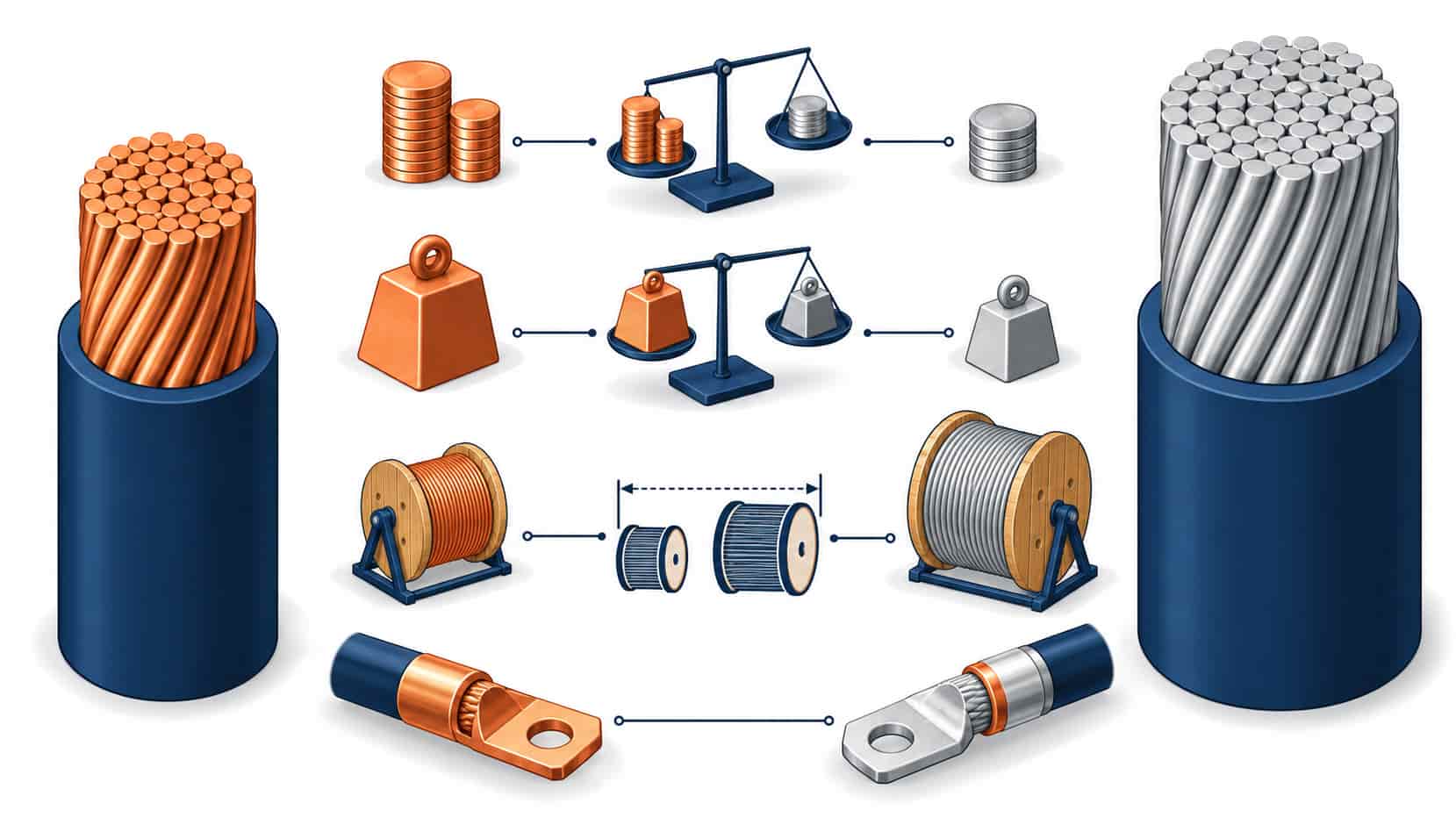
Start with the numbers everything else follows from. Annealed copper conducts about 58 MS/m; aluminum about 35 MS/m — roughly 61 percent. To carry the same current at the same temperature rise, an aluminum conductor needs a cross-section about 1.6 times the copper equivalent. But aluminum’s density is only 3.3 grams per cubic centimeter against copper’s 8.9, so that larger aluminum conductor still weighs about half of the copper one. The consequence chain is short. Aluminum ampacity tables use larger cross-sections, the cable drum is bulkier per ampere, the tray fills faster — yet the pulling tension drops, the supporting structure works less hard, and the drum the rigger lifts is lighter. For long horizontal runs on spacious trays, the size penalty is a paperwork problem. For short runs through packed cable rooms, it’s a routing problem.
The Economics: Where Aluminum's Margin Lives
Copper trades at many times aluminum’s price per kilogram, and even after upsizing the aluminum cross-section, the conductor cost per ampere delivered over distance favors aluminum by a wide margin. The margin concentrates in three places: long feeder runs where every meter multiplies the saving, large cross-sections where the per-kilogram gap dominates, and utility-style circuits where the termination count per meter is low. It shrinks or inverts in three others. Small branch circuits, where the minimum practical size erases the saving. Crowded terminations, where each joint needs anti-oxidant and torque discipline. And moving or vibrating circuits, where copper’s fatigue behavior is worth the premium. A project that maps its circuits into these buckets before quoting captures aluminum’s savings where they’re real and stops paying copper prices only where habit says so — the sizing arithmetic behind the mapping is the one in our cable size selection guide.
| Axis | Copper | Aluminum | Buyer Takeaway |
|---|---|---|---|
| Conductivity | Reference (100%) | About 61% â needs ~1.6Ã the cross-section for equal ampacity | Always compare at equal ampacity, never equal size |
| Weight | Dense â heavy drums, strong supports | About half the weight at equal ampacity | Aluminum eases pulling and structure on long runs |
| Material cost | High and volatile | Fraction of copper per kg; still cheapest per delivered ampere on long runs | The saving is real but concentrated in feeders, not branches |
| Termination | Forgiving â solderable, dimensionally stable | Demands bi-metal or aluminum-rated lugs, anti-oxidant, torque discipline | Count the terminations before counting the savings |
| Creep / fatigue | Stable under pressure and vibration | Cold-flow creep and fatigue sensitivity at joints | Use spring-loaded or compression hardware on aluminum |
| Corrosion | Corrodes alone | Galvanic couple with copper â needs transition fittings | Never land aluminum on copper directly |
The Termination Discipline: Where Aluminum Projects Succeed or Fail
Almost every aluminum horror story is a termination story. Aluminum oxidizes instantly in air, and its oxide is an insulator — so every joint must be brushed, greased with anti-oxidant compound and closed with hardware designed for aluminum. Aluminum also creeps: under sustained pressure it cold-flows away from the clamp, loosening the joint over months until the contact resistance climbs and the hotspot appears. The discipline that answers both is well established — aluminum-rated or bi-metallic compression lugs, calibrated torque, and re-torque checks at commissioning. Where the two metals must meet, bimetallic transition terminals or washers keep the galvanic couple out of the joint. Projects that treat these as optional are treating their ampacity margin as optional too, because a loose aluminum joint doesn’t degrade gracefully; it heats, oxidizes further and fails fast. The thermal hotspots and joint failures that skipped discipline produces are the routine entries in our cable failure causes guide.
Corrosion and the Bimetallic Boundary
Direct copper-to-aluminum contact is a small galvanic cell: moisture plus the potential difference between the metals corrodes the aluminum preferentially, and the joint resistance rises season after season. The fix is mechanical, not chemical — transition terminals with the two metals friction-welded or brazed inside the factory, so the moisture never sees the interface. Schedules should name the boundary explicitly: every point where an aluminum feeder lands on a copper busbar, breaker or downstream copper cable needs a bimetallic component in the bill of materials. Forgetting one is the kind of defect that passes the megger test at commissioning and surfaces as a warm cabinet three years later. That’s why the inspection points worth walking during a factory or pre-delivery review are the ones in our power cable manufacturer checklist.
Mechanical Behavior: Armor, Bending and Installation
Aluminum’s lower yield strength and different temper change handling in ways the crew notices. Aluminum conductors tolerate fewer bend cycles before work-hardening, so the one-bend-and-done discipline matters more than on copper; single-core aluminum feeders in aluminum-wire armor are a classic utility combination precisely because the armor matches the conductor’s expansion. Where the route is tight, armored versus unarmored trade-offs shift slightly toward copper, because copper’s ductility forgives the last-meter routing that aluminum resents — the armor decision framework is the same one in our armored versus unarmored guide, read with the conductor metal in mind. None of this forbids aluminum in confined plants; it just prices the routing time into the comparison honestly.
Standards and Ratings: Reading the Tables Correctly
Both metals are fully standardized — IEC 60228 defines the conductor classes for each, and ampacity tables publish aluminum columns beside copper ones in every modern standard set, including the IEC, GB and BS landscape mapped in our MV and LV standards guide. The classic buyer error is comparing a copper 185 mm² against an aluminum 185 mm² and concluding aluminum undersized. The honest comparison is copper 185 against aluminum 300 — equal in ampacity, half the weight, fraction of the price. Voltage-drop checks matter more on aluminum because the larger cross-section cuts the resistance back down but rarely to parity. Long feeder runs need the arithmetic repeated per metal before the schedule freezes, and the delivery timeline difference between the two metals on large orders is worth checking against the patterns in our cable sourcing delays guide.
| Copper Feeder | Aluminum Equivalent | Weight Change | Typical Fit |
|---|---|---|---|
| 70 mm² | 120 mm² | About half | Short feeders â saving modest; copper often simpler |
| 95 mm² | 150 mm² | About half | Mixed â price the terminations first |
| 185 mm² | 300 mm² | About half | Long feeders â aluminum's core territory |
| 300 mm² | 500 mm² | Under half | Incoming supplies â strongest saving per meter |
| 400 mm² | 630 mm² | About half | Utility-style trunk runs with few joints |
When Aluminum Is Not the Answer
Some circuits should simply stay copper, whatever the spreadsheet says. Control and instrumentation cores terminate dozens of times per panel and belong on copper. Small branch wiring below the sizes where aluminum’s economics activate stays copper. Circuits that flex, vibrate or move — motor drops, crane festoons, generator leads — stay copper. And any installation where the crew’s termination discipline can’t be guaranteed, because the electrical contractor is unfamiliar with aluminum-rated hardware, should default to copper: the metal is only as good as its last joint. Conversely, long straight feeders, utility-style distribution and large cross-section runs are where copper’s premium buys nothing. That’s the honest scope of each metal, and pretending one metal suits every circuit is how both metals get blamed for schedule decisions.
RFQ Checklist: Specifying the Conductor Metal
Make the metal choice auditable, so include:
- Conductor metal explicit per circuit: copper or aluminum, never “as per standard”
- Cross-section sized at equal ampacity, voltage drop verified per metal
- Termination hardware named: aluminum-rated compression or bi-metal lugs
- Anti-oxidant compound and torque values stated in the installation spec
- Bimetallic transitions listed wherever aluminum meets copper
- Conductor class per IEC 60228 (class 2 stranding typical for aluminum feeders)
- Batch test reports with conductor resistance per kilometer keyed to drum IDs
- Re-torque schedule at commissioning written into the handover documents
- Delivery and drum-handling plan for the heavier copper or bulkier aluminum drums
- Destination-market acceptance of aluminum conductors confirmed for the sector
Conclusion
Aluminum versus copper isn’t a winner-take-all comparison but a per-circuit mapping. Aluminum’s cost and weight advantages are real on long, straight, heavily-loaded feeders; copper’s termination forgiveness and compactness are real everywhere else. Projects that size honestly at equal ampacity, specify the termination discipline in the same breath as the metal, and draw the bimetallic boundary on the drawings get aluminum’s savings without aluminum’s folklore.
Kexingyu Cable Group (KXYE) manufactures both conductor families with aluminum-rated accessory support and batch test documentation, so the metal in the schedule arrives with the engineering that makes it perform — costed honestly and export-ready.
Recent Posts

Power Cable Warranty Terms: What to Demand and What to Watch For
Power Cable Warranty Terms: What to Demand and What to Watch For Quick Answer: A usable warranty names its scope, duration, evidence standard, exclusions and
The Cable Sample Approval Process: What to Test Before Mass Production
The Cable Sample Approval Process: What to Test Before Mass Production Quick Answer: Sample approval tests the supplier’s claims while changes are still cheap —
Cable Drum Packaging for Export: Specs, Marking and Transit Protection
Cable Drum Packaging for Export: Specs, Marking and Transit Protection Quick Answer: Export packaging is a technical specification: drum size for weight and bend radius,
Our Products
Need a quote for a specific project?
Switchgear Manufacturer China: What to Verify Before You Order
Switchgear carries a higher stakes verification checklist than most equipment categories — here's what to confirm before you commit to an order.
A
B
A
B
A
B
A
B
A
B
A
B
A
B
A
B
Cable Sizing Basics
Common questions from engineers and project buyers selecting the correct power cable size for industrial installations.
01 Is it safe to round up to the next standard cable size?
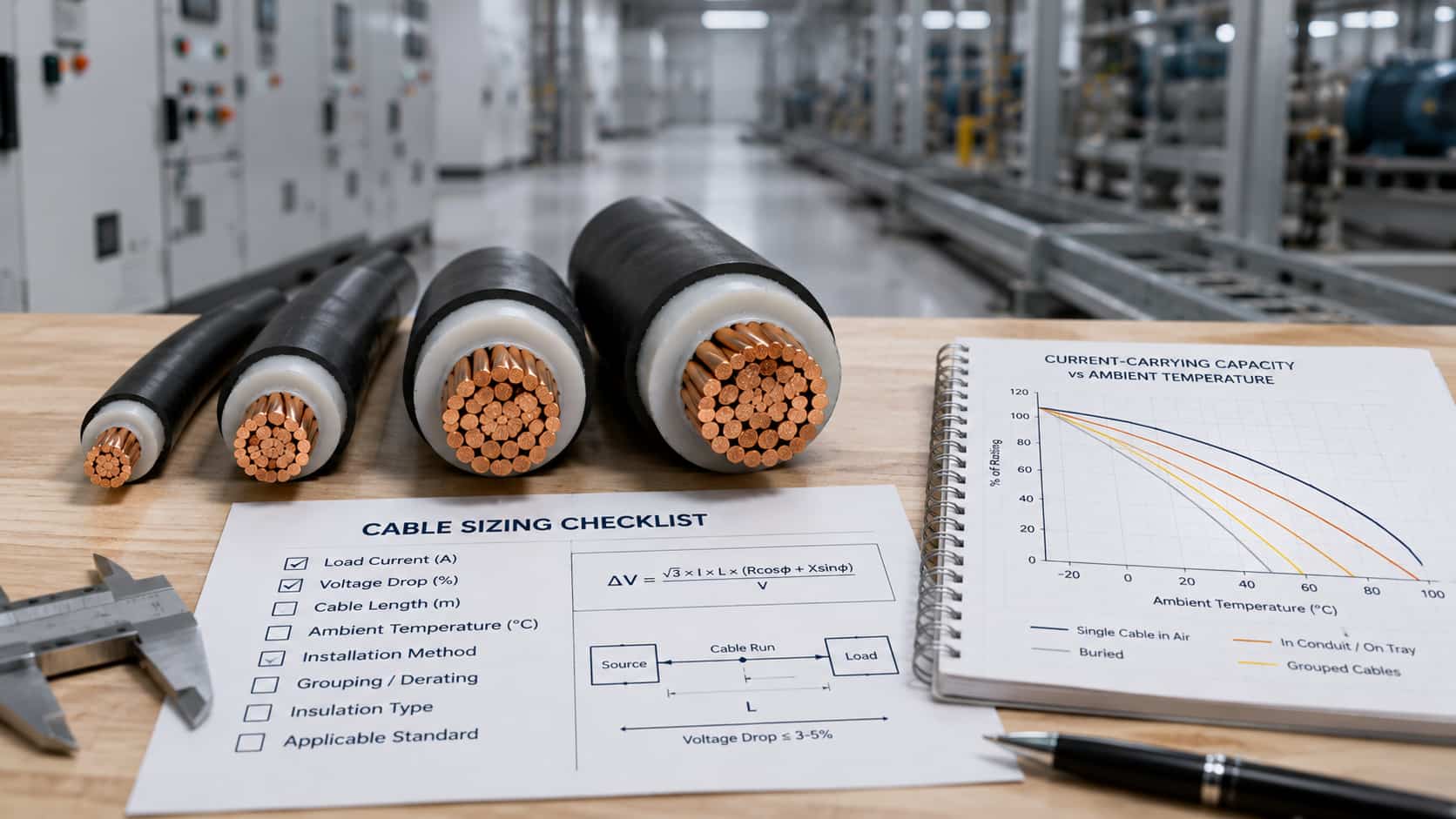
Rounding up to the next standard conductor size can provide additional current-carrying capacity, but it does not automatically confirm that the cable is suitable for the installation. Voltage drop, ambient temperature, grouping, installation method and short-circuit requirements must still be checked separately before the final cable size is approved.
02 Do I need to derate cable capacity in hot climates?
Yes. Published cable current ratings are normally based on a reference ambient temperature, commonly around 30°C. When the actual installation temperature is higher, the applicable temperature correction factor must be applied. Cable grouping, buried installation and restricted ventilation may require additional derating factors.
03 Does cable length matter when the connected load is small?
Yes. Voltage drop depends on both the circuit current and the total cable run length. A relatively small load supplied over a long distance may still require a larger conductor than the current rating alone suggests. The calculated voltage drop should remain within the limits required by the applicable standard and connected equipment.
04 Can a cable supplier confirm the required size before production?
A supplier with technical engineering support can review the load current, system voltage, cable length, installation method, ambient temperature, cable grouping and insulation type before production. However, the final selection should also comply with the project design, protection settings and governing IEC, BS, GB or local electrical standard.
Recent Posts
Power Cable Warranty Terms: What to Demand and What to Watch For
Power Cable Warranty Terms: What to Demand and What to Watch For Quick Answer: A usable warranty names its scope, duration, evidence standard, exclusions and
The Cable Sample Approval Process: What to Test Before Mass Production
The Cable Sample Approval Process: What to Test Before Mass Production Quick Answer: Sample approval tests the supplier’s claims while changes are still cheap —
Cable Drum Packaging for Export: Specs, Marking and Transit Protection
Cable Drum Packaging for Export: Specs, Marking and Transit Protection Quick Answer: Export packaging is a technical specification: drum size for weight and bend radius,