Buying Power Cables for Uzbekistan: How to Prepare an RFQ and Compare Offers
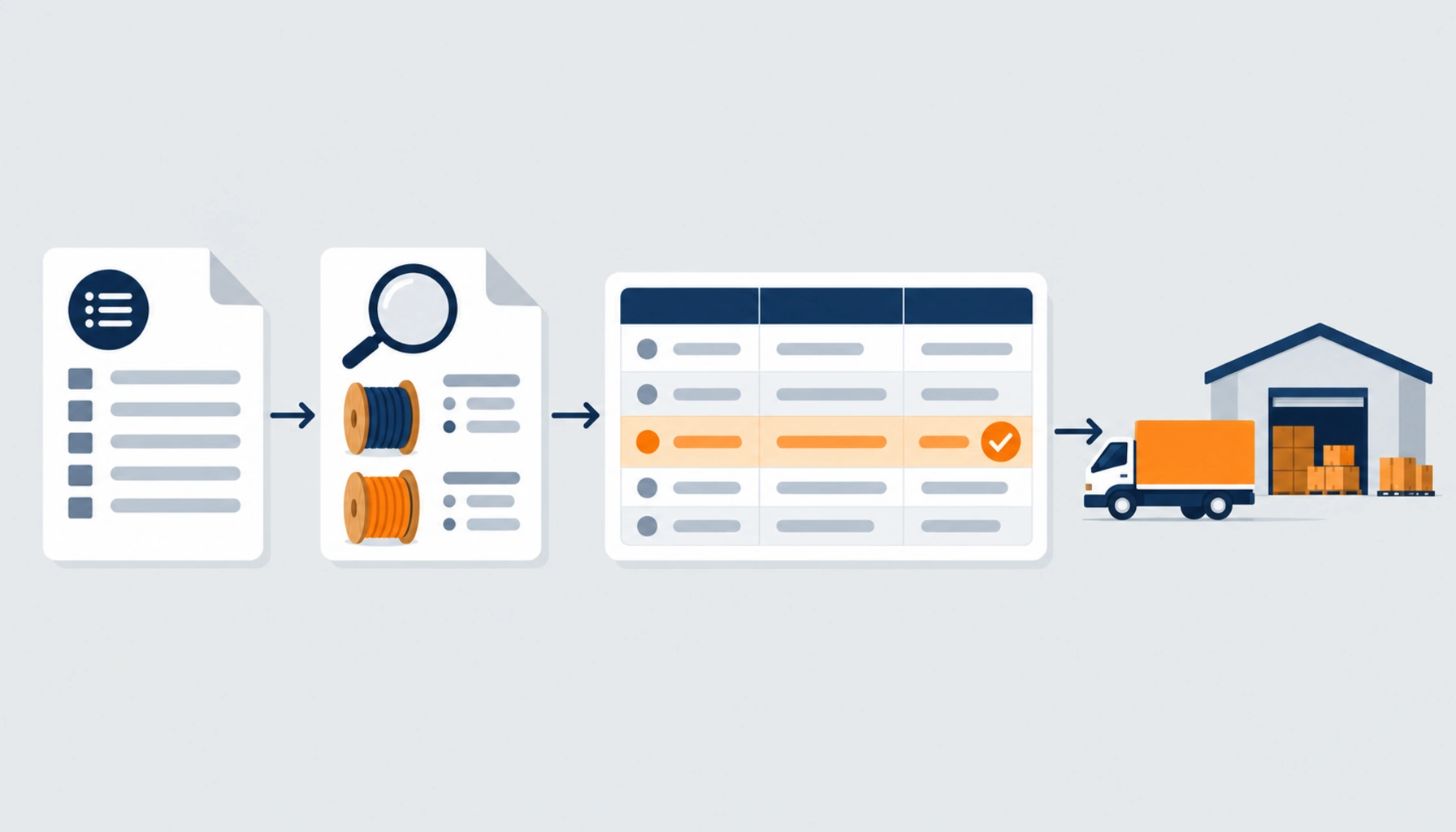
Quick Answer: A project BOQ rarely becomes a good power cable offer by itself. The buyer’s job in between is a line-by-line review: complete the missing construction data, fix conductor and insulation choices where the BOQ leaves them open, attach quantities and drum lengths, and send the result as one structured RFQ. When offers come back, compare them on a three-column sheet, what the BOQ asked, what the offer says, and the deviation with its evidence, and confirm the quotation only when every line has one of those three states.
Introduction
Power cable buying in Uzbekistan usually starts from a bill of quantities written for the project, not for the cable factory. The BOQ carries design intent, but it often omits exactly the fields a factory needs: the full voltage fraction, the conductor class, the screen design, the drum lengths. Sending the BOQ as received produces offers that fill those gaps in whatever way each factory prefers, and the comparison that follows compares guesses.
This guide is for contractors and project buyers in Uzbekistan turning a BOQ into comparable power cable offers. It follows the document’s path: review the BOQ line by line, fill or flag the missing construction data, settle the conductor and insulation choices, fix quantities and lengths, manage the deviation table through the quotation, confirm samples where they matter, and close with a quotation check before the order. The construction parameters behind the lines are set out in our note on XLPE cable construction, and the armoured power constructions behind typical project lines are shown in the medium voltage XLPE armoured cable page.
Country-level supplier screening for Uzbekistan, which sits before this document work, is covered in our Uzbekistan supplier checklist.
Review the BOQ Line by Line Before Anything Is Sent
Sort the lines into three states: complete, incomplete, undecided. Complete lines carry construction, standard and quantity. Incomplete lines carry a description but miss a factory-critical field. Undecided lines are those the project itself has not settled. The sort takes an hour and decides how the RFQ is built, because each state is handled differently.
Complete lines go out as they are. A line with voltage in full, conductor, structure, standard and quantity needs no interpretation, and it should be frozen in the RFQ exactly as written. Freezing the good lines protects them from the drift that incomplete lines cause in the same document.
Incomplete lines get a field-by-field check. The usual gaps are the voltage fraction, the conductor class, the screen design, the sheath compound and the drum lengths. Each gap is either resolved with the designer or marked in the RFQ with a request for the supplier’s stated assumption. The RFQ method for those fields is set out in our note on the industrial cable RFQ checklist.
Undecided lines are labelled as such. Where the project has not settled a choice, say so in the enquiry and ask for the options quoted separately. An offer that quietly picks one has taken a design decision the buyer did not authorise, and the comparison inherits it.
Fill the Missing Construction Data Deliberately
Voltage first, in full. The fraction, phase-to-earth over phase-to-phase, decides insulation thickness, test regime and accessories. Where the BOQ gives a system description, convert it once with the design engineer’s input, and write the resulting cable rating on the line.
Conductor material and class, per line. Copper against aluminium is a design and a cost decision; the class, solid, stranded, compacted or flexible, follows the installation. Where the BOQ is silent, both options can be quoted on clearly marked lines, but the electrical parameters are never left for the supplier to choose.
Screen, armour and sheath where the BOQ omits them. These are the fields a factory most often fills with its standard, and the standard is rarely wrong and never guaranteed to match the project. Write the structure where the design has one; mark the line for the supplier’s stated proposal where it does not.
Fix Quantities and Lengths Against the Route
Quantities per line, with the delivery form. Total metres and the drum lengths they should be delivered in. Where the BOQ carries only totals, the drum lengths come from the supplier’s available sizes, and the splits are fixed after the offer names them. The jointing consequences of that choice are set out in our note on drum length and jointing strategy.
Tolerance on ordered lengths, confirmed in writing. The allowance between ordered and delivered metres varies by factory, and on a project it lands as unplanned joints or surplus. One line in the RFQ fixes it, and the tolerance mechanics are covered in our note on ordered length and drum tolerance.
Delivery stages where the programme demands them. Where the site needs cable in phases, the RFQ should say so and ask for the production plan per phase. Splitting deliveries changes the MOQ arithmetic per line, and the offer is where that arithmetic should surface rather than after the order.
Run the Deviation Table Through the Quotation
The table has three columns and one row per difference. What the BOQ specified, what the offer proposes, and the reason with its evidence. Every difference between your line and the offer’s line belongs there, including the ones that look favourable, because the point is a complete record rather than a catalogue of complaints.
Decide each row against the duty it touches. A conductor class change affects pulling and accessories; a screen change affects the network; a sheath change affects the environment. Deviations with reasons and evidence can be accepted on the merits, and the accepted ones move into the order annex with the same wording.
Watch for deviations that arrive after the comparison. A construction that changes between the quotation and the production is a deviation that escaped the table. The order confirmation should freeze the accepted construction, and any later change restarts the row. The comparison method that keeps offers honest line by line is set out in our note on comparing cable quotes.
The full comparison sheet, line by line and including the omissions, is in our guide to comparing cable quotations for Central Asia.
Confirm Samples Where They Matter
Sample the lines that carry the most risk. On a power cable order that is usually the highest-voltage construction and any line with an unusual structure. The sample is judged against the BOQ line and the accepted deviations, and the approval record becomes the receipt benchmark.
Ask which line the sample runs on. A sample from the production line that will make the order is evidence; a sample from a pilot line is a brochure. The question is direct and the answer belongs in the file, and the batch’s own routine reports tie the delivered drums back to that record.
Keep the sample plan proportionate. One or two lines sampled well beat five sampled casually. The rest of the order rides on the batch documents, which the RFQ has already required, and the acceptance checks at receipt use those documents against the approval record.
Close the Quotation Before the Order
Every line ends in one of three states. Accepted as specified, accepted with a recorded deviation, or excluded from this order. A quotation confirmation that leaves lines in a fourth state, discussed but unresolved, is how the production stage inherits decisions nobody made. The confirmation is one page: the line list with its states, the accepted deviations, the commercial terms and the delivery basis.
Commercial terms close at the same time. Copper basis and validity, MOQ and drum lengths per line, packaging, marking, included documents, payment and delivery basis to the named destination. These are quotation fields, not order-stage discoveries, and the structure they follow is set out in our note on cable MOQ and lead time.
The confirmation becomes the order’s technical annex. Assembled from the BOQ review, the deviation table and the commercial terms, it is the document both sides check at production and at receipt. The screening work that chose the supplier sits behind it, described for this region in the country articles of this series.
BOQ, Offer and Deviation Table
The table is the working sheet this guide describes: one row per line of the BOQ, with the offer’s answer and the deviation decision recorded beside it. Filled honestly, it is the quotation confirmation’s technical core.
| Column | What Goes In | Who Fills It | What It Prevents |
|---|---|---|---|
| BOQ line | The specified construction, standard and quantity, written to be buildable | Buyer, after the line-by-line review | Offers quoted against interpretations of the design |
| Offer line | The construction, standard, price basis and drum plan the supplier offers | Supplier, per line, in the quotation | Merged, dropped or rounded lines passing unnoticed |
| Deviation | The difference, the reason and the evidence, with the decision recorded | Buyer decides, supplier evidences | Silent substitutions discovered at production or receipt |
| Line state | Accepted as specified / accepted with deviation / excluded | Buyer, at the quotation confirmation | Unresolved lines inherited by the production stage |
| Sample record | Which lines were sampled, on which production line, approved against what | Buyer and supplier together | Batches judged against memory instead of a record |
| Commercial terms | Copper basis, validity, MOQ and drum lengths, documents, delivery basis | Supplier states, buyer confirms | Terms renegotiated after the metal moves |
Cost and Lead Time Between BOQ and Order
The review is where the schedule is protected. Every field completed before the RFQ removes a round of clarification after it, and clarification rounds are where delivery dates quietly dissolve. A BOQ reviewed in a day routinely saves weeks between enquiry and confirmation.
Deviation decisions have lead times of their own. An accepted deviation that changes the construction may change the production slot with it, and where a retest is needed the calendar extends further. Deciding the table quickly, with the duty in view, keeps those consequences inside the quotation stage where they can still be planned around.
Quantities move the price at known breaks. Volume steps, drum availability and MOQ per construction are all quantity-driven, and the offer prices them openly when the quantity picture is honest. Where the project can consolidate lines or shift a phase boundary, the offer is where those levers get priced.
The copper basis spans the whole BOQ. One basis and one validity window across all lines keeps the offer’s internal arithmetic consistent and the comparison fair. Mixed bases inside one offer are a finding, not a detail, and they belong in the deviation conversation with everything else.
| Line State | What It Looks Like | RFQ Handling | What It Prevents |
|---|---|---|---|
| Complete | Voltage in full, conductor, structure, standard and quantity all present | Frozen as written into the enquiry | Good lines drifting with the bad ones |
| Incomplete | A description with a missing factory-critical field | Field resolved with the designer, or marked for the supplier's stated assumption | Offers that fill the same gap three different ways |
| Undecided | The project itself has not settled the choice | Labelled as such, with the options quoted separately | The supplier taking a design decision nobody authorised |
| Electrical gap | Voltage, conductor or section missing | Back to the specifier; never quoted on a guess | An entire comparison built on a guessed parameter |
When a Full BOQ Conversion Is Not the Answer
When the purchase is stock, not project. Distributor buying runs on standard constructions and repeat volumes, not on a BOQ. The country checklist for the buying mix covers that case; this guide is for the project path.
When the design is still moving. Converting a BOQ that will change again doubles the work. Freeze the design first, or run the exercise on the frozen lines only and label the rest as indicative.
When one supplier is already qualified and the lines are familiar. Repeating the full conversion for identical repeat lines adds cost without information. The confirmation shrinks to quantities, drum plan and any changed terms, with the annex updated rather than rebuilt.
When the BOQ’s gaps are electrical and unresolved. No supplier answer fixes a missing voltage or section. Those lines go back to the designer, and the RFQ proceeds without them rather than with guesses attached.
RFQ Checklist
- BOQ sorted into complete, incomplete and undecided lines before the enquiry goes out
- Voltage fractions written in full on every line, converted once and deliberately
- Conductor material and class per line, both options quoted where the choice is open
- Screen, armour and sheath written where the design has them, flagged for proposal where it does not
- Quantities per line with drum lengths requested and tolerance confirmed
- Delivery phases stated where the programme requires them
- The deviation table maintained through the quotation, one row per difference with evidence
- Samples planned for the highest-risk lines, on the batch line, with approval records
- Every line confirmed in one of three states before the order
- Commercial terms closed with the technical confirmation, not after it
Conclusion
A BOQ becomes a good power cable order through three documents: the reviewed enquiry, the deviation table, and the quotation confirmation that leaves every line in a decided state. None of them is complicated, and together they are what makes the offers comparable, the award defensible and the receipt checkable. The work happens between the design and the order, which is exactly where it is cheapest.
Kexingyu Cable Group (KXYE) manufactures power constructions in Quanzhou and answers Uzbekistan project enquiries line by line, with deviations evidenced and every line carried to a decided state. Send us your BOQ, quantities and destination, or upload your technical specification, and we will return the offer this guide describes. A request for quotation is the fastest route to start.