Cabling a 1MW Rack: Ampacity, Derating and the Thermal Limits Your Specification Has to Declare
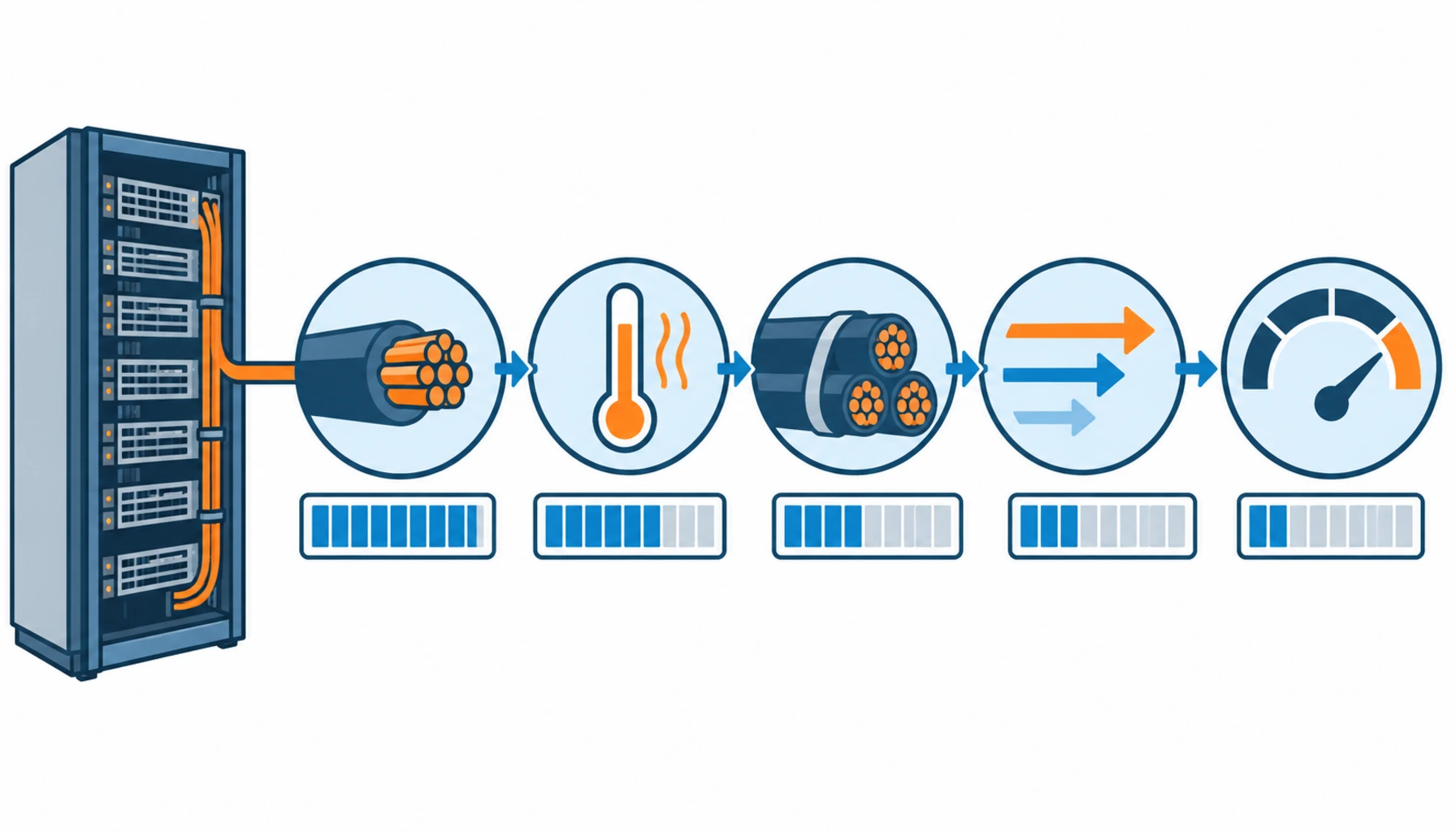
Quick Answer: At 800V DC a one megawatt rack draws roughly 1250A, and the cable that carries it is limited less by copper than by temperature — the conductor’s own heat, the ambient inside a liquid-cooled rack, and the derating factors that follow from how the runs are grouped and routed.
Cable is the cheapest-looking line in a rack power budget and the easiest one to buy badly. It is bought from a table, the table gives a current for a cross-section, and the cross-section goes on the order. The trouble is that the table is built on reference conditions, and a liquid-cooled one megawatt rack is not a reference condition.
Introduction
Data center cabling has always involved derating, but at moderate density the margins absorbed the mistakes. A modern AI rack removes that tolerance. At one megawatt the current is high enough that a wrongly applied derating factor does not produce a slightly warm cable, it produces a conductor running above its insulation’s temperature rating, which shortens life and eventually fails.
The number to hold in mind is roughly 1250A. That is what a one megawatt rack draws at 800V DC, and it is the same current whether the power arrives by busway, by a set of parallel single-core cables, or by heavy multicore. What changes between those options is how the heat leaves the conductor, and that is where the specification has to do real work. The wider cabling picture for dense halls is in our note on high density rack cabling.
Four Ways to Carry 1250A Into a Rack
The conductor decision is usually made on price and then justified on current. It should be made on how each option handles heat and how much evidence it brings with it.
| Option | What You Must Declare | Evidence That Matters | Cost and Lead Time | Main Risk |
|---|---|---|---|---|
| DC busway | Rated current, ambient, grouping and short-circuit withstand per tap | Temperature rise at rated current on the actual assembly | Six to ten weeks, from a shorter supplier list than AC busway | Derating assumed in the design that the installed run does not deliver |
| Parallel single-core cables | Cross-section, number of runs, spacing, grouping and current sharing | Derating calculation for the installed arrangement, plus resistance records | Widely available, three to six weeks, and adaptable on site | Unequal current sharing between parallel runs, which is where the hottest conductor lives |
| Heavy multicore cable | Cross-section, insulation class, bend radius and support spacing | Routine tests plus the derating basis for grouping and ambient | Available on standard lead times but stiff and hard to route late | Bend radius and pulling tension limits discovered on site, after fabrication |
| Fabricated copper busbar | Cross-section, joint design, torque values and support spacing | Joint resistance measurement and temperature rise under load | Custom fabrication, schedule driven by the workshop not the catalogue | A joint that was never measured becomes the hot spot that fails first |
The Derating Chain Is Where Projects Actually Fail
Published current ratings assume reference conditions: a stated ambient air temperature, a stated installation method, and a single circuit in isolation. A real rack installation violates every one of those assumptions, and each violation takes current out of the conductor. The factors multiply rather than add, which is why a set of individually modest adjustments can remove a third of the nominal rating.
The ambient term is the one most often underestimated in dense halls. A conventional data hall is designed around an ambient in the twenties. A liquid-cooled AI rack can be considerably warmer inside its own enclosure, and a cable running in that space sees the higher figure regardless of what the room thermostat reads. Ask for the design ambient inside the rack, not the hall set point, and make the supplier quote against the former.
Grouping and spacing come next. Cable runs are laid in trays in bundles, and the middle of a bundle is warmer than the outside. The larger the cross-section and the tighter the spacing, the more the conductors heat each other. This is where the arithmetic in our note on cable derating factors does the heavy lifting, and it is worth running early rather than discovering at installation that the tray fill assumed in design is not achievable in the aisle.
Parallel runs add a third term that has nothing to do with tables. When several single-core cables are run in parallel to carry one feed, the current does not divide equally unless the runs are geometrically symmetric and the joints are made consistently. A few percent of imbalance sounds trivial, but the rating was already reduced by ambient and grouping, so the least-loaded conductor’s margin has to cover the most-loaded one. Circular arrangements, unequal route lengths and differences in termination torque all shift the balance.
What Changes When the Hall Is Liquid Cooled
Liquid cooling changes the thermal environment of the cable in two directions at once, and buyers tend to assume it helps. In some respects it does: the room air can be warmer because the heat is leaving through the coolant loop rather than the air, and the cable may see less air movement obstruction. In others it makes things worse: the rack enclosure can run hotter than a room-cooled equivalent, coolant plumbing occupies the route, and a cable touching a cold coolant line has a different temperature profile along its length than one running free.
The practical consequence is that the cable’s insulation class has to be chosen against the worst temperature it will see rather than the average. A standard XLPE power cable is typically rated around 90 degrees at the conductor. Where the rack interior pushes the ambient up, a higher-temperature insulation system — silicone rubber or a fluoropolymer — may be the correct purchase, and that is a different product with different mechanical properties. Our high and low temperature resistant cable range is the conventional reference for that class of product.
There is a second-order procurement point that is easy to miss. If the design assumes a high-temperature insulation system, then the termination, the support clamps and the heat-shrink components all have to be rated for the same temperature. A run that is correct for 125 degrees except for a termination rated at 90 is a 90 degree installation. Our note on liquid cooling and cable covers the interaction in more detail.
What to Freeze in the 1MW Rack Cabling Specification
Each item below is a place where a supplier will quote against reference conditions unless the enquiry states otherwise.
| Specification Item | What to State | Evidence to Demand | Cost of Leaving It Open |
|---|---|---|---|
| Design ambient | The temperature inside the rack enclosure, not the hall set point | Derating calculation using that figure | A conductor running above its insulation rating on hot days |
| Grouping and spacing | Number of circuits per tray, spacing between parallel runs, tray fill | Derating factors for the installed arrangement, documented | A rating that only exists in isolation on a drawing |
| Current sharing between parallel runs | Route symmetry, arrangement, and the imbalance limit accepted | Resistance measurement per run, and the joint method | The least-loaded conductor's margin consumed by the most-loaded one |
| Insulation temperature class | The worst conductor temperature expected, and the insulation system chosen for it | Material rating and the test basis for the installed conditions | A cable that ages fast and fails at the end of its thermal life |
| Terminations and joints | Type, torque values, and temperature rating matched to the cable | Joint resistance measurement and inspection records | A 125 degree cable installed with a 90 degree termination |
| Bend radius and pulling limits | Minimum bend radius, maximum pulling tension and sidewall pressure | Manufacturer limits and a site pulling plan | Conductor damage during installation that shows up years later |
| Support and fire-stop | Support spacing for the weight and short-circuit forces, penetration details | Structural and fire-stop certification | Supports sized for the static weight only |
| Test documentation | Conductor resistance, batch traceability, and temperature rise where applicable | Routine test records and third party witness if required | No baseline to compare against when a hot spot appears |
When This Level of Cable Engineering Is Not Warranted
The specification above is proportionate to a one megawatt rack. Applied to an ordinary hall it is expensive ceremony, and there are three cases where it should not be run.
Moderate density. Below roughly 100 kW per rack the derating chain still applies but the margins are comfortable, the ambient assumptions are ordinary, and a conventional cable selected from a standard table is the correct and cheapest purchase. Voltage drop rather than temperature usually governs the cross-section at those currents, and that calculation is set out in our note on voltage drop calculation.
Racks whose power is not yet fixed. A cable run is a physical commitment. Where the rack power is still moving between generations, buying a conductor sized for a figure that may change is a way to buy the wrong cross-section twice. Buying against the distribution layer’s rated voltage and a declared maximum current, rather than against a phase one figure, is the way to avoid that.
Projects that cannot measure what they install. The evidence list above assumes somebody will measure conductor resistance and joint resistance and keep the records. Where that capability is absent, the specification should be simplified to products whose performance is documented by routine test at the factory, rather than relying on site measurement that will not happen. The general selection method is described in our note on cable size selection.
The recurring error at this density is treating the cable as a commodity chosen at the end of the design. On a one megawatt rack the cable is part of the thermal design, and it has to be chosen with the ambient, the grouping and the termination temperature already decided — not discovered afterwards.
RFQ Checklist for 1MW Rack Cabling
Send the thermal environment and the routing, not just the current. Each enquiry should carry:
- Rack power per rack, and the maximum current per feed at the distribution voltage
- The design ambient inside the rack enclosure, and the hall ambient separately
- Number of circuits per tray, spacing, and the tray fill you can actually achieve
- Whether runs are parallel, how many, and the route symmetry between them
- The conductor temperature expected, and the insulation class required for it
- Whether the environment is liquid cooled, and any coolant line proximity
- Termination and joint type, torque values, and the temperature rating required
- Bend radius, pulling tension and sidewall pressure limits for the route
- Support spacing requirements accounting for short-circuit forces
- Test documentation: conductor resistance, batch traceability, and routine test records
- Certification for the destination market and the edition of each standard applied
Conclusion
Cabling a one megawatt rack is a thermal problem wearing a cable’s clothes. The current is fixed at roughly 1250A by the physics of the rack, and the cross-section follows from that — but only after the ambient inside the enclosure, the grouping in the tray, the symmetry of the parallel runs and the temperature rating of the terminations have all been declared. Each of those takes current out of the conductor, and they multiply.
Buy the evidence with the cable. Conductor resistance records, batch traceability, and a derating calculation documented against the arrangement you will actually install, with terminations rated at the same temperature as the cable itself. Kexingyu Cable Group (KXYE) supplies the power, control and mineral insulated cable ranges used in these installations — WDZ-YJY, WDZN-YJY, BTTZ, BBTRZ, NG-A (BTLY), KVV and YJV — including high and low temperature resistant constructions, from a single factory group, with copper price linkage available on project-scale orders. Send your rack power, design ambient and route conditions and we will return a sized cable schedule with the derating basis stated; the fastest start is a request for quotation.