Combination and Security Cables: CCTV and Monitoring Infrastructure
Quick Answer: Combination cables bundle coax or data pairs with power conductors in one jacket — one pull per camera or sensor instead of three. Combine where the services share a route and voltage separation rules allow; run separate where they do not.
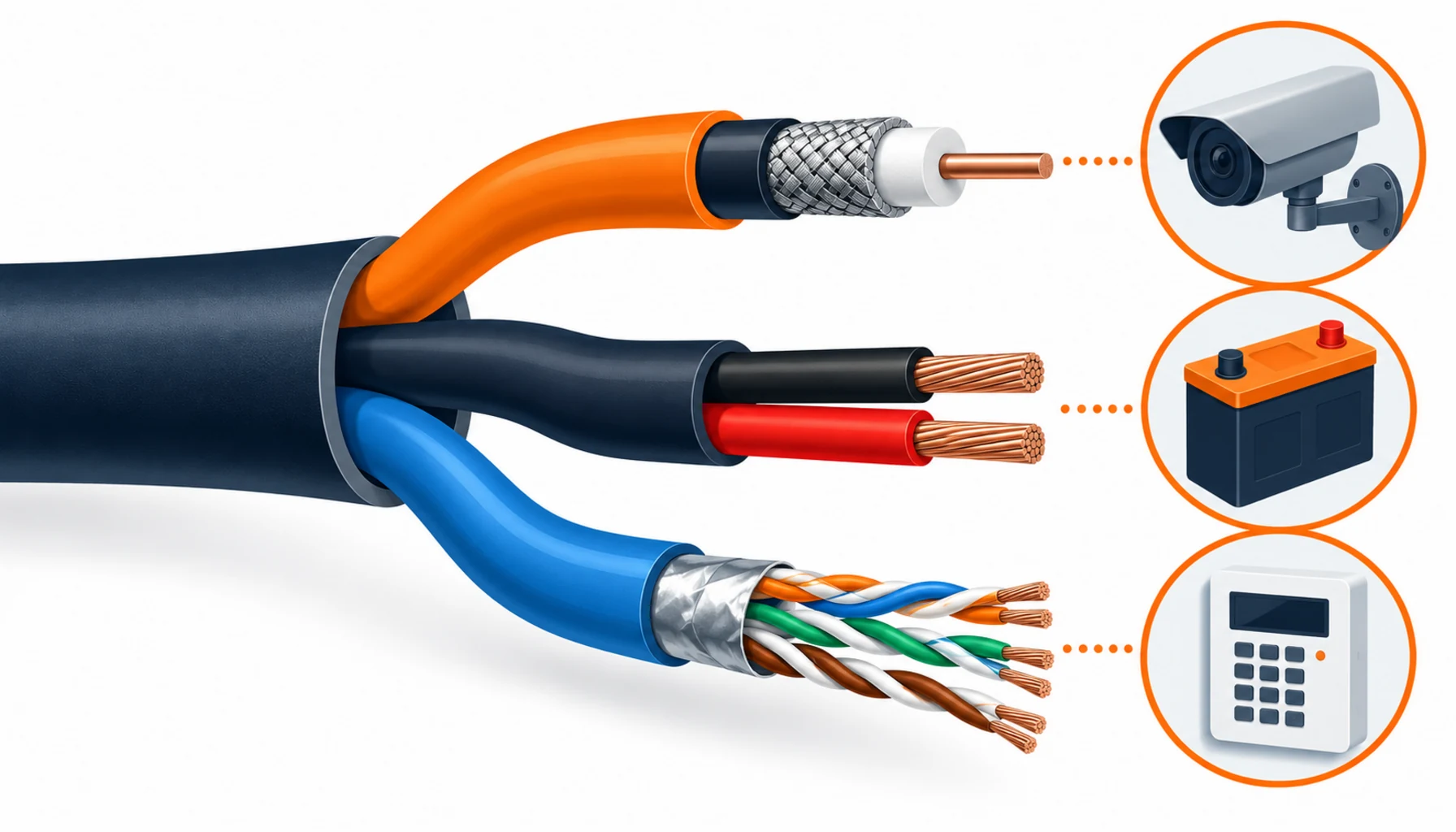
The cctv combination cable exists because a camera is never one service: it needs video or data back to the recorder, power at the camera head, and often a control or audio pair — three cables that almost always follow the same route. Running them separately triples the pulling labor, the tray space, the labeling and the fault surface; the combination construction answers by putting the services in one jacket, factory-separated and factory-verified: a coaxial core or shielded data pairs alongside power conductors, each service keeping its screen, the jacket keeping the bundle together. The economics are clear and the engineering constraints are equally clear — voltage separation, isolation between the video screen and power, fire rating of the shared jacket — and this guide covers both: what the constructions actually contain, where combining wins, and when the services must run apart.
Introduction
Monitoring infrastructure is cable-intensive by nature: a surveillance layer touches every corner a security plan wants eyes on, an alarm layer threads every door and sensor, and both run back to head-end rooms that concentrate the returns. The cable engineering inherits a pattern familiar from industrial control — multiple small services sharing a route, each needing its screen and its isolation — which is why the construction logic of control versus instrumentation cable reads directly onto security cabling: the shield belongs where the noise is, the isolation belongs where the voltage is, and the jacket answers the route’s environment. Combination cables industrialize that logic: instead of three separately specified cables pulled in parallel, one composite product carries the services with their separations built in at the factory, where the spacing and screening are consistent per meter. The buyer’s task is deciding where the composite wins — and where voltage rules or fire zones force the services apart.
What Combination Constructions Contain
The composite family ranges from two-service to full-stack, and the constructions share a layered logic. Video service: a 75-ohm coaxial core — center conductor, foam dielectric, braid screen — for analog CCTV and SDI runs, or one or two twisted pairs with individual screens for IP cameras returning data over the network tier. Power service: two or more insulated conductors sized for the camera head’s draw — 12/24 V DC locally fed, or higher AC where the design centralizes power — with insulation rated to the service voltage. Control and audio pairs: shielded twisted pairs for PTZ control, intercom or sensor returns, each with its own screen where the noise environment warrants. The composite jacket: an overall sheath, PVC or LSZH per pathway, holding the services at factory-maintained separations, with the print stating the construction. The quality levers sit inside: braid coverage on the coax, screen coverage on the pairs, copper purity in every conductor — the same conductor discipline that the network-cable world enforces — and the accessory side, connectors and glands matched to the composite’s geometry, follows the cable accessories checklist because a composite cable terminates as several cables in one jacket.
Where Combining Wins — and Where It Must Not
Combine where three conditions hold: the services genuinely share a route (the camera head is the canonical case), the voltage separation is designed — low-voltage DC power beside video and control within the rules the design follows — and the pathway’s fire code accepts a single jacket carrying all of them. The wins are real: one pull instead of three, one label per head, one fault surface, and tray space conserved along corridors where every meter of tray is contested. Run separate where any condition breaks: power at mains voltage sharing a jacket with signal services moves the design into composite products engineered and certified for that specific separation — not improvised bundles; fire-zone boundaries where one service may pass and another may not; and noise environments where the power service’s load would degrade the video or data return beyond what the screens absorb. The route-survey discipline mirrors the industrial practice in the industrial power distribution checklist — map the services, check the separations, then choose the construction per segment. And the jacket decision follows the pathway: enclosed and occupied spaces take the LSZH logic of the LSZH versus flame-retardant comparison, applied to the composite as a whole.
| Service | Construction | Spec Line to Verify |
|---|---|---|
| Video (analog/SDI) | 75-ohm coax, braid screen | Impedance, braid coverage, loss per 100 m |
| Video/data (IP) | Screened twisted pair(s) | Category or pair spec, screen coverage |
| Power | Insulated conductors, sized to load | Cross-section, voltage rating, copper material |
| Control / audio | Shielded twisted pairs | Pair count, screen per pair, capacitance |
| Overall | Composite jacket, PVC or LSZH | Flame class, LSZH where enclosed |
| Termination | Connectors, glands per service | Accessory set matched to composite geometry |
The Monitoring Layer Beyond Cameras
Security cabling generalizes beyond CCTV, and the combination logic follows it. Intrusion alarm circuits — sensors to panel — are small control circuits whose routes parallel the camera runs; fire alarm and detection cabling, often with its own survival requirements, shares corridors without sharing jackets with security services; building management and access control add reader, lock and door-position circuits whose cable types echo the control-and-instrumentation family. Each layer has its code context — fire detection cabling especially, with survival ratings that security cabling does not carry — and the head-end rooms where the layers converge are exactly the spaces where the pathway mapping of the data center power hub applies at building scale. The procurement pattern that works: specify per layer, combine per route where the rules allow, and keep the certification evidence per layer — because a composite jacket is one product with several services inside, and each service’s compliance line stands or falls on its own test evidence, verified per the market’s requirements in the China equipment certification checklist.
When a Combination Cable Is Not the Answer
The composite has three honest failure modes. Improvised separation: a combination cable whose power service exceeds the voltage class the design’s separation rules allow is not a convenience — it is a code violation bundled into one jacket; the design, not the product catalog, sets what may share. Service mismatch: an IP camera estate whose video returns over network switches has little use for the coax service in a traditional composite — the combination that wins is network cable plus power, and forcing the legacy construction wastes money and performance. Fault coupling: one jacket means one mechanical failure surface — a crushed segment takes video and power together; in redundant or high-availability monitoring designs, that coupling may be unacceptable, and separate routes are the design answer. The mature pattern treats combination cable as a route-optimization tool applied where its conditions hold, not a default for every security run.
| Condition | Decision | Why |
|---|---|---|
| Camera head: video + low-voltage power, one route | Combine | One pull, designed separation |
| Mains-voltage power beside signal services | Separate or certified composite | Separation rules govern, not habit |
| IP estate over network switches | Network + power, not coax composite | Service mismatch wastes the construction |
| Fire zone boundary on the route | Separate per zone rules | One service passes where another may not |
| Redundant monitoring design | Separate routes | One jacket couples the fault surface |
| Enclosed occupied pathways | Any construction + LSZH jacket | Fire performance is independent axis |
RFQ Checklist: Security Cabling Lines for the RFQ
Put the services in writing:
- Services per run named: video, data, power, control
- Composite construction stated with each service’s spec
- Coax impedance, braid coverage and loss verified
- Power conductors sized to camera load, copper stated
- Jacket per pathway: flame class, LSZH where enclosed
- Accessory set matched to the composite geometry
- Certification evidence per service, per market
Conclusion
Combination and security cables bundle the services of monitoring infrastructure — video, power, control — into constructions whose separations are engineered at the factory, cutting pulls and tray space where routes and rules allow. Decide per route: combine where the services share a path and the voltage separation is designed; run separate where codes, noise or redundancy demand it; and keep each service’s compliance evidence standing on its own.
Kexingyu Cable Group (KXYE) manufactures combination security cables with each service built to its own specification — braid-verified coax, screened pairs, copper-sized power conductors — under PVC or LSZH composite jackets, with construction print and test evidence that name what the jacket carries.