Exporting Cables to Europe: CE Marking, EN Standards and the CPR
Quick Answer: Cable enters the EU through self-declaration with teeth — CE marking against EN standards, CPR fire performance where it applies, backed by a Declaration of Conformity and a technical file.
Europe regulates cable the opposite way from China’s CCC or Saudi Arabia’s SABER: no ministry pre-approves the product, and no platform certifies the shipment. Instead, the manufacturer declares, and the declaration is only as good as the standards behind it and the file behind the declaration. Buyers who understand this model know what to demand from a supplier selling into the EU. Buyers who don’t discover that a CE mark on a drum can mean everything or nothing. This guide explains what CE marking actually requires for cable, how the CPR’s fire classes reshape building cable, and how to verify a declaration’s substance.
Introduction
The EU’s approach to product conformity is often misread as light-touch: no pre-approval sounds like no control. The reality is the reverse of light. It’s control distributed to every participant in the market. The manufacturer must know the applicable standards, test against them, assemble the technical file and sign the declaration; the importer and distributor carry their own verification duties; market surveillance authorities can demand the file years later; and project consultants routinely make the declaration a submittal condition before the cable is even approved for installation. The model shifts the burden from the state to the supply chain, which makes documentation discipline the core export skill. For cable, two legal frames matter: the product-safety frame with its harmonized EN standards, and the Construction Products Regulation, CPR, which governs cable’s fire performance in buildings. That second topic transformed European cable specification in the last decade. Both frames connect to the verification habits covered in the power cable certifications checklist, and the standards landscape they adopt is the EN cousin of the IEC structure mapped in our MV and LV cable standards guide.
How CE Marking Actually Works for Cable
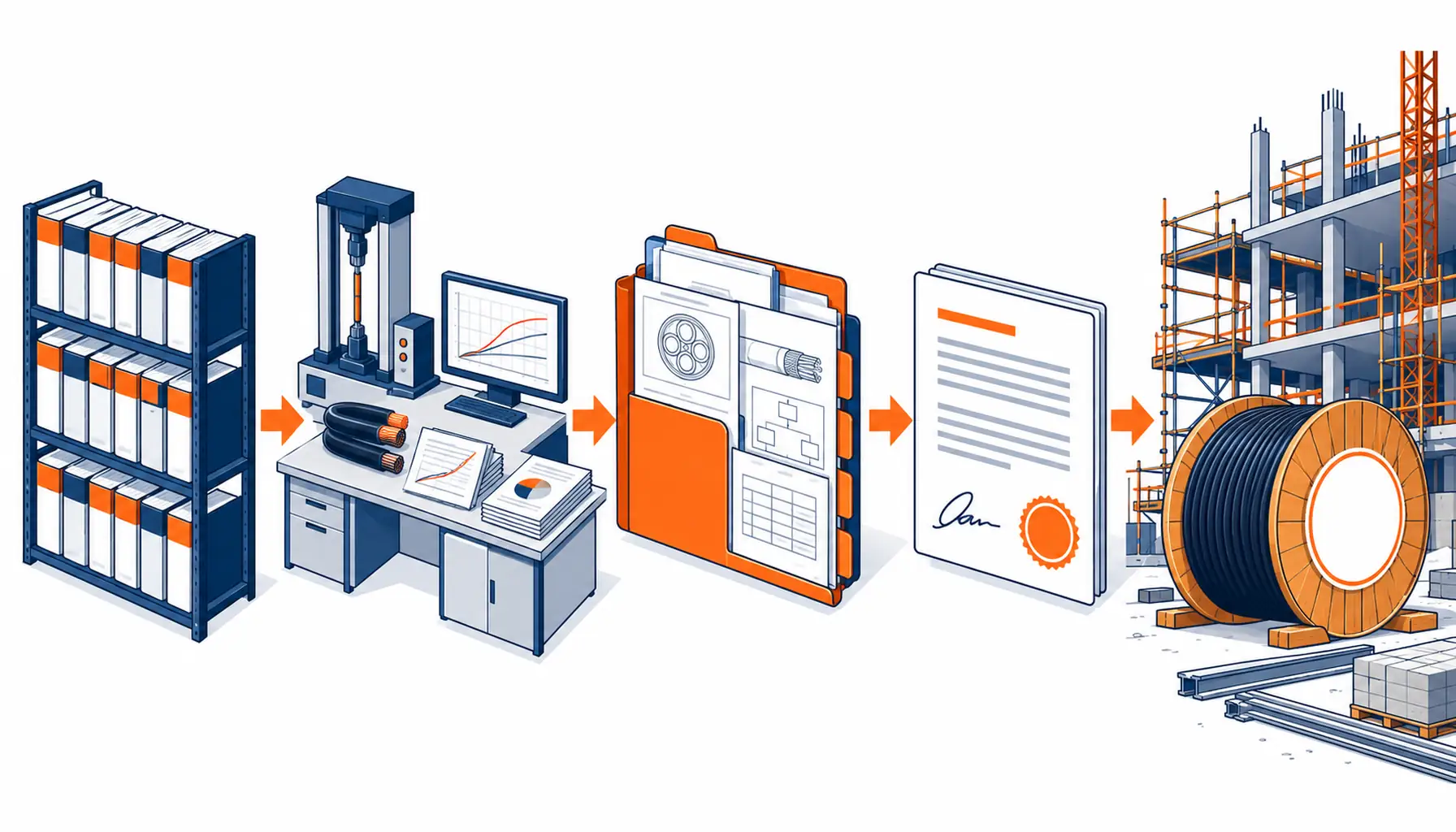
CE marking is not a test, a certificate or an approval. It’s a declaration, and its validity rests on a chain the manufacturer assembles. The chain runs: identify the applicable legislation and harmonized EN standards for the cable category; test the product against them, at accredited laboratories where the stakes or the module require; assemble the technical file, including test reports, drawings, calculations and risk assessment; sign the Declaration of Conformity naming the standards and the signatory; and affix the CE mark to the product and its packaging. The system’s teeth come from what follows: any market surveillance authority, importer or professional buyer can demand the technical file, and a declaration without a file is fraud, not formality. For the buyer importing into the EU, the practical instruction is precise. Don’t ask “is it CE marked”; ask to see the Declaration of Conformity and the test reports behind it, matched to the construction on the drum. The same documents-identity logic that governs batch reports governs declarations, and the sourcing contract should treat the DoC as a delivery item per the terms described in FOB vs CIF for power equipment.
The CPR: Fire Classes for Building Cable
The Construction Products Regulation governs products that become part of buildings, and cable qualified in 2016 as a construction product, which changed European cable specification profoundly. Under the CPR, power and communication cables for fixed installation in buildings carry fire performance classes, from B2ca at the top down through Cca, Dca and below, each combining reaction-to-fire performance with smoke, flaming droplets and acidity subclasses. The class is declared by the manufacturer, backed by testing under the CPR’s harmonized test methods, and the market uses it: consultants specify minimum classes by building type, and cable without a declared class increasingly cannot enter public and commercial projects. The buyer’s duties follow: know the class the project requires, verify the declared class against the CPR test reports, and match the class on the label to the class in the declaration. The chemistry behind the classes, from halogen content and smoke density to the LSZH compounds that earn the better subclasses, is explained in our LSZH vs fire-retardant cable guide. The CPR is where that chemistry becomes a legal letter on a label.
| Chain Link | What It Requires | Buyer Verification |
|---|---|---|
| Standards identified | Harmonized EN standards named for the cable category | DoC lists the exact standards and versions |
| Testing | Product tested against those standards, reports retained | Test reports match the offered construction |
| Technical file | Reports, drawings, assessment assembled and retained 10 years | Supplier confirms the file exists and is producible |
| Declaration of Conformity | Signed DoC naming product, standards, signatory | DoC received per shipment or on file per agreement |
| Marking | CE mark on product/packaging with required label data | Mark present and label identity matches the DoC |
| CPR class (where applicable) | Fire class declared per the CPR for building cables | Class on label matches declared class and project spec |
What Buyers Should Verify — and How
Verification under the self-declaration model is document work, and it runs in the order the chain runs. The DoC first: it names the product, the standards and the signatory, and its signatory should be the manufacturer or the EU-established representative, matching your supply chain. The test reports second: each standard named in the DoC should trace to a report from a competent laboratory, and the report’s construction should match the offered cable. The family-certificate trap is as live in Europe as anywhere. The label third: CE mark, class marks where CPR applies, and the manufacturer’s identity on the drum. The technical file fourth, on demand: a supplier who assembles the first three almost always holds the fourth, and a supplier who hesitates at the file question is advertising where its weakness sits. For projects, these documents double as the submittal package the consultant’s approval cycle needs. Assembling them before the order, per the sourcing discipline in sourcing power equipment for China EPC projects, removes weeks from the approval path.
| Document | What to Check | Red Flag |
|---|---|---|
| Declaration of Conformity | Product identity, standards, signatory matches the supply chain | Unsigned, undated, or "available on request" forever |
| Test reports | Accredited laboratory, construction matches the offer | Family report covering "similar constructions" |
| CPR class declaration (building cable) | Class matches project requirement and label | Class stated verbally, absent from label and DoC |
| Label and marking | CE mark, manufacturer identity, class marks | Mark on drum label only, not traceable to the cable print |
| Technical file | Producible on demand within the retention period | Supplier cannot state what the file contains |
When CE Marking Is Not the Answer
Three boundaries keep the model clear. CE is not a quality certificate: it declares conformity to the named standards’ minimums, not superiority, so a B2ca class label is a floor and the project may demand more. CE is not universal market access either: it covers the EEA and markets that accept the model, while other destinations run their own schemes, per the market access map of this series. And CE is not self-executing. The model’s weakness is exactly its strength’s source, since the declaration is only as honest as the declaring manufacturer. That’s why the verification habits, the audit discipline of supplier vetting and the report-reading culture matter more in Europe’s model than in any pre-approval scheme, not less. Self-declaration only works when someone checks the homework.
RFQ Checklist: CE and CPR Lines for the RFQ
Write the European requirements into the specification:
- Harmonized EN standards for the offered constructions named in the DoC
- Declaration of Conformity provided per shipment or held on file per agreement
- Test reports from accredited laboratories matched to the exact constructions
- CPR fire class declared for building cables, matching the project’s required class
- CE mark and required label data on packaging, traceable to the cable print
- Technical file retained by the manufacturer and producible on demand
- EU-established representative identified where the importer role requires it
- Language versions of the DoC per the destination market’s requirements
Conclusion
Europe’s cable market access is a chain the manufacturer builds and the buyer audits: standards, tests, technical file, declaration and mark, with the CPR’s fire classes layered on top for building cable. No office pre-approves any of it; every professional in the market can demand all of it. The buyer who demands the documents, matched, current and construction-specific, turns self-declaration from a mark on a drum into evidence with teeth.
Kexingyu Cable Group (KXYE) exports to European markets with Declarations of Conformity, accredited test reports and declared CPR classes matched to the constructions that ship. The full chain behind the mark is delivered with the drums.