Conveyor and Crushing Plant Power Cable: What to Specify
Quick Answer: A conveyor line is not one cable run. Power reaches it through a drive station, a take-up, transfer points and often a variable speed drive, spread over hundreds of metres of trestle. Long runs make voltage drop a specification constraint rather than a margin, and a variable speed drive changes which cable belongs on the motor. This guide covers the locations worth specifying separately, the derating and shielding to state, the evidence to demand, and what to freeze before the RFQ goes out.
Introduction
Conveyors and crushing plants look like the simplest electrical load on a mine and behave like the most demanding. The drives are large, they start loaded, they run for years with almost no attention, and they are spread along a structure that nobody wants to re-cable after commissioning.
That combination makes the specification worth getting right the first time. A conveyor cable bought on unit price alone is judged over a decade of service, and the failures that matter, a drive tripping on a long run, noise on a control circuit, a motor cable that cannot carry a variable speed drive’s waveform, appear long after the order is closed.
How a Conveyor Line Uses Power
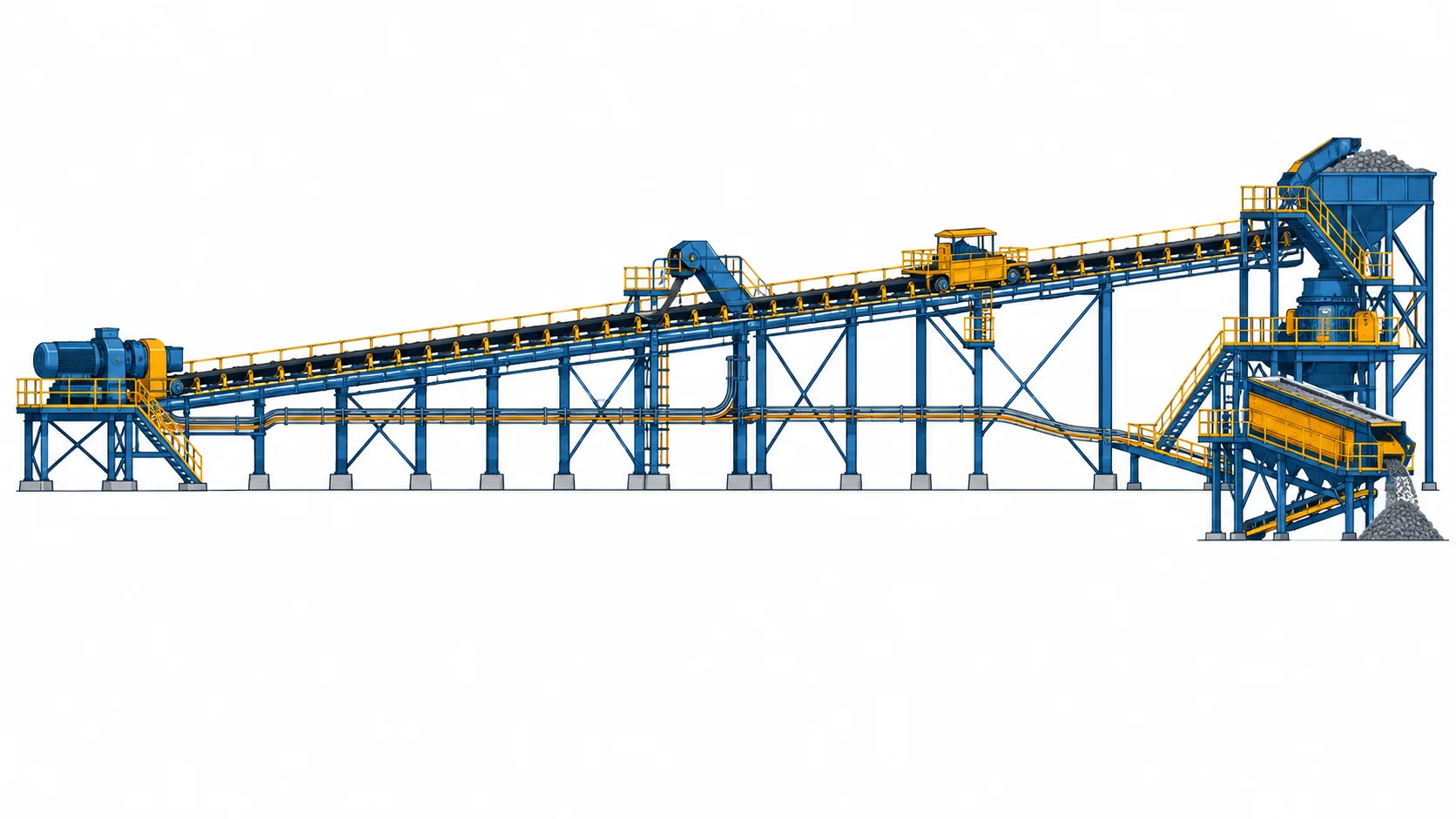
A single flight of conveyor usually has four electrical locations, and they are not the same cable.
The drive station. One or more large motors, often with variable speed control, at the head end. This is where motor cable construction, shielding and terminations matter most, and where the largest current is concentrated.
The take-up and tensioning area. Small motors, brakes and instrumentation, fed from a control and power circuit that shares a route with the main drive cable. Separation here decides whether the control circuit behaves.
Transfer points and trippers. Local motors, position switches and lighting at moving structures, where cable must tolerate some movement and a lot of dust.
The long run between them. Trestle or tray routing over hundreds of metres, exposed to sun, rain and washdown, and to the vibration of the structure it is clamped to.
Treating those four as one cable order is the most common specification mistake on a conveyor project. The right specification is a short schedule, one line per location, with the duty and the environment written against it.
The VFD Question Comes First
Where a conveyor is driven by a variable frequency drive, the cable between the drive and the motor is not a power cable in the ordinary sense. It carries a switched waveform, and that changes what belongs on the motor.
Shielding. A drive output cable should be shielded, with the screen bonded at both ends to the drive and motor enclosures. The screen is there to return common mode current and to keep the switching noise out of neighbouring circuits, and a cable without it makes the drive’s own EMC performance depend on luck.
Insulation stress. Fast switching puts a voltage stress on the insulation that a plain mains cable was not designed for, particularly on long motor leads. State the drive type and the lead length in the RFQ and let the supplier confirm the insulation system, rather than buying a general cable and discovering the problem at commissioning.
Standing wave and length. Beyond a certain lead length, the reflected wave at the motor terminal can exceed the drive’s output voltage. This is a drives problem with a cable solution, and it is cheaper to solve by cable selection or an output filter than by replacing motors.
Where a conveyor has no drive and runs direct on line, most of this does not apply, and the specification returns to a conventional motor feeder. Our note on inverter sizing covers the drive side of the calculation, and the screened control constructions that go with it sit in the shielded control cable range.
Long Runs and Voltage Drop
A conveyor’s electrical problem is distance. The drive station may be a kilometre from the substation, and the load is heavy and intermittent.
Route length. State the route length including vertical rises up the trestle and any slack left for structure movement, not the distance on the plan.
Starting duty. Conveyors start loaded, and a loaded start draws a current a table figure does not describe. Give the continuous and starting current and how often the belt starts per shift, because a conveyor that starts several times an hour puts a duty on the cable that a fan running continuously does not.
Derating. Cable in a tray on a trestle in the sun, cable grouped beside a second run and cable in a washdown area derate differently. Ask for the derated current at the stated conditions rather than the catalogue figure; our note on cable derating factors explains where the tables mislead.
Earth loop and protection. Protection is set against the circuit’s earth loop impedance, which makes the calculation a pre-order task. A long conveyor feeder that cannot clear a fault at the far end is a protection problem that a larger cable can solve and a smaller one cannot hide.
The table below maps the locations of a conveyor or crushing line against what to specify, what to demand as evidence, and how each one fails.
| Location | Duty on Site | What to Specify | Evidence to Demand | Cost and Lead-Time Driver | How It Fails |
|---|---|---|---|---|---|
| Drive station motor cable | Large motor, often on a variable speed drive, started loaded | Shielded construction with both-end bonding, insulation system rated for the drive waveform, lead length stated | Screen coverage, insulation system data, EMC concept drawing | Shielding and drive-rated insulation add cost a general feeder avoids | Conducted noise into neighbouring circuits, insulation failure at the motor terminal |
| Long trestle or tray run | Hundreds of metres in sun, rain and washdown, on a vibrating structure | Route length, derated current, sheath grade for UV and moisture, clamping and expansion allowance | Derated current at stated conditions, sheath weathering and UV data | Copper content dominates; the run length sets the drum planning | Voltage drop at the far end, sheath cracking where it was clamped too tightly |
| Take-up and tensioning area | Small motors, brakes and instrumentation sharing a route | Separation from power runs, screened control construction, earthing arrangement | Screen concept drawing, separation distances as installed | A second smaller drum; screening adds unit cost | Noise on analogue signals, earth loops through screens |
| Transfer points and trippers | Local motors and switches on a moving structure, heavy dust | Flexible construction for relative movement, abrasion-resistant sheath, IP-rated terminations | Flex and abrasion data, gland and termination details | A flexible construction on a short run is a small cost item that prevents a large one | Conductor breakage at the moving joint, ingress into terminations |
| Crushing and screening plant | High starting current, shock loading, dust and frequent stops | Starting duty stated, sheath grade for dust and impact, earthing and protection coordination | Starting cycle data, sheath impact and abrasion results | Heavier sheath and higher current capacity move the price band | Sheath damaged by falling material, terminations loosened by vibration |
Cable Types and Construction
Motor feeder. Where the drive is direct on line, an ordinary power cable with adequate current capacity is usually enough. Where a variable speed drive is involved, the shielded drive-rated construction is the starting point, not an upgrade.
Control and instrumentation. Screened control cable, separated from the power runs along the route, and with a shielding concept that is actually drawn rather than assumed. Screen coverage per pair and the bonding arrangement matter more than the overall figure.
Sheath. A conveyor line lives outdoors and is washed down, so the sheath has to resist UV, moisture and the structure’s movement. Our note on cable sheath materials compared works through where each compound earns its price.
Armour and mechanical protection. Where a cable crosses a roadway or is exposed to falling material, mechanical protection is part of the specification. The trade-off between an armoured and an unarmoured construction is set out in our note on armoured versus unarmoured cable.
What to Freeze Before the Order Goes Out
These five items are cheap at specification stage and expensive once drums are on a truck.
| Decision | What to State | Evidence to Attach | Cost of Leaving It Open |
|---|---|---|---|
| Drive type per motor | Direct on line or variable speed, with the drive make and model | Drive datasheet and the lead length between drive and motor | Motor cable that cannot carry the drive waveform |
| Shielding and bonding | Screen type, coverage and where it is bonded at each end | An EMC concept drawing for the drive circuit | Noise on control circuits that is hard to trace after commissioning |
| Derated current | Route length, installation conditions and the derated current required | The voltage drop and earth loop calculation | A feeder that drops too much voltage or defeats protection |
| Sheath and UV grade | Outdoor exposure, washdown and the sheath grade required | UV and weathering data for the compound | Sheath cracking within a few years of installation |
| Lengths and joints | Drum lengths against the trestle sections and any planned joints | A packing list checked against the cable schedule | Joints in positions that are hard to reach from the ground |
Starting Duty and Stop-Start Cycle
A conveyor’s cable duty is set by how the belt starts, not by how long it runs, and this is where a specification written from the nameplate goes wrong.
A belt that starts loaded several times a shift imposes a thermal and mechanical cycle that a continuous rating does not capture. State the starting current, the duration of the start and the number of starts per shift, and require the cable to be rated against that cycle. On a long flight, the far-end voltage during a loaded start is the number that decides whether the drive holds, and it is calculated rather than estimated.
The same applies to the crushing plant, where shock loading and frequent stops combine. Where a crusher and a conveyor share a substation, the protection coordination is a system question, and the cable’s earth loop impedance is part of its answer.
Incoming Inspection: What to Witness
Against the drum, before anything is cut. Count drums against the packing list, verify the marked lengths and photograph the markings, including the construction code and drum number.
Electrical checks. Conductor resistance and continuity, insulation resistance, and screen continuity and coverage on the finished length, which matters most on the drive cable. A screen that is continuous at one end and floating at the other defeats the EMC design it was bought for.
Dimensional checks. Overall diameter, sheath thickness and actual conductor cross-section on a cut sample, checked against the derated current the cable was specified for.
When a Conveyor Cable Specification Is Not the Answer
When the failure is mechanical, not electrical. Damage concentrated at a clamp, a transfer point or a structure joint is a routing problem. Our note on cable damage wear patterns is written to separate a mechanical fault from a cable fault before a heavier drum is bought.
When the run has outgrown the cable economically. Past a certain distance, the copper needed to hold voltage drop costs more than moving the source closer. A conveyor fed from a distant substation is often better served by a closer feed point than by a larger cable.
When the drive is the problem. A motor tripping on overvoltage at the terminals is telling you about the reflected wave on a long lead, not about cable quality. Replacing the cable without changing the drive setup, the lead length or the filtering repeats the trip.
When one cable is expected to do power and control. Sharing a route does not mean sharing a construction. Buying one cable for both is how a control circuit acquires noise it never had on the bench, and the fix afterwards is more expensive than the separation would have been.
When price is the only variable asked about. A conveyor cable bought on unit price alone is judged in service over a decade, and the cost of a stop is measured in tonnes not carried, which no quotation shows.
RFQ Checklist
- Location schedule: drive station, take-up, transfer points and long run listed separately
- Drive type per motor, with the drive make and model and the lead length
- Shielding requirement and where the screen is bonded at each end
- Route length including vertical rises and structure slack
- Continuous and starting current, start duration and starts per shift
- Ambient and installation conditions, with the derated current required
- System voltage, insulation level and prospective fault current
- Sheath grade for UV, moisture, dust and washdown, per location
- Mechanical protection required where the route crosses or is exposed
- Control and instrumentation cable, with its separation from power runs
- Drum lengths against trestle sections, plus any planned joint positions
- Tests to be witnessed, records per drum, and the copper basis with its validity window
Conclusion
A conveyor line is a schedule of locations, not a single cable order, and the specification is only as good as the duty written against each one. Separate the drive cable from the long run, treat the variable speed drive as a cable decision rather than a drives detail, and calculate the voltage drop before the drums are ordered rather than after they are installed.
Kexingyu Cable Group (KXYE) has supplied electrical cable from Quanzhou since 1996, including the screened motor, control and power constructions that conveyor and crushing duty calls for, along with the glands, terminations and accessories that go with them. Send us the location schedule with the drive details, the route lengths, the starting duty and the site conditions, and we will come back with the constructions, the test evidence that applies to each, and a delivery plan against your shutdown window. The fastest route is a request for quotation.