Buying Cable Spares for Data Centers: What to Stock, Where to Keep It and How to Set the Levels
Quick Answer: Cable spares are bought to remove a lead time from a failure, so the list should be built backwards from the failures that hurt. Start with the circuits whose loss would take a row or a tenant down, work out what that circuit needs to be repaired, and stock the item with the longest lead time first. For most halls that is termination kits, glands, joints and short pre-cut lengths of the installed cable types, not drums. Cable that is stored badly is not a spare; it is an asset with a shelf life that nobody is tracking.
A spare exists to convert a multi-week procurement into a same-day repair. Whether it does that depends less on how much is on the shelf than on whether the right items are on it.
Introduction
Most data centers have some spares and few can say why those particular items are there. The usual pattern is a mixture of leftover material from the original build and purchases made after a previous incident, which means the stock reflects what happened rather than what could happen. The result is a store room full of the wrong cable sizes and empty of the termination kits that every repair needs.
Our note on the spare cable programme for integrators covers the machine builder’s version of this problem, where spares ship with a finished line. A data center’s version is different, because the facility is running and the repair has to happen now. The lead times involved are set out in our note on cable minimum order quantities and lead times.
What Actually Fails, and What the Repair Needs
Repairs in a data hall concentrate in a few places, and each one consumes a predictable set of items.
Terminations and joints. The most common failure, and the one most dependent on small items: lugs, ferrules, heat shrink, termination kits matched to the cable type and the cable size, and the torque tooling to install them correctly. These items are cheap and long lead only when they are non-standard.
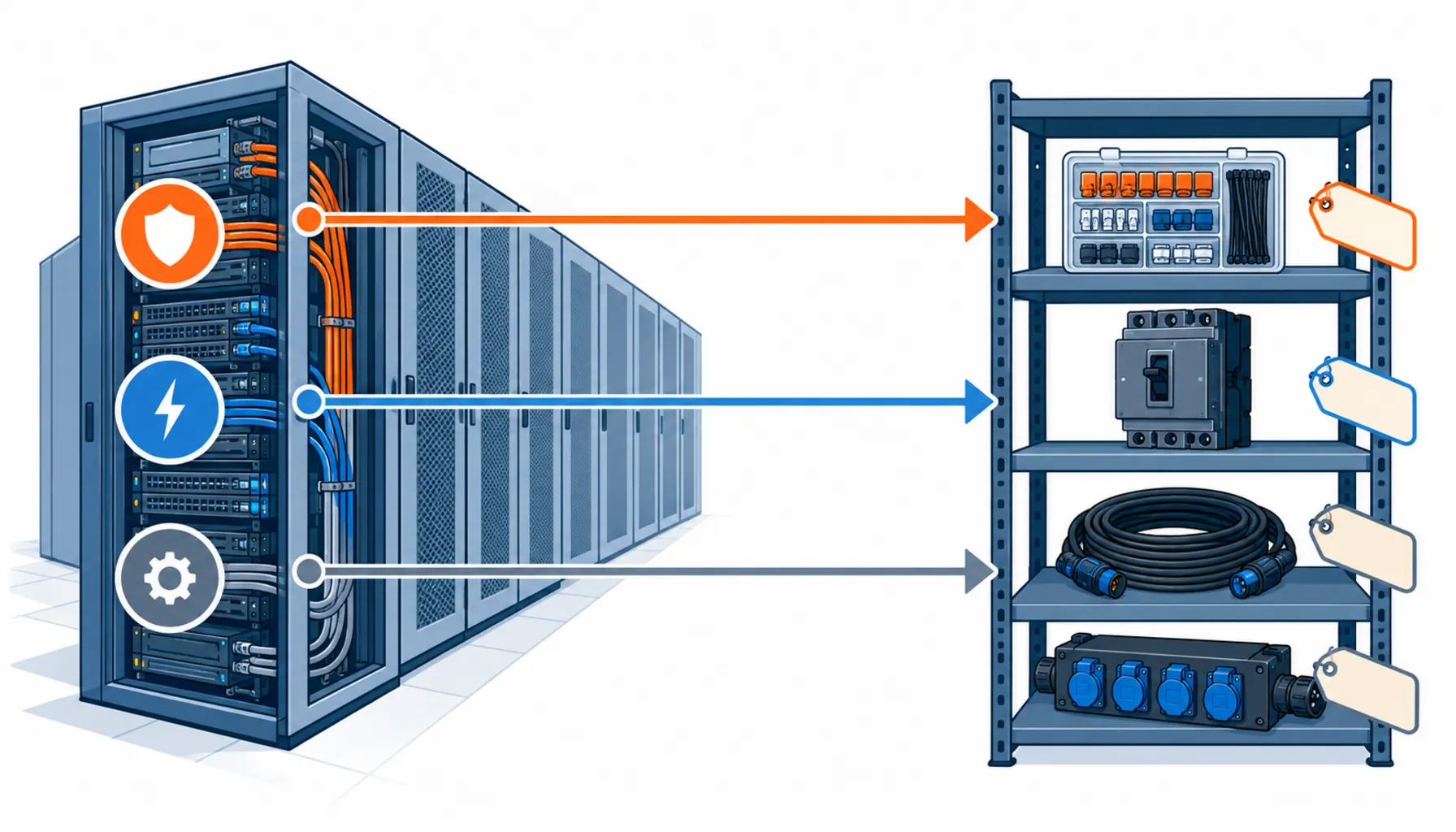
Connections at tap-offs and boards. A damaged tap-off or a failed breaker is replaced rather than repaired, so the spare is a complete unit rather than a part. This is the spare with the longest lead time and the clearest case for holding stock.
Damaged cable runs. Physical damage, water ingress or a failed section of a riser. The repair usually needs a short length of the same cable construction, plus two joints or terminations. Full drums are rarely needed; a 50 to 100 metre coil of each type on the riser and submain side covers most repairs.
Control and monitoring cabling. Low value, easily overlooked and difficult to source quickly in the correct construction. Control cable is where a small stock delivers a disproportionate benefit, because the alternative is an unmetered circuit or a defeated interlock.
The Decision Table: Spares Strategies Compared
The table compares the ways a facility can hold spares, priced against the delay each one removes.
| Strategy | What to Specify | Evidence You Should Receive | Cost and Storage Shape | Failure Mode If Chosen Wrong |
|---|---|---|---|---|
| No stock, rely on supplier | Agreed response and delivery times per cable type, kept current as ranges change | A written lead time list confirmed at each annual review | No storage cost; the delay is whatever the supplier quotes on the day | A repair measured in weeks, and an argument about who approved the expedited freight |
| Critical item only | The items consumed by a repair on the top criticality circuits: termination kits, lugs, glands, joints, tap-off units | An item list mapped to the circuits it repairs, with quantities and expiry where relevant | Low capital, small footprint, easy to store properly | A kit that fits the wrong cable size, or a tap-off that does not match the installed range |
| Short cable coils per type | The installed constructions and sizes, with the minimum repair length and the joint allowance | A spares schedule referencing the cable schedule, with drum or coil lengths stated | Moderate capital; needs dry storage and rotation | Coils of a construction that was superseded, unusable because the terminations no longer match |
| Pre-terminated assemblies | Pre-made lengths with terminations fitted and tested, for the circuits where speed matters most | Factory test records per assembly and a storage method that protects the terminations | Highest cost per item; the fastest repair, measured in hours | Assemblies whose termination type no longer matches the board they were made for |
| Consignment or supplier-held stock | The stock held at the supplier, the release process, the replenishment rule and the pricing basis | A consignment agreement listing items, quantities and the release procedure | Low capital, requires a supplier close enough to deliver quickly | Stock on paper that has been sold to someone else, discovered during a failure |
Setting Levels From Criticality, Not Instinct
Spare levels are usually set by judgement. They can also be set by arithmetic, and the arithmetic takes an afternoon.
Rank the circuits. Grade each circuit by what its loss would do: a single rack, a row, a hall or the site. The top grade gets spares that remove the longest delay; the lowest grade gets none.
List what the repair consumes. For each failure mode on that circuit, list every item needed to complete the repair, including the small ones. A termination kit without the correct lugs is not a repair kit.
Multiply by lead time. The stock list is built from items whose lead time exceeds the tolerable repair time for that grade. An item with a two day lead time on a circuit that can be down for a week does not need stocking.
Add the matched items. Every cable spare needs the termination and gland that fits it. Stocking cable without the matching accessory is a common and expensive mistake, because the cable arrives with the wrong termination and the repair stalls anyway.
What to Freeze Before Ordering Spares
| Item | What to State | Evidence to Attach | Cost of Leaving It Open |
|---|---|---|---|
| Criticality grading | Which circuits are graded, how many grades, and what each grade is entitled to | A graded circuit list agreed with operations | A store room of leftover material and no repair kit for the circuits that matter |
| Item list per failure mode | Every item a repair consumes, including consumables and accessories | A mapping table from failure mode to item list | Repairs that stop halfway for a lug or a gland that nobody stocked |
| Cable constructions | The installed types and sizes, by reference to the as-built cable schedule | A spares schedule that mirrors the cable schedule | Spares that do not match the cable actually installed |
| Quantities and lengths | Coil or drum lengths, plus the joint and termination allowance per repair | Stated lengths per type, with the allowance explained | Coils too short to reach, and a second order placed during the incident |
| Storage conditions | Dry, ventilated storage, racked off the floor, ends sealed, and cable not left in sunlight | A storage location identified and photographed as part of acceptance | Moisture ingress and UV damage, turning the spare into a future fault |
| Rotation and review | Review interval, who owns it, and the rule for items approaching shelf life | A review schedule with a named owner | Spares that have silently aged out, discovered when they are needed |
| Issue and replenishment | How an item is drawn from stock, how it is recorded, and how it is replaced | A simple issue log and a replenishment trigger | A stock level that erodes quietly until nothing is left |
| Documentation | Stock list, item references, supplier contacts and lead times, held where the maintenance team can reach it out of hours | An editable stock register with supplier references | A spare on the shelf that nobody can identify or match to a circuit |
Storage: Where Most Spare Programmes Fail
Cable is not a component and does not store like one. Two properties decide whether a spare is still usable when it is needed.
Moisture. Many cable constructions absorb moisture through an unsealed end, and the effect on insulation resistance appears the moment the cable is energised. Sealed ends and dry storage are the whole requirement, and both are cheap.
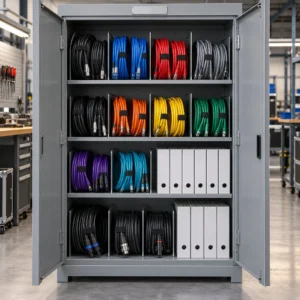
Mechanical condition. Coils stored on the floor deform, and cable stored where it can be walked on or moved by other trades acquires damage that is invisible until the repair is complete. Rack it, keep it off the floor, and keep it out of the way of everyone else’s work.
When Holding Cable Spares Is Not the Answer
Where the construction is obsolete. Spares of a cable type that is no longer installed anywhere in the hall repair nothing. The useful spare for an obsolete run is the termination that fits it, not more cable.
Where a supplier can genuinely deliver in hours. A consignment agreement with a local distributor can remove the lead time without the storage and capital. Compare the two on the delay each actually removes, not on the list price.
Where the real problem is planning. Cable failures that are foreseeable, because a circuit has been trending downward for a year, are better addressed with planned replacement than with stock. Stock shortens a repair; planning prevents the need for one. Our note on planned cable replacement covers how to schedule that work.
Where the stock would be small and mixed. A handful of coils in a dozen sizes is a stock that is hard to control and easy to erode. Fewer types held in useful quantities is more effective than complete coverage held thinly.
RFQ Checklist
- Graded circuit list with the stock entitlement for each grade stated
- Failure mode to item list mapping, including consumables and accessories
- Spares schedule mirroring the as-built cable schedule, by type and size
- Coil or drum lengths stated with the joint and termination allowance per repair
- Matching termination kits, glands and lugs included for every stocked cable type
- Tap-off units and breakers for the installed ranges quoted with their own lead times
- Control and monitoring cable specified in the installed construction, not a substitute
- Storage requirements stated, including sealed ends, racked storage and dry conditions
- Delivery in sealed packaging with test records per batch, where the construction requires it
- Review interval and named owner for the spares register agreed
- Issue and replenishment process defined, with a trigger level per item
- Supplier lead times confirmed in writing and reviewed annually against the installed ranges
Conclusion
A spare is only worth holding if it removes a delay that would otherwise be unacceptable. That test is easy to apply and rarely applied, which is why so many halls hold the wrong items. Build the list from the circuits that matter, match every cable spare with its terminations, store it so it is still usable, and review it once a year against the as-built schedule.
Kexingyu Cable Group (KXYE) supplies the cable and accessories that a spares programme is built from, including the WDZ-YJY, WDZN-YJY, BTTZ, NG-A (BTLY), KVV and YJV ranges, the data center cable range used on submain and riser routes, and the multi-purpose distribution cable used on distribution circuits, from one factory group with copper price linkage on project-scale orders. Spares can be ordered with the original contract against the same construction and size, so the stock matches what is installed rather than what is available later. Send your graded circuit list and the failure modes you are covering, and we will return a spares schedule with matching accessories; the fastest route is a request for quotation.