Buying Planned Cable Replacement in Data Centers: Scheduling the Work Around Uptime Tiers
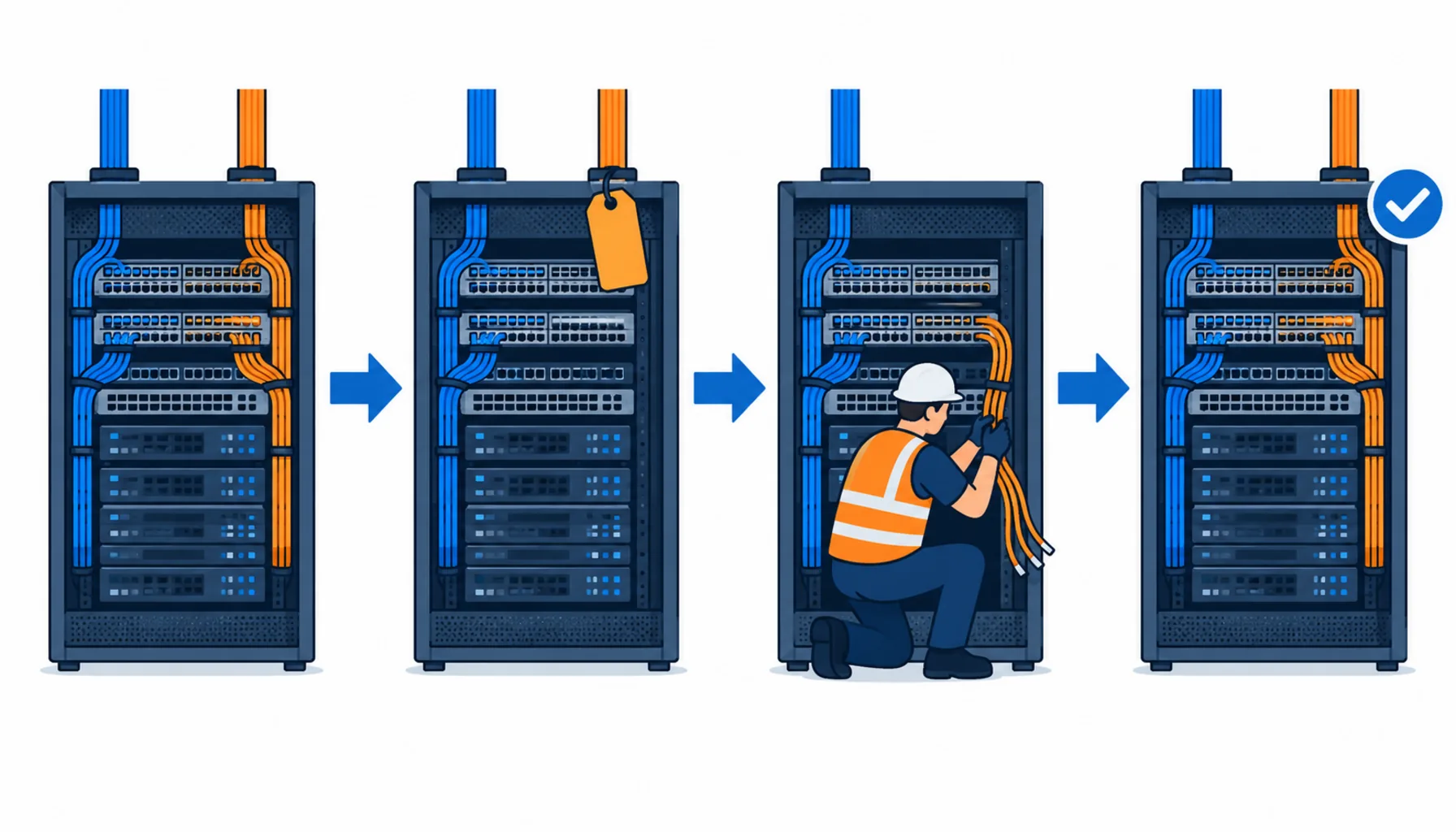
Quick Answer: A cable replacement project is bought as a sequence, not as a quantity. The sequence is set by redundancy: where a circuit has a live second path, the work is a normal operation; where it does not, the work is a shutdown and belongs in a window agreed with the tenant. Buy the replacement in an order that always works on the circuit you can afford to lose, and the tier rating survives the project. Buy it in the order that is convenient for the contractor, and the project becomes the event the tier was designed to prevent.
Replacing cable is unusual among maintenance activities because the asset being replaced is usually also the only path to the load. Whether the work is routine or critical depends almost entirely on what redundant path exists at the time.
Introduction
Planned replacement is the point at which the diagnostics done earlier turn into work. The technical scope is rarely difficult: the cable is known, the route is known, and the terminations are known. The difficulty is scheduling, because every circuit being replaced is a circuit carrying load, and in a tiered facility the rules about what may be taken out of service are not negotiable.
Our note on cable aging diagnostics covers how a circuit ends up on the replacement list, and our note on redundant power feeds covers the architecture that decides how the work can be sequenced. This note is about the purchase and the sequence.
What a Tier Rating Actually Constrains
Tier ratings are often discussed as a statement about equipment. For replacement planning they are better read as a statement about concurrent maintenance, and three consequences follow.
Concurrent maintainability. The defining requirement is that any element can be removed from service without affecting the load. Where that holds, replacement is routine. Where the second path is degraded because it was never fully commissioned, or because a component was removed years ago and never replaced, the facility does not have the redundancy the drawing claims.
Single points disguised as redundant pairs. Two cables from one board are one path if the board is common. Replacement planning has to trace the path upstream of the pair, and it is common to find that a “redundant” feed shares a busbar, a tap-off or a route with its partner.
Route dependency. Two independent feeders in one tray, or in one riser shaft, are not independent against fire, mechanical damage or a single piece of work. This matters for sequencing because it limits how much can be worked on at once.
The Decision Table: Replacement Approaches Compared
The table compares the sequences available in a tiered hall, priced against the redundancy each one requires.
| Sequence | What to Specify | Evidence You Should Receive | Cost and Window Shape | Failure Mode If Chosen Wrong |
|---|---|---|---|---|
| Like-for-like in a window | The circuits included, the window length, the isolation points and the reconnect procedure | Method statement, isolation schedule, and a tested reconnect record | Lowest cable cost; the operational cost is the window itself | A window that overruns, leaving circuits isolated with no agreed extension |
| Rolling replacement row by row | The row sequence, which feed works while the other carries load, and the load cap during each phase | Phase plan showing the redundant feed available at each step, with load limits | Longer programme, no single window; needs steady supervision | Two phases overlapping until both feeds on a row are degraded at once |
| New parallel route then transfer | The new route, its support and fire stopping, the transfer points, and the changeover method | Route drawing, penetration register entry, and a transfer procedure with rollback | Highest capital; the safest and the least dependent on tenant tolerance | A parallel route installed in the same tray as the original, so neither is independent |
| Bypass and replace live | The bypass path and rating, the interlocking, and the permit under which the work proceeds | Bypass test record, permit, and a witnessing regime for the live steps | No window needed; requires bypass hardware and a live working regime | Work done live in a hall with no bypass, converting maintenance into an incident |
| Replace alongside other shutdown work | The replacement scope, combined with the other activities sharing the window | A single method statement covering all activities, with a combined duration | Cheapest per circuit, because the window cost is shared across the works | A combined programme with no critical path, where one activity delays all of them |
Building the Sequence From Redundancy
A replacement programme is written as a sequence of states, and each state has to be one the facility is allowed to be in.
Map the paths, not the circuits. Trace each circuit from origin to load and identify what else shares each element. The unit of planning is the dependent group, not the individual cable.
Set the load cap per phase. Where one of two feeds is out of service, the surviving feed carries the full load. Cap the row at a level the surviving path can carry on its own, derated for the conditions it will see while the work is in progress.
Sequence so that only one feed of a dependent group is out at a time. This is the rule that makes a rolling programme safe, and it is also the rule that most often fails on site when a contractor works ahead to recover a schedule.
Define the hold point. Before each phase closes, the state of the facility is confirmed against the plan. Where a phase cannot be closed, the plan holds the facility in a known condition rather than moving on. Write the hold point into the contract, not only into the method statement.
What to Freeze Before the Replacement Order
| Item | What to State | Evidence to Attach | Cost of Leaving It Open |
|---|---|---|---|
| Dependent group map | Which circuits share an origin, a tap-off or a route, and therefore cannot be worked together | A dependency diagram issued with the tender | Two circuits of the same group out at once, and a row without a live feed |
| Phase sequence | The order of work, the state of the facility at each phase, and the hold points | A phase plan with states, not just a list of cables | A programme that becomes a single long outage when the sequence is compressed |
| Load caps | The maximum load permitted on the surviving path during each phase, and who enforces it | A derated capacity figure per phase with the calculation | A surviving feed overloaded while its partner is out of service |
| Window definition | The window length, the notice period, the tenant agreement and the overrun procedure | An approved window agreement with an overrun decision path | A window that ends with the facility in an unplanned state |
| Replacement specification | The construction and size required, including any upgrade agreed at the same time, and the termination types | A replacement schedule mapped to the as-built cable schedule | Cable that fits the route but not the termination, discovered on site |
| Route and fire stopping | Route changes, support, and the firestop scope for every penetration disturbed | Route drawing and the penetration register marked up | Penetrations left unsealed after the work, and a compliance finding later |
| Testing and acceptance | Insulation and continuity criteria, load test level, and the record format | A test plan with numeric criteria | A replaced cable energised on a visual check |
| Removed material | Whether removed cable is recovered by the contractor or retained, and the scrap value treatment | A clause covering ownership and disposal | Copper removed from site with no credit, or left in a store room indefinitely |
What the Replacement Actually Buys
Replacement is an opportunity to correct things that are expensive to change at any other time, and those corrections should be bought deliberately rather than discovered.
Capacity. Replacing a cable that has reached its thermal limit with a larger conductor on the same route adds usable capacity without new containment. Whether it is worth doing depends on the route’s ability to accept the larger cable and on how the terminations change, and the trade-offs are covered in our note on cabling a 1 MW rack.
Observability. A cable being replaced can be replaced with a construction that is easier to monitor, or with a route that has a spare way left in it for later. Neither is possible once the work is done.
Documentation. Every replaced circuit is a chance to correct the as-built schedule. Include the record update as a deliverable, because the next replacement programme will be planned from those records.
When Planned Replacement Is Not the Answer
Where the driver is a single incident, not a condition. A damaged cable from a one-off event is repaired. A replacement programme needs a condition that affects a population, such as a construction used across a hall that has proved unsuitable.
Where the redundancy does not exist. A rolling programme requires two paths. Where only one exists, the honest options are a window, a parallel route or a bypass, and a programme written as if redundancy existed will fail at the first phase.
Where the records are wrong. A programme planned from drawings that do not match the installation will sequence against a facility that does not exist. Survey and correct the records first, then plan. The maintenance planning context for the windows is covered in our note on maintenance windows in 24/7 facilities.
Where the load is being decommissioned anyway. Replacing cable on a row that will be dismantled within the planning horizon is work with no return.
RFQ Checklist
- Dependency map showing which circuits cannot be worked simultaneously
- Phase plan stated as facility states with hold points, not as a cable list
- Load cap per phase, with the derated capacity of the surviving path stated
- Window definition, notice period and an overrun decision path agreed with the tenant
- Replacement schedule mapped to the as-built cable schedule, including termination types
- Any capacity upgrade decided at tender stage rather than during the work
- Route changes, support and the firestop scope for every disturbed penetration included
- Insulation, continuity and load test criteria stated numerically
- Record updates as deliverables: single line diagram, cable schedule and penetration register
- Removed cable ownership, recovery and disposal terms stated in the contract
- Witness points and independent verification where the work interacts with live circuits
- Hold point sign off required before each phase proceeds to the next
Conclusion
Replacement work is judged by what the facility looked like during it, not only by what it looks like after. Sequencing it from redundancy keeps every phase inside a state the design allows, and it costs nothing except the discipline of planning before the drums arrive. The added value of buying capacity, observability and clean records at the same time is usually larger than the difference between contractors’ unit rates.
Kexingyu Cable Group (KXYE) supplies the cable a replacement programme is built from, including the WDZ-YJY, WDZN-YJY, BTTZ, NG-A (BTLY), KVV and YJV ranges, the data center cable range used on submain and riser routes, and the multi-purpose distribution cable used on distribution circuits, from one factory group with copper price linkage on project-scale orders. Replacement programmes can be quoted against the original construction and size, so the new cable matches the terminations and glands already installed. Send your dependency map and phase plan, and we will return a replacement schedule with matching accessories and lead times; the fastest route is a request for quotation.