Buying Cable Aging Diagnostics for Data Centers: Tests, Triggers and What the Results Change
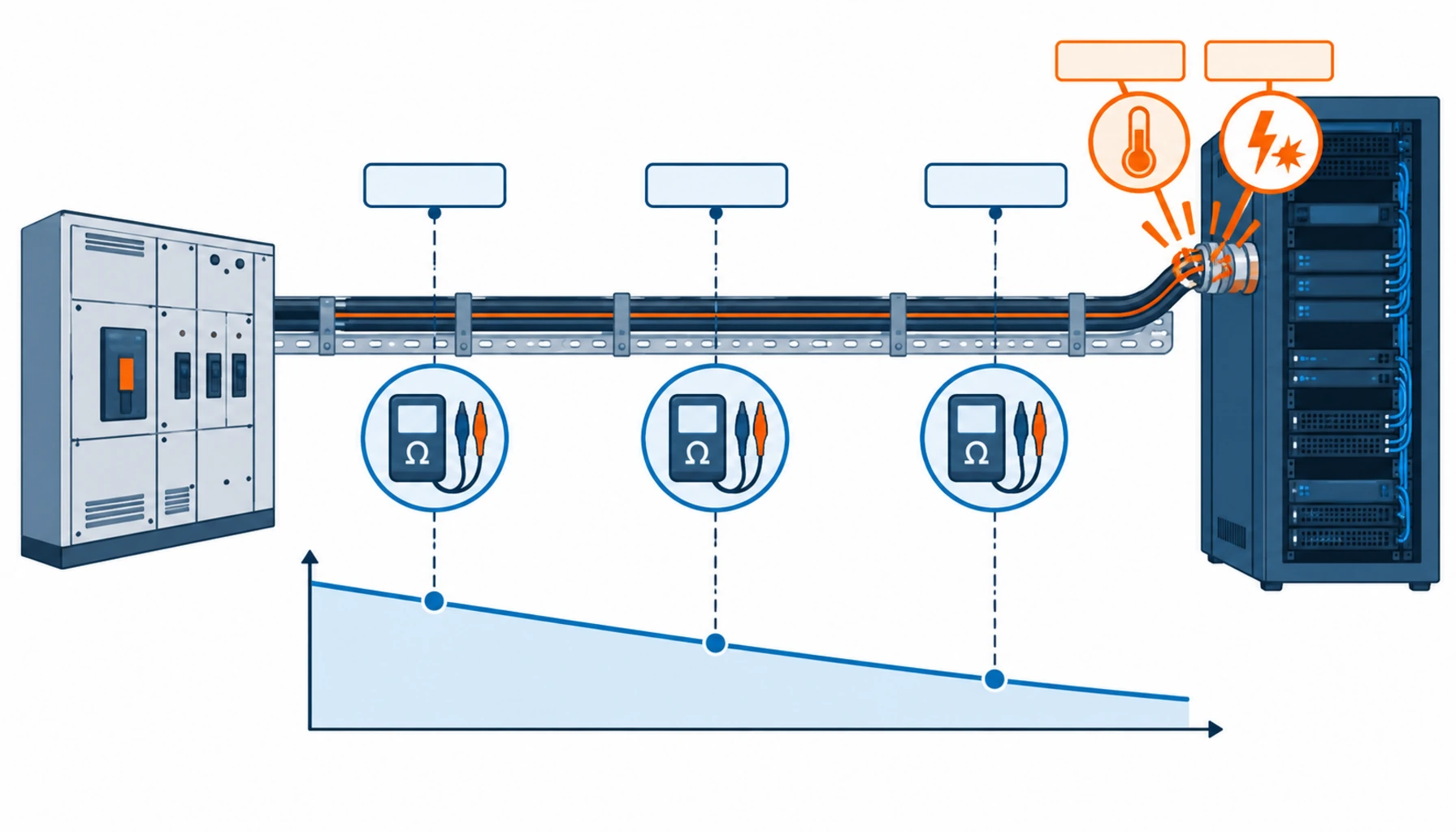
Quick Answer: A diagnostic test is worth its cost only when the result changes a decision, which means the trigger has to be agreed before the test rather than after the report arrives. Buy insulation resistance trends, a partial discharge survey on the terminations, and a loaded infrared scan, each with a stated pass criterion and a stated action for a marginal result. Buy them on a schedule that produces a trend rather than a snapshot, because a single reading below a threshold proves very little and a consistent fall across three surveys proves a great deal.
Aging is a slow process until it is not. Diagnostics exist to find the state change while the cable is still in service, at a point where the work can be planned rather than reacted to.
Introduction
Cable failure in a data hall usually arrives as an event: a termination flashes over, an insulation fault trips a feeder, a joint runs hot enough to discolour the lug. In almost every case the condition existed for weeks or months beforehand, and the information needed to see it was available from a test nobody commissioned.
Our note on the cable lifecycle in data centers covers how replacement is planned, and our note on planned cable replacement covers how the work is scheduled around uptime tiers. This note covers the step in between: the diagnostics that decide whether that plan needs to move forward.
What Aging Actually Looks Like
The mechanisms that matter in a data hall are few, and each is visible to a specific test.
Thermal degradation of insulation. Sustained operation above the rated conductor temperature accelerates the loss of dielectric and mechanical strength. The symptoms are a fall in insulation resistance and a rise in dielectric loss, and the usual cause is a circuit that has run near its limit for years.
Termination and joint degradation. Most faults sit at the ends of a cable rather than along it. Loose or corroded connections raise resistance, which raises local temperature, which accelerates oxidation. This is what a loaded infrared scan finds, and what a partial discharge survey finds slightly earlier.
Mechanical damage and moisture ingress. Pulling damage, tight bend radii and water entering through an unsealed penetration do not announce themselves. They appear as an insulation reading drifting down over successive surveys, or as a discharge signature at one location.
Harmonic and neutral loading. Non-linear load raises neutral current and third harmonic heating, ageing the neutral faster than the phase currents suggest. Circuits feeding modern IT load are where this matters most. The wider survey is in our note on common causes of cable failure.
The Decision Table: Diagnostic Methods Compared
The table compares the tests a specialist will propose, priced against what each one can change.
| Diagnostic | What to Specify | Evidence You Should Receive | Cost and When It Runs | Failure Mode If Chosen Wrong |
|---|---|---|---|---|
| Insulation resistance trend | Test voltage, duration, instrument class, ambient and humidity recorded, and the same method every survey | Per circuit readings with conditions, plus a trend table against previous surveys | Low cost per circuit; runs on an isolated circuit or in a window | Readings taken under different conditions each time, producing noise instead of a trend |
| Dielectric loss and polarisation index | Test method, temperature correction, and acceptance values for each cable type in the schedule | Values per circuit with temperature correction shown and a pass or investigate verdict | Moderate cost; needs the circuit isolated, so it fits planned windows | Values read without temperature correction, flagging healthy circuits and clearing aged ones |
| Partial discharge survey | Detection method, whether the circuit has to be energised or isolated, sensitivity, and location reporting | A discharge map with locations identified, magnitudes, and repeat measurements at the same points | Highest specialist cost; some methods run with the circuit live, which protects uptime | A survey that reports a global condition without locating the defect, leaving nothing to act on |
| Loaded infrared scan | Load at the time of scan as a percentage of rating, emissivity settings, and the reporting threshold for each connection type | Thermal images paired with visible images, temperature rise per connection, and a ranked exception list | Moderate cost, no outage; the constraint is having enough load during the scan | A scan at low load that shows nothing, repeated each year and never finding the fault |
| Sheath, gland and route inspection | Inspection points, penetration register status, and photographic record format | Photographic record per point with dates, and a defect list against the penetration register | Low cost, no outage; labour scales with route length | Damage found after the ceiling closes, when remediation costs a removal rather than a repair |
Triggers: Deciding Before the Report Arrives
A diagnostic programme without agreed triggers produces reports that are read once and filed. Four triggers cover most of what a data hall needs, and each one should be written into the scope before the first survey.
Absolute limits. A minimum insulation resistance or a maximum temperature rise that requires investigation regardless of history. Simple, and reliable for identifying connections that are already poor.
Rate of change. A fall of a stated proportion between successive surveys is more meaningful than a single value, because it identifies a cable that is changing rather than one that has always run at that level. Set the interval so that three surveys fit inside the planning horizon for replacement.
Load relative triggers. A circuit found at 85% of its derated rating during a thermal scan is a capacity trigger rather than a health trigger, and it belongs in the same report. The derating basis for that figure is covered in our note on cable derating factors.
Locational triggers. Any discharge, hotspot or defect at a termination or joint is treated as more urgent than the same reading on a straight run, because that is where failure concentrates and where repair is most contained.
Each trigger needs a named action and an owner. The usual set is: no action and continue monitoring, plan replacement within the next window, restrict the circuit’s load, or replace now. Publish the mapping and the report becomes a decision document rather than a technical annex.
What to Freeze Before Commissioning a Diagnostic Programme
| Item | What to State | Evidence to Attach | Cost of Leaving It Open |
|---|---|---|---|
| Circuit list and priority | Which circuits are surveyed, ranked by criticality and by whether a fault would be contained | A register excerpt with circuit identifiers matching the as-built schedule | Surveys that cover the accessible circuits and miss the ones that matter |
| Method and instrument | The test method, instrument class and settings, held constant across surveys | Instrument calibration certificates and the recorded settings | Serial results that cannot be compared, and a trend that is an artefact |
| Conditions recorded | Ambient temperature, humidity, load and time of day recorded with every reading | A record format agreed before the first survey | Readings that differ by conditions rather than by cable condition |
| Pass and investigate criteria | The values that require action, expressed per cable type and per criticality | Criteria tabulated and issued with the tender, not proposed by the bidder | A report that states results without a verdict, and an argument about what they mean |
| Trigger to action mapping | Which result leads to monitor, plan, derate or replace, and who decides | A signed mapping table with owners | Findings discovered, agreed and then left until the next failure |
| Survey interval | The interval, and the requirement that the same points are measured each time | A survey plan for the next three cycles | A single snapshot that proves little and supports no decision |
| Report content | Per circuit results, trend against history, locations identified, photographs and a ranked exception list | A sample report from a comparable project | A report that lists readings and locates nothing |
| Access and outage requirement | Which surveys need isolation, which run live, and how access is coordinated with operations | An access plan agreed with the operations team | Surveys cancelled twice and then abandoned, with the budget already spent |
When Diagnostics Are Not the Answer
Where there is no replacement plan. Diagnostics identify cables that need work. Where no plan exists to do the work, the findings accumulate and become a record of known defects. Build the plan first, then buy the diagnostics to schedule it.
Where the cable is being replaced anyway. Testing a circuit that is due for replacement in the next window spends money on information that will not change the decision.
Where a single snapshot is being bought. One survey of an unknown installation has some value, but far less than a trend. Where only one survey is affordable, spend it on the terminations and joints, where failure concentrates, rather than across the whole estate.
Where the driver is a recent fault and the cause is known. If a termination failed because it was not tightened to the specified torque, the correct response is a torque check across the rest of the installation and a supervision change. A general diagnostic survey finds less than the targeted check at a higher price.
RFQ Checklist
- Circuit list with identifiers matching the as-built schedule and priority ranking
- Test methods named, with instrument class and settings to be held constant
- Ambient, humidity and load recorded with every reading, in an agreed format
- Pass and investigate criteria issued with the tender, per cable type and criticality
- Partial discharge survey required to locate defects, not only to report a global condition
- Infrared scans required at a stated minimum load, with emissivity and thresholds documented
- Trend table across surveys required as part of the standard report
- Trigger to action mapping signed off before the first survey
- Survey interval and the requirement to repeat the same measurement points stated
- Access and isolation requirements agreed with operations in writing
- Report content defined, including photographs, locations and a ranked exception list
- Calibration certificates for all instruments supplied with the report
Conclusion
Diagnostics are a way of buying time, and time is what a data hall cannot manufacture. The purchase only works when the report ends in a decision, which means the criteria and the actions have to be settled before the survey rather than after it. Buy three tests well, run them on a schedule, and keep the method identical, and the trend that develops becomes more useful every year it runs.
Kexingyu Cable Group (KXYE) supplies the cable that these surveys examine and the records that make the results interpretable, including the WDZ-YJY, WDZN-YJY, BTTZ, NG-A (BTLY) and YJV ranges, the data center cable range used on submain and riser routes, and the multi-purpose distribution cable used on distribution circuits, all from one factory group with copper price linkage available on project-scale orders. Factory routine test records ship with every order, which gives a diagnostic survey a baseline recorded before the cable left the factory. Send your circuit list and the criteria you intend to test against, and we will return the construction and test records that make the comparison possible; the fastest route is a request for quotation.