Fiber Optic Cable Types for Data Centers: Indoor, Outdoor and FTTH

Quick Answer: One campus needs several fiber constructions: tight-buffered indoor for racks and plenums, loose-tube armored for ducts and direct burial, ADSS for aerial spans, drop cable for FTTH edges. Each answers a different physical threat.
Fiber optic cable types are easier to buy than to buy correctly, because every construction looks like a black cable of a different diameter and the differences that matter — buffer type, armor, water blocking, strength member — are printed in small words that decide twenty-year behavior. A data center campus is the clearest case: between the core switch and the campus edge, a signal crosses four or five physical regimes — inside racks, under floors, through ducts between buildings, up poles across a yard, and down a drop to an edge cabinet — and no single construction survives all of them. The buyer’s task is mapping regimes to constructions: tight-buffered indoor cable where handling and fire code govern, loose-tube armored where water and rodents govern, all-dielectric self-supporting where poles and lightning govern, and drop constructions where the last hundred meters meet the subscriber. This guide is that map, with the construction logic each family shares.
Introduction
The families exist because glass itself is nearly invulnerable and everything around it is not. A fiber’s optical performance lives in a hair-thin strand of glass protected by a coating; the cable around that strand is an answer to mechanical and environmental threats — crush, tension, water, cold, rodents, fire code — and each family answers a different threat profile. Indoors, the governing constraints are handling (fiber terminates and patch-flexes constantly) and fire code (jackets in occupied and plenum spaces carry flame and smoke requirements); the industry’s answer is tight-buffered construction with the fire-rated jacket. Outdoors, the governing constraints are moisture over decades, temperature swing, tension in ducts and trenches, and rodents; the answer is loose-tube construction with gel or dry water blocking, armor where the threat demands it, and the campus demand context — buildouts multiplying per the demand growth analysis — keeps widening the distance these constructions must span. Between buildings and to the subscriber edge, the answer diversifies again. The regime map below organizes the families; the sections read each one.
Indoor: Tight-Buffered Constructions
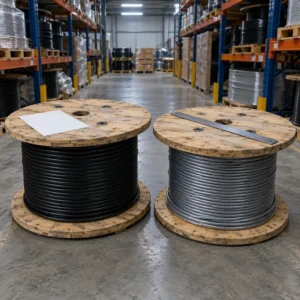
Indoor fiber is tight-buffered: each strand carries a stiff plastic buffer applied directly over the coating, making the fiber robust enough to handle, fan out and terminate individually — exactly what racks, panels and patching demand. The family splits by destination. Distribution cable carries several to dozens of strands in a single jacket for runs from the main distribution frame to zone panels; it pulls easily through trays and terminates to standard connectors. Breakout cable gives each strand its own sub-jacket and strength member — heavier, tougher, built for direct termination at each fiber without a panel, common where short rugged runs feed equipment directly. Duplex and simplex patch cords finish every link. The jacket rating is the code decision: plenum and riser classifications per the pathway, with the LSZH logic for enclosed spaces identical to the copper case. Indoors, fiber competes with high-speed copper only in the short tiers; beyond the copper geometry — and for the switch fabric tiers beyond 10G — the structured-cabling picture in the data center power hub shows fiber taking the distance and bandwidth tiers outright.
Outdoor: Loose-Tube, Armored and ADSS
Outdoor fiber is loose-tube: strands sit in gel-filled or dry-buffered tubes whose extra length lets the cable expand, contract and stretch without straining the glass, with water blocking and strength members carrying the load. Loose-tube duct cable runs in conduit between buildings — steel-tape or corrugated armor when rodents are a factor, polyethylene sheath when the duct is the protection. Direct-buried cable adds the armor layer permanently, rated for trench installation where ducts are an expense the route does not justify. All-dielectric self-supporting (ADSS) hangs from poles with no metallic parts at all — the strength member is aramid or fiberglass, so the cable is invisible to lightning and to the electrical fields of the lines it shares poles with; it is the answer for aerial campus spans and for routes that cross power corridors, a dielectric discipline familiar from the power side of the campus in the compact substation guide. Figure-8 self-supporting cable with an integral messenger is the metallic alternative where poles allow it. The campus pattern that emerges across Asian and tropical buildouts — duct where ducts exist, ADSS where poles do — recurs in the regional demand analyses like the Southeast Asia data center power review, where interbuilding fiber and interbuilding power face the same weather and the same poles.
| Regime | Construction | Governing Threat |
|---|---|---|
| Racks and panels | Tight-buffered distribution and patch | Handling, fire code |
| Direct equipment runs | Breakout cable | Abrasion without a panel |
| Ducts between buildings | Loose-tube, armored by route | Water, temperature, rodents |
| Direct burial | Armored loose-tube | Trench mechanics, moisture |
| Aerial spans | ADSS or figure-8 | Tension, lightning, poles |
| FTTH drop to cabinet | Flat drop cable | Minimum bend, last-100m cost |
FTTH and the Edge Cabinet
The FTTH tier enters the campus picture through edge cabinets and multi-dwelling reach: the drop cable that runs from a splice point to the final cabinet or building entrance is a specialized construction — flat or circular, bend-insensitive fiber, a strength member sized for subscriber-side abuse, sheaths rated for direct installation on facades or in shallow ducts. For a data center operator extending services outward, the drop construction is where the campus fiber becomes someone’s access network, and the construction rules change from campus engineering to installation practicality: minimum bend radius that survives corners, field-installable connectors, and jacket print that tells the installer what they are holding. Multi-tenant and edge facilities in growth markets — the pattern documented in the multi-site operations guide at the multi-site UPS supplier analysis — treat the FTTH tier as the same campus problem at a smaller scale: regimes, constructions, and a specification that names both. The core discipline survives at every tier: the glass is chosen by class (single-mode or multimode, the subject of its own comparison), and the cable around it is chosen by the threats of the regime it crosses.
When One Fiber Type Everywhere Is Not the Answer
The uniformity instinct fails in fiber more visibly than in copper, because the constructions disagree sharply on handling: a loose-tube armored cable pulled through a rack’s patching is a termination nightmare of gel and fan-out kits, and a tight-buffered indoor cable buried in a trench is a water-sponge failure inside two seasons. The false economy runs the other direction too — buying outdoor armored cable for the indoor tray because “it is tougher” imports a stiff, heavy, fire-inappropriate construction into plenum spaces whose code it does not meet. The honest plan segments by regime with transition points designed deliberately: outdoor cable lands at an entrance facility where it splices to indoor riser, armor is grounded or removed where it crosses from earth to rack, and each regime’s cable is terminated with its own hardware. The transition discipline costs a splice budget up front and saves the campus a lifetime of mis-terminated, wrongly-rated links.
| Line | What to Specify | What It Prevents |
|---|---|---|
| Fiber class | Single-mode G.652.D or multimode OM4 by tier | Mixed glass across a route |
| Construction | Tight-buffered or loose-tube per regime | Wrong family in the wrong space |
| Water blocking | Gel or dry per environment | Decade-scale moisture ingress |
| Armor | Presence and type per route survey | Rodent and trench damage |
| Jacket rating | Plenum, riser, LSZH per pathway | Fire code failure at inspection |
| Transitions | Splice points and armor grounding designed | Improvisation at building entrances |
RFQ Checklist: Fiber Lines for the RFQ
Put the regime map in writing:
- Regimes mapped: rack, plenum, duct, burial, aerial, drop
- Construction named per regime with fiber class
- Water blocking and armor specified per route survey
- Jacket rating per pathway code, LSZH where enclosed
- Transition and splice points designed, not improvised
- Attenuation and test requirements stated per span
- Drum lengths matched to pulling plans
Conclusion
Fiber optic cable types are answers to physical regimes: tight-buffered indoors where hands and fire code govern, loose-tube outdoors where water and trench mechanics govern, dielectric self-supporting on poles where lightning governs, and drop constructions at the subscriber edge. Map the campus, name the construction per regime, and design the transitions — that’s really the whole specification.
Kexingyu Cable Group (KXYE) manufactures across the fiber families — tight-buffered indoor, armored loose-tube, ADSS aerial and FTTH drop — with the construction, water blocking and jacket rating stated per drum, and datasheets that say which regime each cable is built to survive.