Buying Data Center Decommissioning: Cable Removal, Copper Recovery and What It Is Worth
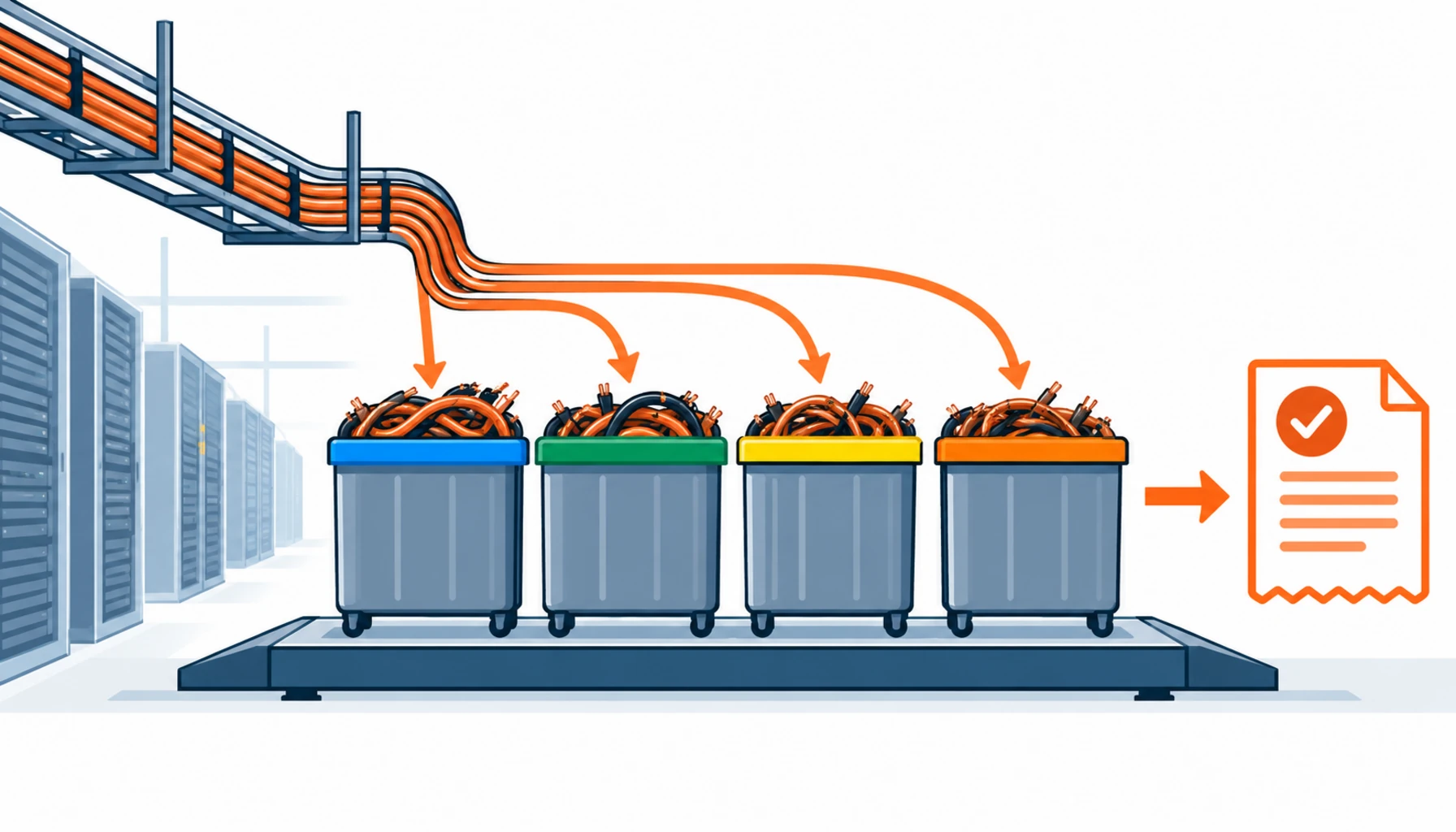
Quick Answer: A decommissioning contract is bought twice. The first purchase is the removal work: isolation, dismantling, tray clearing, penetration reinstatement and record updates. The second is the copper itself, and whether its value accrues to the owner or disappears into a contractor’s rate. Settle ownership, weighing and verification before the work starts, and the recovery typically funds a meaningful share of the removal. Leave them undecided and the material leaves the site with no credit and no record.
Decommissioning is the only stage of a cable’s life at which it becomes a commodity. The value depends almost entirely on how the removal is contracted.
Introduction
Retrofit programmes concentrate on what is being installed, and the material coming out is treated as waste to be cleared. That is an expensive default. Copper is the dominant material cost in a power cable, and a hall being decommissioned contains a significant quantity of it in a form that is easy to recover and easy to sell. Our note on copper demand in data centers covers the demand side; this note covers the moment when a hall’s copper re-enters the market.
The two things that decide whether the owner captures that value are commercial rather than technical: who owns the removed material, and how it is measured. Both have to be settled before the first tray section is opened.
What Is Actually Recoverable
Three categories of material come out of a data hall retrofit, and they are not equal.
Power cable with intact insulation. The largest tonnage and the easiest to value. Clean, unarmoured copper cable grades well at a scrap yard; armoured cable requires more processing and grades lower. Cable that has been cut into short lengths for removal retains its metal value but loses the possibility of being reused.
Busway and tap-off units. Busway contains substantial copper per metre in a form that is compact and easy to transport. Tap-off units are often better sold as serviceable equipment than scrapped, particularly where the installed range is still current and spares are hard to source.
Terminations, gland plates and accessories. Low value individually, but brass and copper content accumulates quickly across a hall. Most projects lose this fraction entirely because it is thrown into the same skip as the packaging.
What is recoverable also depends on how the cable was installed. Cable in a tray can be pulled and coiled. Cable cast into concrete or run in a duct that has been backfilled is a demolition project, and the economics change completely. Determining which routes are economically recoverable is a survey task that belongs in the tender.
The Decision Table: Decommissioning Options Compared
The table compares the ways a removal can be contracted, priced against who captures the scrap value.
| Contract Form | What to Specify | Evidence You Should Receive | Cost and Value Shape | Failure Mode If Chosen Wrong |
|---|---|---|---|---|
| Contractor removes, contractor retains | The removal scope, and the rate reduction that reflects the scrap the contractor keeps | A rate showing the scrap allowance as a separate line, not absorbed silently | Lowest headline removal rate; the value is invisible and unverified | A generous removal rate and a scrap value several times larger than anyone recorded |
| Contractor removes, owner retains | Removal scope, segregation and storage requirements, weighing method and handover | Weighbridge tickets per load, plus signed handover of material to the owner | Higher removal rate, offset by scrap receipts the owner controls | Material mixed and downgraded because segregation was not enforced on site |
| Split by material grade | Grades defined, separation of power cable, busway, accessories and mixed waste | Weighbridge tickets by grade, with the grade definitions referenced | Best recovery per tonne; needs supervision and space to segregate | One mixed skip, so every category prices at the lowest common grade |
| Owner removes with own labour | Isolation provision, access, lifting equipment, and the rate for the contractor's isolated work | Internal labour records and the same weighbridge tickets | Highest recovery, highest internal labour and supervision burden | Programme delays because removal competes with the installation for the same crew |
| Recovery only, no removal | The material offered as a separate lot, with removal by the buyer and site rules stated | A signed sale agreement plus the buyer's removal and insurance documentation | No removal cost at all; the buyer takes the material and the obligation | Unvetted buyers on site, and copper leaving without a record of what left |
Getting the Value: Weighing, Grades and Verification
The difference between capturing the value and losing it is a set of practices that are boring and effective.
Weigh at a weighbridge, not by estimate. Tonnage estimated from drawings is systematically optimistic, because cable lengths in as-built records are nominal. Weighbridge tickets per load are the only figure that can be reconciled against a scrap receipt.
Segregate on site. Every grade boundary that is lost on site is paid for at the yard. This means separate containers for power cable with intact insulation, armoured cable, busway, accessories and general waste, and a named person responsible for enforcing it.
Photograph the loads. A photograph of each container before it leaves, with the ticket number, costs almost nothing and settles most disputes afterwards, particularly the ones about how much was actually removed.
Reconcile the receipts. The scrap sale produces a receipt per load. Reconcile those receipts against the weighbridge tickets and against the quantity the removal scope implied. Where a load has no matching receipt, that is the question to ask before the next load leaves.
Consider the resale route. Serviceable busway, tap-off units and switchgear from a current range can be worth considerably more as equipment than as scrap metal. Where the installed range is still in production and lead times are long, offering the material as equipment rather than metal is often the better transaction. The pattern of long lead times that makes this true is set out in our note on switchgear lead times in 2026.
Grade the material against the construction. Not every kilogramme of copper is worth the same, because metal content per metre differs between constructions and conductor classes. Fine-stranded and flexible conductors often value differently from solid or stranded power conductors, and aluminium is worth a fraction of copper and should be segregated rather than mixed in. Building an expected value from the cable schedule before removal gives a baseline to compare the scrap quotation against, and our note on aluminum versus copper cable sets out where the substitution is practical and where it is not.
What to Freeze Before the Decommissioning Contract
| Item | What to State | Evidence to Attach | Cost of Leaving It Open |
|---|---|---|---|
| Removal scope | Which routes and equipment are removed, which are abandoned in place, and the boundary between them | A marked up drawing showing removal and retention | Material removed that was needed, or retained that was contracted for removal |
| Material ownership | Who owns the removed cable, busway and accessories, stated explicitly per category | A contract clause with the ownership position named | Scrap value silently absorbed into the contractor's rate |
| Segregation and storage | The grades required, the containers, and the storage area on site | A segregation plan with a named owner | One mixed skip and the lowest grade price for everything |
| Weighing and verification | The weighbridge, the ticket format, photographs and who receives the records | Weighbridge tickets per load and a reconciliation format | No figure to compare with the scrap receipts, and no basis for a query |
| Isolation and safety | Which circuits are isolated, by whom, and the point at which the contractor is permitted to cut | An isolation schedule and permit arrangements | Cable cut while still connected, and a fault introduced during a retrofit |
| Hazardous materials | Survey for asbestos, lead, and oils in legacy equipment before removal begins | A survey report and a disposal route for anything identified | Work stopped on discovery, with a disposal cost that was never tendered |
| Records and register | The as-built updates required after removal, and the asset register entries to be closed | A record update schedule with a named owner | A hall where drawings show circuits that no longer exist |
| Site security | Cable storage, access control, and the rule for material leaving site | An access and removal procedure, with a sign out log | Material leaving without a record, which is the most common loss in a retrofit |
When Leaving Cable in Place Is the Right Answer
Where the route cannot be recovered economically. Cable cast into concrete or in a duct that cannot be opened costs more to remove than its metal is worth. Abandoning it in place and recording the position is the correct commercial decision, provided it does not compromise fire stopping or create a future hazard.
Where the material has a second use. Serviceable busway, tap-offs and cable in the current range may be worth more as spares than as metal, particularly where the same range is still installed elsewhere in the estate. Our note on cable spares strategy covers how to judge whether holding it is worth more than selling it.
Where removal disrupts an adjacent live area. Removal work in a ceiling void above a live hall carries risk. Where the material recovered is small relative to that risk, leaving the containment in place and removing only what must go is often the better trade.
Where the programme has no room for removal. Decommissioning that competes with the installation for the same access and crew slows both. Where the retrofit is on a tight date, removing material later, as a separate package, is usually cheaper than doing it concurrently.
RFQ Checklist
- Removal scope drawn and issued, distinguishing removal from retention in place
- Material ownership stated per category, with the scrap allowance shown as a separate line in the rate
- Material grades defined and a segregation plan with containers and a named owner
- Weighbridge tickets required per load, with photographs and a reconciliation format
- Resale route considered for busway, tap-off units and switchgear from current ranges
- Isolation schedule and permit arrangements agreed, naming who authorises cutting
- Hazardous materials survey completed before any removal work begins
- As-built updates and asset register closures specified as deliverables
- Site access, material storage and removal procedures agreed, with a sign out log
- Scrap receipts reconciled against weighbridge tickets, with an agreed review point
- Disposal documentation and duty of care records supplied per load
- Removal sequenced so it does not compete with the installation for access or crew
Conclusion
The material coming out of a retrofit has a market value that is decided by a handful of contract terms rather than by the market itself. Weighing, segregating, recording and retaining ownership take a little supervision and recover a meaningful share of the removal cost. Where those terms are left open, the value still exists; it simply belongs to someone else, and the site has no record of how much there was.
Kexingyu Cable Group (KXYE) supplies the cable that replaces what comes out of a retrofit, including the WDZ-YJY, WDZN-YJY, BTTZ, NG-A (BTLY) and YJV ranges, the data center cable range used on submain and riser routes, and the multi-purpose distribution cable used on distribution circuits, all from one factory group with copper price linkage available on project-scale orders, which means the replacement can be priced against the same copper basis that the recovered material will be sold on. Send your removal scope and the material grades you intend to segregate, and we will return a replacement schedule with matching accessories and current lead times; the fastest route is a request for quotation.