Dexterous Hand Cable: What to Specify When Dozens of Channels Fit in a Palm
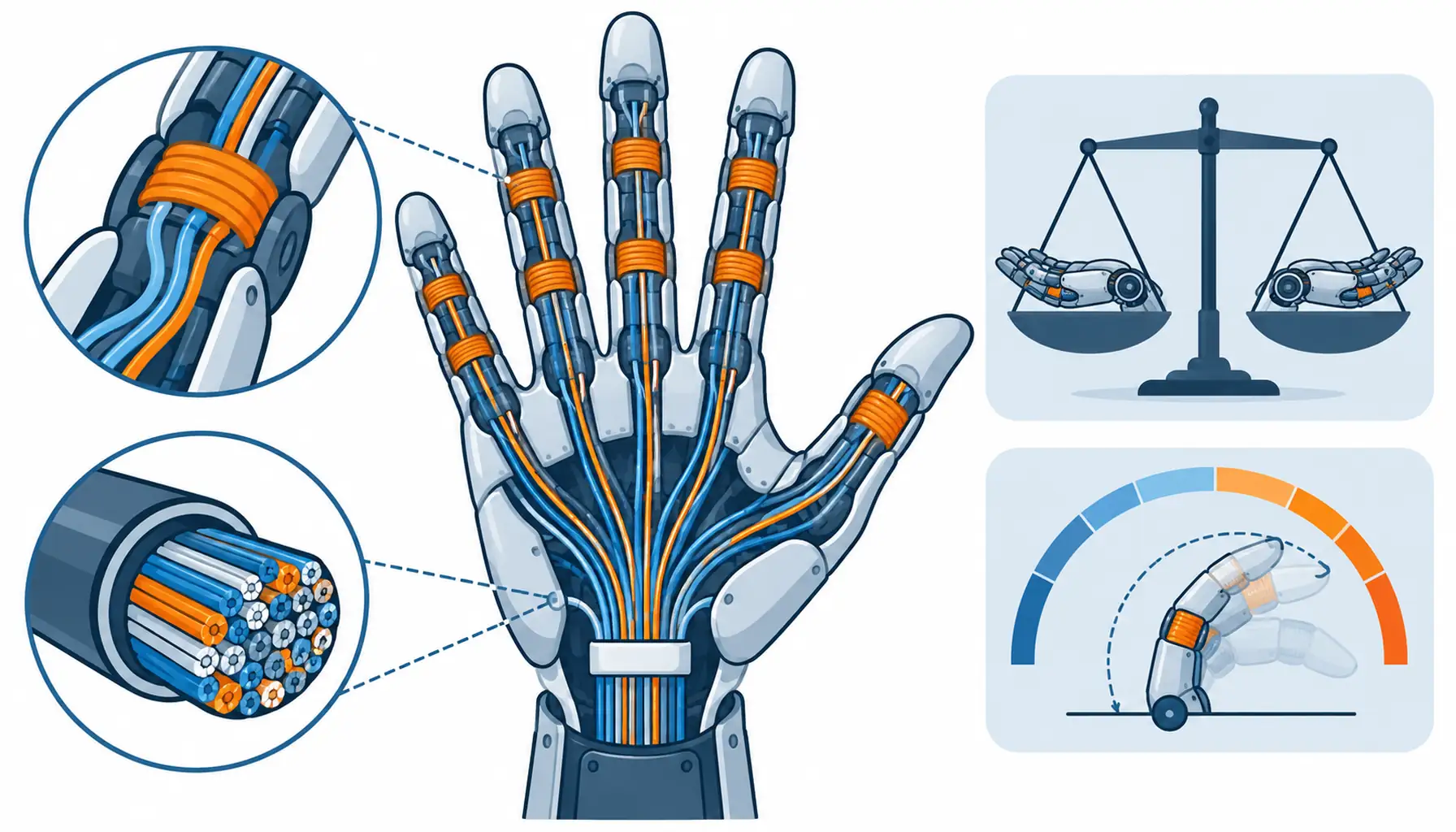
Quick Answer: A humanoid hand is the densest cable environment on the machine: dozens of signal and power channels, bends at the scale of a finger, and a weight budget measured in grams. This guide sets out the channel schedule, the micro bend evidence and the strain relief details to specify, and the ten decisions to freeze before the order.
Introduction
The arm side of a humanoid is covered by our note on humanoid actuator cable, where the duty is mechanical and the envelope is a joint can. The hand is a different problem. Tactile arrays, finger encoders and tendon or motor drives pack twenty or more channels into a volume smaller than a coffee cup, and every one of those channels crosses a bending zone with each grip.
For a buyer, the hand harness is also the part most likely to be treated as an afterthought, because it is small and cheap next to the actuators. That is backwards. It carries the most failure-prone signal paths on the machine, it is the fiddliest thing a technician ever replaces, and its specification is decided almost entirely by what the buyer writes down before the order.
What Twenty Channels in a Palm Actually Demands
Start with the schedule, because “a harness for the hand” is not a specification. Count the channels: tactile sensing lines from each fingertip, encoder pairs from each finger joint, power to the finger drives, and whatever instrumentation the grip controller wants. State the schedule as a table with conductor size, signal type and destination, and the rest of the conversation becomes concrete. Without the schedule, every supplier quotes a different bundle and none of them is comparable.
Density then sets the construction. Twenty channels in a round bundle produces a cable too stiff for a finger, which is why hand builds usually go flat, layered, or split into several micro-bundles that each follow their own path. Each choice changes the bend behaviour, the termination method and the way the harness fails, and the choice belongs in the requirement rather than in the supplier’s default catalogue answer.
Separation is the third demand. Tactile signals are small and slow, which makes them easy victims of crosstalk from the drives sharing the same palm. The schedule should mark which pairs are sensitive and which are noisy, and the build should carry a shield or separation plan that answers it. Quiet-by-construction beats quiet-by-luck, and the mechanics of hybrid builds are set out in our note on hybrid connectors.
Micro Bends Are a Different Test, Not a Smaller One
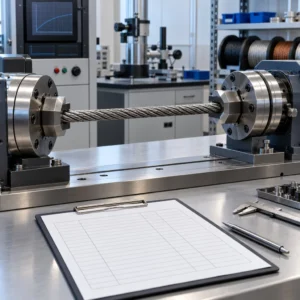
A finger joint bends through a radius that no industrial robot cable datasheet contemplates, and it does so tens of thousands of times a day. Fine stranding and soft jacket compounds get a bundle down to the geometry, but the flex life claim then has to be proven at that micro scale, with the same amplitude and rate the fingers produce. A figure measured at a forty-millimetre radius says nothing about a five-millimetre fingertip path. The test method matters more as the scale shrinks, which our note on cable flex testing methods covers in detail.
The path matters as much as the cable. A bundle routed straight across the back of the hand crosses every knuckle; the same channels routed with a relief loop per finger segment concentrate the bend where the construction was chosen for it. Ask for the routing drawing with the harness quotation, because the construction and the path are one design decision, and a supplier who quotes the cable without the path is quoting half a product.
Weight Is a Specification, Not a Consequence
Mass at the end of the arm is paid for twice: once by the wrist actuators that swing it and once by the grip dynamics that slow down when fingertip inertia rises. A hand harness therefore carries a grams-per-metre figure at finished level, jacket included, and that figure belongs on the drawing next to the bend radius. Suppliers hit weight targets by trading jacket thickness and shield coverage, so state which one is fixed and which one may flex, or the trade happens silently.
Termination weight is part of the same budget. A micro connector with a metal shell can outweigh the length of cable it serves, and an overmold can add mass at exactly the point the finger tips through its arc. The fix is not exotic: pick the smallest connector the contact count allows, and let the strain relief live in the mold or the clamp rather than in extra shell. The relief geometry itself is the subject of our note on strain relief at the connector interface.
The Jacket the Fingers Actually Wear Out
A hand harness does not fail like an arm harness. The damage concentrates where the cable is exposed and touched: the back of the fingers, the thumb web and the palm edge, all of which meet tools, door frames and work surfaces all day. A jacket chosen for chemical resistance or temperature alone will lose that fight, because the operative stress here is abrasion against hard edges at low force, repeated a very large number of times.
Polyurethane compounds dominate this duty for a reason, and within the family the abrasion grade is worth specifying explicitly rather than accepting “PU” as the answer. Ask for an abrasion test record at the load and counterface the hand will actually see, not a generic taber figure, and prefer a light-coloured jacket on the exposed runs so wear shows up as a change rather than as a fault. The materials and their test methods are compared in our note on abrasion resistant cable jackets.
Skin contact adds a final constraint that is easy to forget. Where the hand works alongside people, the jacket should tolerate repeated handling, wipe-down with the cleaning agents the site already uses, and the oils that transfer from gloves and skin. None of that requires exotic chemistry; it requires the agents to be named in the requirement so the compound is checked against them before shipment instead of after a complaint.
The Decision Table: Four Wiring Approaches for a Dexterous Hand
| Approach | What to specify | Evidence to demand | Cost and lead time | Where it fails |
|---|---|---|---|---|
| Split micro-round bundles | Bundle count, per-path bend radius and flex cycles | Flex records at each micro radius, per bundle | Lowest cost, short lead time | Routing errors that put a bundle across a knuckle |
| Flat ribbon with fixed path | Thickness, bend axis and the approved path drawing | A flex record with the ribbon oriented as installed | Medium cost, moderate lead time | Twist out of plane where the path was assumed flat |
| Layered flex printed circuit | Layer stack, stiffener zones and fold radii | A fold-cycle record at each stiffener transition | High cost, long design lead time | Cracks at stiffener edges after design changes |
| Overmolded hand harness | Mold geometry at palm and fingertips, exit angles | A pull and flex record on the molded assembly | Highest tooling cost, longest first lead | Mold cost spent before the hand design freezes |
Termination and Service at Thumb Scale
Micro terminations fail before micro cables do, so the connection plan needs the same scrutiny as the conductor schedule. Contact count, locking method and the mating force a technician can apply with cold fingers all belong in the requirement. Where the hand is meant to be swappable as a module, the disconnect point should sit at the wrist, not inside the palm, because a palm-level connector turns a five-minute module swap into an hour of disassembly. Termination practice at this scale is covered in our note on terminating robot harnesses.
Plan the failure mode before the field supplies it. Hands meet doors, tools and the floor, and the wear record from any fleet will show damage concentrated at the fingertips and the thumb web. A harness that is inspectable along its visible runs, with wear indicators or light-coloured jackets at the exposed sections, turns those events from intermittent faults into visible maintenance. The wear signatures worth learning are catalogued in our note on robot cable failure modes.
What to Freeze Before the Order
| Item | What to state | Evidence to attach | Cost of leaving it open |
|---|---|---|---|
| Channel schedule | Every conductor with size, signal type and destination | A schedule table signed by the controls team | Quotes that cannot be compared |
| Bend radii | The radius at each finger joint and palm fold | A routing drawing marking each bend zone | Strand fatigue hidden inside the palm |
| Flex life | Cycles to failure at the micro radii, per path | Bench records at the declared amplitudes | Fingertip faults after the warranty ends |
| Weight budget | Grams per metre at finished level, jacket included | A weighed record from the first article | Wrist torque spent on copper |
| Separation plan | Which pairs are sensitive, which are noisy | An immunity record for the tactile lines | Ghost sensor readings under load |
| Connectors | Contact count, locking method and mating force | A mating cycle record from the connector vendor | Contacts that fret loose in the palm |
| Service point | Where the hand disconnects for replacement | A drawing marking the wrist-level break | Module swaps that take hours instead of minutes |
| Strain relief | Relief method at palm exit and fingertips | A pull test record on the finished assembly | Lead breakage at the smallest terminations |
| First article | Which assembly is the approved reference | A signed first-article report with weights | Production units heavier than the tested one |
| Spares | Complete hand assemblies held per test station | A spares list agreed with production | A station idle over one harness |
When a Custom Hand Harness Is Not the Answer
When the hand design is still moving. Harness tooling, molds and flex-print layouts all assume a frozen geometry, and a design iteration turns that investment into scrap. Buy split micro-bundles through the prototype phase, freeze the hand, and only then commit to the custom build.
When the faults are at the contacts. If the failure log shows fretting or intermittent readings rather than conductor breaks, a new harness construction changes nothing. The contact interface is the suspect, and the failure physics are set out in our note on why robot connectors fail. Fix the connector first.
When the hand arrives as a sealed vendor module. Some humanoid hands ship as integrated units with the wiring proprietary. Specifying your own harness for the inside is then impossible, so spend the effort on the wrist-level interface instead: cable schedule, connector and service break. Where the machine’s wiring overall is being standardised, our special wire and cable range is the practical starting point.
When the duty is demonstration and lab work. A hand that mostly performs scripted grasps in a lab sees a fraction of field duty, and an over-built harness adds stiffness that the grip demonstrably does not need. Match the flex rating to the logged duty, keep the weight low, and hold a spare.
RFQ Checklist
- Channel schedule listing every conductor with size, signal type and destination
- Bend radius stated at each finger joint and palm fold, on a routing drawing
- Flex life records at the micro radii, with amplitude, rate and method named
- Grams per metre at finished level, weighed on the first article
- Separation or shield plan for the tactile pairs, with an immunity record
- Connector contact count, locking method and mating force stated
- Service break located at the wrist for module-level replacement
- Strain relief method at palm exit and fingertips, with pull test evidence
- First article approved in writing before production release
- Spare hand assemblies held per station, built to the approved revision
Conclusion
A dexterous hand harness is bought on four numbers and one drawing: the channel schedule, the micro bend radii, the flex life at those radii, the grams-per-metre figure, and the routing path that decides where the bends actually land. None of them is exotic, and all of them are cheap to state early. The expensive version is the harness that gets discovered late, when the palm is already moulded around a bundle nobody chose.
Kexingyu Cable Group (KXYE) builds micro-diameter high-flex bundles and flat constructions for compact multi-channel duty, and supplies them with the bend and pull records a hand program needs for sign-off. Send us the channel schedule and the routing drawing, and we will return constructions, micro bend data and sample assemblies; the fastest route is a request for quotation.