Turkey, Poland and Czechia: Auto Supply Chains Automating on Europe's Edge
Quick Answer: Turkey, Poland and Czechia build a large share of Europe’s cars and components, and their supply chains are automating fast enough to become a distinct motion cable demand centre.
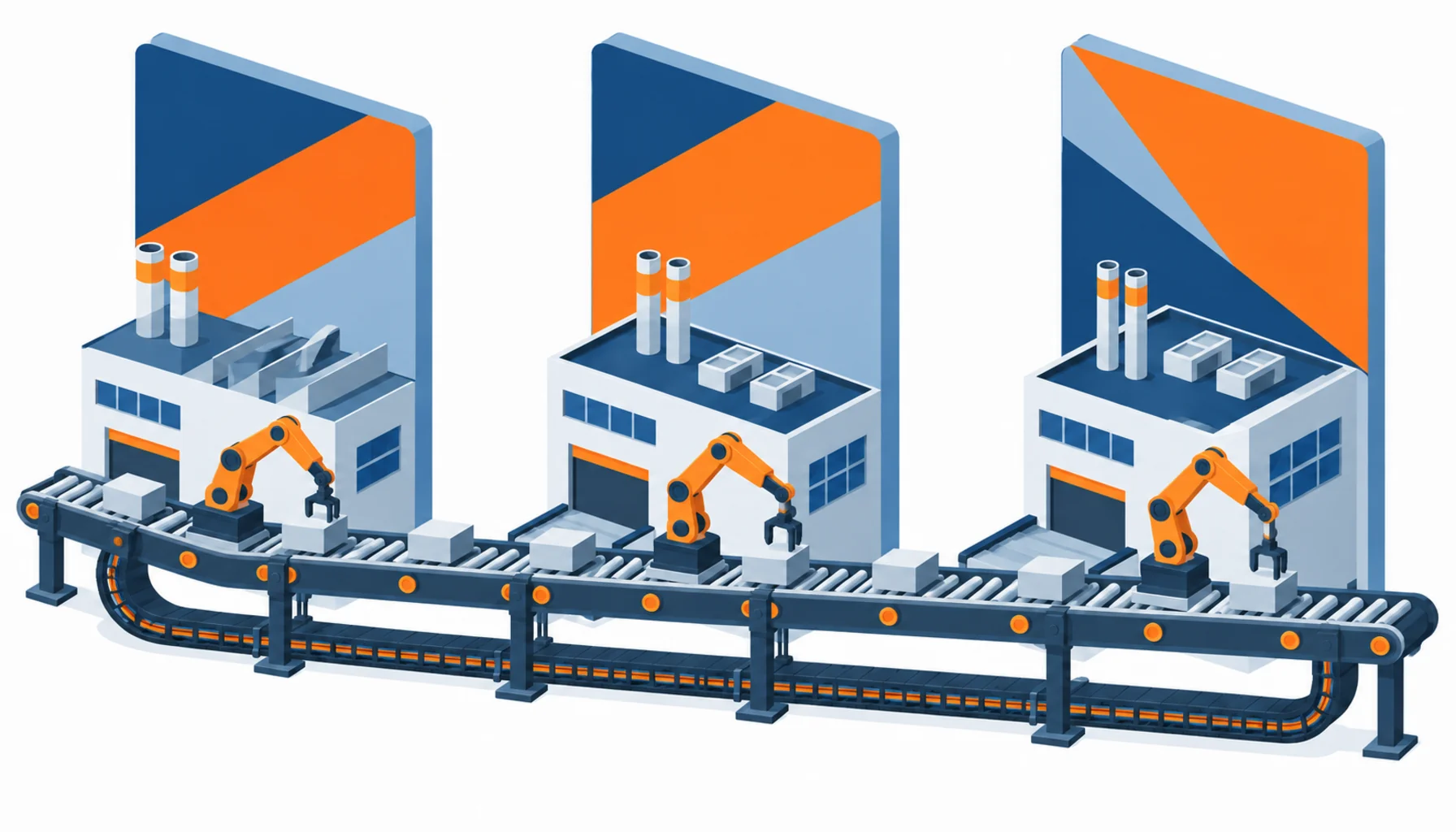
Western Europe designs the cars; the map’s eastern and southern edge increasingly builds them. Turkey assembles vehicles for nearly every major European brand and exports most of what it makes. Czechia produces more cars per capita than almost any country on earth. Poland has become the continent’s default answer for components, from wiring harnesses to axles to battery modules. These three economies sit one logistics decision away from the German customer, and their shared industry is now automating its way up the value chain, cell by cell, with motion cable following every robot and every transfer line that arrives.
Introduction
The regional logic is straightforward. Cost advantages, proximity to German OEMs, and decades of accumulated supplier capability turned Turkey, Poland and Czechia into the load-bearing wall of European automotive production. IFR’s World Robotics 2026 counts global installations at roughly 600,000 units for 2025, and while none of these three markets rivals Germany’s fleet in size, their growth profile differs in kind: they are not maintaining a mature installed base so much as adding one, tier supplier by tier supplier, as OEMs push automation requirements down the chain.
This article reads the three markets as one demand region, with attention to what makes each different. The certification regime they ultimately export into, the Machinery Directive and its European framework, is covered in its own guide and not repeated here. Buyers comparing cable sources for this region should begin with the framework in the guide to international sourcing mistakes.
Three Economies, One Supply Chain
Czechia is the deep-automation veteran. Its car plants and first-tier suppliers have run German-standard automation for decades, and its cable demand behaves like Germany’s writ smaller: mature fleets, replacement cycles, and specifications inherited directly from OEM build standards. Poland is the volume story. Its component sector spans powertrain, interiors, harnesses and increasingly battery systems, and its automation wave is younger, broader and more price-sensitive, driven by OEM mandates to cut cost and variability. Turkey is the scale story: a complete vehicle industry with its own domestic brands and export contracts far beyond Europe, whose plants automate under the combined pressure of currency swings and quality demands from German, French and Asian customers.
The three together create a demand profile that neither a mature market nor a catch-up market matches. There is real replacement demand in Czechia and parts of Poland, real first-installation growth across all three, and a constant inflow of machines built elsewhere whose cable arrives inside them. Suppliers who model the region as “emerging” misprice it; suppliers who model it as “Germany junior” mis-specify it.
What the Supply Chain Buys
Automotive tier suppliers automate in recognisable patterns, and each pattern carries a cable signature. Machining and forming cells, the backbone of the component industry, run transfer lines and tending robots whose drag chains cycle continuously around the clock. Welding and assembly cells for subframes, seat structures and battery trays add torsion duty and spatter exposure. Press shops combine high-tonnage machines with long, heavy cable runs whose sizing logic the guide to cable size selection covers in detail. And intralogistics, the silent automator of every supplier park, adds AGVs and conveyor systems whose continuous-motion duty consumes cable without ever appearing in a robot statistic.
Two regional conditions shape the specification beyond the mechanical duty. The first is the drive environment: press and transfer machinery runs on large variable frequency drives, and the electrical relationship between drives and their cabling, outlined in the comparison of VFDs versus soft starters, determines shield and grounding requirements in halls that are electrically rough. The second is the audit gradient: the closer a supplier sits to the German OEM in the chain, the closer its documentation must sit to German expectations, a gradient the infrastructure planning in the industrial power distribution checklist helps suppliers meet on the electrical side.
| Market | Industrial character | Cable demand profile | What decides orders |
|---|---|---|---|
| Czechia | Deep-automation veteran; car plants and first-tier suppliers | Mature fleet replacement plus steady upgrades to German standards | Evidence and dimensional fit for replacement work |
| Poland | Broad component base; harnesses, powertrain, battery modules | Young, broad, price-sensitive growth wave on OEM mandates | Duty-honest ratings at competitive cost |
| Turkey | Complete vehicle industry with wide export reach | Scale installations under currency and quality pressure | Landed-cost realism and delivery reliability |
The Import Reality and Local Assembly
The table’s last column converges on a shared truth: buyers in all three markets are professional, audited and schedule-driven, but they carry less specification infrastructure than German first tiers, so they lean on suppliers who bring evidence rather than ask for it. The failure patterns their cells generate are the industry’s standard list, documented in the analysis of common cable failure causes, and suppliers who quote against those patterns, with test data attached, convert at visibly higher rates than those who quote against a parts number.
When the Regional Story Is Not the Answer
Motion cable for this region divides between what arrives inside imported machines and what local integrators buy directly. The imported share follows the machine builder’s country of origin: German-built lines bring German cable, Asian-built lines bring theirs, and the local maintenance teams inherit the matching obligation. The directly bought share is growing as regional integrators take on larger projects, and it favours suppliers who can hold both price discipline and evidence discipline, because the integrator needs the former to win the job and the latter to keep it. Where machines built in the region ship onward into the European Union, the export paperwork, mapped in the overview of cable certification schemes, travels with the cable.
| Decision | Why it matters here | Practical handling |
|---|---|---|
| Match the imported machine's spec | Maintenance teams inherit foreign constructions without support | Identify the original cable and verify equivalents by test, not appearance |
| Evidence with the quote | Buyers sit below German-grade spec departments | Attach flex and shield data to the quotation, not after it |
| Drive-environment shields | Press halls and transfer lines are electrically rough | Specify braid class and grounding for VFD-dense halls |
| Currency and cost discipline | Turkish buyers especially carry currency exposure | Offer copper-linked pricing and stable validity windows |
| Export paperwork | Machines built here ship into the EU | Prepare certificates per destination before the order |
RFQ Checklist: Cable for a Regional Auto Supplier Project
Three cautions. First, the three markets differ enough that a regional strategy needs a national plan: Czechia’s replacement work, Poland’s volume wave and Turkey’s scale projects reward different offers, and a single catalogue price sheet serves none of them well. Second, OEM mandates push automation down the chain in waves, and a supplier who arrives between waves will find the quiet misleading; the next mandate round restarts the demand. Third, exporting into the EU still carries the full European framework, and the Machinery Directive guide remains the honest reference for machines and their cable crossing that border.
Conclusion
Send these so quotes match the plant and the audit gradient:
- Country and tier position, with the OEM standard inherited at that tier, if known
- Application class: machining, welding, press, assembly or intralogistics
- Duty per axis: travel, cycles per shift, and the shift pattern at the plant
- Actual bend radius and carrier type, measured where cable is being replaced
- Environmental exposure: coolant, chips, spatter, washdown or outdoor runs
- Drive environment: VFD-dense halls noted, so shield class matches the noise
- Required certificates for machines shipping onward into the EU
- Pricing structure: validity window and copper adjustment mechanism