Fault Isolation in Live Data Halls: Bypass Strategies and What to Buy Before the Incident
Quick Answer: Fault isolation is a purchase decision made months before the fault. What you can isolate quickly depends on what was bought: a board with a spare compartment and a draw-out breaker isolates in minutes, a board with fixed breakers and no bypass isolates in a shutdown window. Define the fault domains on paper first, then buy the switching, the bypass path and the labelling that let each domain be worked on while the rest of the hall keeps running. The equipment is cheap when it is ordered with the switchboard and expensive when it is added to a live hall.
Every live hall is one failed component away from a decision that has to be made in minutes with incomplete information. The equipment and the drawings decide how many options exist at that moment.
Introduction
Fault isolation is usually discussed as a procedure. In practice it is an equipment capability that a procedure then uses. A team cannot isolate a fault it has no switch for, and it cannot bypass a path that has no bypass. The preparation that matters is the work done at design and order stage, when the choice of switchgear, the number of spare ways and the presence of a maintenance bypass are still open.
Our note on redundant power feeds covers the architecture that makes isolation possible in the first place, and our note on N+1 and 2N UPS redundancy covers the upstream topology. This note is about the equipment and the switches that turn those designs into something an engineer can operate at two in the morning.
Define the Fault Domains Before Buying Anything
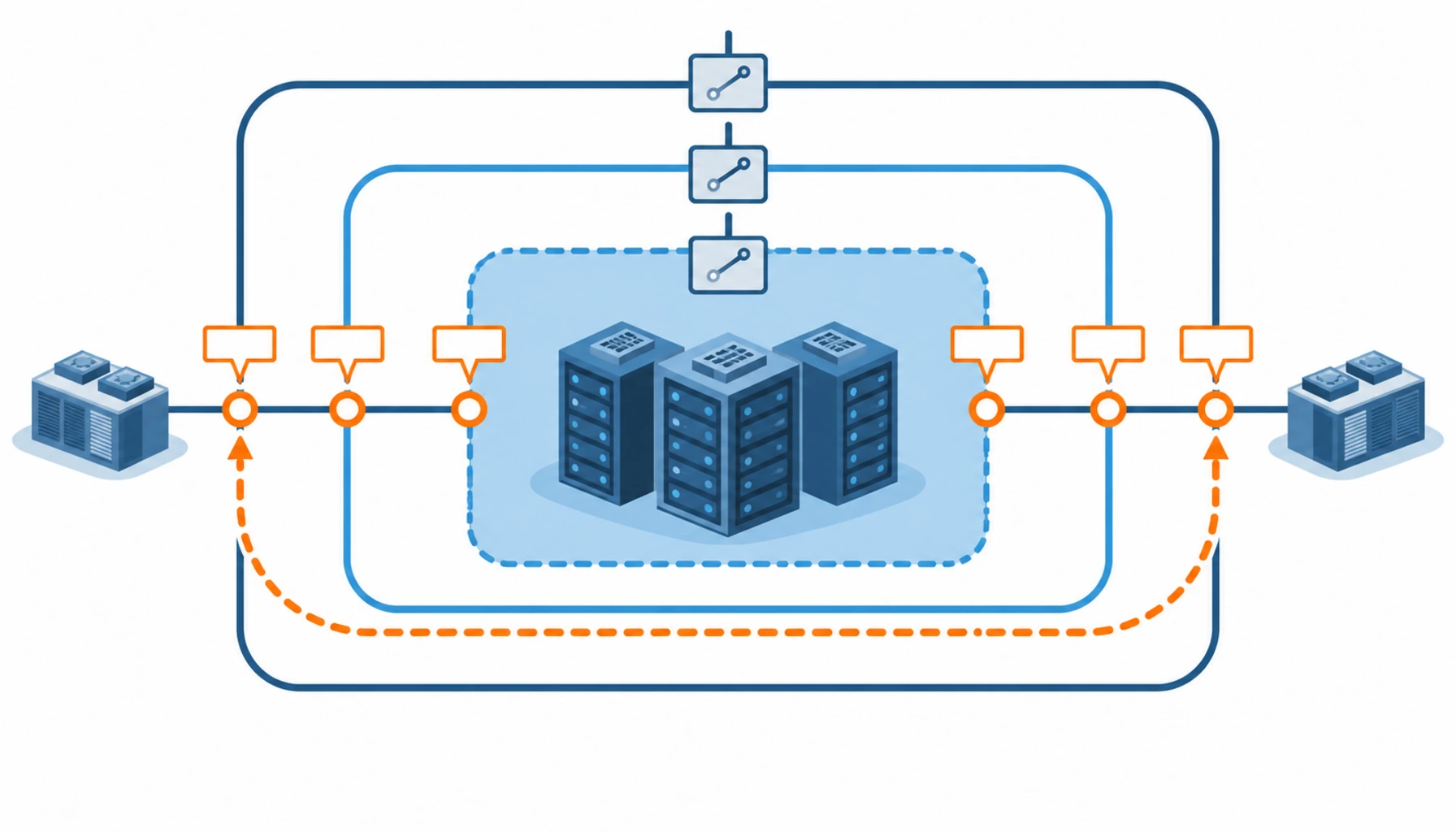
A fault domain is the largest set of equipment that goes dark when one thing fails. Isolation strategy is the list of domains and the switching available at each boundary. Three domains have to be drawn for a data hall.
Electrical domains. The boundaries are the breakers. In a well prepared hall, each domain has an upstream isolation point, a downstream isolation point and a documented spare way for temporary feeds. Where a board has no spare ways and no draw-out breakers, the domain cannot be worked on without a board shutdown.
Thermal domains. Cooling boundaries matter because a cable that has been derated on the assumption of a working hall will run hotter when a section loses air movement. Isolation work that removes cooling from a live section changes the cable rating in that section for the duration.
Control domains. Monitoring and interlock circuits cross electrical boundaries. A bypass that ignores them leaves a hall whose protection is partially defeated and whose monitoring reports normal. Every bypass procedure needs a matching list of interlocks that are temporarily disabled and the compensating measures for each.
The Decision Table: Isolation and Bypass Methods Compared
The table compares the methods a hall can actually be built around, priced against how quickly each one can be used.
| Isolation Method | What to Specify | Evidence You Should Receive | Cost and Lead Time Shape | Failure Mode If Chosen Wrong |
|---|---|---|---|---|
| Draw-out breaker with spare compartment | Draw-out construction, compartment rating, mechanical and electrical interlocking, racking tool | Type test certificates, interlock test record, circuit schedule showing spare ways | Modest premium on the switchboard, ordered once with the board | Fixed breakers and no spare ways, so any work becomes a board shutdown |
| Dual feed with transfer at the ATS | Transfer type, break-before-make or make-before-break, transfer time, failure mode, bypass of the ATS itself | Type tests, transfer time record, a documented way to bypass or isolate the ATS | Cost carried in the board and the ATS, not in the cables | An ATS with no bypass path, which becomes the single point it was bought to remove |
| Busway tap-off isolation | Isolating plug-in or bolt-on tap-off, rating, mechanical keying, shutters on the busway | Type tests, keying schedule, tap-off register mapped to rack rows | Premium on the busway order; lead time set by busway manufacture | Non-isolating tap-offs, so a tap-off change requires the run to be de-energised |
| External maintenance bypass cabinet | Bypass rating, interlocking with the main device, cabling between bypass and upstream board, labelling | Interlock test, bypass procedure witnessed at commissioning, spare fuse or breaker schedule | Additional cabinet and cabling, plus space in the room | A bypass that exists on a drawing but was never proven under load before it was needed |
| Planned shutdown window | Window duration, tenant notice, sequencing plan, rollback plan, and who holds the authority to abort | Approved method statement, permit, and a completion record | No equipment cost; highest operational cost and the least flexible | Work attempted live to avoid the window, in a hall with no hardware to make that safe |
What Can Actually Be Switched Under Load
Bypass hardware is bought for one purpose: moving load from a path that needs work to a path that does not, without interrupting the load. Two details decide whether that is possible.
Make-before-break or break-before-make. A make-before-break transfer momentarily parallels two sources, which requires them to be synchronised and requires the upstream protection to accept the fault level during the overlap. A break-before-make transfer interrupts the load for the transfer time. Buying the wrong one for the application produces either an outage or an overcurrent event.
Interlocking. The value of a bypass is that it cannot be operated into an unsafe state. Mechanical keying between the main device and the bypass is what makes a written procedure enforceable by the hardware rather than by memory. Where keying is specified, the keys and the interlock schedule ship with the equipment and belong on the wall beside it.
For the cable path, the equivalent is the isolating tap-off. A busway plug-in unit that can be removed while the run stays energised turns a row level cable change into a short local operation, and it is far cheaper as a factory option than as a retrofit. Where the tap-off is not isolating, the only alternative is to shut the run down, which on a live hall means either a window or a risk that a method statement will struggle to justify. The relative merits of busway and cable for these runs are covered in our note on busway versus power cable.
What to Freeze Before the Switchgear Order
| Item | What to State | Evidence to Attach | Cost of Leaving It Open |
|---|---|---|---|
| Fault domain schedule | The list of domains and the isolation point at each boundary | A domain diagram issued with the tender | Procedures written after delivery for equipment that cannot support them |
| Spare ways | The number and rating of spare ways and compartments per board | Board single line diagram with spares marked | Temporary feeds run from wherever there is space, often not where they are wanted |
| Breaker type | Draw-out or fixed, with racking and interlock requirements | Type test certificates and an interlock test record | A board full of fixed devices, and no way to work on one circuit without a shutdown |
| Bypass provision | Whether a maintenance bypass exists, its rating, and whether it can be operated under load | Interlock test record and a witnessed bypass procedure at commissioning | A bypass proven for the first time during the incident it was bought for |
| Tap-off isolation | Isolating plug-in or bolt-on design, rating, keying schedule | Type tests, keying schedule, tap-off register | Row level changes that require a busway run to be shut down |
| Transfer characteristics | Make-before-break or break-before-make, transfer time, and the failure mode on loss of control power | Type tests and a transfer time test at commissioning | An unintended outage, or a parallel operation the protection was not set for |
| Labelling and schedules | Device labels matching the single line diagram, the domain diagram and the tap-off register | As-built schedules issued as editable files, not scans | Isolation decisions made from a drawing that does not match the board |
| Spares and tooling | Spare breakers, fuses, racking tools, interlock keys and the spare parts list for the installed range | Spares list with part numbers and a delivery schedule | A fault that cannot be cleared because the replacement device is on a six week lead time |
When Bypass Hardware Is Not the Answer
Where the hall has no second path. A maintenance bypass moves load to an alternative source. Where there is no alternative source, the cabinet adds a switching operation without adding an option. The money is better spent on the second path. The supply constraints that make that awkward in the current market are set out in our note on switchgear and transformer shortages in 2026.
Where the work can wait for a window. A planned window is almost always cheaper and safer than live working. Bypass hardware earns its cost where the work cannot wait, and buying it for work that can wait is paying twice.
Where the procedure does not exist. Hardware without an approved procedure and trained operators is a box on the wall. Where the operations team has no permitted live working regime, buy the isolation capability and use shutdown windows until the regime is in place. Our note on maintenance windows in 24/7 facilities covers how to plan those.
Where the constraint is spares, not switching. The most common reason a fault becomes an outage is not the inability to isolate, it is the absence of the replacement device. A spares list is cheaper than a bypass cabinet and frequently more useful.
RFQ Checklist
- Fault domain schedule issued with the tender and referenced in the switchgear scope
- Spare ways and spare compartments listed per board with ratings
- Draw-out or fixed breaker construction stated, with interlocking requirements
- Maintenance bypass included where continuous operation is required, with its rating and operating mode
- Bypass interlock tested and the bypass procedure witnessed before final payment
- Isolating tap-offs specified for busway runs serving rack rows, with a keying schedule
- Transfer type stated and the failure mode on loss of control power confirmed in writing
- Labelling regime defined so device labels match the single line diagram and the domain diagram
- As-built schedules supplied as editable files, with the tap-off register included
- Spares list with part numbers covering breakers, fuses, racking tools and interlock keys
- Lead times for the spare devices stated separately from the lead time for the main equipment
- Commissioning includes a live transfer test at a representative load, with the result recorded
Conclusion
Isolation capability is the difference between a fault that costs an afternoon and a fault that costs a weekend. It is bought in a handful of decisions that are all easier at order stage than at any point afterwards: draw-out devices, spare ways, an isolating tap-off, a bypass that has been proven under load, and schedules that match the equipment on the wall.
Kexingyu Cable Group (KXYE) supplies the cable and distribution equipment that a fault isolation strategy depends on, including the WDZ-YJY, WDZN-YJY, BTTZ, NG-A (BTLY), KVV and YJV ranges, the dual power ATS cabinet that provides the transfer path, and the busbar tap-off box that makes a rack row isolatable while the run stays live, from one factory group with copper price linkage on project-scale orders. Send your fault domain schedule and the isolation points you intend to rely on, and we will return the equipment records that show what each one can actually switch; the fastest route is a request for quotation.