Procuring Cable for High-Rise Buildings: Risers, Mains and Safety Circuits
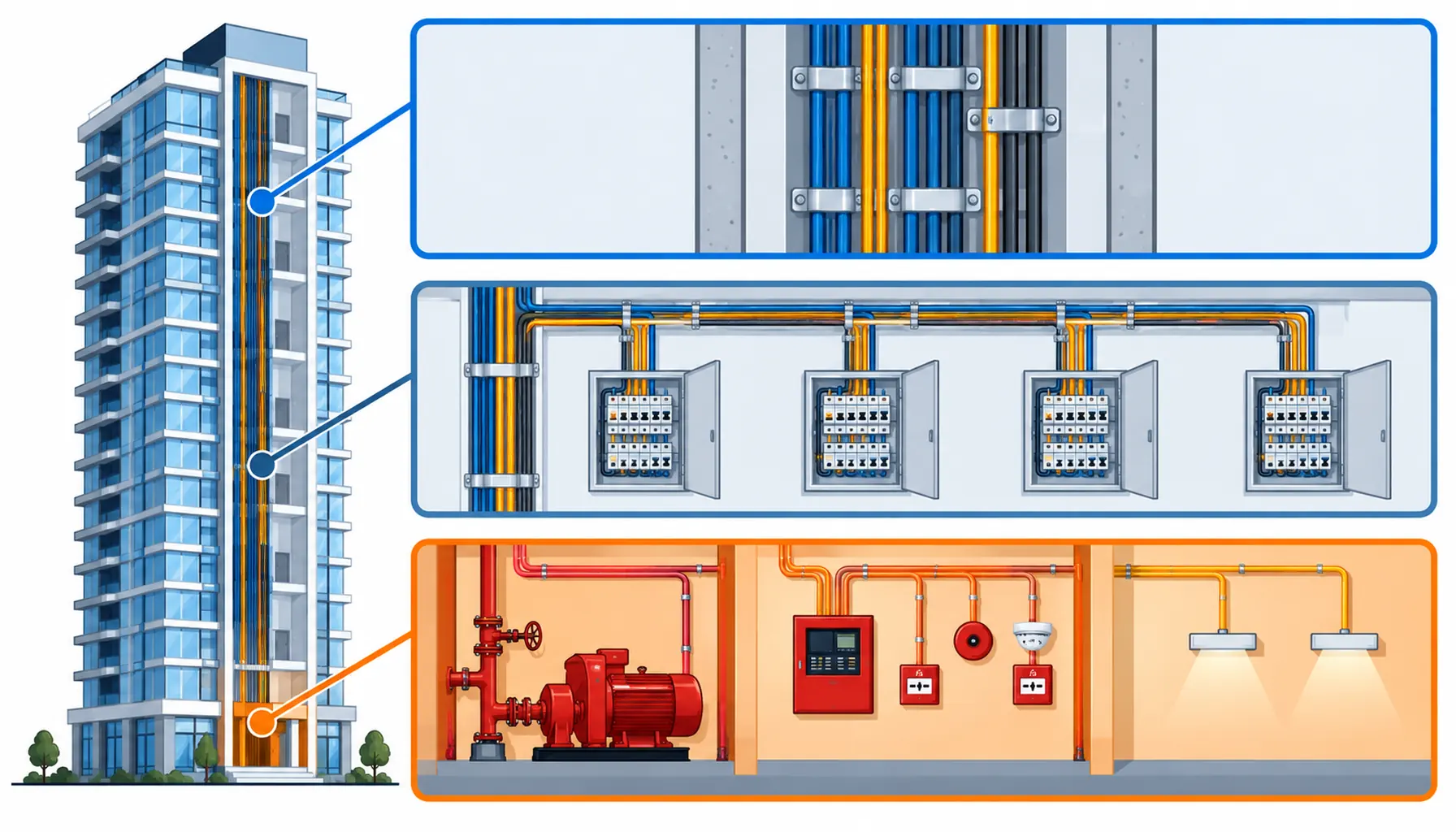
Quick Answer: A high rise building cable package is not one purchase. It is a vertical mains problem, an in-floor distribution problem and a life safety problem. Buy the riser on installation and derating, the distribution on copper economy, and the safety circuits on evidence that the circuit survives a fire rather than on a sheath description. Freeze those three scopes separately before the RFQ goes out.
Introduction
Cable in a low building is a simple problem: it runs horizontally, it is easy to get at, and if a run is too long somebody upsizes it and moves on. Put the same building up forty floors and both the physics and the paperwork change. Vertical runs get long enough that voltage drop and fault level drive the copper content of the order, access is a lift shaft rather than a tray, and every circuit that keeps people alive through a fire has to be bought on test evidence.
The trap is that all three scopes arrive under one heading on the tender, and the cheapest way to quote the whole thing is to specify the safety circuits like ordinary building cable wrapped in a nicer sheath. That is the order rejected at commissioning, months after the drums are on site.
The Three Scopes Inside One Building Cable Package
Vertical mains and riser cable. The spine of the building, from the main switchroom up through the riser to the floor boards. Long runs, high current, a vertical installation that changes derating rules, and a fire compartment boundary at every slab. On a tall building this scope is usually single-core XLPE in trefoil, or busbar trunking.
In-floor and tenant distribution. Everything above each floor board: sub-mains to tenant panels, final circuits, small power and lighting. Moderate current, dense routing, and a strong pull towards copper economy because the metreage is huge.
Life safety and essential circuits. Fire pumps, fire lifts, smoke and pressurisation fans, alarms and emergency lighting. The cable here is not chosen for load, it is chosen for the ability to keep working while the building burns and the fire service is standing in water in the basement.
Scoping those three as separate lines on the tender is the most useful thing a buyer can do: suppliers who are good at riser mains are not always the ones holding fire test evidence, and a package quoted as one lump hides that difference.
Riser Mains: Duty and Installation That Move the Specification
Continuous length. A forty-floor riser main is a very long circuit, so the manufacturer needs to know whether it ships as one length or as drum lengths spliced in accessible chambers. A joint half way up a shaft with no access is a maintenance problem for the life of the building.
Derating. Cables grouped in a shaft and passing through warm risers derate differently from the same cables in free air, and the number the designer used has to reach the quotation. Our notes on cable derating factors and on vertical riser and shaft cable cover the factors that decide the copper content, and missing them is how a riser main ends up a size larger than it needed to be.
Mechanical loading. A long vertical drop carries its own weight, so state the mass per metre and the maximum unsupported span, and buy a cleat arrangement that clamps without cutting the sheath.
Fire compartment crossing. The riser pierces a slab at every level, and each of those is a firestop with its own tested detail. Our note on firestop cable penetrations covers what it has to include, and the penetration method is worth fixing alongside the cable, because an untested combination fails inspection even when both parts are certified.
Where the riser is a straight, heavily loaded spine in a building that will be reconfigured floor by floor, busbar trunking is a legitimate alternative; our note on busway versus power cable covers the comparison, and only the cable side is treated here.
Sizing a vertical run. A long vertical run is a long circuit, so the permitted voltage drop at the far end can set the conductor size regardless of what the load allows, and that calculation belongs in the RFQ package. Higher floors also sit on circuits with more impedance, which changes the fault current and the earth loop impedance the protection relies on; a cable that satisfies the load but not the disconnection time shows up as nuisance tripping. Our note on insulation resistance testing covers the measurement side. Past a certain height the copper needed to hold voltage drop costs more than an intermediate distribution point partway up, so a good RFQ asks for that alternative priced side by side.
Safety Circuits: Fire Performance Is a Circuit Property
This is the scope where money is most often spent badly, and it comes from one misunderstanding: fire performance belongs to the whole circuit, not to the cable. A fire-rated cable terminated into an ordinary plastic gland, through an untested penetration and clipped with combustible fixings, is not a fire-rated circuit whatever the drum certificate says.
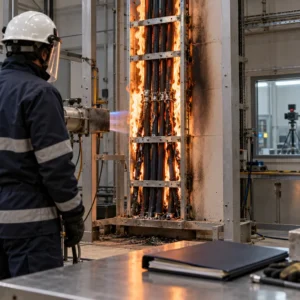
What the test applies. A fire survival test applies a flame to an energised cable and may add a water spray and mechanical shock, during or after the fire. A cable approved for one combination is not automatically approved for another, and the category schemes encode the same idea: the more of fire, water and impact a circuit must survive, the higher the grade, and the cost follows. Where the requirement is high and the environment punishing, the copper-sheathed mineral-insulated family in our note on mineral insulated cable earns its cost because there is no organic material to degrade.
Match the grade to the location, not the building. Grades should follow where a circuit runs and how long it must work. One inside a protected shaft and needed for thirty minutes is not the same product as one crossing an unprotected atrium and needed for two hours with the fire service still using it.
What to demand. Not the words fire rated, but the test standard, the category, the duration, whether water and impact were included, and a system approval covering the cable plus its terminations and fixings as one tested assembly. A supplier who can produce a cable certificate but not a system approval is selling a component, not a circuit.
The table below is the scope of the purchase, family by family: what the cable has to do, what to specify, what evidence to demand, and how each one fails.
| Cable scope | Duty in the building | What to Specify | Evidence to Demand | Cost and Lead-Time Driver | How It Fails |
|---|---|---|---|---|---|
| Vertical riser mains | Long vertical run, high current, grouped in a shaft, cleated each floor | Conductor size and class, XLPE insulation, LSZH sheath, trefoil or multicore, drum lengths and joint positions | Derated current for the actual grouping, vertical load and clamping detail, dimensional records per drum | Copper and the drum length schedule dominate; longer lengths add weeks | Overheating from underestimated derating, sheath cut at a cleat, unplanned joints |
| In-floor and tenant distribution | Dense horizontal routing, moderate loads, many small circuits, reconfigured over life | Copper or aluminium conductor, sheath compound per the fire strategy, sizes and bend radius for tight trays | Construction declaration, flame and smoke classification, dimensional records on a sample | Metreage and conductor metal set the price; aluminium needs larger ducts | Undersized sub-mains from a late load change, tray fill exceeded |
| Fire pump and fire lift supplies | Must run during a fire, often wet, usually the highest survival grade in the building | Survival grade and duration, water and impact inclusion, system approval for terminations and fixings | Test standard and category, duration, system approval for the whole assembly, installation drawings | The highest grade at the longest duration carries a premium and narrows the supplier list | Passed the megger dry but not after the water spray, terminations failing before the cable |
| Fire alarm and emergency lighting | Signalling integrity through the fire, plus luminaires supplied for the full escape duration | Integrity grade and duration for the alarm standard and escape strategy, screening and pair arrangement, final circuit sizing | Integrity and smoke test evidence, screen continuity records, voltage drop calculation for final circuits | Certified construction and screening drive unit cost; the integrity grade rather than copper drives cost | Signal loss at the first damaged section, luminaires dimming below the required level |
| Lift travelling cable and controls | Continuous flexing in the shaft, control and communication duty, long service life | Flexible conductor class and travel-cycle rating, composite construction with control pairs, shaft-duty sheath | Flex or bend-cycle test data, composite construction drawing, termination kit compatibility | Flexible and composite constructions are specialist lines with their own lead times | Cores breaking in the travelling loop, control pairs interfering with monitoring |
Compliance: Which Standard Applies to Which Circuit
Building cable is regulated on three separate axes, and mixing them up is the most common reason a delivery is rejected on paperwork rather than quality.
Reaction to fire, on the cable itself. How the cable behaves when it burns: flame spread, heat release, smoke and acid gas. In the European framework cables sold as construction products carry a reaction-to-fire class built on those tests, and China’s building material classification does the same job for domestic projects. Both answer one question: what does this cable do to the escape route when it burns. Our notes on the GB 31247 B1 building cable class and on LSZH versus fire retardant cable show how to read those declarations.
Fire survival, on the circuit. This is the resistance axis and it is separate: a cable can be excellent at not spreading flame and useless at keeping a pump running, because the two are tested and declared differently. Life safety circuits are bought on this axis at a stated grade and duration.
Country approval for the destination. Domestic projects run on the national code; export projects run on whatever the destination authority and the specifying engineer have named, often a British or European framework with a national overlay. Get that named in writing at tender stage, because a manufacturer holding one country’s certification cannot simply repaper it for another. Where a project mixes frameworks, specify the stricter one for life safety circuits and the local framework for the rest.
What to Freeze Before the Order Goes Out
These eight items are cheap at specification stage and expensive once drums are on site.
| Decision | What to State | Evidence to Attach | Cost of Leaving It Open |
|---|---|---|---|
| Scope split | Riser mains, distribution and life safety scoped as three lines | A cable schedule mapping every run to one scope and duty | Safety circuits bought at building-cable prices and rejected at commissioning |
| Framework and class | The reaction-to-fire class and the national framework named in writing | Classification report for the exact construction quoted | A delivery that cannot be accepted on paperwork |
| Survival grade per circuit | Grade, duration, and whether water and impact are included | Survival test report plus a system approval for terminations and fixings | Rebuilding a life safety circuit after the fire test fails |
| Riser installation detail | Cleat type and spacing, unsupported span, mass per metre | Installation drawing with the supplier's support figures | Sheath damage and cable creep in a hard-to-work shaft |
| Derating basis | The grouping, ambient and installation method the derated current assumes | The derating calculation with its inputs shown | A riser main that runs hot and is upsized on site at premium cost |
| Joint positions and drum lengths | Where joints are permitted and the maximum drum length per riser | Drum length schedule checked against the riser elevation | Joints in an inaccessible shaft with no maintenance access |
| Penetration method | The tested firestop detail for each slab crossing | The penetration system approval, not a sealant certificate | An inspection failure for a combination nobody tested together |
| Tests and records per drum | Which tests are witnessed and what records ship per drum | A written test plan with acceptance criteria and dates | A whole riser accepted on one sample nobody kept |
Lead Time and Cost Structure
On a building package the lead time is set by the least standard item in the order. Standard building cable is largely a copper and logistics business and stock sizes ship quickly; long riser lengths sit on the drum and handling capacity of the line, so a run needing forty floors in one length has to be booked; fire-rated and mineral-insulated constructions are the longest line, because the tested construction is fixed and the system approval ties the product to particular terminations and fixings that ship with it. Buyers who discover the survival grade requirement after the order is placed routinely lose several weeks.
On price, copper is the largest single component of the riser and distribution scopes and the only part that moves between quotation and order. Building programmes run for years, so the copper element of a riser package is large enough that movement between tender and purchase order outweighs most of the margin. Ask how the copper element is calculated and how long the price holds; our note on copper price and cable procurement sets out the same discipline for site purchasing.
Incoming Inspection: What to Check on a Building Delivery
Against the drum, before anything is cut. Count drums against the packing list, verify marked lengths against the riser schedule and photograph the markings. A drum short of the riser length forces a joint nobody planned.
Electrical and dimensional checks. Conductor resistance and continuity, insulation resistance, and screen continuity where screened. Then diameter, sheath thickness and conductor cross-section on a cut sample, with both parties present. Measuring the real copper area settles arguments faster than any certificate.
Certificates and accessories. Match the reaction-to-fire declaration and, for safety circuits, the survival report to the drum references, and confirm that the approved terminations, glands and clips arrived with the cable. A fire-rated cable delivered without the fixings its approval depends on is not yet a fire-rated circuit.
When a High Rise Cable Specification Is Not the Answer
When the failure is a calculation, not the cable. Upsizing a riser main that runs hot, when the real cause is a grouping or ambient figure nobody recalculated, buys copper at premium prices and keeps the problem.
When the fire strategy is being solved with cable alone. A fire-rated cable through an unprotected space does not deliver a protected circuit. If the route cannot be protected, the answer is a protected route or an enclosure, not a higher grade of cable.
When the destination framework is being guessed at. A cable certified against the wrong classification is one inspection away from being unusable, and the discovery costs a lead time nobody allowed for.
When one grade is applied to the whole building. The highest survival grade everywhere over-spends on circuits that will never see a fire, and the lowest everywhere fails the strategy. Grade per circuit and per route.
RFQ Checklist
- Cable schedule splitting riser mains, distribution and life safety runs
- Vertical run lengths per riser, with the maximum continuous drum length
- Derating basis: grouping, ambient and installation method per riser
- Voltage drop and fault level calculations for the longest circuits
- Reaction-to-fire class and the national framework named for the project
- Survival grade, duration and water or impact inclusion, circuit by circuit
- System approval for terminations, glands and fixings as one assembly
- Cleat type, spacing, unsupported span and mass per metre for vertical support
- Permitted joint positions and the tested penetration detail at each slab
- Composite or travelling cable specification for lifts, with flex test data
- Tests to be witnessed and the records that ship with each drum
- Copper basis and the period for which the quoted price holds
Conclusion
A high rise cable package is bought well when the three scopes stay apart. The riser is an installation and derating problem, the in-floor distribution is a copper economy problem, and the life safety circuits are an evidence problem. Separate them on the tender, name the framework in writing, and grade the safety circuits by route and duration.
Kexingyu Cable Group (KXYE) has manufactured cable in Quanzhou since 1996, supplying the riser mains, building wire, fire-rated and mineral-insulated constructions a high rise electrical package calls for, with the glands, cleats and penetration components their approvals depend on. Send us the cable schedule with the riser heights, the derating basis, the fire strategy grades and the destination framework, and we will come back with the constructions, the test evidence for each circuit, and a delivery plan against your handover date. The fastest route is a request for quotation.