Submersible Cable for Sumps, Pits and Flood Zones: Specification and Checks
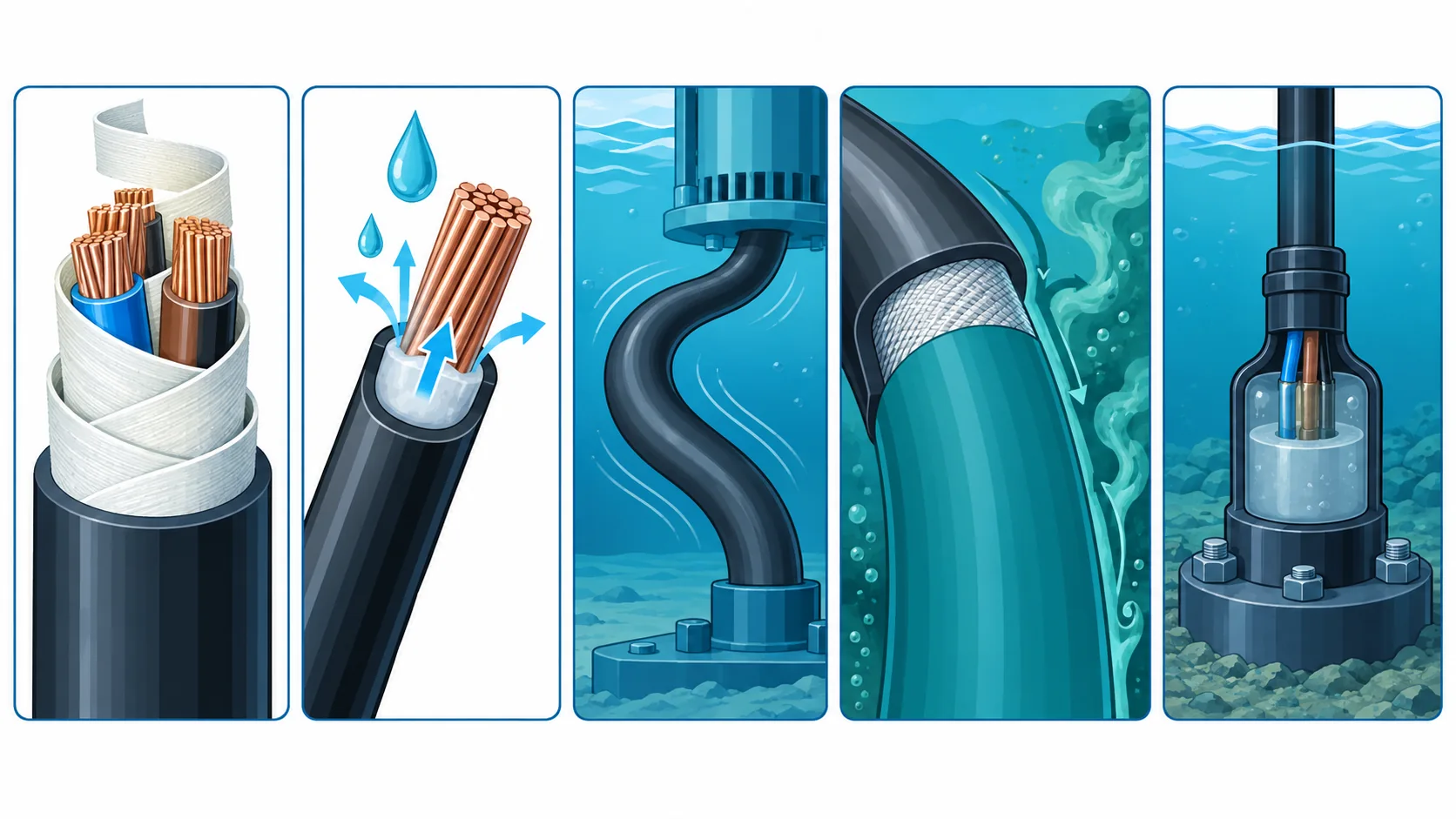
Quick Answer: Continuous immersion is a different duty from getting wet. A cable in a sump or a pit can sit under water for years, so the construction has to stop water travelling along the cores, the sheath has to suit the fluid and its temperature, and both ends have to be sealed against the pressure and the level changes. The word waterproof on a datasheet tells you very little; the blocking, the sheath compound and the end seal are what decide whether the run survives.
Introduction
A cable that gets rained on and a cable that lives under water are usually bought with the same word on the order. They are not the same product, and the difference shows up two years later when a pump pit has to be drained and a joint has to be remade in a wet hole.
This guide is for the buyer specifying cable for sumps, pump pits, wet wells, bunds and flood-exposed routes. It covers what continuous immersion actually demands, the blocking and sealing options that answer it, the decisions to freeze before the order goes out, and the checks that catch a wet drum before it is installed. Constructions built for these duties sit in our submersible pump cable range, and the blocking materials behind them are covered in our longitudinal water blocking construction.
What Continuous Immersion Actually Demands
Hydrostatic pressure, and it changes. Water at the bottom of a pit presses on the cable, and every pump cycle changes that pressure. A cable that is sealed when the pit is full may pump water along its own cores when the level drops, which is why level movement matters as much as depth.
Water travels along the cores. Unless the core is blocked, water that enters at one end keeps moving toward the other, and a low point in the run collects it. On a permanently wet route this is the mechanism that turns a small gland leak into a filled joint.
The fluid is rarely clean water. Sewage, slurry, brine and process effluent all attack the sheath, and solids in the fluid abrade it. A compound chosen for clean water may swell, harden or wear out in a sludge pit, so the fluid belongs on the specification rather than the word immersion.
The fluid has a temperature. Warm effluent softens a sheath that would be fine in cold water, and a warm fluid also increases the pressure on the seal. Ask for the temperature of the fluid, not the temperature of the room.
Immersion Constructions Compared
The table sets out the routes a buyer can take: what each one answers, what to write into the specification, the evidence to demand, what drives cost and lead time, and how each one fails when the wording on the order was simply waterproof.
| Construction | What it answers | What to Specify | Evidence to Demand | Cost and Lead-Time Driver | How It Fails |
|---|---|---|---|---|---|
| Water-blocking tape or powder in the core | Water travelling along the interstices once it has entered a cable end | Where the tape sits, its swell rate and swell height, and the core layout it covers | Water penetration test to a named method with the swell recorded | Materials and an extra taping pass; days rather than weeks | Blocking left out at the ends, so water enters before the tape can swell |
| Blocked or compacted conductor | Capillary flow through the conductor strands, which is the fastest path of all | Blocking method, the fill, and the resistance per kilometre that still applies | Water penetration result on the conductor plus the resistance on the finished length | Extra drawing and blocking work on every core; longer in large sizes | A plain conductor supplied where a blocked one was specified |
| Rubber sheath for flexible immersion duty | Movement of a pump, a mixer or a rising main, while resisting water and abrasion | Compound type, thickness, and the flex and abrasion performance claimed | Compound data plus flex and abrasion test results at the service radius | Rubber compounds cost more and run to order more often than PVC | A stiff sheath that cracks at the guide bracket after a season of pump cycling |
| Barrier and oversheath for aggressive fluids | Chemical attack on the metal layers, and radial moisture into the core | The barrier type and thickness, and the oversheath compound matched to the fluid | Barrier thickness record and compound resistance data against the named fluid | The longest item of the five; several layers applied and tested in sequence | A barrier that is broken at the joint, leaving the armour to the fluid |
| Sealed glands and resin or potted terminations | Entry at the ends, which is where most immersed cables actually fail | The gland model and rating, and the joint or termination method below the water line | Gland certificate, termination instructions, and a test on the finished joint | Modest material cost; the programme cost is a competent crew and a dry window | An ordinary gland in a pit, letting water into a cable that was correctly blocked |
Sealing the Ends Is Where Most Jobs Are Won
Both ends, or the blocking does nothing. A blocked cable landed in an ordinary gland is open at one end, and water entering there has the whole run to travel along. The end seal and the core blocking are a pair; specifying one without the other is the most common mistake on a wet installation.
Joints below the water line want to be avoided. Where a joint is unavoidable, it has to be a properly sealed and pressure-tested joint rather than a taped one, and it should be a deliberate part of the design with a recorded test. The jointing side of the same question is set out in our note on waterproof cable constructions.
Terminations under water need the right method. A resin or potted termination suits a submerged motor connection far better than an open lug, and the method should be agreed before the cable is bought rather than improvised on site. Where the termination stays above the water line by design, that decision should be on the drawing so nobody moves it later.
Ingress ratings have to be read properly. A gland carrying a high ingress rating protects against a defined test condition, not against years of fluctuating pressure and sludge. Our note on IP ratings for connectors explains how the numbers are stated and where a claim does not cover a permanently submerged duty.
What to Freeze Before the Order Goes Out
Six decisions decide whether an immersion order can be accepted without argument. Each is cheap at specification stage and expensive once the pit is full.
| Decision | What to State | Evidence to Attach | Cost of Leaving It Open |
|---|---|---|---|
| Fluid type and temperature | The fluid, its solids content and its highest temperature, per sump or pit | A schedule naming the fluid at each location | A compound chosen for clean water that swells or wears in effluent |
| Depth and level range | Maximum depth, minimum depth and how fast the level changes | A drawing with high and low water levels marked | A seal that holds when full and pumps water when the pit empties |
| Blocking system and evidence | The blocking type, swell rate and swell height required | Water penetration test to a named method with the swell recorded | Water travelling along the cores to a joint far from the leak |
| Sheath compound and abrasion | The compound, its fluid resistance and its abrasion performance | Compound data plus abrasion results on the compound delivered | A sheath worn through at a bracket in a sludge-laden pit |
| End seal and joint method | The gland model, the joint or termination method, and who installs it | Gland certificate, termination instructions and a test on the finished joint | A correctly blocked cable opened at one end by an ordinary gland |
| Acceptance test | The insulation resistance figure before and after installation, plus any pressure test | Results recorded against the drum and the location | No way to tell a delivery problem from an installation problem |
Installation in Pits, Sumps and Flood Zones
Keep the ends out of the water where you can. The cheapest improvement on a wet installation is a gland that sits above the normal high level, so the cable is blocked and dry at its most vulnerable point. Where a design change can lift a termination, it is worth more than a better gland.
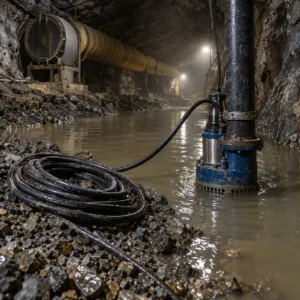
Support the cable off the sludge. A cable lying in the bottom of a sump is abraded by every solids movement and buried in deposits that hold moisture against the sheath. Support it clear and leave a slack length that can move with the pump without pulling on the gland.
Duct entries matter as much as glands. A duct that runs water down into a pit has defeated a perfectly good cable, so the entry sealing detail belongs on the drawing rather than in a tube of sealant on the day.
Repair with the maker’s material. A sheath damaged during installation has to be repaired with a material that resists the same fluid and bonds to the sheath, and the repair has to be recorded. A taped patch in a sump is a scheduled failure.
Incoming Inspection and Pre-Energisation Checks
Check the ends are capped. A submersible cable that arrives with open ends has taken on whatever the yard and the voyage offered. Caps and intact wrapping are the first thing to look at, and they are covered in our note on cable drum packaging and export.
Test insulation resistance on arrival and again before energising. Two readings, one before installation and one after, separate a delivery problem from an installation problem and give a baseline for the trend that follows. The method is set out in our note on insulation resistance testing.
Cut a sample and check the layers. Where blocking, a barrier or a rubber sheath was specified, a short sample from a drum end shows whether the layers ordered are the layers present. On a wet duty this check is worth more than any certificate.
Record the acceptance. Note who checked the delivery, which drum references were tested and against which clause, so a later fault can be traced to a drum or to an installation step rather than to a general argument.
Cost and Lead Time
Blocked constructions with a rubber or heavy sheath are the standard answer for a wet pit and add a percentage plus some lead time, because the taping and the compound take longer to run. Barrier constructions for aggressive fluids are the longest item and normally run to order. Sealed accessories and potted terminations are a small material cost and a large programme cost, because they need a dry window and a competent crew.
Copper remains the biggest component of the bill and the blocking premium is small beside it. Over a project that runs a year, the movement in copper between tender and purchase order is usually larger than the whole immersion premium, so ask how the copper element is calculated and how long the price holds. The mechanism is covered in our note on copper price and cable procurement.
When an Immersion Rating Is Not the Answer
When the exposure is occasional. A cable that gets wet twice a year does not need a blocked construction, and a standard weather-resistant sheath with a sealed gland will do the job for less money and less stiffness.
When the failure is at the gland. Repeated faults at one termination, on a run whose middle has never failed, are a sealing problem. Buying a better cable leaves the real fault in the pit.
When the enclosure is the problem. A submerged cable connected to an unsealed motor or a rusted box will fail whatever its own construction. Fix the equipment, then decide whether the cable needs to be blocked at all.
When nothing is tested. A blocked construction with no insulation resistance figure, no water penetration test and no record is a claim rather than a specification, and it will be argued about at the first fault instead of at acceptance.
RFQ Checklist
- The fluid at each location, with its solids content and its highest temperature
- Maximum and minimum water levels, and how quickly the level changes
- Blocking system, with its swell rate, swell height and the water penetration test to a named method
- Conductor construction, compacted or blocked, with the resistance per kilometre that applies
- Sheath compound, its fluid resistance and its abrasion performance, with test results
- Whether a barrier or oversheath is required for an aggressive fluid, and how it stays continuous
- Gland model and rating, with confirmation that it suits the sheath and the fluid
- Joint or termination method below the water line, with the test on the finished joint
- Duct entry sealing detail, issued as a drawing rather than left to site
- Insulation resistance figure on arrival and before energising, recorded per drum
- Sheath repair material and the procedure to be issued with the delivery
- Copper basis and the validity window of the quoted price
Conclusion
Immersion duty is decided by three things: blocking that stops water travelling along the cores, a sheath that suits the fluid and the temperature, and seals at both ends that survive the pressure and the level changes. Get those right and a pump pit is a maintenance item rather than a recurring fault. Get the end seal wrong and the rest of the specification never gets a chance to work.
Kexingyu Cable Group (KXYE) has manufactured cable in Quanzhou since 1996, including blocked and rubber-sheathed submersible constructions for pump pits, wet wells and flood-exposed routes, with water penetration and insulation resistance records that travel with the drums. Send us the fluid, the levels and the termination arrangement at each location, and we will come back with the construction, the sealing method and the tests that apply. A request for quotation is the fastest route.