Buying Intelligent PDU Metering for Data Center Racks: Accuracy, Alarms and What to Verify
Quick Answer: Metered rack PDUs are bought for three distinct jobs and the specification has to say which one is being bought. Capacity work needs input metering and per-phase current. Alarm work needs thresholds tied to the rack’s design load and a broken-circuit alert that fires when a feed drops. Chargeback needs outlet level metering at a stated accuracy class. Specify the level, the class and the thresholds, and the RFQ answers compare. Specify none of them and every bidder quotes a different product at a different price.
A rack PDU is the last meter in the chain. Nothing downstream of it measures anything, so if the rack total is wrong, every capacity decision above it inherits the error. That is why the metering level matters more than the feature list.
Introduction
Rack level metering is often bought as an accessory to a cabinet rather than as a measurement system. The result is a population of PDUs that display load in a browser, feed a monitoring platform with numbers nobody reconciles, and never raise an alarm before a breaker opens.
Fixing that is a specification exercise, not a product exercise. Three decisions account for nearly all of the operational value: how deep the metering goes, how accurate it claims to be, and what the device does when a reading crosses a limit. Our note on DCIM power monitoring for cable capacity covers the platform side that receives these readings, and our note on rack mounted versus floor mounted PDUs covers the form factor decision that usually comes first.
Three Metering Levels and the Job Each One Does
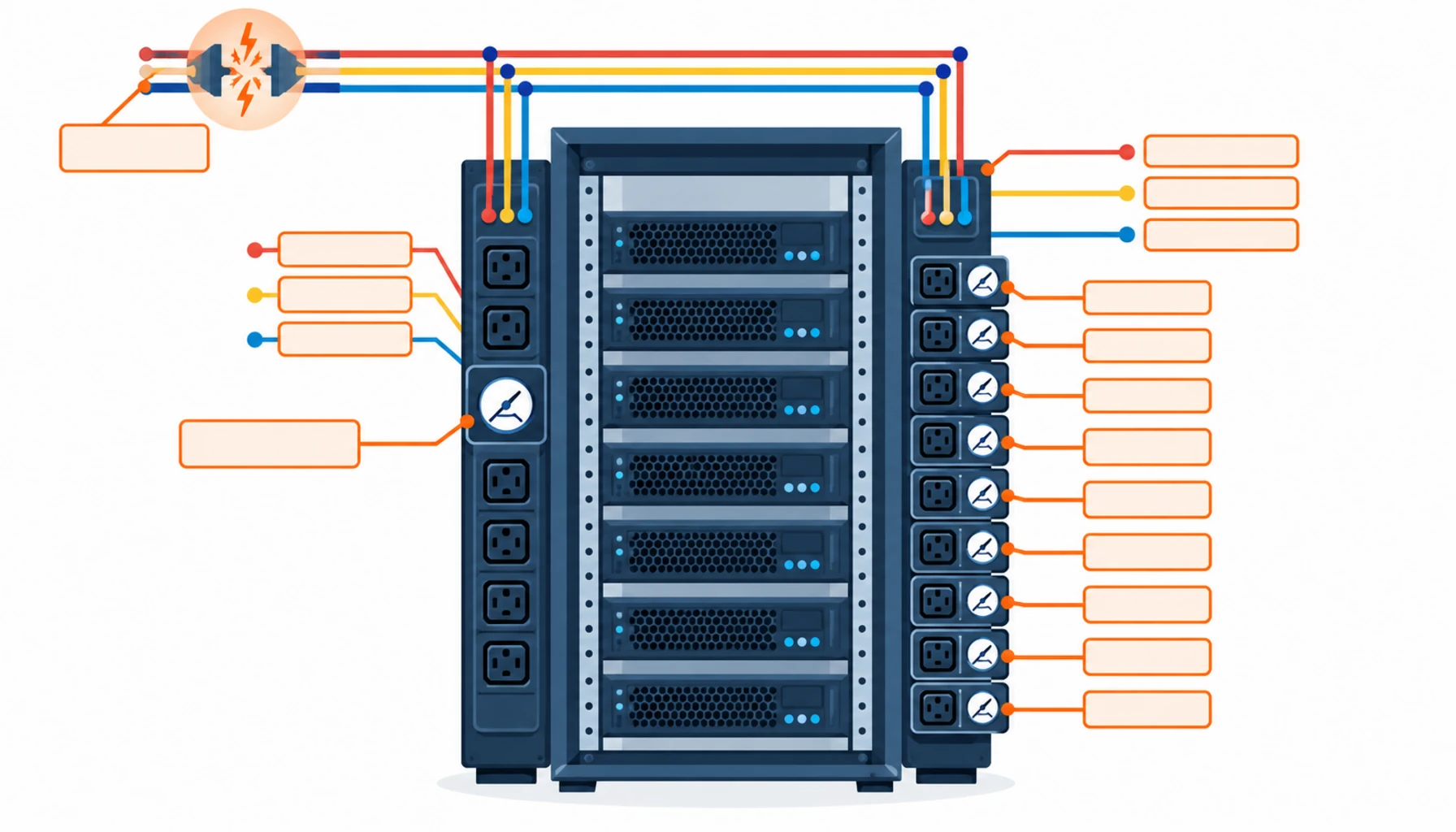
Input metered. A current transformer and meter at the PDU inlet measure total PDU load, often per phase on a three-phase unit. This is the level that answers capacity questions for the rack and is the minimum worth buying. It cannot tell you which server is drawing the power.
Outlet metered. Each outlet pair is measured individually. This is the level that supports chargeback, tenant reporting and locating a single device that is drawing more than its share. It multiplies the electronics in the PDU and is priced accordingly.
Outlet metered and switched. Remote switching adds the ability to shed or cycle an outlet without a site visit. It is bought for operational reasons rather than measurement ones, and it introduces a remote control path that has to be secured and tested.
The common mistake is buying outlet metering for capacity work. Per-outlet data is far more granular than a cable limit needs, and the money is better spent on the board and submain layer above the rack, where the actual cable constraint sits.
The Decision Table: Metering Levels Compared
The table prices the three levels against what an operations team can do with each one.
| Metering Level | What to Specify | Evidence You Should Receive | Cost and Lead Time Shape | Failure Mode If Chosen Wrong |
|---|---|---|---|---|
| Input metered | Per phase or total only, accuracy class, display or network only, protocol, alarm contacts | Factory calibration certificate per unit, protocol conformance statement, sample point list | Lowest premium over an unmetered PDU; short lead time | Total-only metering on an unbalanced three-phase rack, hiding a phase running hot |
| Outlet metered | Which outlets are metered, outlet pair granularity, accuracy class, poll rate at full count | Per outlet certificate, poll rate test under worst case outlet count, register map | Roughly doubles the electronics cost per PDU; adds weeks to lead time | Buying outlet detail when the constraint is upstream, at several times the cost of board metering |
| Outlet metered and switched | Switching method, latching or non-latching, per outlet control, access control and logging of remote actions | Switching test report, security annex, audit log of switching events, fail safe state defined | Highest unit cost; needs a change control process before go live | A remote control path nobody governs, and an outlet switched off without a record of who did it |
Accuracy, Per-Phase Measurement and Thresholds
Accuracy. Rack metering is capacity and alarm work, so a stated class around 1% is normally adequate. Billing grade belongs only where the readings will be invoiced. Ask for the class at the operating range you will actually run in, because accuracy quoted at full scale says little about behaviour at 20% load, and 20% is where idle racks sit.
Per-phase measurement. Three-phase racks are rarely balanced. Where only the total is measured, a 32 A phase and a 12 A phase can look comfortable together. Per-phase current is the cheapest way to catch an unbalanced rack before a phase trips, and it is the first metering feature to cut when a budget is tight and the last one that should be.
Thresholds. Set warnings against the rack design load, not the PDU rating. A 32 A three-phase PDU feeding a rack designed for 10 kW should warn where the design load is approached, which is well below 32 A. Add a broken circuit alarm that fires when a feed loses current, since a dropped feed is the event most likely to take a rack down and the easiest to detect. The interaction between rack load and upstream cable sizing is set out in our note on cabling a 1 MW rack.
What to Freeze Before the PDU Order
| Item | What to State | Evidence to Attach | Cost of Leaving It Open |
|---|---|---|---|
| Metering level | Input, outlet or outlet switched, stated per rack type rather than per project | A metering matrix by rack type in the tender | Mixed fleets that cannot be compared, and a platform with inconsistent data |
| Accuracy class | The class required, and the load range over which it must hold | Factory certificates stating class and test points | Achieving compliance on paper and unreliable alarms in service |
| Phase measurement | Per-phase current on every three-phase unit, with phase identification | Sample display or register map showing phase values | Unbalanced racks that look normal until a phase trips |
| Inlet and cord | Inlet rating, plug type, cord length and phase rotation marking | Dimensional drawing and plug specification | PDUs that will not reach the busway tap-off, or plugs that do not match |
| Form factor | Zero U or rack mount, mounting hardware, and the rack space consumed | Dimensional drawing with mounting bracket details | PDUs that foul the rail or block a PSU, discovered during install |
| Protocol and firmware | Protocol, polling rate, firmware update path, credential policy and network segment | Integration test note and a security annex | A device the IT team will not connect, or one nobody can patch |
| Alarm configuration | Warning and critical thresholds per rack type, broken feed alarm, and who receives them | Alarm schedule signed by the operations team | Alarms set at factory defaults that fire either never or constantly |
| Acceptance and spares | The load comparison test at handover, plus a spare PDU per rack type | Signed test record and a spares list | A platform accepted on a display reading, and a swap that takes days to source |
Receiving, Configuring and Proving the Fleet
A metered PDU is a networked device, and the cost of getting the fleet right sits mostly after delivery. Four steps are worth writing into the order.
Receiving inspection. Check the inlet plug type, cord length and phase markings against the order before the units go anywhere near a rack. A plug that does not match the busway tap-off is a return, and a return during a fit-out programme is a delay. Count the outlets, confirm the metering level from the label rather than the carton, and record serial numbers against rack positions on receipt, not later.
Configuration baseline. Configure thresholds, alarm recipients and network settings from a template per rack type rather than one unit at a time. Where the PDU supports a configuration file, require the vendor to supply it and require the file to be version controlled. A fleet configured by hand has as many configurations as it has units.
Firmware and credentials. Set a baseline firmware version, change default credentials before the device reaches the network, and agree who owns future updates. Devices that arrive on a live network with factory credentials are the most common security finding in a new data hall.
Handover proof. Add the rack loads at the board, compare the sum with the board reading, and record the result per row rather than as a single site number. Where the two disagree by more than the stated accuracy allows, the cause is usually a mislabelled PDU or a rack fed from a circuit nobody mapped, and both are cheap to fix at handover and expensive to find a year later.
When Metered PDUs Are Not the Answer
Where the constraint is upstream. A rack PDU cannot show you that a submain is approaching its derated limit. Where capacity planning is the goal and the board is unmetered, buy board metering first and rack metering later.
Where racks are fixed and single tenant. In a hall where each rack is dedicated to one tenant at a contractual load, outlet metering adds reporting that nobody reconciles. Input metering plus a design load limit is enough.
Where there is no change control for switching. Outlet switching without an audited process is a remote control that can take a production rack down from a browser. Where the operational discipline does not exist yet, buy metering without switching and add switching when the process is in place.
Where the fleet is too mixed to compare. Metering thirty rack types to five different depths produces data that cannot be aggregated and a support burden that scales with the variety. Standardise the rack types first, then specify the metering once. The redundancy designs these racks are built on are covered in our note on redundant power feeds.
RFQ Checklist
- Metering level named per rack type, not as a project wide statement
- Accuracy class stated with the load range over which it must hold
- Per-phase current on all three-phase units, with phase identification in the register map
- Outlet granularity defined as outlet pairs or single outlets, and the polling rate at full outlet count
- Warning and critical thresholds per rack type, derived from rack design load
- Broken feed alarm required, with the response defined and tested at commissioning
- Inlet rating, plug type, cord length and phase rotation marking stated
- Form factor and mounting hardware confirmed against the actual cabinet drawing
- Protocol, polling interval, firmware update path and credential handling specified
- Audit logging required on any unit with remote switching, plus an agreed change control process
- Load comparison test at handover, with board totals and rack totals reconciled
- Spare PDU per rack type included in the initial order
Conclusion
Rack metering pays for itself when it changes a decision: deferring a rack deployment because the phase is hot, catching a dropped feed before the second one goes, or showing a tenant exactly what they used. Each of those needs a specified metering level, a stated accuracy and a threshold with an owner. None of them needs the most expensive PDU in the catalogue.
Kexingyu Cable Group (KXYE) supplies the cable and distribution equipment that sits above and around the rack, including the WDZ-YJY, WDZN-YJY, BTTZ, NG-A (BTLY), KVV and YJV ranges, the data center cable range used on submain and rack feed routes, and the GGD power distribution cabinet where the board level metering that rack data reconciles to is installed, from one factory group with copper price linkage on project-scale orders. Send your rack types and the metering level you intend to buy, and we will return the cable ratings and factory records that the readings need to be compared against; the fastest route is a request for quotation.