Trailing Cable for LHDs and Drill Rigs: Specifying for Drag and Reel
Quick Answer: A loader and a drill rig drag their cable over the same ground all shift, but the two machines load it differently and the replacement triggers are not the same. This guide sets out the drag and reel numbers a supplier needs, the coupler and reel interfaces that decide where the cable fails first, the evidence to demand, and the criteria to write down so a replacement is a decision rather than a reaction.
Introduction
Trailing cable is the part of a mine’s electrical system that is designed to be consumed. No sheath survives indefinite dragging over broken rock, and the honest question is not whether the cable will be replaced but how many shifts it should last and what condition justifies taking it out of service.
That reframes procurement. A trailing cable order is not only about the drum; it is about the coupler, the reel or guide it runs through, and the maintenance routine that keeps the sheath from being cut at the same point every shift. Buyers who specify only the cable and leave the interfaces to the site end up replacing drums for reasons that were fixed at the machine, not at the factory.
What an LHD Does to Its Trailing Cable
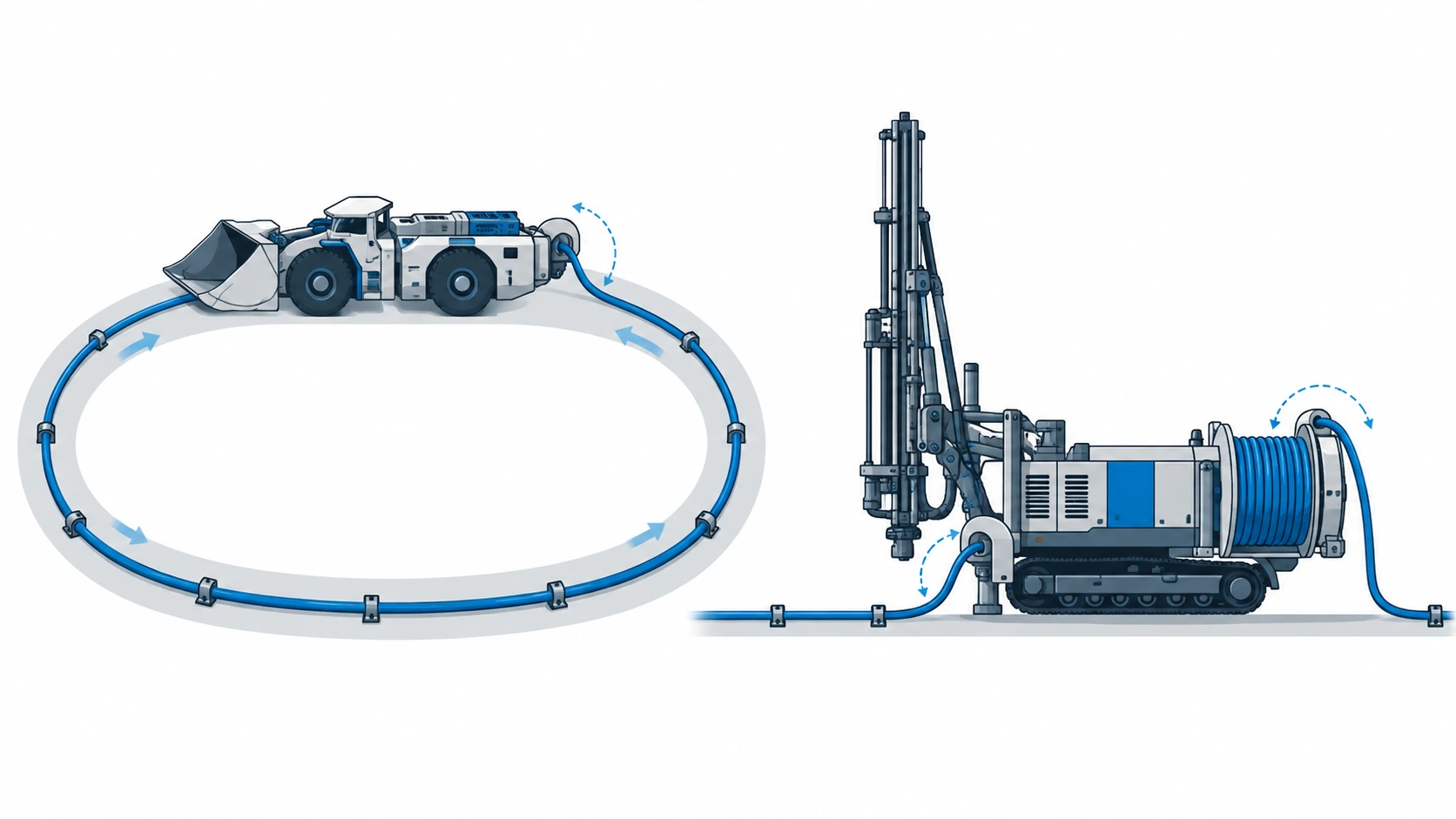
A load-haul-dump machine works in a loop, and the cable follows a path that repeats several hundred times a shift.
Drag over broken ground. The sheath is pulled across blasted rock and through wet muck, so the failure that matters is abrasion on the underside of the cable rather than a clean cut. Once the sheath is worn thin, water reaches the screen and the run fails as an earth fault some weeks later.
Bending at the machine entry. The tightest radius on the whole run is usually where the cable enters the machine or its junction box. A cable that meets the standard bend allowance can still fail there if the entry is poorly restrained.
Crush at the switchback. Drivers cross the cable at the end of a haul, and the result is not always a cut. A flattened core bundle resists current, runs hot, and shows up as a termination failure rather than a cable failure.
All three point at the same two specification clauses: conductor class and sheath reinforcement. A flexible conductor keeps the copper alive through the bending, and a reinforced sheath keeps the water out.
Drill Rigs: A Different Drag Profile
A drill rig does not run a loop. It walks or is towed between holes, and the cable is dragged behind it in a straight line, then wound onto a reel or coiled at the end of the move.
That changes the load. The dominant stress on a rig cable is axial pull, taken through the sheath and the conductor stranding, plus the torsion that a spiral-wound reel adds with every revolution. A construction that performs well on an LHD’s abrasion duty can corkscrew within a few thousand reel cycles on a rig, because the reeling geometry is a different problem from the drag.
The practical consequence is that a fleet running both machine types usually needs two trailing specifications. Sharing one drum between them over-specifies the loader run in torsion it never uses and under-specifies the rig in sheath reinforcement. Our note on reel crane cable covers the reeling duty in more detail, and the tension-rated options sit in the reeling cable range.
Sizing the Trailing Run
Trailing runs are short in distance and heavy in current, so the electrical calculation looks different from a feeder.
Run length. State the working length including the loop or the tow path, not the distance between the ends. A trailing cable that measures sixty metres laid out can be a hundred metres in service.
Starting duty. Give continuous and starting current and how often the machine starts. A loader starting loaded several hundred times a shift puts a duty on the cable that a pump running continuously does not, and the conductor that satisfies steady-state current may still fail the starting voltage requirement at the motor terminals.
Ambient and installation. Cable coiled on a reel, cable lying in a puddle and cable grouped beside a second run derate differently, so ask for the derated current rather than the table figure. Earth fault protection is set against the circuit’s earth loop impedance, which makes the calculation a pre-order task rather than a commissioning one.
The table below maps the two machine types against what to specify, what to demand as evidence, and how each one usually fails.
| Machine or interface | Duty on Site | What to Specify | Evidence to Demand | Cost and Lead-Time Driver | How It Fails |
|---|---|---|---|---|---|
| LHD trailing cable | Dragged in a loop over broken rock, hundreds of cycles a shift | Class 5 or 6 conductor, EPR insulation, reinforced sheath, screen arrangement, declared bend radius | Drag and flex data at the declared radius, sheath abrasion results, screen continuity on the finished length | Sheath compound and reinforcement set the price band; working lengths add to logistics | Sheath worn through to the screen, then water ingress and an earth fault |
| Drill rig trailing cable | Dragged in a straight line, then reeled or coiled | Reel duty and torsion rating for the winding geometry, tension range, guide dimensions, length per drum | Reeling cycle test at the declared tension and geometry, torsion test for spiral drums | Torsion-rated construction is usually made to order and costs more | Corkscrewing beyond rating, core breakage at the drum entry |
| Reel and guide assembly | Takes the cable in and out with the machine's move | Drum diameter against the cable's rated radius, guide roller spacing, tension setting | Dimensions checked against the cable datasheet, not the other way round | A matching reel is cheaper than a repeat cable order | Sheath flattening at the guide, cable stacking on one side of the drum |
| Coupler and machine entry | Uncoupled and moved daily, wet and dirty | Rated voltage and current, ingress protection, compatibility with the cable construction, strain relief | Type test evidence, sealing verification for the assembled state, torque values | Kits are cheap against the labour of a joint; incompatible kits are the expensive version | Joints that pass a megger and fail under load, repeat failures in the first metre |
| Repair sleeve and splice | Applied in the field to a cut sheath or a damaged screen | Compatibility with the sheath compound, dielectric rating, moisture sealing for the repaired length | Instructions and acceptance criteria for the repaired joint | A field repair buys days of service, not a season | Moisture into the screen, a fault that returns to the same location |
Construction Choices That Move Life
Conductor class. Flexible trailing cable uses finely stranded copper, and the finer the stranding the longer it survives repeated bending. Class 5 and class 6 conductors cost more than standard stranding, and on a trailing application they are not optional. Our note on class 6 conductor flex explains what the finer stranding buys in cycles.
Insulation and sheath. Ethylene propylene rubber stays flexible at low temperature and tolerates the working that comes with a moving cable. The sheath takes most of the budget and most of the abuse; reinforcement is what separates a haul-road cable from a general-purpose rubber one, and our note on abrasion-resistant cable jackets works through the options. A screen or pilot core for earth continuity monitoring is a safety function rather than a signal function, so how it behaves when the sheath is cut matters more than the coverage figure.
Replacement Criteria and Expected Life
A trailing cable programme is cheaper when the replacement trigger is written down before the drums arrive, because “when it looks bad” is a judgement that varies by shift.
Condition triggers worth writing into the maintenance plan. Sheath wall thickness below the stated minimum at the worst point; visible reinforcement exposed or broken; screen continuity outside tolerance end to end; a rising insulation resistance trend across successive tests; and any repair within a metre of the machine entry or the drum.
Test method. Insulation resistance and screen continuity checks recorded against the cable’s asset number turn the replacement decision into a trend rather than an opinion. Our note on cable flex testing method explains what the factory test does and does not tell you about service life.
Suppliers can be asked to state an expected cycle life at the declared radius and tension. The number is only useful if it is tied to the same bend radius and the same reeling geometry the machine actually imposes, so put those figures in the RFQ rather than accepting a headline.
What to Freeze Before the Order Goes Out
These five items are cheap at specification stage and expensive once drums are on a truck.
| Decision | What to State | Evidence to Attach | Cost of Leaving It Open |
|---|---|---|---|
| Machine duty | Loader or drill rig, with the cycle and the reel geometry | A cable schedule mapping each machine to its duty | One drum bought for two different load cases |
| Working length | Loop or tow path length, not the laid-out distance | A route sketch with the trailing loop marked | A cable too short to work the face |
| Bend radius and tension | Minimum radius at the machine entry, plus reel tension where reeling applies | Flex and reeling cycle data at the declared duty | Core breakage or corkscrewing inside the first year |
| Interfaces | Coupler type, reel diameter, guide spacing and strain relief | Dimensions checked against the cable datasheet | Repeat failures in the first metre of every drum |
| Replacement criteria | The condition triggers and test records that retire a cable | A written maintenance plan with acceptance criteria | Drums kept in service past the point where they are safe |
Cost Structure and Lead Time
Trailing cable is priced from the copper outward. A flexible conductor is the largest single component and the only one that moves between quotation and order, so on a programme that runs long the copper basis and its validity window belong in the comparison rather than in a footnote.
The sheath compound and the reinforcement are the second lever. A torsion-rated construction for a rig reel and a submersible service cable each add cost a general-purpose drum avoids, and a quotation that is unexpectedly cheap is usually a quotation for less cable than was asked for.
Lead time follows the same pattern as the rest of the mining range. Stock constructions ship in days, made-to-order trailing cable runs on the sheath line, and anything carrying a certified underground construction is the longest because the approved compound and the test regime sit on the critical path. Plan back from the shutdown, not forward from the specification date.
Incoming Inspection and First-Week Checks
Against the drum, before anything is cut. Count drums against the packing list, verify marked lengths and photograph the markings, including the construction code and drum number.
Electrical and dimensional checks. Conductor resistance and continuity, insulation resistance, and screen continuity end to end; then overall diameter, sheath thickness and conductor cross-section on a cut sample. Measuring the copper area settles arguments about the conductor, and it is best done with both parties present.
First-week checks on the machine. Record the bend at the machine entry and at the guide, check the coupler seating and the strain relief, and note the cable’s tracking on the drum. Most repeat failures start as a routing fault that was visible in the first week and left alone.
When a Trailing Cable Specification Is Not the Answer
When the failure is routing, not cable. Damage at the same point on the run is usually a guide, a clamp or a bend radius problem. Our note on cable damage wear patterns is written to separate a routing fault from a cable fault before a heavier drum is bought.
When one specification is expected to cover loaders and rigs. The drag duty of a loader and the reeling duty of a rig do not have the same answer at a sensible price. Two specifications cost less over a fleet’s life than one compromise.
When the reel is the constraint. A drum smaller than the cable’s rated radius will fail a correct cable. Changing the construction rather than the reel is the expensive way to solve a geometry problem.
When the protection settings are the real problem. A trailing circuit tripping on earth fault above its setting is telling you about the earth loop, not the cable. Replacing the drum without doing the calculation repeats the fault with newer copper, and the shift loses the same hours again.
When price is the only variable asked about. A trailing cable bought on unit price alone is judged in service rather than in the quotation, and the currency is maintenance hours rather than money.
RFQ Checklist
- Machine type per run: loader, drill rig or service machine
- Working length including the trailing loop or tow path
- Reel or guide geometry, tension range and drum diameter
- Minimum bend radius at the machine entry and at the guide
- System voltage, insulation level and prospective fault current
- Continuous and starting current, plus starting frequency per shift
- Ambient and installation conditions, with the derated current required
- Conductor class, insulation and sheath compound, with reinforcement stated
- Screen or pilot core arrangement, plus the monitoring system it supports
- Coupler type, supplier and strain relief arrangement
- Factory-fitted ends versus field joints, and repair sleeve compatibility
- Expected cycle life at the declared radius and tension
- Working lengths, drum sizes, drum marking, and the copper basis with its validity window
Conclusion
Trailing cable for loaders and drill rigs is bought against two different load cases, and the specification should say which one it is solving. State the working length, the drag or reel duty, the interfaces at the machine, and the criteria that will retire the cable, and the order stops being a replacement cycle you cannot forecast.
Kexingyu Cable Group (KXYE) has supplied electrical cable from Quanzhou since 1996, including the rubber-sheathed, screened and control constructions that mobile mining duty calls for, along with the couplers, joints and accessories that go with them. Send us the cable schedule with the machine types, the working lengths, the reel or guide dimensions and the site conditions, and we will come back with the constructions, the test evidence that applies to each, and a delivery plan against your shutdown window. The fastest route is a request for quotation.