EMC Standards for Machinery Cabling: Emission and Immunity Requirements
Quick Answer: Machinery EMC rules ask a machine to keep its emissions inside limits and its functions working under interference, and the cabling layer, shields, routing and bonding, carries most of that load in practice.
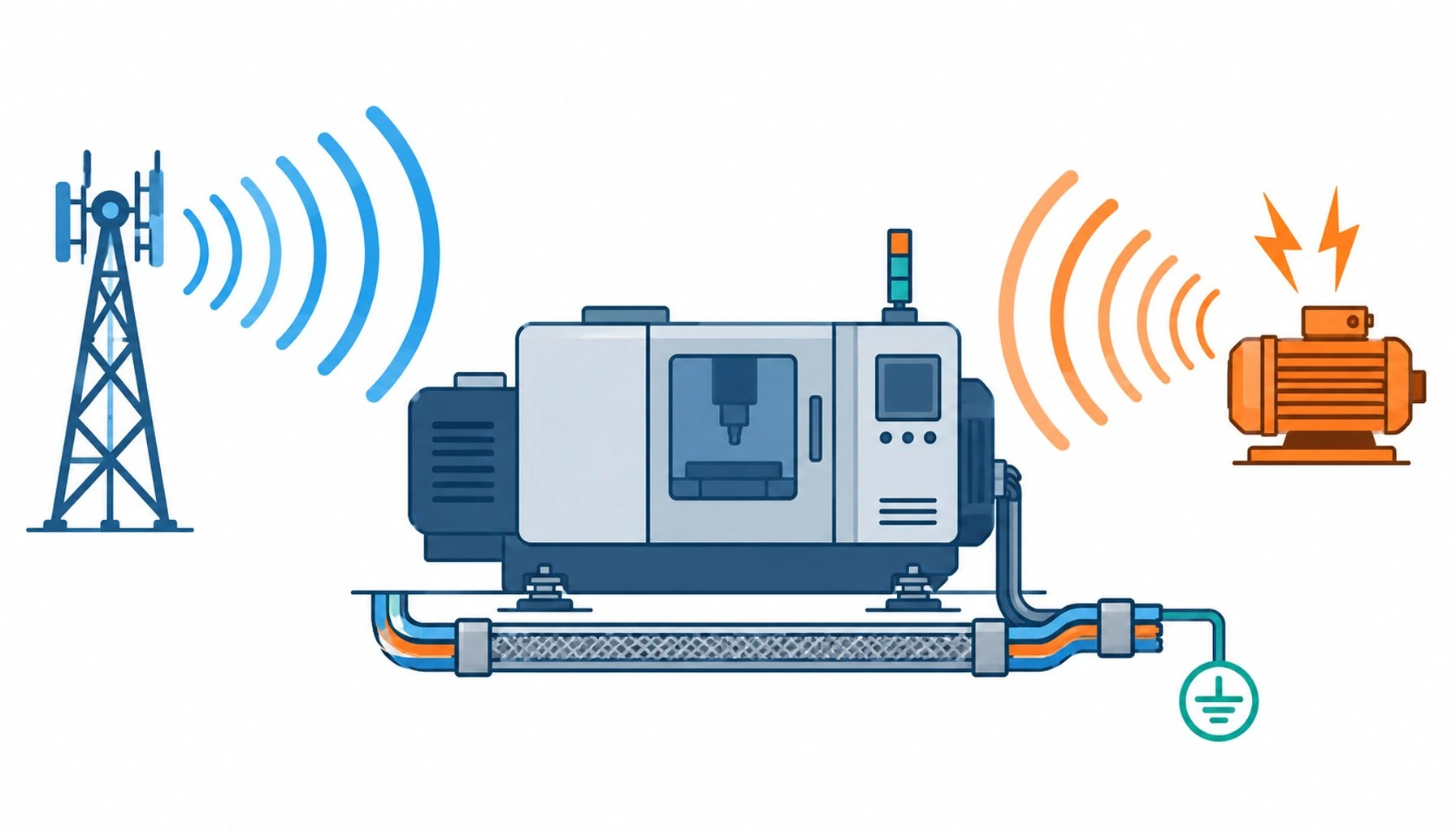
Every modern machine is both a broadcaster and a listener. Its drives switch kilowatts at frequencies that radiate, and its sensors, encoders and communication links carry millivolts that interference can flatten. The EMC standards for machinery exist to keep both sides inside workable bounds, and while filters, enclosures and grounding design carry their share, the cabling layer carries more than buyers expect: shield construction, shield termination, separation discipline and routing geometry are where a machine’s EMC plan is mostly won or lost. This guide maps the standards that apply, translates emission and immunity into cable decisions, and marks the difference between what the standards demand and what the machine actually needs to stay quiet through its life.
Introduction
Two regulatory directions shape machine EMC. The emissions direction limits what the machine pushes into its environment, onto the mains and into the radio spectrum, so the machine does not disturb its neighbors. The immunity direction requires the machine’s functions to survive the interference of a realistic industrial environment, transients, fields and conducted noise, so the machine is not the victim. Standards encode both: generic frameworks for emission and immunity in industrial settings, product-level frameworks for power drive systems, and the machinery wiring standard’s own requirement that signal functions remain unimpaired by interference. The cabling that ties a machine together appears in all of them, mostly as the physical mechanism through which the requirements are met.
The machine-level wiring obligations that frame all of this are treated in the guide to control cabinet construction, and the electrical wiring standard behind them in the EN 60204-1 context; this guide stays on the EMC layer and its cable consequences.
The Standards Map: Which Rules Apply to a Machine
A machinery EMC assessment typically stands on three layers. The generic standards for industrial environments set emission and immunity baselines that most machines must meet, defining test levels and limits for the equipment as installed. The power drive systems standard, the one most cited around variable frequency drives, adds the drive-specific expectations, including the conducted emission management that filters and screened motor cables serve. And the machinery wiring standard contributes the design requirement that signal circuits be arranged so interference does not impair function, which is the clause cable separation and shield plans are written against. National frameworks lean on these layers rather than replacing them, which is why a coherent EMC plan travels across markets far better than a machine rebuilt per destination.
For the buyer of cables, the map’s practical message is simple: the same machine, wired with the right screened cables and disciplined routing, passes; the same machine with unscreened motor runs and mixed bundles can fail through hardware that was never the problem. The interference failures that drives and wiring cause when neglected are treated in the guide to common inverter problems and the companion on drives and starting methods, and the EMC layer is where those issues are prevented rather than patched.
Emission: Keeping the Machine Quiet for Its Neighbors
Emission requirements target two paths. Radiated emission, the energy the machine broadcasts, is shaped by enclosure design and by the cables that leave the enclosure, because screened cables with shields landed correctly stay quieter than their unscreened cousins by a margin the standards measure in decibels. Conducted emission, the noise the machine pushes back onto the mains, is mostly a filter matter, but the filter’s job depends on the installation: a screened motor cable with a good shield termination lets the drive’s filter work as designed, while a long unscreened run turns the cable into an antenna and undoes the filter’s work. The cable decisions that serve emission, screened constructions for the noisy circuits, shield coverage stated honestly, and terminations that are 360 degrees rather than pigtails, are cheap at specification time and expensive at certification time.
Immunity: Keeping the Machine Working in a Noisy World
Immunity requirements flip the question: the machine’s functions must survive defined interference levels, and the sensitive circuits are where immunity is won. Encoders, sensor lines and communication cables carry signals measured in millivolts through an environment full of drive noise, and their defense is threefold: screen coverage that keeps interference out, separation from power runs that keeps sources away, and shield termination that gives interference a clean path to earth instead of through the signal. Cable choice here is a signal-integrity decision, and the distinction between cable families for control and for measurement circuits is treated in the guide to control versus instrumentation cable, where the screen constructions differ for reasons the immunity tests make concrete.
| Layer | Scope | What it requires | Cable decisions it drives |
|---|---|---|---|
| Generic industrial EMC standards | Emission and immunity baselines for industrial equipment | Limits on emission, defined immunity test levels | Screened constructions for circuits that leave the cabinet |
| Power drive systems EMC standard | Variable speed drives and their installations | Conducted emission management, screened motor cabling practice | Screened motor cables with proper shield termination |
| Machinery wiring standard | Electrical equipment of machines | Signal functions unimpaired by interference | Separation plans, shield landing, routing discipline |
| Product and radio frameworks | Specific equipment and wireless functions | Product-specific emission and immunity profiles | Device-level screening and filtered entries |
The Cable Decisions That Carry the EMC Plan
Across both directions, the same cable decisions recur. Screen coverage: braid coverage stated as a number, not an adjective, because coverage is the shield’s material budget. Termination: shields landed over full circumference at metal surfaces, since the pigtail that is easy to install converts the shield into an antenna at exactly the frequency that matters. Separation: power and signal runs physically divided, with crossing at right angles where separation is impossible. Continuity: the shield a continuous conductor end to end, and the bonding path it lands on a designed one, per the cabinet practice described in the control cabinet construction guide. None of these decisions is exotic, which is why they are so diagnostic: machines that follow them pass EMC as a formality, and machines that skip them buy compliance twice.
| Item | Requirement in practice | Failure mode if skipped |
|---|---|---|
| Screened motor and drive cables | Screened construction rated for the drive's output | Radiated and conducted emission limits exceeded |
| Full-circumference shield termination | Shields landed 360 degrees to metal at both ends per plan | Pigtail turns the shield into an antenna |
| Separation discipline | Power and signal runs divided; crossings at right angles | Drive noise couples into encoder and sensor lines |
| Screen coverage stated | Braid or braid-plus-foil coverage quoted as a figure | Thin coverage leaks at the frequencies that matter |
| Bonding path designed | Shield lands on a planned, low-impedance earth path | Interference finds its own path through signals |
| Moving-axis screening | Screens rated to survive flex without coverage loss | Shield degrades with cycles and immunity fades |
When Standards Compliance Is Not the Whole EMC Story
Honest limits: passing the EMC tests proves the machine met limits in a defined configuration, and machines are later modified, cables replaced, lengths changed, shields re-terminated by whoever opens the cabinet. The EMC plan therefore needs an afterlife in maintenance documents: which circuits are screened, what the termination standard is, and what a substitute cable must match. Standards also test a snapshot of couplings and layouts that the factory floor will not reproduce exactly, so margin, building the plan with buffer above the limits, is the difference between a machine that passes once and a machine that stays quiet. And for equipment crossing markets, the EMC layer sits inside the broader certification stack treated in the guide to the equipment certification checklist, which decides which framework the tests follow.
RFQ Checklist: EMC Requirements on a Cable RFQ
Attach these items to the RFQ:
- Circuit inventory: which runs are noisy sources, which are sensitive victims, which are both
- Screen requirements: coverage figures and construction for each circuit class
- Motion duty: flex and torsion requirements for screened cables on moving axes
- Termination plan: shield landing architecture the cables must support
- Environment: temperature, oil and abrasion conditions along the EMC-critical routes
- Documentation: construction records that feed the machine’s EMC file and maintenance plan
The reading discipline that keeps supplier construction claims verifiable is covered in the guide to reading equipment datasheets, and screen coverage is one of the claims that most rewards the habit.
Conclusion
Machinery EMC is a two-way contract, emissions bounded, immunity proven, and the cabling layer does more of the physical work than any other single subsystem: screened constructions for the noisy circuits, defended screens on the sensitive ones, termination and separation that decide whether shields function or decorate. Specified deliberately, the EMC layer passes tests as a formality and stays quiet for the machine’s life; specified casually, it becomes the reason the project revisits hardware nobody wanted to touch.
Kexingyu Cable Group (KXYE) supplies screened machine cable with coverage and construction stated plainly, rated for the flex duty moving axes impose. Send your machine’s EMC-critical scope through the RFQ page, and we will quote the screens to match the plan.