Cable for Methane and Coal Dust Hazard Zones: The Approval Path
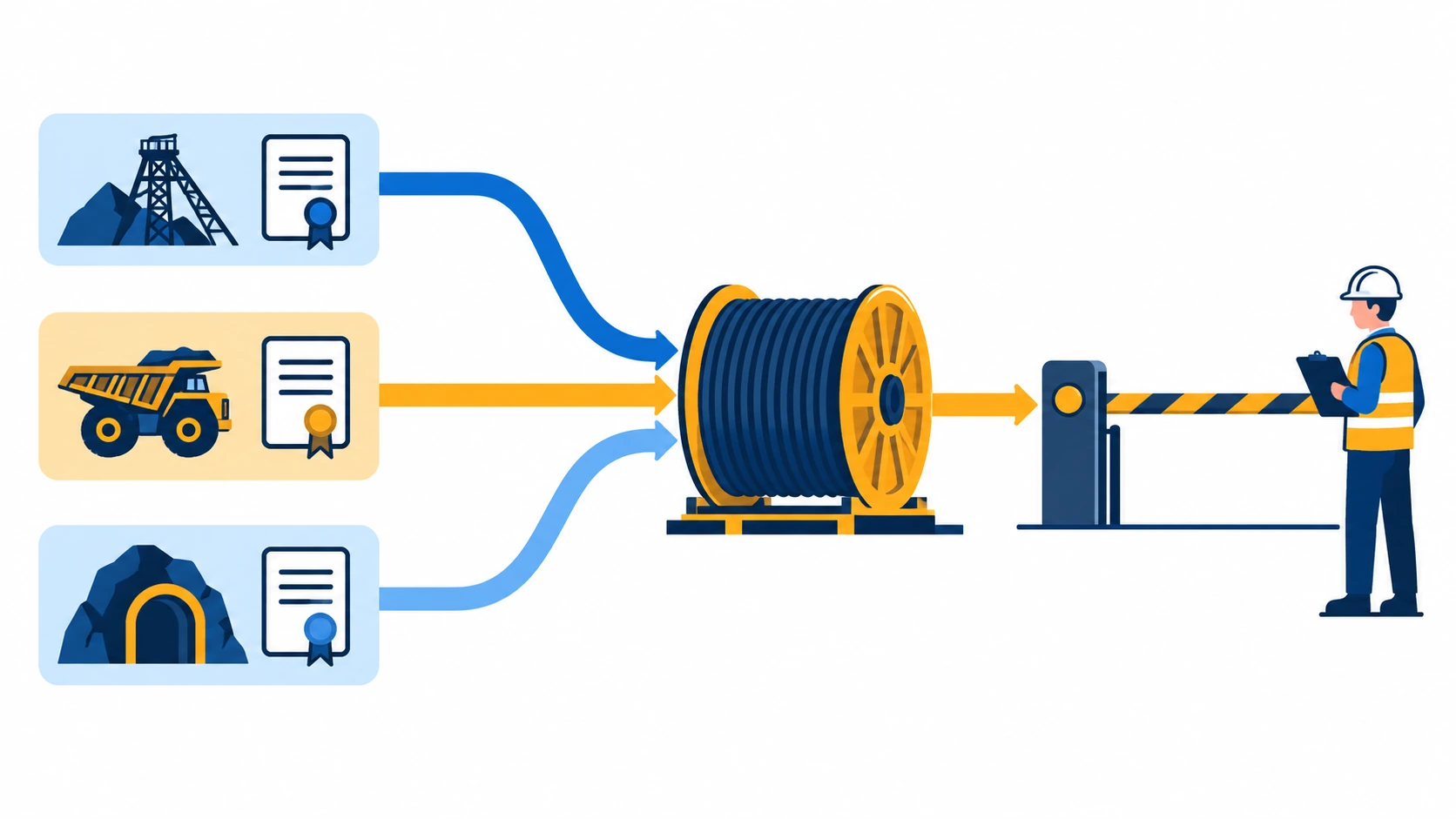
Quick Answer: In a gassy roadway a cable is not accepted because it is well specified; it is accepted because an authority has approved that construction, and the mark is what the inspector looks for. The approval attaches to a defined construction, follows a path that differs by destination market, and adds lead time that has to be planned rather than discovered. This guide covers what makes a zone hazardous, how the approval systems differ, what the mark covers, and what to freeze before the order goes out.
Introduction
Most cable procurement is a technical exercise with a commercial wrapper. Approval cable procurement is the reverse: the technical answer is usually settled early, and the project is decided by whether the paperwork arrives in time and covers the construction that is actually being supplied.
That makes the approval path the critical path. Buyers who treat certification as something the supplier handles in the background routinely lose four to eight weeks, because the compound has to be the approved one, the tests follow a fixed regime, and the mark is issued against a construction rather than a company. The equipment on the same order, the junction boxes and switchgear, follows a similar discipline and is covered in our note on the mining power equipment package.
What Makes a Zone Hazardous
The approval requirement follows the hazard, and the hazard is defined before the cable is chosen.
Methane. A gassy roadway can accumulate firedamp, and the ignition source that matters for cable is not the conductor but a spark from a charged surface or a broken circuit. This is why flammability and antistatic performance carry so much weight in a coal mine, and why the approval evidence is about those properties rather than about current rating.
Coal dust. A dust cloud is explosive in its own right, and settled dust spreads a small event into a large one. Cable in a dusty roadway is assessed on the same general principle: keep the surface from holding or releasing energy, and keep the installation from providing an ignition path.
Hybrid zones. Where both hazards are present, the approval addresses both, and the requirements do not simply add up. The zone classification is the starting point, and it belongs in the RFQ as a stated condition rather than as an assumption.
The practical consequence is that a hazard zone classification should appear on the cable schedule line by line. Cable that runs from a gassy heading to a surface plant crosses a boundary, and the boundary is where a specification written for one zone becomes wrong for the other.
How the Approval Systems Differ
Three approval families cover most mining cable, and they are not interchangeable.
The international explosion-protection scheme is built on a common standard with national certificates issued against it, so a cable approved under it can be recognised across participating markets. It is the usual route where a project is financed internationally and the operating company expects a recognisable mark.
The European directive route applies where the destination is inside that market, and it carries its own marking and documentation obligations. Where a project sits outside Europe but specifies European equipment, the mark may still be required by the buyer’s engineering standard rather than by law.
The national mining safety mark is the route in markets such as China, where a mining product safety mark is issued against a named construction, and it is what the mine’s own inspector will ask for. It is not replaced by an international certificate; it sits alongside it.
Choosing the wrong family is an expensive mistake because the marks are not substitutional. Our note on cable import certification by country sets out how the requirements change between destinations, and our note on machine export cable certification covers the case where the cable ships as part of a machine rather than as a separate order.
What the Approval Attaches To
The single most useful fact about approval cable is that the certificate describes a construction, not a product line.
A typical approval names the conductor class and material, the insulation, the sheath compound, the screen or armour arrangement and often a wall thickness or a diameter range. Change any of those and the approval no longer describes the cable, even where the drum looks identical and the performance is nominally the same.
That has three consequences for a buyer. First, a substitution agreed to save cost is an approval event, not a commercial one. Second, moving production to a second line can break the mark even when the process is identical, so the manufacturing location belongs in the purchase order. Third, the approval covers the cable and the accessories that were tested with it, so a coupler or a joint from a different source is outside it unless it carries its own approval.
Treat the construction drawing as the controlling document in an approved order. Everything that changes gets compared against it, and any change is confirmed in writing against the certificate before it is made.
The table below sets the approval systems side by side, with what each covers, the evidence it produces and the lead time it adds.
| Approval route | Where It Applies | What to Specify | Evidence to Demand | Cost and Lead-Time Driver | How It Fails |
|---|---|---|---|---|---|
| International explosion-protection scheme | Projects financed internationally, recognised across participating markets | The certificate number and the construction it names, including the manufacturing location | Certificate plus the test reports behind it, for that construction | Testing to the regime and documentation sit on the critical path | A certificate for a similar construction that does not cover the cable supplied |
| European directive route | Destinations inside that market, or buyers whose standard requires the mark | The marking obligation, the documentation set and the notified body involved | Declaration and the supporting test evidence for the construction | Documentation and any notified body involvement add weeks | A cable shipped without the marking the buyer's standard requires |
| National mining safety mark | Markets where a mining product safety mark is issued against the construction | The mark, the construction it covers, and the validity period | Mark documentation with the named construction and any batch references | Approval administration and the approved compound set the lead time | A delivery the mine's inspector cannot accept, and a re-award |
| Accessories and couplers | Same zone as the cable, and often overlooked | Whether the accessory carries its own approval and to which standard | Approval evidence for the assembled accessory | An unapproved coupler can delay an otherwise approved order | A compliant cable held at the gate because the coupler is not approved |
| Manufacturing location and change control | Every approved order | The production site, plus a written rule that changes are approval events | Confirmation that any change still sits inside the certificate | A change after approval can restart part of the process | An approval silently invalidated between award and delivery |
The Documents in an Approval Pack
An approval submission is a pack rather than a single certificate, and knowing what is in it makes the timeline predictable.
The construction drawing, with every layer declared and dimensions with tolerances. This is the document the certificate refers to, and it is the reference for every later comparison.
Test reports for the properties the approval covers, naming the standard, the method and the measured values. For a coal mine cable those are usually flammability and antistatic results, and our note on ZA, ZB and ZC flame retardant cable explains how the classes differ.
The certificate or mark, naming the construction, the manufacturing location and its validity. Our note on third-party cable inspection covers how independent verification fits alongside a supplier’s own documents.
Factory quality evidence, which is where a buyer’s own audit or a third-party factory check earns its cost. Our note on cable factory audit sets out what to look at when the order depends on a process rather than an inspection.
What to Freeze Before the Order Goes Out
These five items are cheap at specification stage and expensive once a delivery is refused at the gate.
| Decision | What to State | Evidence to Attach | Cost of Leaving It Open |
|---|---|---|---|
| Destination requirement | The mark the destination mine's authority actually recognises | Written confirmation of the accepted standard from the mine | A cable approved to a standard the site does not accept |
| Zone classification | The hazard class for each run, line by line | A zone drawing with the cable schedule mapped to it | A surface construction used inside a gassy boundary |
| Construction scope | The exact construction the certificate must name | The construction drawing, declared layer by layer | A certificate that describes a different cable |
| Manufacturing location | The production site, with changes treated as approval events | Confirmation that the site is inside the certificate | An approval invalidated between award and delivery |
| Timeline | The approval and test lead time, working back from the shutdown | A schedule showing approval, test and shipping milestones | Weeks lost to a queue nobody planned for |
Timeline and Lead Time
Approval cable runs on a longer clock than ordinary cable, and the useful way to plan it is backwards from the date the roadway has to be energised.
Approval administration. Submitting a construction for a mark, or confirming that an existing certificate covers a variation, takes time that does not compress well. Start it when the construction is frozen rather than when the order is placed.
Testing. The tests follow a fixed regime and cannot be shortened by paying more. Where a compound has to be the approved one, the compound itself may need to be scheduled.
Documentation. The paperwork is part of the product, and a drum that arrives before its certificate cannot be inspected in. Build a documentation milestone into the supply plan rather than assuming it arrives with the cable.
Where a project has a fixed energisation date, the approval path is usually the longest single item in the electrical package. Buying earlier is the only lever that works; buying cheaper is what creates the delay.
Incoming Inspection Against the Mark
Documents first. Match the certificate and the test reports to the drum references, and check the construction named against the construction delivered. This is where a substitution is caught, and it is far cheaper to catch here than underground.
Construction checks. Verify conductor class, sheath compound and screen arrangement against the approved drawing, using the sample cut for dimensional measurement. The point of the check is to confirm identity, not performance.
Accessories. Confirm that couplers and joints arriving with the order carry their own approval where the zone requires it, and match them to the cable rather than to the packing list alone.
When an Approval Path Is Not the Answer
When the run is outside the zone. A surface feeder or a plant circuit does not need an underground approval, and paying for one adds lead time for a condition the route does not have. Map the zone boundary onto the cable schedule before the order is written.
When the mark is assumed to be portable. An approval issued in one market is not automatically recognised in another, and the receiving authority’s list is what counts. Confirm the accepted mark in writing and keep the confirmation with the order.
When a similar certificate is offered. A certificate for a construction that is close but not identical is the most common approval trap, and it is invisible until the inspector compares the drawing with the drum.
When the accessory is treated as an afterthought. A compliant cable with an unapproved coupler is a delivery that cannot be energised, and the fix is a second shipment rather than a decision.
When price is the only variable asked about. On approval cable the comparison is between two equivalent approved constructions, and a quotation that omits the approval is a quotation for a different product. The currency of that mistake is a missed energisation date.
RFQ Checklist
- The mark the destination mine’s authority recognises, confirmed in writing
- Zone classification per run, with the zone drawing attached
- Construction drawing with every layer and dimension declared
- Certificate or mark scope matched to that construction
- Manufacturing location named, with a written change control rule
- Test reports for the properties the approval covers, with measured values
- Accessories and couplers, with their own approval status stated
- Validity period of the mark, and what happens if it lapses mid-order
- Approval and test milestones in the supply schedule
- Documentation milestone, separate from the shipping milestone
- Factory audit or independent verification requirement, where the order depends on process
- Copper basis and its validity window, stated per quotation
Conclusion
In a hazardous zone the cable is accepted on an approval, and the approval follows a construction, a manufacturing location and a destination market. Confirm the mark the mine accepts, freeze the construction before the application is made, and plan the approval and documentation milestones backwards from the energisation date rather than forwards from the purchase order.
Kexingyu Cable Group (KXYE) has supplied electrical cable from Quanzhou since 1996, including the flame retardant, screened and rubber-sheathed constructions that gassy and dusty roadways call for, with the test evidence that goes with them. Send us the zone classification, the mark your authority accepts, the duty and the run lengths, and we will come back with the constructions, the documents behind them, and a delivery plan against your energisation date. The fastest route is a request for quotation.