Flame-Retardant and Anti-Static Mining Cable: What the Tests Prove
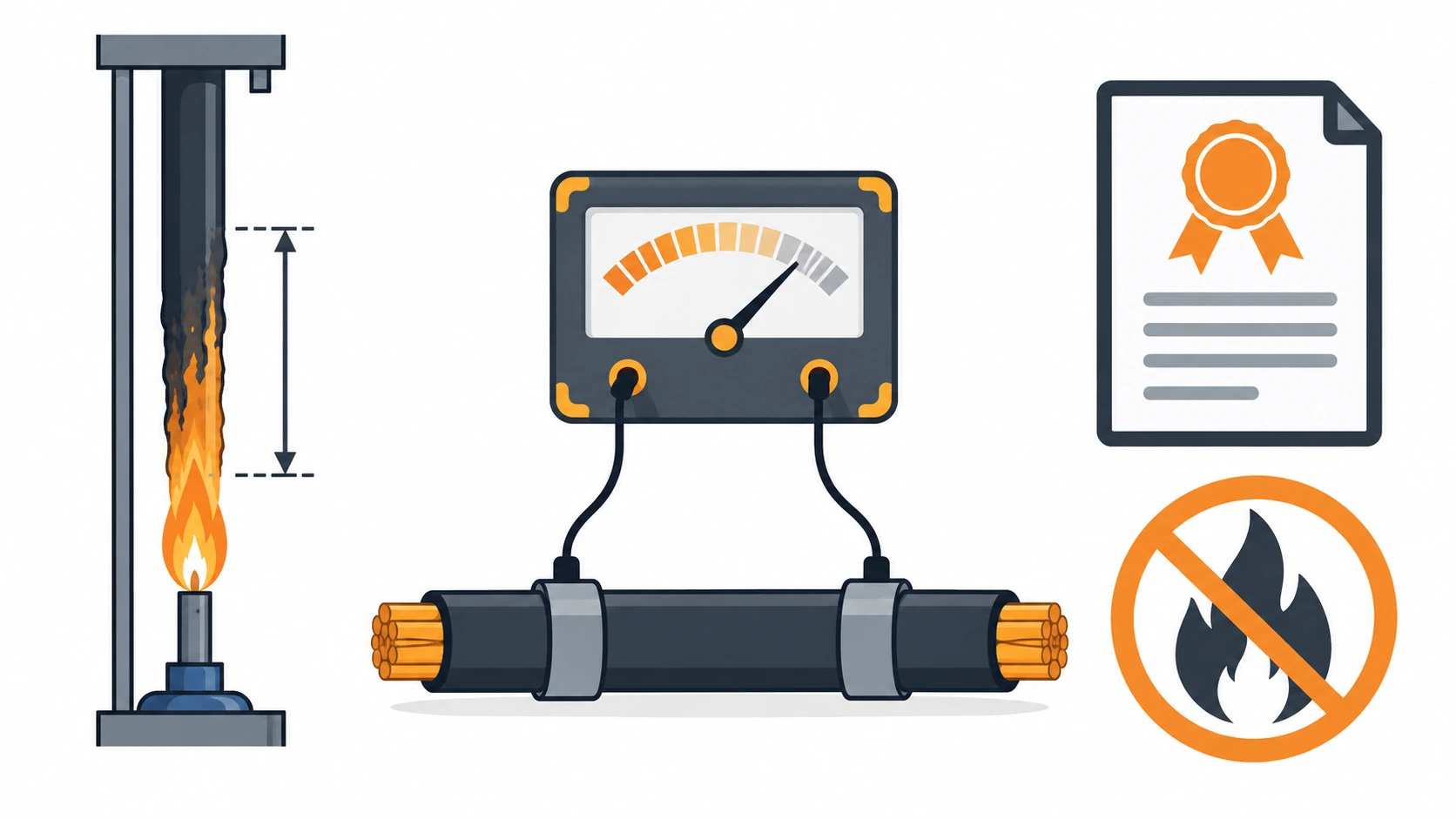
Quick Answer: Flame retardant describes a material and antistatic describes a measured property, and a mine accepts cable on the second of those, not the first. The two claims rest on different tests, produce different numbers, and are covered by a certificate that names one construction rather than a product family. This guide covers what each test proves, the reports to demand with a quotation, the scope of a mark, and the decisions to freeze before the order goes out.
Introduction
Underground cable is bought twice: once on price and once on evidence. The price part is familiar. The evidence part is where projects lose weeks, because a cable that is perfectly adequate in a workshop can be refused at a mine gate for a report the buyer never asked for.
Two properties carry most of that risk. Flammability decides how a cable behaves if it is the thing that catches fire, and antistatic performance decides whether the sheath can hold a static charge that sparks in a gassy atmosphere. Both are testable, both are measured in defined ways, and neither is established by an adjective on a datasheet.
The buying discipline is straightforward once the two are separated. Ask for the standard, the method, the measured values, and the certificate that covers the construction quoted, and compare quotations on that rather than on the word flame retardant.
Two Properties, Two Tests, One Cable
The confusion starts because both claims usually appear on the same line of a specification, and they are not the same kind of statement.
Flame retardance is about fire behaviour. It describes how a cable resists flame propagation, how far damage spreads, and what the materials release when they burn. Those are test outcomes measured to a method, and the method matters as much as the result.
Antistatic performance is about electrical resistance. A sheath that can hold a charge can discharge it as a spark. Surface resistance is measured, and the requirement is a range rather than a maximum, because a sheath that conducts too well is a different problem.
The two interact but they are bought separately. A cable can pass a flammability test and fail the resistance requirement, and the reverse happens as well, particularly where a compound is optimised for one and not the other. A specification that says “flame retardant and antistatic” without naming the methods has specified nothing that can be inspected.
What the Flammability Test Proves
Flammability testing answers three separate questions, and a quotation that answers one of them is not answering the others.
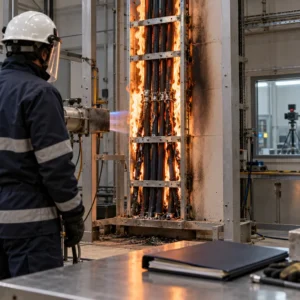
Does flame spread along the cable? The test applies a flame to a defined sample and measures how far the damage travels. A cable that self-extinguishes within the marked distance passes; the number is the evidence. Our note on ZA, ZB and ZC flame retardant cable explains how the Chinese classes differ in what they require of the sample.
What does the material release? Halogen content and acid gas emission matter in an underground roadway where people have to escape and equipment has to survive. Our note on IEC 60754 and 61034 testing covers the halogen acid gas and smoke density measurements, and our comparison of LSZH and fire retardant cable explains where the two ideas diverge.
Does it survive a real fire condition? Circuit integrity under fire is a different requirement again, tested with the cable energised, and it applies where a circuit has to keep working during a fire. It is usually not the requirement for a roadway feeder, and buying it by accident is expensive.
Read the report against the question being asked. A flame spread result does not answer the acid gas question, and a smoke density figure does not tell you whether the circuit survives.
Antistatic Performance and Surface Resistance
Antistatic cable exists because a charged sheath in a gassy roadway can spark. The property is surface resistance, measured across a defined length of sheath under stated conditions, and it is quoted as a range.
Why a range and not a minimum. A sheath with very high resistance holds charge. A sheath with very low resistance behaves like a conductive path and creates its own problems, including leakage and corrosion at terminations. The requirement is a band, and a cable quoted outside it fails the purpose even if it looks impressive.
How it is achieved. The compound carries a conductive filler, and that filler is sensitive to how the compound is mixed and to the surface condition of the finished sheath. Two cables made to the same nominal formulation can measure differently, which is why the report belongs to a batch and a construction rather than to a product family.
What changes in service. Surface condition shifts with abrasion, dirt and moisture, so a resistance measured on a clean new sample is the starting point rather than a service guarantee. This is another reason to buy a construction with a track record on the same duty rather than the cheapest one that passes a bench test.
The Reports to Demand With a Quotation
Ask for documents, not adjectives. For a mining cable quotation that will have to be inspected in, the list is short and specific.
The construction drawing, with conductor class, insulation, screen arrangement, sheath compound and wall thickness. Everything else hangs off this, because a certificate names a construction rather than a brand.
The flammability test report for that construction, naming the standard, the method and the measured values rather than a pass or fail verdict.
The antistatic test report, with the surface resistance figures and the test conditions.
The acid gas and smoke data where the roadway is one people have to escape from, and the certificate or mark the destination mine’s authority recognises.
Our notes on cable factory testing and on third-party cable inspection cover how routine tests differ from type tests and when an independent witness earns its cost.
The table below maps the claims that appear on a mining cable datasheet against the test behind each, the evidence to demand and the failure mode when the claim is accepted unexamined.
| Claim or property | What It Means on Site | What to Specify | Evidence to Demand | Cost and Lead-Time Driver | How It Fails |
|---|---|---|---|---|---|
| Flame retardance | Limits how far damage spreads if the cable is the ignition source | The standard and class required, with the test method named | Flame spread report for the exact construction, with measured values | Certified compounds add cost and usually lead time | A delivery refused for a report that names a different construction |
| Antistatic performance | Prevents a static spark from the sheath in a gassy roadway | Surface resistance band, test conditions and the required limits | Surface resistance report with figures and conditions | Conductive filler and process control raise the unit price | A cable that passes a clean bench test and drifts out of band in service |
| Halogen and acid gas release | Decides whether the roadway stays workable and escapable | Halogen content limit and acid gas emission requirement | Halogen acid gas and smoke density data to the named method | Halogen-free compounds cost more than standard ones | Corrosive damage to equipment and an evacuation problem |
| Circuit integrity under fire | Keeps a circuit working during a fire, where that is required | The fire survival requirement and duration, where it applies | Fire survival test report with the circuit energised | A significantly more expensive construction; often bought by mistake | Cost paid for a property the roadway feeder never needed |
| Certificate and mark | The document an inspector will accept a delivery against | The standard and mark the destination mine's authority recognises | Certificate naming the exact construction, plus its validity | Approval administration sits in the lead time | A cable that cannot be inspected in, and weeks lost to re-award |
What a Certificate Covers, and What It Does Not
A certificate or safety mark attaches to a defined construction, not to a company or a product family. That single fact explains most approval disputes.
The certificate names a conductor class, an insulation, a sheath compound, a screen or armour arrangement and often a wall thickness. Substitute the sheath compound for a cheaper one, move production to a second line, or change the screen from metallic to composite, and the certificate no longer describes the cable even though it looks identical from the outside.
The practical rule is to treat any compound change as an approval event rather than a commercial one. Ask for written confirmation that the certificate still covers the construction before the change is made, not after the drums arrive. On an export order, confirm the mark the receiving country’s mining authority recognises rather than the one held for the home market, because the two are not interchangeable.
What to Freeze Before the Order Goes Out
These five items are cheap at specification stage and expensive once a delivery is refused at the gate.
| Decision | What to State | Evidence to Attach | Cost of Leaving It Open |
|---|---|---|---|
| Test basis | The standard and method required for each property, by name | Reports referencing those methods and the construction | A delivery with evidence that answers the wrong question |
| Surface resistance band | The required range and the test conditions | Measured figures, not a pass or fail statement | A cable that passes on the bench and drifts in service |
| Certificate scope | The mark the destination authority recognises, and the construction it covers | Certificate naming conductor, insulation, sheath and screen | An approved-looking cable that no longer matches its certificate |
| Substitution rule | Any compound or supplier change is an approval event, agreed in writing | A written substitution procedure in the purchase order | A silent change that invalidates the approval on paper |
| Witnessing plan | Which tests are witnessed, by whom, and what ships with each drum | A written plan with acceptance criteria and dates | Volume accepted on a sample nobody kept |
Incoming Inspection and Witnessing
Documents first. Match the test reports and the certificate to the drum references before anything is cut. A drum without traceable documents cannot be linked back to them afterwards, whichever test it passed at the factory.
Sample checks. Conductor resistance and continuity, insulation resistance, screen continuity, and overall diameter and sheath thickness on a cut sample. On a flame retardant and antistatic order, the jacket compound is the item under scrutiny, so the sample taken for measurement is also the one that evidences the material.
When to witness. Witness routine tests where the order is large or the site’s history with the supplier is short, and reserve independent witnessing for the tests whose outcome cannot be checked on site.
When Flame-Retardant and Antistatic Cable Is Not the Answer
When the requirement is a surface installation. A bench or plant feeder does not need an underground compound, and paying for one is money spent on a condition the route does not have. The correct saving is in the compound, not in the standard the site does require.
When circuit integrity is assumed to be included. Flame retardance and fire survival are different tests and different prices. A roadway feeder bought for flame spread does not keep working during a fire, and assuming otherwise is a design error that shows up in an emergency rather than in a quotation.
When the certificate is quoted but not read. A certificate for a similar construction is the most common approval trap. Check the conductor class, the compound and the screen arrangement against the cable being supplied, because that is what the inspector will check.
When the compound change is treated as a commercial matter. A substitution agreed to save cost, without checking the certificate, is how a compliant order becomes a non-compliant delivery somewhere between the factory and the gate.
When price is the only variable asked about. A cable bought on unit price alone is judged when the reports are read, and by then the delivery is on site and the schedule has no room to re-award.
RFQ Checklist
- Flammability standard and class required, with the test method named
- Surface resistance band and the test conditions it must be measured under
- Halogen content and acid gas emission requirements, where they apply
- Whether circuit integrity under fire is required, stated explicitly either way
- The standard and mark the destination mine’s authority recognises
- Certificate scope checked against conductor class, compound and screen arrangement
- A written substitution rule treating compound changes as approval events
- Construction drawing with all layers declared, as the reference document
- Test reports for the exact construction, with measured values rather than verdicts
- Which tests are witnessed, by whom, and the records that ship per drum
- Sample retention requirement, and who holds the retained sample
- Copper basis and its validity window, stated per quotation
Conclusion
Flame retardance and antistatic performance are two different claims, proved by two different tests, and covered by a certificate that names one construction. Ask for the standard, the method, the measured values and the certificate, tie any compound change to a written approval event, and the delivery stops being a negotiation at the gate.
Kexingyu Cable Group (KXYE) has supplied electrical cable from Quanzhou since 1996, including the flame retardant, screened and rubber-sheathed constructions that underground duty calls for, with the test evidence that applies to each. Send us the roadway conditions, the standard your mine accepts, the duty and the run lengths, and we will come back with the constructions, the reports that go with them, and a delivery plan against your shutdown window. The fastest route is a request for quotation.