Exporting Cables to Vietnam: QCVN Requirements and Import Process
Quick Answer: Vietnam gates wire and cable through QCVN national technical regulations, with certification of conformity and import procedures built around the applicable regulation, verified before the drums sail.
Vietnam’s industrial buildout is one of Asia’s fastest, and its cable imports grow with every new industrial park and data hall. The regulatory door is QCVN, Vietnam’s national technical regulations, and the paperwork behind it is more approachable than India’s BIS or Saudi Arabia’s SABER. But it rewards the same discipline: know which regulation applies, certify the construction, and sequence the import procedure against the shipping schedule. This guide walks the door and the paperwork.
Introduction
Vietnam regulates products through QCVN — Quy chuẩn kỹ thuật quốc gia, the national technical regulations. Each one is numbered, each defines the technical requirements a product family must meet, and each is enforced through conformity assessment before the product enters the market. Wire and cable sit under this umbrella with a notable institutional split. Telecom and IT cables fall under the Ministry of Information and Communications’ regulations, while electrical cable is handled through the general product conformity machinery. The split matters because the certification route and the paperwork differ by regulator. The market context makes the effort worthwhile: Vietnam’s manufacturing boom and data infrastructure growth drive sustained cable demand, with demand centers described in Vietnam’s industrial park power demand and the regional buildout in Southeast Asia data center power. The buyer’s task is to match the construction to its regulation, certify it, and let the import procedure follow — the same sequencing logic this cluster teaches, applied to a lighter but real gate.
Which QCVN Applies: Mapping Cable to Regulation
The first verification question is categorical, and Vietnam’s institutional split makes it two questions. For telecom and structured cabling — the data-side cables of a building — the applicable QCVN sits under the MIC, which regulates terminal and network equipment and its transmission media, with conformity certification through designated bodies. For electrical cable, meaning power and building wire, the applicable regulation sits under the product-safety machinery, with requirements aligned to IEC-derived standards and conformity demonstrated through the state’s certification routes. The mapping exercise is exactly the cluster’s matrix habit: constructions down one axis, applicable QCVN and regulator across the other, and the cells decide the certification route. The mapping also catches the most common surprise. A “network cable” order that is really two orders — power cable under one regulator and telecom cable under another — with two certifications and two timetables. The standards beneath the regulations are the IEC family, so factories tested to IEC start close to conforming. That’s the same foundation-not-passport relationship noted across this cluster in the power cable certifications checklist.
Conformity Routes: Certification and Declaration
Vietnam’s conformity system distinguishes two instruments, and cable families land in one or the other by regulation. Certification of conformity: a designated certification body assesses the product — testing against the QCVN’s requirements at recognized laboratories — and issues a certificate valid for a term. It’s the heavier route, and the one mandatory schemes resemble. Declaration of conformity: the responsible party declares conformity backed by its evidence, registered with the authorities. The lighter route, appropriate to lower-risk families. Which instrument applies to which cable is defined by the regulation and its amendments, so the verification question at RFQ is precise: which instrument, which body, which standard version. Both routes end in the same place — the product’s conformity documented before market entry — and both reward the same upstream preparation: accredited IEC-aligned test reports, construction identity, and current-standard discipline. Those habits are detailed in the China certification checklist and applied destination by destination.
| Cable Family | Regulator / Regulation | Conformity Route |
|---|---|---|
| Telecom and IT cable | MIC — relevant QCVN for network media | Certification of conformity through designated bodies |
| Power and building wire | Product-safety machinery, IEC-derived QCVN | Certification or declaration per the regulation's assignment |
| Data center orders (mixed) | Both of the above in one project | Two certifications, two timetables — matrix them |
| Specialized constructions | Verify current scope — regulations evolve | Confirm status at RFQ, not from memory |
The Import Process: From Certificate to Clearance
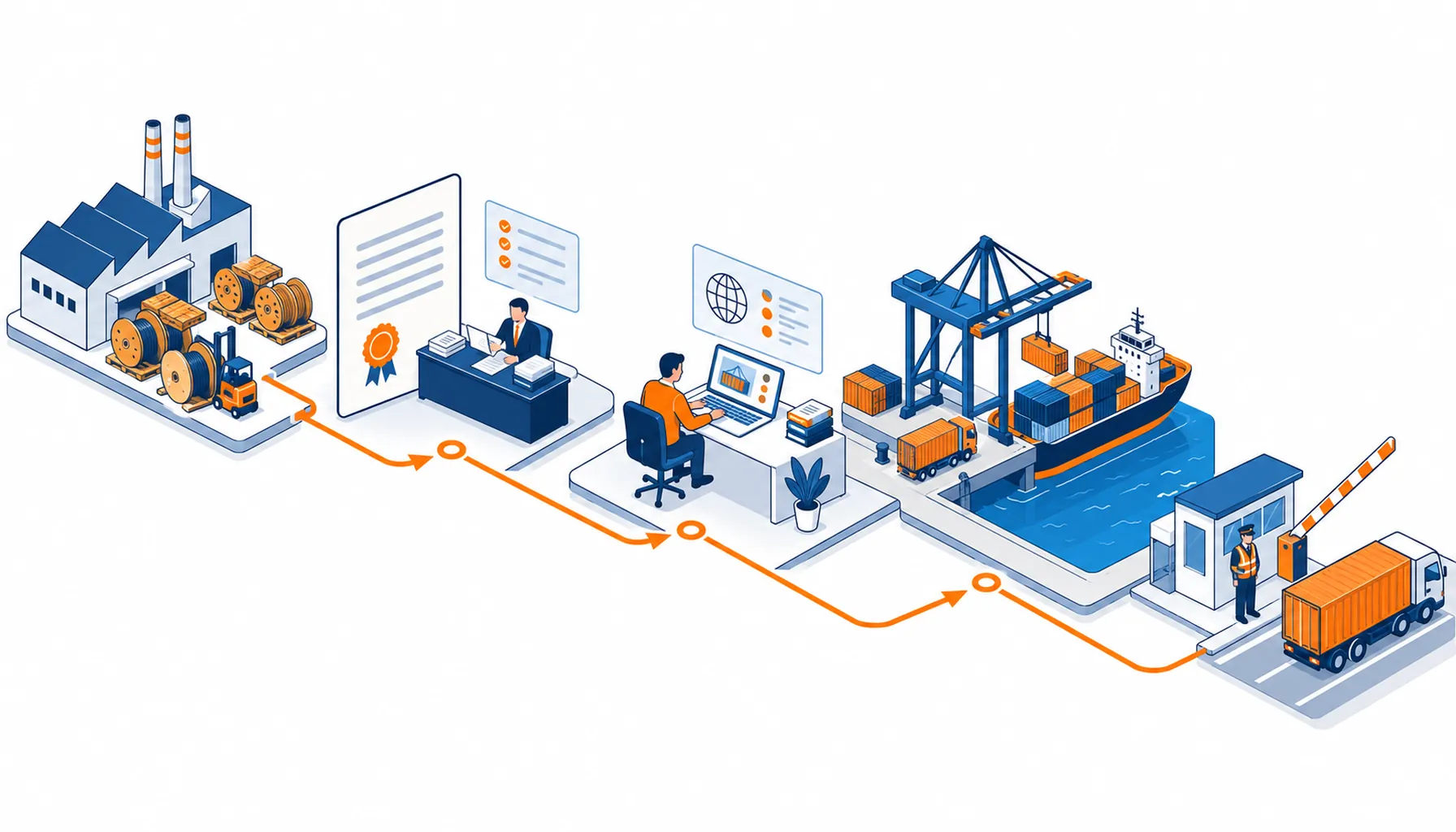
Vietnam’s import procedure rewards early sequencing. The chain runs: the importer of record — your Vietnamese customer or their agent — registers the import and holds the conformity file; the customs system checks the shipment’s documents against the applicable regulation’s requirement; and clearance completes when the certificate or declaration matches the goods. The buyer-side preparation is three documents deep: the conformity certificate or registered declaration for the construction, the test reports from recognized laboratories behind it, and a document set — invoice, packing list, specifications — generated from one source so descriptions match across the file. Timing matters less than in pre-shipment-certificate schemes because the assessment is product-level and precedes shipping, but identity still decides. The goods that arrive must match the certified construction, and a mixed container where one family is certified and its neighbor is not is a clearance argument. The ownership pattern — importer-led registration, exporter-supplied evidence — is the same one that governs Gulf schemes, and the contract allocation of who does what is the incoterms-adjacent question framed in FOB vs CIF for power equipment.
What Vietnam's Demand Does to the Order
Vietnam’s cable demand has a shape worth planning around. Industrial parks want building wire, feeder cable and control cable on construction schedules, with order windows that move with tenant fit-outs. Data center projects want power chains and structured cabling under consultant specifications, submittal-gated like the regional buildout already described. Both shapes reward the same preparation: conformity file ready before the order window opens, drum marking consistent with the certified construction, and the submittal package assembled so consultant review starts immediately. The suppliers who win Vietnamese orders are rarely the ones with the lowest quote. They’re the ones whose paperwork arrives with the quote, because in a market moving this fast, schedule is the currency and conformity delay is the discount nobody prices. The recurring trap remains the generic one this cluster catalogs in international power equipment sourcing mistakes: treating “Asia” as one market, when every border keeps its own rules.
| Stage | Action and Owner | Classic Trap |
|---|---|---|
| RFQ | Map constructions to QCVN and regulator; ask for held conformity files | Telecom and power cable treated as one certification |
| Conformity | Certification or declaration through the regulation's route, factory-side evidence | Standard versions drift from the current QCVN text |
| Contract | Allocate importer registration, cost bearing, document supply | Importer's registration role discovered at shipping time |
| Shipment | Document set from one source, identity consistent | Mixed container with one uncertified family |
| Arrival | Customs match; drum-to-document verification | Construction drift between certificate and drums |
When QCVN Is Not the Answer
Two limits frame the scheme. It is a border gate: conformity documents clear customs and prove the regulation’s minimums, while project ampacity, fire strategy and installation quality remain the specification’s work, verified through the per-drum evidence regime. And it is a moving map. QCVNs are numbered, amended and expanded, and a cable family’s regulatory status can change between orders — which makes RFQ-time verification a habit rather than a formality, the same current-status discipline every destination in this cluster teaches. Where a construction sits outside a mandatory QCVN’s scope, the engineering question is answered by type tests and batch evidence under the standards framework in our MV and LV standards guide, not by the gate’s silence.
RFQ Checklist: Vietnam Access Lines for the RFQ
Write the Vietnamese requirements into the order:
- Applicable QCVN and regulator identified per construction — telecom and power split mapped
- Conformity route confirmed: certification or declaration, per the regulation’s assignment
- Test reports from recognized laboratories against the current QCVN requirements
- Certificate or declaration held and current, reference numbers stated
- Importer of record and registration responsibility named on the customer side
- Document set generated from one source, consistent with the conformity file
- Mixed orders matrixed: every construction’s route and timetable in one table
- Drum marking consistent with certified constructions, per the receiving protocol
Conclusion
Vietnam’s cable gate is lighter than its neighbors’, but it is real, institutionally split, and schedule-sensitive in a market that moves fast. Map the constructions to their QCVNs, certify through the regulation’s route, and let the importer’s registration run on a calendar rather than on hope. The paperwork that arrives with the quote is the quietest competitive advantage in this market.
Kexingyu Cable Group (KXYE) supports Vietnam-bound orders with IEC-aligned test reports, conformity documentation per the applicable QCVN routes, and drum marking keyed to the certified constructions. The paperwork arrives with the quote, not after the port.