Lighting Towers and Night Works: Buying Cable for Temporary Lighting
Quick Answer: Temporary lighting is the most relocated electrical system on any site, and its cable lives in wind, rain, mud and constant handling. Buy the tower’s own connections for reeling and mast flexing, buy the area circuits for UV and weather, standardise connectors and lengths across the fleet, and put the inspection into the daily setup routine. Night works run on cheap cable bought well, not expensive cable bought twice.
Introduction
Night works have become normal on highways, bridges and urban projects, and the lighting that makes them possible is electrical work under the worst conditions a cable will meet: masts that flex in the wind, trailers that move weekly, circuits that get dragged across the ground every shift, and fixtures that swing from towers and scaffolds.
Most lighting failures are cable failures in disguise, and most cable failures trace back to three specification errors: fixed-installation cable used on moving duty, indoor-grade sheaths left in the sun, and connectors mixed across the fleet. This guide covers the tower, the circuits it feeds, and the disciplines that keep the lights on through the programme.
The Tower Itself: Mast, Trailer and Winch Duty
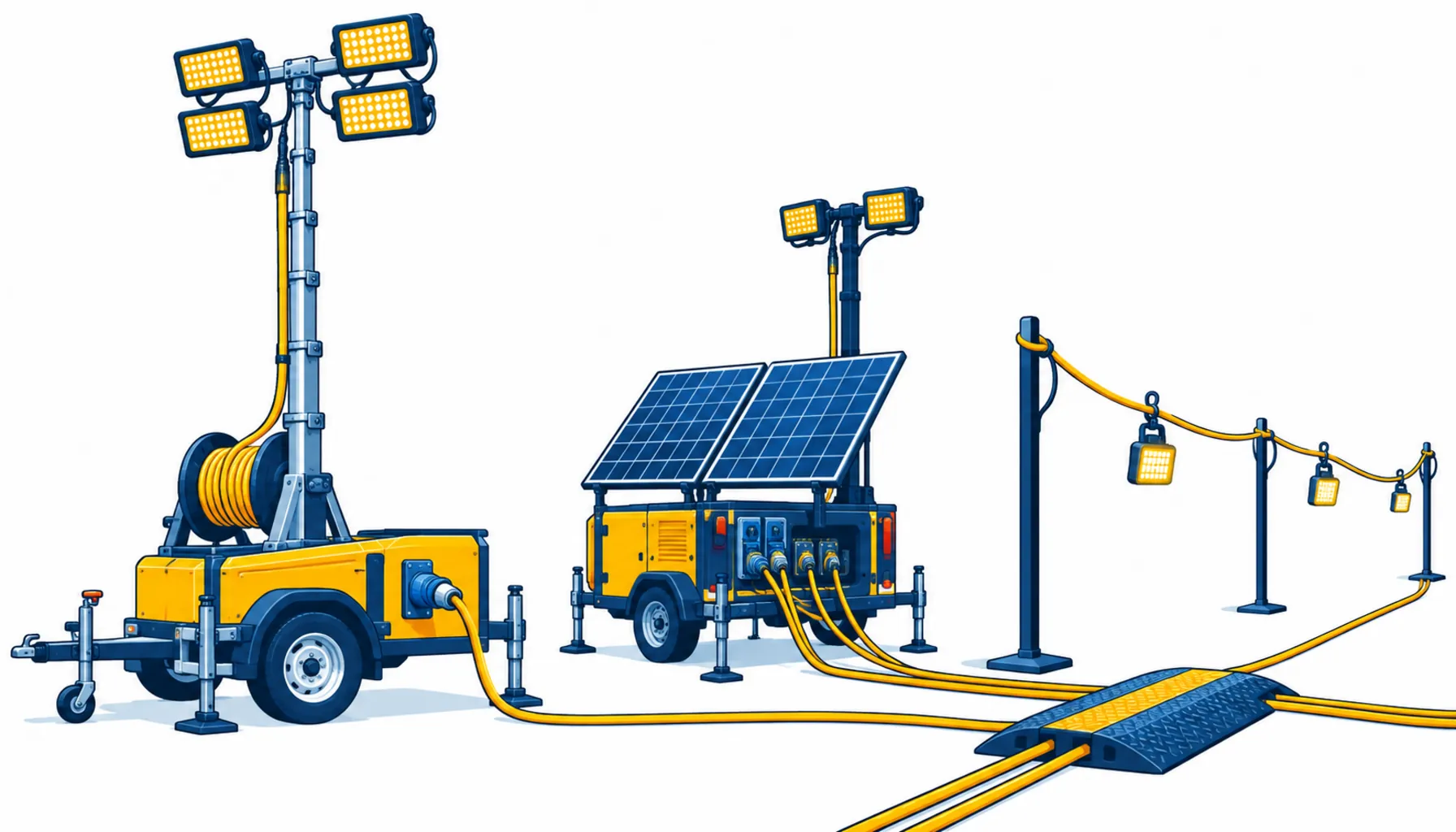
A lighting tower is a small cable machine. The mast cable flexes every time the tower raises or lowers, the winch drum winds it under tension, and the trailer connection lives with vibration and weather for the length of the hire. It is reeling duty on a small scale, and the same rules apply as for any cable that winds and unwinds under load.
What to specify. Fine-stranded conductor that survives repeated winding, a rubber sheath rated for outdoor UV and temperature swing, and a service loop routed so the mast’s motion flexes the cable in one controlled place rather than at the gland. Where towers are fleet equipment raised and lowered daily, the mast cable is a wear item with a life measured in cycles, and buying it as a rated reeling construction rather than a generic cord turns a quarterly replacement into an annual one. Our heavy-duty connecting cable is the class of construction that handles this duty, and our note on minimum bend radius gives the routing rules the winch drum has to respect.
The trailer connection. The plug and socket at the tower’s base takes the abuse: driven over, stood in water, connected wet. Weather-rated connectors with a defined ingress rating, strain relief at the entry, and one connector standard across the fleet are the three decisions that stop the weekly failed-tower report.
Hybrid and Solar Towers: A Different Cable Order
The fleet is shifting toward hybrid and solar lighting towers, and the cable order changes with it. Battery-hybrid units add DC strings between panels, batteries and the controller, and the cabling between them is fixed-installation duty on a moving trailer: vibration, UV and temperature cycling without the reeling.
What changes. The DC side needs UV-stable sheaths and connectors rated for outdoor DC duty, and the runs should be short and supported, because every metre of undersized DC cable wastes charging energy. Our note on generator and storage hybrid systems covers the architecture; the procurement point is that these towers are ordered with their internal cabling as part of the unit, and the buyer’s leverage is at specification: ask for the DC cable construction, the connector ingress ratings and the service loop design to be named. Units that arrive with generic cordage become the towers that fail first in the fleet, and the failure is warranty conversation nobody enjoys.
The Area Circuits: Feeding the Work at Ground Level
Between the towers and the task, the site runs temporary lighting circuits: festoon runs along corridors and access routes, floodlight clusters on scaffold and ground stands, and task lighting inside structures. This is the cable that moves every shift, and it is where most of the replacement budget actually goes.
Sheaths that live outdoors. Every outdoor temporary run takes sun, rain and abrasion, and the sheath decides its life. UV-stable compounds are the baseline; our UV-resistant cable is built for permanent outdoor exposure, and where runs lie flat on mud and rubble, weather-resistant flat constructions such as our weather-resistant flat cable resist the twisting and kinking that round cords suffer on repositioning. Our comparison of cable sheath materials covers why the compound, not the price, decides the replacement cycle.
Support and routing. Overhead wherever possible, on insulated hooks or the structure itself, with drops protected at edges. Ground runs belong on the walkway edge, ramped at crossings, and never as the bridge across an access route. Routing discipline adds nothing to the order and doubles the life of everything in it.
| Duty | Environment | What to Specify | Evidence to Demand | Cost and Lead-Time Driver | How It Fails |
|---|---|---|---|---|---|
| Mast and winch cable | Wound under tension, flexed at raise and lower | Fine-stranded reeling-class construction, controlled service loop, strain-relieved gland entry | Flex cycle data, stranding class, bend radius compliance | Wear item bought by cycle life, not unit price | Strand fatigue at the gland, jacket cut on the drum edge |
| Trailer and base connections | Weather, standing water, vehicle traffic | Weather-rated connectors with ingress ratings, one standard across the fleet | Ingress ratings, connector cycle life | Connector quality is a small cost with a fleet-wide return | Wet connections, broken latches, mixed plug standards |
| Hybrid and solar DC runs | Vibration and UV on a moving trailer | UV-stable sheaths, outdoor DC-rated connectors, short supported runs | DC connector ratings, sheath UV data, wiring drawings | Leverage is at tower specification, not after delivery | Undersized DC runs wasting charge, cracked cordage in year one |
| Area circuits and festoon | Dragged, hung, relocated every shift | UV or weather sheaths, flat constructions on ground runs, insulated hooks overhead | Sheath compound data, cold-flex ratings for winter works | Biggest replacement budget; routing discipline is free | Sun-hardened jackets, cut ground runs, taped mixed sets |
Standardisation: The Fleet Decision That Pays Most
The single biggest lever in temporary lighting procurement is not the cable at all; it is standardisation. A site with one connector type, three standard cable lengths and a defined setup pattern replaces failures in minutes. A site with four connector generations and random lengths improvises every night, and improvisation is what cuts, tapes and daisy-chains cable into the failure pile.
Write the kit. Define the standard lighting kit: lengths, connector types, hanging hardware and the ramp or hook accessories for each crossing type. Buy the kits complete, and hold spares as complete kits rather than a bin of mixed cords. Crews work with what is on the rack, and a rack of coherent kits makes the safe setup the easy setup. The kit standard also decides the buy itself, because once lengths and connectors are fixed, the order becomes a short repeated line item that any supplier can fulfil from stock, instead of a bespoke list quoted fresh each time.
Tag and count. A tag with length and test date on every set turns inspection into a glance, and a quarterly count against the tower fleet tells procurement what the next order actually is. Night works programmes that run this discipline buy lighting cable twice per project; programmes that skip it buy it continuously and never know why.
Inspection and the Daily Setup Routine
Temporary lighting is inspected best when inspection is part of the setup, not a separate task nobody has time for. The setup check is thirty seconds per set: jacket undamaged along the run, connectors clean and latching, no taped joints, cable off the traffic line. Any set failing the check goes back to the store, not onto the rack.
Scheduled adds. Beyond the daily glance, a weekly walk of the lighting system at full load catches the dim run and the hot connector that the daytime eye misses, and a seasonal check of the mast cables’ service loops catches the wear before the strand fatigue does. Record what is found; the record is what separates a managed fleet from a pile. Where the programme runs third-party safety audits, the lighting records are the first thing asked for, and our note on third-party cable inspection explains what auditors look for.
What to Freeze Before the Order
| Decision | What to State | Evidence to Attach | Cost of Leaving It Open |
|---|---|---|---|
| Mast cable construction | Reeling-class fine-stranded build with service loop design | Flex cycle data per construction | Quarterly mast cable replacement across the fleet |
| Connector standard | One connector type and ingress rating site-wide | Connector ratings and cycle life | Mixed sets, wet connections, weekly failed towers |
| Hybrid tower cabling | DC runs, UV sheaths and connectors named at unit order | Wiring drawings and UV data | First-to-fail towers and a warranty argument |
| Area circuit sheaths | UV or weather compounds, flat builds on ground runs | Sheath compound and cold-flex data | Continuous replacement through the programme |
| Standard kit | Lengths, hanging hardware and crossing protection defined | A one-page lighting standard | Improvised setups and the failure pile |
| Inspection routine | Setup glance, weekly full-load walk, tagged sets | Inspection record template | Unmanaged pile discovered at the audit |
Lead Time and Cost Structure
Standard flexible and weather-resistant constructions ship from stock in days, and the lighting order is mostly stock product. Bespoke mast cable lengths and factory-fitted connectors add modest lead time and belong in the tower fleet’s standing order rather than in emergency purchases. For large programmes, phasing the order against the works programme avoids both the winter shortage and the surplus that gets left in the mud; our note on cable MOQ and lead time covers how to phase without paying for it.
On cost, the honest unit is cost per lit shift, not price per metre. A weather-sheathed set that survives a season beats a cheap set replaced monthly, and the connector standard saves its cost the first time a failed tower is swapped in minutes instead of rewired at midnight. Fleets running hybrid towers should compare the cabling specification between suppliers as carefully as the photometrics, because the cable is where the cheap units save their money. Budget for replacement from day one as well: a programme that plans a modest monthly renewal of its area circuits spends less, and more predictably, than one that funds lighting through emergency purchases.
Incoming Inspection
Construction and sheath. Cut a sample on each new construction: conductor stranding, sheath feel and flexibility at the season’s coldest expected temperature. Outdoor cable substitutions are common and silent, and the sample check at delivery is the only defence.
Connectors and ends. Verify the ingress ratings and the strain relief against the standard, and reject any set arriving with a different connector generation, because one mixed set becomes a rack within a month.
Tag at entry. Tag length and date at handover, so the set enters the fleet managed rather than anonymous. The tag is what makes every later inspection and the quarterly count possible.
When a Lighting Cable Standard Is Not the Answer
When the tower is the fault. A tower that trips its feed repeatedly may have a failing controller or a wet fixture, not a cable problem. Test the tower with a known-good set before re-ordering.
When the layout is the fault. Runs that fail every month at the same crossing need a ramp, an overhead route or a traffic change, not a tougher jacket.
When the load has grown. Circuits extended tower by tower lose voltage at the far end and burn connectors; the fix is circuit design, not heavier cable.
When the works are permanent. A lighting system that has survived two years in place is no longer temporary; it deserves a designed installation with proper containment, and the temporary fleet should be retired from it.
RFQ Checklist
- Tower mast cable: reeling-class construction, flex cycle data, service loop design
- Connector standard: one type site-wide, ingress rating declared
- Hybrid and solar tower DC cabling named at unit order
- Area circuit sheaths: UV and weather compound data, cold-flex for winter
- Standard kit definition: lengths, hanging hardware, crossing protection
- Trailer connection rating and strain relief specification
- Tagging and record template for the fleet
- Seasonal temperature range for sheath and cold-flex selection
- Spares as complete kits, not mixed cords
- Phased delivery against the works programme
- Replacement budget planned as a monthly line, not emergency buys
Conclusion
Temporary lighting cable is bought well when the moving parts get moving-duty construction, the outdoor circuits get weather sheaths, the fleet gets one connector standard, and inspection rides the daily setup routine instead of a separate task nobody has time for. Freeze those decisions at order time and the night shift stops being the section that reports cable faults every week.
Kexingyu Cable Group (KXYE) has manufactured cable in Quanzhou since 1996, supplying reeling-class mast cable, UV and weather-resistant constructions and heavy-duty connecting cable for lighting towers and night works fleets, with data and tags against every delivery. Send us your fleet size and your worst night, and we will come back with the kit specification. The fastest route is a request for quotation.