Cable Shielding Selection for Industrial Sites: What to Specify and What to Prove
Quick Answer: Cable shielding selection follows the interference. Foil screens suit high-frequency noise and short runs, braid screens suit mechanical abuse and lower frequencies, and a foil-over-braid composite covers both. The screen only works if it is earthed at the right end or ends, which makes the termination arrangement part of the cable purchase. Specify the interference source, the frequency band and the earthing arrangement, then choose the screen that matches them.
Introduction
Screening is usually specified after something goes wrong. A drive starts, an analogue signal wanders, a network drops packets, and the fix that gets written into the specification is a screened cable, without much thought about which screen or how it is earthed.
That approach produces cables that cost more and still do not work. This guide covers what a screen actually does, the screen types worth choosing between on an industrial site, how earthing decides the result, and the evidence to demand before the drums ship. Where the noise is a motion problem rather than a static one, our note on shielded motion cable covers the moving-cable version.
What a Screen Actually Does
It blocks electrostatic coupling. A foil or braid screen intercepts capacitive coupling from neighbouring cables and from nearby conductors, which is the dominant problem on long runs beside motor feeders.
It reduces magnetic coupling only slightly. A screen does little against low-frequency magnetic fields from a nearby power conductor. Twisted pairs and physical separation do more, which is why a screened cable run beside a feeder can still pick up noise.
It provides a defined reference. On instrument and communication circuits the screen gives the signal a reference and a return path, and that is often as important as the blocking.
It carries current if it is misused. A screen earthed at both ends on a long run becomes a path for circulating currents from potential differences between the two ends. That current appears as noise in the very circuit the screen was bought for.
The Screen Types a Site Buyer Chooses Between
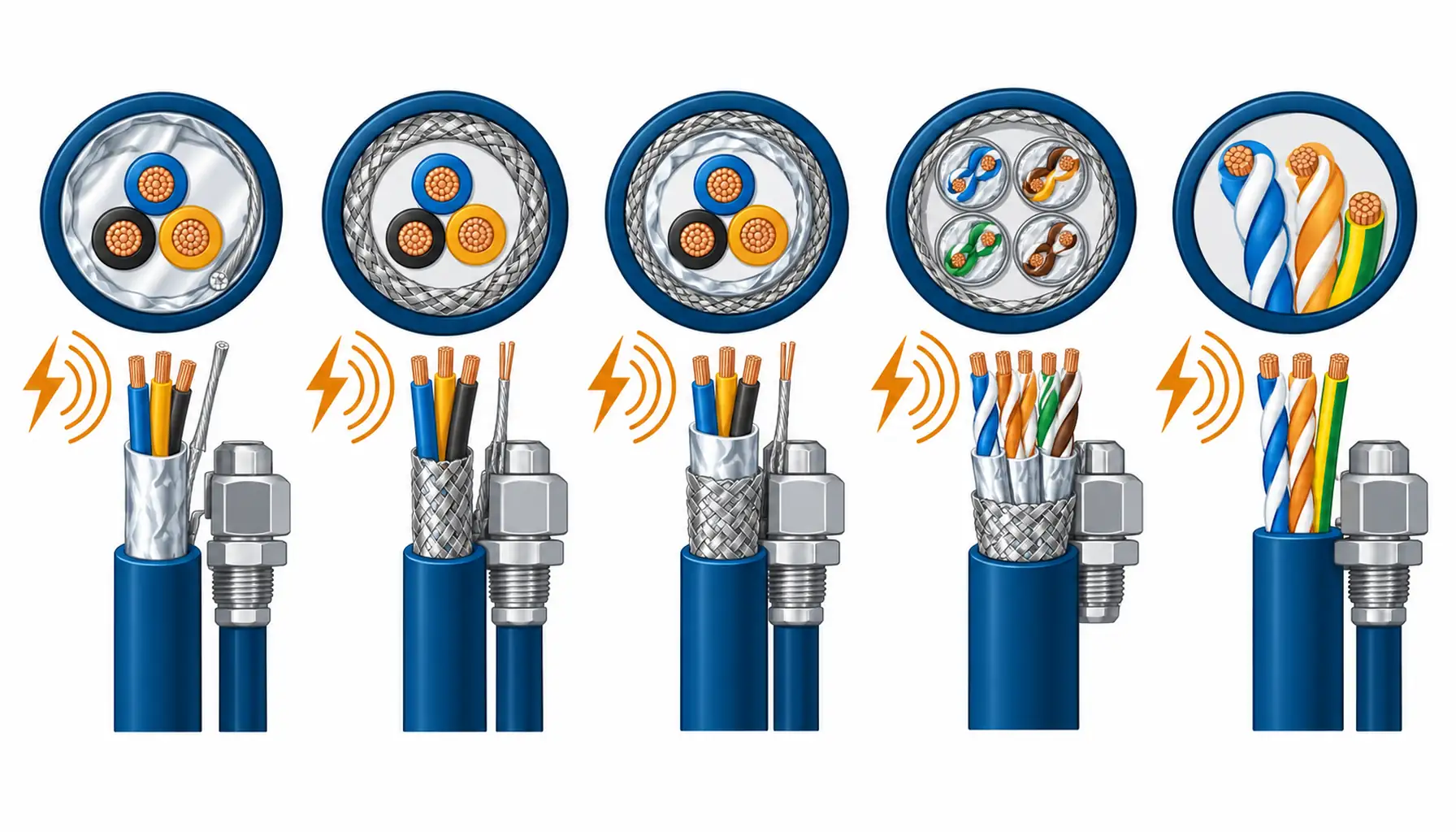
Aluminium foil is thin, cheap, gives excellent coverage and is best at higher frequencies. It is fragile, awkward to terminate and needs a drain wire bonded to the foil to make the connection.
Braid is woven copper or tinned copper wire. Coverage is lower than foil, but the screen withstands handling, flexing and repeated termination, which is why it is the usual choice on anything that moves or is terminated on site routinely.
Composite screens put foil over braid, or braid over foil. That combination covers a wider frequency band and survives handling better than either alone, at a higher cost and a larger diameter.
The table below compares the options on the interference they suit, with the evidence worth demanding and how each choice fails when it is made on price or on habit.
| Screen type | Best duty | What to Specify | Evidence to Demand | Cost and Lead-Time Driver | How It Fails |
|---|---|---|---|---|---|
| Aluminium foil with drain wire | Long fixed runs beside drives and feeders, higher-frequency noise | Coverage, foil thickness, drain wire size and material, screen to be earthed at the signal end | Coverage figure, drain wire continuity, coupling or attenuation data where the circuit is fast | Low material cost; the drain wire and the termination labour are the real cost | Foil torn during termination, drain wire broken at the gland, screen floating |
| Braided screen | Flexing cable, machine connections, terminations made and re-made on site | Coverage percentage, braid material and wire size, flex and torsion duty, earthing arrangement | Coverage figure, conductivity data, flex results at the declared radius | Braid coverage and material set the cost; higher coverage is slower to weave | Braid damaged at a support, coverage reduced at a joint, screen used as a load conductor |
| Foil over braid composite | Circuits needing wide-band coverage in a mechanically tough route | Order of the layers, coverage of each, drain wire arrangement, overall diameter limits | Coverage and attenuation data, dimensional records, continuity on the finished length | Two screening layers add cost and diameter, which can change glands and trays | A screen earthed at both ends on a long run, circulating current appearing as noise |
| Individual pair screen plus overall screen | Multi-pair instrument and communication cable in a noisy plant | Whether pairs are individually screened, the overall screen, and which screen is earthed where | Coverage per pair, capacitance and crosstalk data, earthing instructions per screen | Multi-pass screening adds cost and lead time; core count drives the work | Crosstalk between pairs left unscreened, earthing instructions ignored on site |
| Unscreened twisted pair with earth core | Short runs in clean areas or where the circuit is inherently balanced | Twist lay, separation from power runs, whether a separate earth core is required | Capacitance and balance data, separation requirements in the installation instructions | Cheapest option; the saving is only real if the routing discipline is maintained | Long parallel run beside a drive, noise that no screen can remove afterwards |
Earthing the Screen: The Decision That Decides the Result
A screen that is not earthed is a conductor wrapped around a core, and it usually makes the circuit worse than no screen at all because it couples noise capacitively between the core and whatever the screen touches.
Signal end only, or both ends. On most industrial signal circuits the screen is earthed at one end, usually the signal source or the panel end. On high-frequency or EMC-critical circuits the practice is to earth at both ends, which controls the higher-frequency currents at the cost of a low-frequency circulating current. Which one applies is a design decision and belongs in the installation instructions that ship with the cable.
Termination at the gland. A screen bonded through a short pigtail loses most of its performance at high frequency, because the pigtail is an inductance. A screened gland or a clamp that bonds the screen around the full circumference keeps the screen effective. Our note on shielded connectors and EMC covers the connector side of the same problem.
Screen as an earth path. A drain wire or braid is not a protective conductor unless it was sized as one. Where the screen is also used for earth continuity, that requirement has to be stated so the cross-section is adequate, and it has to be verified. Our note on grounding and bonding verification covers the checks at the source end.
What to Freeze Before the Order Goes Out
These six items are cheap at specification stage and expensive once drums are on a truck.
| Decision | What to State | Evidence to Attach | Cost of Leaving It Open |
|---|---|---|---|
| Interference source and band | What is causing the noise and over what frequency range, per circuit | A circuit schedule with the source and the separation from power runs | A screen chosen on habit that does not address the actual noise |
| Screen type and coverage | Foil, braid or composite, with the coverage percentage required | Coverage figure and the material declaration for the screen supplied | A foil screen torn at termination on a route that needed braid |
| Screen earthing arrangement | Which end or ends the screen is earthed at, per circuit, with the reason | Installation instructions showing the screen termination at each end | Circulating screen current appearing as noise on a long run |
| Screen termination method | Full-circumference clamp or screened gland, rather than a pigtail | Gland and clamp compatibility, with the screen type named | A screen that works on the bench and not once it is installed |
| Screen as earth path | Whether the screen or drain wire carries earth continuity, and the cross-section required | An earthing calculation where continuity through the screen is relied on | A circuit that cannot be proved at commissioning |
| Test and evidence | Screen continuity and insulation resistance tests required, per circuit | A test plan with acceptance criteria and records per drum | A defect found after the panels are closed |
Evidence and Testing
Coverage is a number, not an adjective. Ask for the percentage coverage of the screen supplied, because a 70 percent braid and a 95 percent braid are different products at different prices and the difference matters at high frequency.
Continuity is the test that proves the installation. Screen continuity end to end, measured after termination, is the one check that catches a foil torn at a gland or a braid lost inside a joint. Our note on insulation resistance testing covers the companion test on the dielectric.
Coupling or attenuation data where the circuit is fast. On a fast or high-integrity circuit, a supplier who can provide coupling or transfer impedance data is worth more than one who cannot, because the figure is what a design engineer can check against the requirement.
Match the report to the construction. Where screening forms part of a certified product, the test report has to name the construction on the drum, including the screening layers, rather than a product family. Our screened instrumentation cable and the multi-pair screened communication cable are supplied with the screen arrangement and core count already fixed, which keeps the report and the delivery aligned.
Cost and Lead Time
Stock screened cable is usually foil screened with a drain wire in the common core counts, because that is what sells in volume. Made-to-order screening covers braid, composite and individually screened pairs, and it runs on the core count, the coverage and the drum lengths. Certified screened constructions for fire or instrument duty are the longest line, because the screen arrangement is part of the tested construction.
Screening changes the price in two ways that are easy to miss. The screen material and the extra passes add cost, and the larger diameter changes the glands and the tray fill, which is a second order on the same project. That second effect is why a screen should be specified per circuit rather than applied to every cable on the site.
Buying the Screen as Part of a Construction
A screen is never bought on its own. It arrives on a cable whose core count, pair configuration, insulation and sheath were fixed at the same time, and the screen has to suit all of them. Screening added to a construction that was not built for it usually lands as a loose foil and a drain wire, which is the version that fails at termination.
Where a circuit needs screening and a defined environment at once, buying the whole assembly is safer than assembling it from clauses. Our silicone rubber shielded control cable is supplied with the screen arrangement, the core count and the temperature class already fixed for the duty, which keeps the coverage figure quoted and the coverage delivered the same thing.
When a Screen Is Not the Answer
When the interference is magnetic and low frequency. A screen barely helps against a magnetic field from a nearby feeder. More separation, twisted pairs and a change of route do more, and they cost less than a screening upgrade.
When the screen is earthed at both ends on a long run. The circulating current that results appears as noise in the circuit, and it looks exactly like the problem the screen was bought to solve. Fix the earthing before buying a better screen.
When the screen is terminated through a pigtail. The installation has undone the purchase. Where high-frequency performance matters, the termination method is part of the specification rather than a site choice.
When screening is applied to a circuit that was routed badly. Laying a screened control cable in the same tray as a drive feeder defeats the screen. Routing discipline is free and screening is not.
RFQ Checklist
- Interference source and frequency band stated per circuit, with the separation from power runs
- Screen type required: foil, braid or composite, with the coverage percentage
- Whether pairs are individually screened and whether an overall screen is also required
- Drain wire size and material, and whether the screen or drain carries earth continuity
- Screen earthing arrangement, stated per circuit as one end or both ends
- Screen termination method required, and the glands and clamps that suit it
- Core count, pair configuration and twist lay where twisted pairs are specified
- Flex, torsion or flexing duty where the cable moves, with the radius and cycle count
- Screen continuity and insulation resistance tests required, with records per drum
- Overall diameter and tray fill limits, and the copper basis with its validity window
Conclusion
Screening follows the interference, and the interference is a frequency and a route question. Name the source, choose the screen that suits the band, and decide where the screen is earthed before the glands are ordered. Most screening that fails on site was bought correctly and installed without the termination and earthing arrangement the product needed.
Kexingyu Cable Group (KXYE) has manufactured cable in Quanzhou since 1996, supplying foil, braid and composite screened constructions for instrument, control and communication duty, with coverage figures, screen continuity results and termination instructions that travel with the drums. Send us the circuit schedule with the interference sources, the earthing arrangement and the routes, and we will come back with the constructions, the glands that suit them and a delivery plan against your programme. A request for quotation is the fastest route.