Thailand's Data Center Pipeline: Power Equipment and Cable Opportunities
Quick Answer: Bangkok’s data center pipeline is the fastest scaling in Southeast Asia, and each megawatt buys a fixed cable bill — all of it passing through Thailand’s TISI gate.
Thailand spent years as Southeast Asia’s manufacturing power base. It’s now becoming one of its computing power bases too. Bangkok’s data center pipeline has scaled at triple-digit growth rates, and the construction underway is roughly two-and-a-half times what existed before the wave. Cloud investment, AI workloads and a government determined to make the country a digital hub are all pushing it. For the electrical supply chain, growth of that speed is a very specific opportunity: each megawatt of computing capacity converts into switchgear, transformers, UPS systems and the cable that binds them, on schedules that punish latecomers. This guide maps the demand and the supply route.
Introduction
Start with the regional frame. Southeast Asia is the fastest-growing data center corner of a global buildout, tracked in Southeast Asia data center power, and Thailand is its fastest-scaling pipeline, concentrated in Bangkok and the surrounding industrial corridor. The demand drivers stack cleanly: cloud regions, AI training clusters, and the digital-economy investment that follows both. The electrical consequence stacks just as cleanly. Every hall built is a power chain built, from the utility intake through substations, distribution and backup systems down to the rack level, with cable as the connective tissue of the whole chain. For equipment and cable suppliers, the Thai market rewards what every high-growth market rewards: credentials, schedules and batch discipline. For buyers, it adds one specific gate — Thailand’s TISI licensing regime — and that belongs in the plan from day one.
What the Pipeline Buys: The Power Chain, Meter by Meter
The scale of the conversion is easy to state and worth internalizing. A single hyperscale campus buys more MV feeder cable than a mid-size industrial estate, and Bangkok’s pipeline stacks several of them per year. The redundancy discipline compounds the volume: parallel UPS strings and dual-path distribution multiply the LV runs behind every megawatt. The tropical duty cycle adds its own engineering weight, because high ambient temperatures drive derating margins and corrosion-aware jacket choices in coastal districts. None of it is exotic. All of it is voluminous, specified, and calendar-bound.
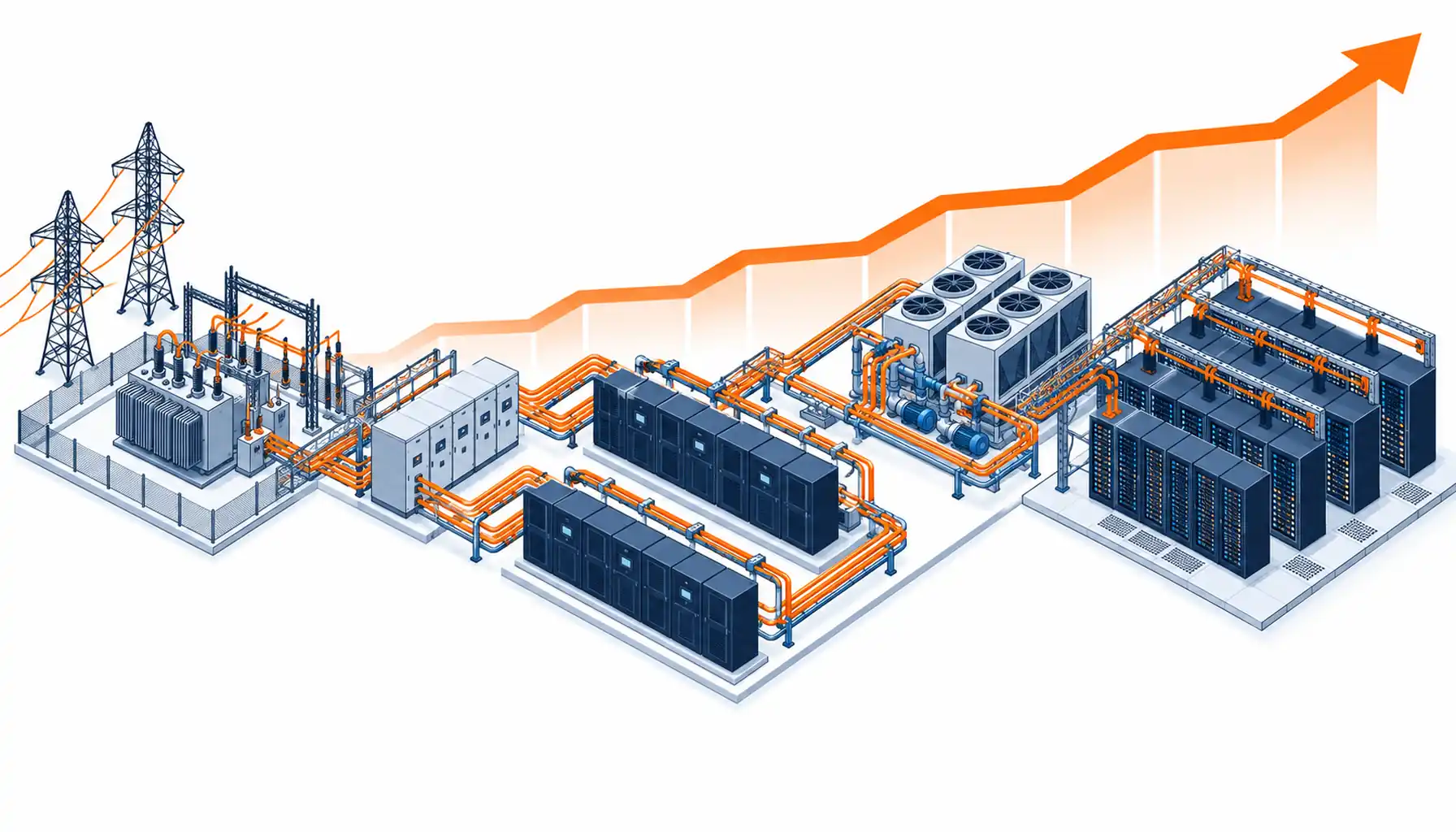
Follow the power path of a Bangkok hyperscale hall. At the intake you find MV feeder cable from the utility connection to on-site substations: XLPE-insulated constructions in the medium-voltage class, armored where the route demands it, engineered to the standards mapped in our MV and LV standards guide. The distribution layer is LV power cable from transformers through main switchgear to the UPS strings — that’s the backup chain whose sizing logic runs through UPS sizing for data centers, and whose redundancy architecture decides how many parallel cable runs the design carries. The cooling plant takes heavy LV feeders to chillers and pumps, runs long enough that voltage drop and derating discipline decide the copper cost. Inside the halls, LSZH-jacketed power and structured cabling sits under the fire regime, with the material trade-offs covered in LSZH vs fire-retardant cable. And the control layer uses shielded instrumentation pairs for the monitoring systems that run the facility. The pattern repeats across every Thai project: the cable bill is standard, the schedules aren’t negotiable, and the documentation is the differentiator.
| Chain Position | Cable Family | What Decides the Spec |
|---|---|---|
| Utility intake to substations | MV XLPE feeder cable, armored constructions | Voltage class, fault ratings, accredited test reports |
| Transformers to UPS to halls | LV power cable, parallel UPS feeders | Ampacity, derating, redundancy-driven run counts |
| Cooling plant feeders | Heavy LV power cable, long runs | Voltage drop and grouping derating discipline |
| Enclosed halls and galleries | LSZH power and structured cabling | Halogen-free and smoke certificates under the fire regime |
| Monitoring and BMS | Shielded control and instrumentation pairs | Shield integrity and documentation consistency |
The Supply Route: Imports and the TISI Gate
Thailand’s buildout outruns local capacity at hyperscale schedules, and the country imports its electrical infrastructure accordingly — through the market-access gate this series maps in the Thailand guide: TISI licensing for regulated cable families, plant-issued and surveillance-kept. The practical consequences for a Thai-bound cable program come down to three. Credential-first selection: constructions on the mandatory list need the TISI license in the manufacturing plant’s name before the goods can clear, so verify it at RFQ, not at the port; that’s the four-check discipline of the power cable certifications checklist. Schedule honesty: hyperscale programs compete for the same global cable capacity as every other boom market, and pairing cable lead times with the switchgear and transformer calendar carries real coordination cost. Programs that coordinate the electrical family on one timeline, the integrated logic of one-stop power equipment sourcing, outperform those that tender each family separately. And allocation discipline: who books clearance, who carries duty and who owns the documents belongs in the contract. The recurring failure catalog in international power equipment sourcing mistakes applies to Bangkok exactly as anywhere.
| Stage | Action | Classic Trap |
|---|---|---|
| Design | Power chain mapped; cable families and fire regime fixed per hall | Cable scoped after equipment is frozen |
| RFQ | TISI status verified per construction; batch evidence required | License check left to the shipping stage |
| Contract | Clearance duties, lead times and milestone dates allocated | Delivery promised against a future license |
| Delivery | Phased volumes; drum identity and documents reconciled per load | Batch mixing without traceability |
| Expansion | Repeat constructions under framework terms | Re-tendering identical scope at higher friction |
When a Pipeline Is Not the Whole Answer
Two cautions frame the opportunity. A growth statistic is not a procurement strategy: triple-digit pipeline growth means the supplier field is crowded with entrants, and the projects that energize on schedule are the ones whose cable arrived with credentials, batch reports and a realistic calendar, not the ones that chased the fastest quote. And a national pipeline is not a single schedule: Thai projects land in waves, and the suppliers who hold capacity for the second wave — licenses current, frameworks signed — capture the expansion that first-wave suppliers priced themselves out of. The demand is real. The discipline is what converts it into revenue.
RFQ Checklist: Thailand Data Center Lines for the RFQ
Put the program’s questions in writing:
- Power chain mapped: intake, distribution, UPS, cooling, halls, controls
- Cable families matched to TISI scope; license status disclosed and verified per construction
- Batch test reports and drum traceability committed contractually
- Fire-regime evidence — certificates, not claims — for hall cabling
- Lead times coordinated across cable, switchgear and transformer packages
- Clearance duties and document ownership allocated in the contract
- Framework terms for repeat volumes across project waves considered
Conclusion
Thailand’s data center pipeline is the fastest-scaling in the region, and it buys the same electrical bill every megawatt buys — MV feeders, LV distribution, UPS-side cabling, LSZH halls — through a market gate that rewards credential-holding factories and punishes improvisation. Suppliers who bring licenses and batch discipline to Bangkok win the wave. Buyers who verify both keep their schedules.
Kexingyu Cable Group (KXYE) supports Thailand-bound data center programs with IEC-aligned power cable across the full chain, accurate TISI status disclosure, and batch documentation that survives both customs and submittal review, coordinated to the calendar the pipeline builds on.