Trailing Cable Life on Reels: Setting Replacement Intervals Before You Buy
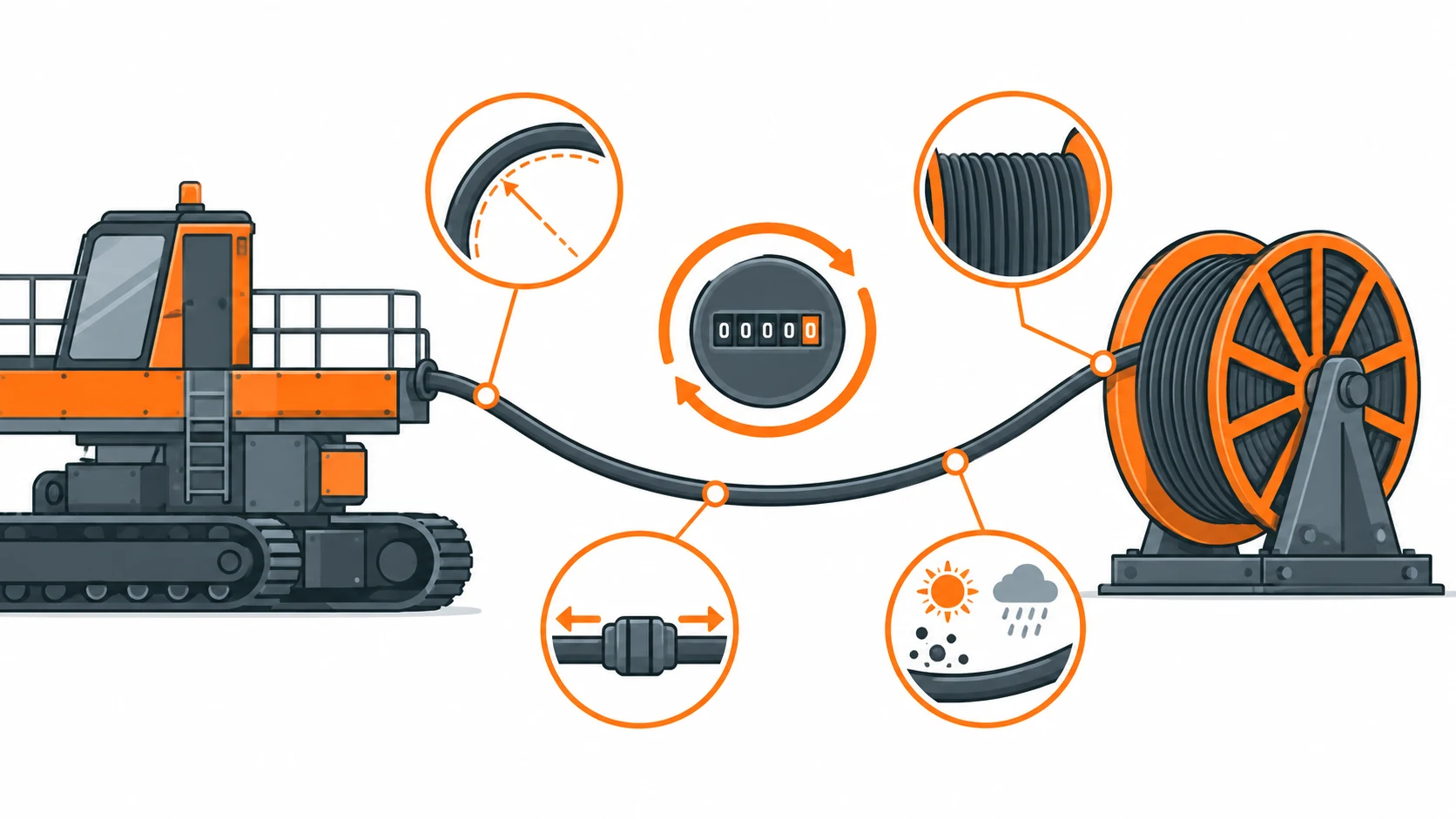
Quick Answer: Trailing cable life is bought as a number of cycles, not as a number of years. What actually decides it is the bend radius at the machine entry, the winding pattern on the reel, the axial tension the cable carries, and the ground it is dragged over. A specification that states these four things can be contracted against. One that says the cable should last five years cannot be measured by anyone.
Introduction
Mines replace trailing cable on a calendar whether or not the calendar matches the duty. One site retires a drum every eighteen months on a machine that runs two shifts. Another runs the same construction for six years on a machine that moves twice a day. The difference is rarely the cable. It is the number of times it bends, and how tightly.
That matters on both sides of the purchase. A buyer who cannot describe the duty gets a cable built to a generic standard and pays the price in replacements. A buyer who can describe it in cycles and radius has something to hold a supplier to, and can ask for a construction that is actually matched to the reel it will live on.
What Sets Trailing Cable Life
Bend cycles, not hours. A machine that travels a closed loop bends its cable at the same two points several times an hour. A drill rig moving in a straight line bends it rarely. Two machines with identical running hours can differ by two orders of magnitude in bend cycles, and the cable sees the cycles.
Bend radius at the tightest point. The tightest point is almost always the machine entry or the reel guide, not the middle of the run. Radius matters non-linearly: going from a generous entry radius to a tight one can cut life by more than half, even though nothing else about the installation changed. Our note on cable minimum bend radius explains how the limits should be applied at a moving entry.
Axial tension. A cable pulled under tension while it is bent is being asked to do two things at once at the same point. Tension also drags the sheath across the ground, which is where the outer layer wears away and water finds the screen.
Winding pattern on the reel. How the cable lays onto the drum decides whether it bends or twists. This is the factor most often ignored in the specification and the one that most often explains a cable that failed far earlier than the test data suggested.
Reel Geometry and the Twist Nobody Specifies
A level-wound reel lays the cable in layers that sit almost parallel to the drum axis. A spiral-wound reel, which is what most machines use when the cable is guided across a plain drum, twists the cable by one full turn for every revolution of the reel. Over a few thousand cycles, a straight construction corkscrews and starts breaking at the drum entry.
The practical consequence is that the same cable behaves very differently on two machines with the same power rating. Where the reel is a plain drum with a guide, ask the supplier for a construction that tolerates torsion, and say so in the enquiry. Our notes on torsion cable construction and on rotating applications cover what changes in the cable when twist is part of the duty.
Where the reel is a proper level-wind or a spooling arrangement, torsion is much less of a factor and the bend at the guide becomes the dominant limit. Cable selected for one arrangement and installed on the other is a common and expensive mismatch, and it is invisible in the purchase documents unless the winding pattern is written down.
The Five Factors That Decide Life
Read the table against the machine, not against the cable. Each row is a lever the buyer can actually move.
| Factor | What Drives It | What to Specify | Evidence to Demand | Cost and Lead Time | How It Shortens Life |
|---|---|---|---|---|---|
| Bend cycles | Machine travel pattern and cycle length | Expected cycles per shift and the duty it represents | Flex test result at the declared radius and cycle count | Fine stranding and a flexible screen add cost, minimal lead time effect | Core breakage at the entry well before the sheath is worn |
| Bend radius | Tightest point on the route, usually the machine entry | Minimum radius at the worst point, not the average | Test data at that radius rather than a catalogue figure | Forgiving radiuses can allow a lighter, cheaper construction | Concentrated strain and cracking at one short length |
| Winding pattern | Spiral against level wind on the machine reel | Which pattern the reel produces, stated in the enquiry | Torsion test result where twist is part of the duty | Torsion-tolerant construction carries a price premium | Corkscrewing and drum entry failure within a few thousand cycles |
| Tension and drag | Pull force and the ground the cable crosses | Working tension, and the surface it is dragged over | Sheath abrasion and tensile results at the declared duty | A tougher jacket costs more but is cheaper than replacements | Sheath worn to the screen, then water ingress and an earth fault |
| Environment | Water, acid seepage, heat and ultraviolet | Conditions per run, including the wet season | Immersion, ageing and UV results at the site conditions | Water blocking and UV-stable compounds add some cost | Insulation water treeing and a short circuit inside the cable |
Expressing Life in a Contract You Can Enforce
A warranty that says the cable will last five years is unenforceable on a mine, because nobody can prove which of the five factors above was the binding one. A warranty that names cycles at a stated radius can be checked, and it forces both parties to agree on the duty before the first drum is made.
Name the test. The cycle count should come from the same test method the supplier used to qualify the cable. Our note on cable flex testing methods describes what the different methods do and do not show, and it is worth agreeing on one before quoting.
Name the radius. A cycle figure is meaningless without the radius it was measured at. Write both, and write them at the worst point on the actual machine.
Name the remedy. Decide in advance whether a premature failure is met by a free length, a pro-rata credit or a joint investigation. Mines that leave this to goodwill usually get a length and lose the argument about the cause. Our note on power cable warranty terms sets out how the usual clauses are worded.
Keep a sample. Retain a one metre sample of each construction from the delivery, sealed and labelled. When a failure happens, the sample is what turns a discussion into a measurement.
Measuring Life on Site Instead of Guessing
Life claims only become real when the site records something. Three records are enough to manage a trailing cable fleet.
Failure position. Where on the cable it failed, in metres from the machine end. Failures that cluster near the entry are a radius or guide problem. Failures spread along the length are a drag or tension problem. The two need different fixes, and the record is what tells them apart.
Cycles at failure. A rough count from the machine’s travel pattern is close enough. A cable that reaches thirty thousand cycles on one machine and eight thousand on another is telling you something about the second machine, not about the cable.
Condition at inspection. Sheath thickness and any exposed screen, checked at the same interval so the trend is comparable. This is the input that lets a mine plan a replacement instead of reacting to one, and it is what makes the difference between a scheduled stop and a shovel sitting idle. Our note on cable damage wear patterns shows what each pattern usually points at.
What to Freeze Before the RFQ Goes Out
| Decision | What to State | Evidence to Attach | Cost of Leaving It Open |
|---|---|---|---|
| Duty in cycles | Cycles per shift and the duty behind the number | Machine travel pattern and cycle length | A cable bought for a duty it never sees, or worse, one it exceeds |
| Worst radius | Minimum radius at the entry, the guide and the drum | Measurement at the actual machine, not the drawing | A construction that fails early with no contractual remedy |
| Reel pattern | Spiral or level wind, with the guide arrangement described | Torsion qualification where twist applies | A guaranteed-life cable that corkscrews and cannot be claimed |
| Tension and drag | Working tension and the surface crossed | Abrasion and tensile data at that duty | Sheath worn to the screen and a mid-run earth fault |
| Environment | Water, acid, heat and UV per run | Immersion, ageing and UV results | Insulation failure unrelated to any mechanical claim |
| Life commitment | Cycles, radius, test method and remedy, in writing | Agreed test report plus a retained delivery sample | A dispute settled by opinion rather than by measurement |
Lead Time and Cost Structure
Trailing cable that is bought for a stated duty is usually made to order. The sheath compound, the conductor class and the working length all have to be fixed, and the reel or drum the cable arrives on has to match the machine. That last point catches projects out more often than the cable itself, because a finished reel that will not fit the machine means the cable is rewound on site or returned.
Measure the machine’s drum and the guide before ordering, and put those dimensions on the purchase order. Where the machine is new, get the drawing from the machine supplier rather than from the mine’s own measurements, because the guide is often fitted after delivery.
Copper is a large share of the cost on a heavy trailing cable, so the copper basis and its validity window belong in the comparison of quotations. Where a mine replaces trailing cable on a rolling basis, a framework agreement that fixes the construction and the copper mechanism but not the quantity usually gets a better unit price than a series of one-off orders, and it keeps the spare construction identical to the installed one.
Incoming Inspection for Reeling Cable
Check the length and the ends first. Count the length on a measured run, and confirm that the factory-fitted ends match the machine’s coupler. A length that is short by a few metres is discovered on the machine, not on the pallet, and by then the drum is open.
Run the electrical checks before cutting. Conductor resistance and continuity, insulation resistance and screen or pilot core continuity end to end. On a screened construction, check the screen continuity after the ends are fitted, because that is where it most often fails.
Look at the lay of the cable on the reel. A delivery reel that has been wound unevenly or in a way that already twists the cable tells you something about how the cable was handled. Note it with the delivery, because it feeds directly into the life claim if the cable fails early.
When a Longer Life Claim Is Not the Answer
When the failures are at one spot. Cable failing repeatedly at the same guide is a machine problem. A longer-life construction buys a postponement, not a fix.
When the site wants a five-year warranty instead of a cycle figure. A year-based warranty on a trailing cable encourages a supplier to sell margin rather than engineering, and it gives the mine nothing to measure. Ask for cycles at a stated radius.
When the machine has changed but the construction has not. A cable qualified on a straight-line drill rig is the wrong reference for a machine that travels a closed loop. Re-qualify when the travel pattern changes, not when the cable fails.
When the cable is being blamed for a guide failure. Look at the guide and the entry radius before ordering a heavier construction. Most premature trailing cable failures are geometry, and geometry is cheap to correct.
When the replacement interval is set by the accountant. A calendar interval that ignores cycles retires sound cable on quiet machines and runs worn cable on busy ones. Set the interval from inspection records instead.
RFQ Checklist
- Bend cycles per shift, with the machine travel pattern described
- Minimum bend radius at the entry, the guide and the drum
- Reel type and winding pattern, spiral or level wind
- Working tension and the surface the cable is dragged over
- Environment per run, including water, acid, heat and ultraviolet
- Conductor class and screen arrangement for the declared duty
- Sheath compound matched to the dominant damage mechanism
- Working length, plus the drum or reel dimensions from the machine drawing
- Factory-fitted ends and coupler type, matched to the machine
- Life commitment stated in cycles at the declared radius, with the test method
- Remedy for premature failure, agreed before award
- Retained delivery sample, sealed and referenced on the order
- Copper basis and validity window on the quotation
Conclusion
Trailing cable life is a number of cycles at a radius, not a number of years, and the specification should say so. Write the winding pattern, the tension and the environment alongside the radius, and keep a sample from every delivery so a claim can be measured rather than argued.
Kexingyu Cable Group (KXYE) has supplied electrical cable from Quanzhou since 1996, including the flexible, screened and reeling-duty constructions used on mobile mining machines, along with the ends, couplers and guides that go with them. Send the machine travel pattern, the worst radius, the reel arrangement and the working length, and we will come back with the construction, the flex and torsion results that apply at your duty, and a delivery plan against your shutdown window. The fastest route is a request for quotation.