Selling Cables into the US: UL Listing, Section 232 Tariffs and a Reality Check
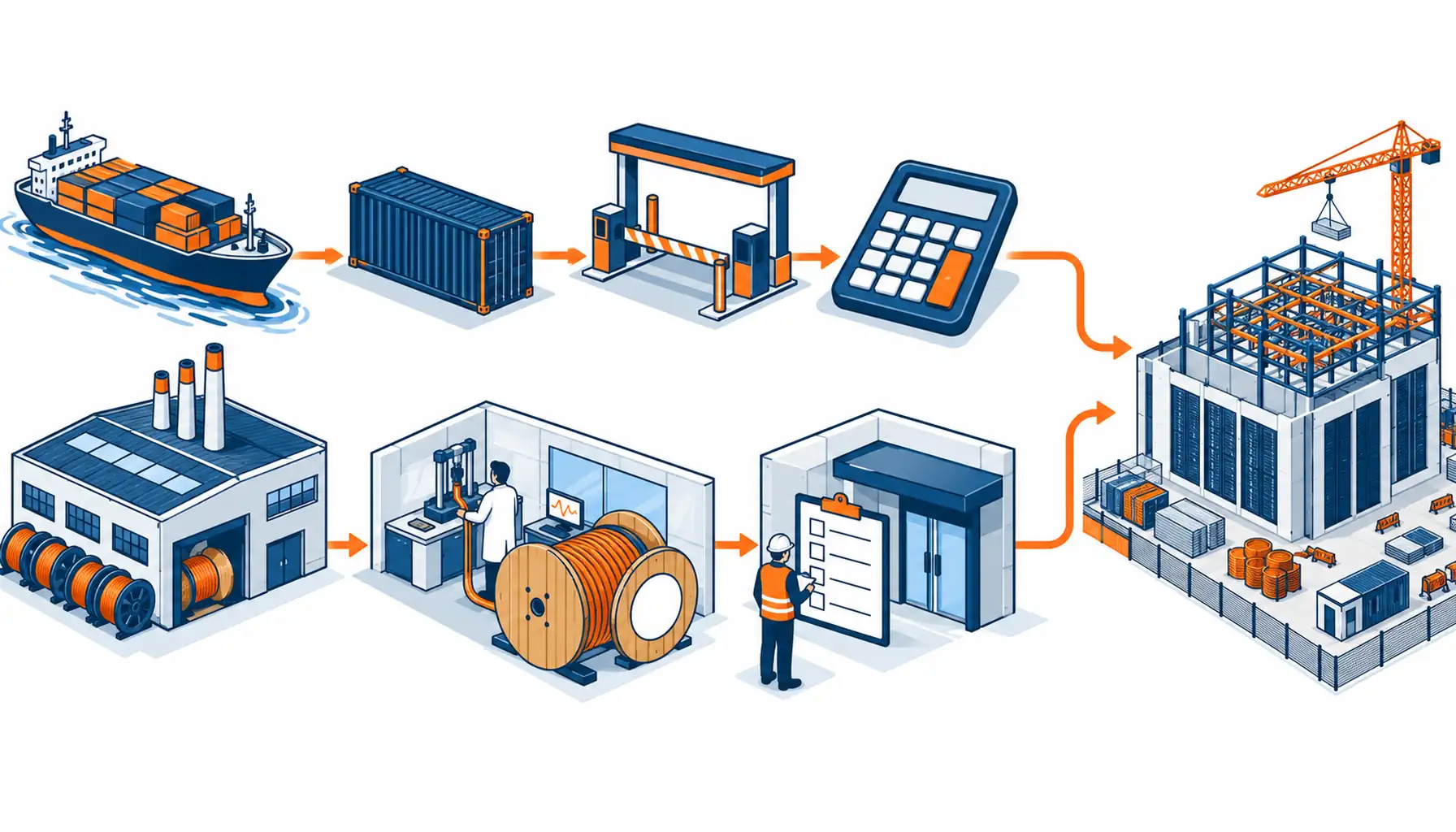
Quick Answer: The US has no mandatory national cable certification — but the code’s listing requirement makes UL listing a de facto gate, while Section 232 tariffs reshape the landed cost.
The American cable market is the world’s largest and its most unusual. There is no national certificate to earn, no plant audit at the border, no per-shipment conformity document — and yet most imported cable can’t legally be installed, because the inspection regime that actually governs the market demands listed product. Layer on trade policy, with Section 232 tariffs and their derivative expansions reaching cable inputs and products, and the market entry question becomes two questions at once: can your product pass inspection, and can your price survive the duty. Both deserve a hard look before a US program is attempted.
Introduction
The demand context is extraordinary: the American data center buildout — a power-hungry expansion tracked in our data center power hub and the growth analysis in data center power demand growth — alongside grid spending and industrial reshoring, keeps US cable demand far ahead of domestic supply, with imports covering a meaningful share of consumption by industry estimates. That gap is why foreign manufacturers keep asking about the US market. The honest answer has three layers: the listing regime that decides whether the product can be installed; the tariff structure that decides what it costs to land; and the economics that decide whether the program survives both. None of the three is optional, and the second has been moving fast enough that quotes written last year may not clear this year.
The Listing Regime: How "Voluntary" Becomes Mandatory
The mechanism is indirect but iron. The National Electrical Code, adopted by states and municipalities, requires electrical products in inspected installations to be listed by a Nationally Recognized Testing Laboratory, an NRTL. Underwriters Laboratories is the best known; the system includes several. Listing is a product-family affair: the product is evaluated against the applicable UL standard — UL 83 for thermoplastic-insulated wire, UL 44 for thermoset, UL 1277 for power and control tray cable, UL 1569 for metal-clad cable among others — samples are tested, the factory is audited, and the listing survives through follow-up services: recurring factory inspections and testing that keep the mark meaningful. The result is “voluntary” certification that no inspector will wave through. A listing is the difference between a product that can be installed and one that cannot, regardless of its technical merit. For a foreign factory, the route is real but heavy: US-standard design work, UL-standard testing, an audit, and an ongoing follow-up relationship. It’s a multi-quarter program with recurring cost, closer in weight to the plant-license schemes of the heavier national gates than to a paperwork gate. The follow-up discipline is the same factory-credibility logic detailed in the power cable certifications checklist.
Section 232: The Tariff Layer
The second gate is fiscal. Section 232 tariffs — originally steel and aluminum — have expanded through derivative-product listings that sweep in cable inputs and cable products, with aluminum-conductor constructions squarely in scope and the broader tariff environment pushing rates on many Chinese-origin goods to levels that reprice the entire landed-cost calculation. Industry analyses put effective duties on some low-voltage cable categories at rates that rival or exceed the product’s ex-works price. The consequence is arithmetic, not opinion: for a Chinese-origin cable program, the duty line in the landed-cost model can exceed every other cost line combined. Three planning responses follow. Model the duty first: the landed cost — ex-works, freight, duty at the current rate for the exact HTS classification — is the only price that matters, and the classification is a professional judgment worth confirming. Watch the origin question: origin rules, transshipment exposure and trade-remedy risk make “routed through a third country” a compliance hazard rather than a solution. And watch the policy clock: rates and derivative scopes have changed repeatedly, so a program built on today’s number needs a review trigger — the same schedule-honesty that governs 2026 lead-time planning across the equipment family.
| Layer | What It Decides | What It Takes |
|---|---|---|
| NRTL listing (UL and peers) | Whether the product can legally be installed | UL-standard design and testing, factory audit, recurring follow-up services |
| NEC and inspection | Whether the installation passes | Listed product selected and documented by the contractor |
| Section 232 and related duties | What the landed cost becomes | HTS classification, current rate modeling, origin compliance |
| Program economics | Whether the program survives | Landed cost against US alternatives, reviewed on every tariff change |
The Reality Check for Chinese Manufacturers
Put together, the two gates sort programs into three honest categories. The first: factories already holding listings with follow-up history. Their listing cost is sunk, and their competition happens on landed cost and service, where tariffs still bite but the door is open. The second: factories considering a listing program. It’s viable for component-level and export-grade products, but for construction-grade US market entry the combined weight of US-standard redesign, testing, audit, follow-up fees and a moving tariff wall usually points the arithmetic toward other markets first. The third: the majority — programs best redirected toward destinations where IEC-based credentials earn their keep, the redirection logic of the market-by-market matrix in this series’ overview. The failure mode this guide exists to prevent is the half-planned US attempt: a listing quote without follow-up fees, a landed cost without the current duty, an LOI to a US buyer without either. The sourcing discipline that prevents it — full-cost verification before commitment — is the same one cataloged in international power equipment sourcing mistakes.
| Stage | Action | Classic Trap |
|---|---|---|
| RFQ | Map the construction to the UL standard; confirm HTS classification | IEC-based quote sent to a UL-spec enquiry unchanged |
| Economics | Landed cost modeled with the current duty rate and a review trigger | Duty modeled on last year's rate |
| Certification | Listing program scoped: testing, audit, follow-up fees, quarters not weeks | Follow-up services priced out of the plan |
| Contract | Listing status, marking and tariff-review terms written in | Delivery promised against a listing that does not exist |
| Execution | Marking, documents and follow-up inspections kept in rhythm | Follow-up lapsed, listing suspended mid-program |
When the US Route Is Not the Answer
Two boundaries close the loop. Listing is not a quality trophy: it proves conformity to US construction standards under a follow-up regime. It doesn’t make an IEC product better or worse, and projects specified to IEC standards have no use for it. And tariffs are not a law of nature: they are policy with a history of change, which cuts both ways. A program priced out today may return, and a program priced in today may not survive. The disciplined posture is conditional: maintain the file that a listing program would need, model the landed cost with current rates and a review trigger, and commit capital only when both gates are simultaneously clear. That posture costs a spreadsheet; the alternative costs a container.
RFQ Checklist: US-Entry Lines for the RFQ
Put both gates’ questions in writing:
- Target construction mapped to the applicable UL standard, or the IEC-to-UL gap stated
- Listing status confirmed: listed, in program, or not held — with follow-up currency checked
- HTS classification confirmed professionally, with the current duty rate sourced
- Landed cost modeled ex-works, freight, duty, with a tariff-review trigger date
- Origin compliance confirmed — no third-country routing assumptions
- Program milestones — testing, audit, follow-up schedule — anchored in the contract where a listing is planned
- Marking, documents and follow-up inspections assigned owners
Conclusion
The US market asks two questions and answers neither politely: can your cable pass an inspector — which means a listing — and can it survive the duty, which means arithmetic on today’s rates. Factories that answer both honestly, with follow-up history on the first and a review-triggered model on the second, run real programs; the rest have an export answer waiting in the IEC world. The reality check is the product: most failed US entries were pricing or paperwork fantasies, not bad cable.
Kexingyu Cable Group (KXYE) approaches the US market with that honesty: accurate listing-status disclosure, IEC-accredited evidence for the destinations where it earns its keep, and US-entry guidance that models both gates before any commitment — the same full-cost discipline we apply to every market.