Termite Resistant Cable and UV Protection: Sourcing Cable for Exposed Routes
Quick Answer: Exposed and buried routes face three separate threats, not one: sunlight that ages a sheath from the outside, termites that will chew through soft compounds, and rodents that gnaw at what they can reach. A termite resistant cable usually means a sheath or an armour layer chosen to resist one of these, and the buying job is to decide which threats the route actually carries. State the exposure, the burial depth and the inspection regime in the RFQ, and the construction nearly picks itself.
Introduction
An indoor cable rarely has to earn its keep. A cable run outdoors, in a duct, up a pole or buried in soil is a different purchase, because the sheath is the only thing standing between the conductors and a slow mechanical and chemical attack.
This guide is written for the buyer raising the requisition. It separates the three threats that get confused under a single label, maps each one to the construction that answers it, covers how the choice changes the order and the price, and lists the evidence to demand and the clauses to freeze. Where a route is buried, our note on weather resistant cable sets out the wider family the decision sits inside.
What Actually Attacks an Exposed or Buried Cable
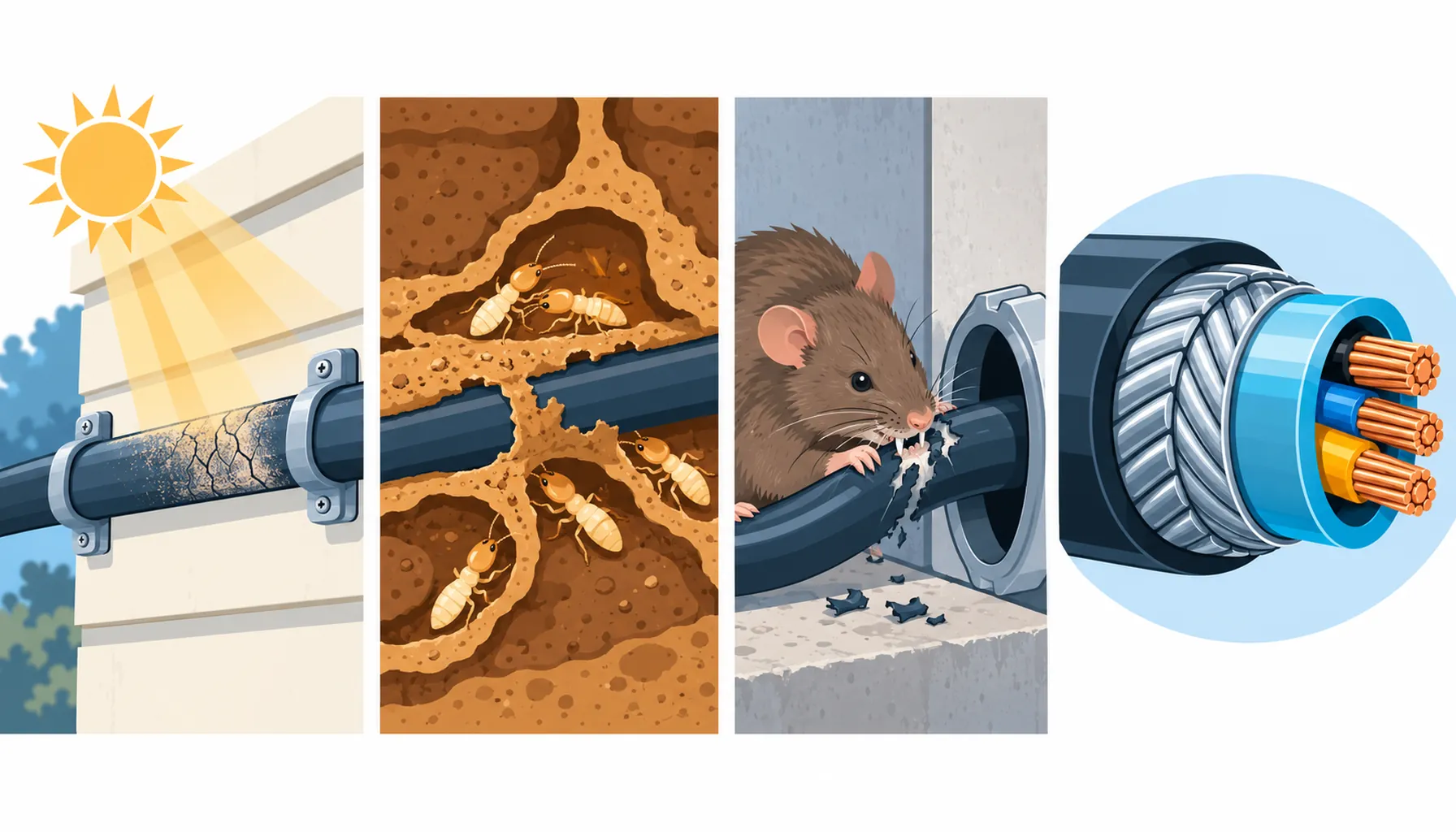
Ultraviolet light. Sunlight attacks the outer sheath of a plastic cable continuously. Compounds without a UV stabiliser chalk, crack and lose their mechanical strength, and a run that looked fine at handover can be brittle within a few summers. The damage starts on the sun-facing side, which is why a route that turns through a full circle shows an obvious band rather than an even failure.
Termites. Termites attack the sheath to reach what lies inside, and some species will tunnel through standard thermoplastic jackets to do it. Soft PVC and soft rubber compounds are the vulnerable ones. The defence is either a harder sheath the mandibles cannot open, a nylonsheath or barrier layer under the jacket, or a metallic armour the colony has to get past.
Rodents. Rats and squirrels gnaw for the sake of gnawing, not to feed. They damage cables at entry points, in wall voids, along ledges and inside ducts, and the damage is usually found as a fault rather than as an inspection result. Steel tape and steel wire armour, and metallic conduits, are the usual counter.
Moisture, soil chemistry and abrasion. A buried cable also sees water, salts and, in some soils, acids and hydrocarbons, and it moves against stones and roots as the ground shifts. This is where a lead sheath, a plastic barrier or a heavier armour earns its place, and where the burial depth and the backfill specification belong in the order.
These threats do not arrive one at a time, and that is the central point. A buried cable in a termite zone, running through a farm or a plantation, is exposed to all four, and the construction has to answer the combined duty rather than the loudest single word in the enquiry.
Protection Options and What Each One Answers
The table below sets out the protection routes a site can buy, what duty each serves, what to state in the order and how each choice fails when the threat was guessed rather than measured.
| Protection route | Where it applies | What to Specify | Evidence to Demand | Cost and Lead-Time Driver | How It Fails |
|---|---|---|---|---|---|
| UV stabilised jacket | Open air runs, walls, poles, roof and rack work in strong sunlight | Sheath compound with a declared UV stabiliser, the exposure class and the expected service life | Weathering and UV test data on the compound, not on a generic PVC grade | Compounded jacket, small premium over plain PVC, usually ex stock | Surface chalking and cracking within a few seasons on the sun-facing side |
| Hard or nylonsheathed jacket | Termite zones, tropical and subtropical sites, timber and plantation edges | The anti-termite barrier type, sheath hardness and the declared test method | Termite resistance test results naming the species and the standard used | Extra barrier layer, adds cost and weeks to the schedule | Colony tunnels through a soft jacket and reaches the conductor |
| Steel tape or wire armour | Buried and duct routes, wall voids, sites with rodent pressure | Armour type, coverage, bedding and whether an inner sheath is required | Armour dimensions and coverage against the construction sheet | Steel content and weight, plus slower handling and heavier drums | Rodent gnawing at a gland or a duct entry point where armour is absent |
| Metallic barrier for soil conditions | Routes in aggressive soil, near salt, acid or hydrocarbon contamination | Barrier material, thickness, and the soil chemistry it was selected against | Corrosion test data for the barrier in the declared soil condition | Lead or specialist barrier, the longest lead time of the four | Sheath pitting at one point, then moisture into the insulation |
| Route and bedding measures | Any buried or exposed route where the sheath should not carry the whole duty | Burial depth, sand bedding, tile or duct protection, expansion allowance | An installation drawing showing depth, bedding and warning tape | Civil cost rather than cable cost, but it removes the cable premium | Direct-laid cable cut by backfill or by later excavation with no warning marker |
How the Specification Changes the Order
The threat list comes first. Before any construction is chosen, write down which of the four threats the route carries and where. A route that is buried for two hundred metres and then climbs a pole has two different duties on the same drum, and the sheath has to satisfy both.
Then comes the barrier decision. A UV problem is a jacket compound question, a termite problem is a sheath hardness or barrier question, and a rodent problem is usually an armour or containment question. They are answered by different parts of the construction, so a cable bought for the wrong threat can carry the full premium and still fail. Our comparison of cable sheath materials sets out how those compounds and barriers differ.
Then the route measures. Burial depth, backfill, the presence of a duct, the tightest bend and the pull tension all sit alongside the protection choice, because a heavily armoured cable is stiffer and heavier to handle. Where a route has tight bends and heavy armour, confirm the minimum bend radius before the drums are ordered, as covered in our note on cable minimum bend radius.
Where a cable is buried, the buyer should also decide who owns the excavation. Bedding, protection tiles and warning tape cost civil money and protect the cable for its whole life. Leaving them out and upgrading the sheath instead is a common trade, and it usually belongs on the wrong side of the ledger.
Then the environment data. Where the route passes acid soil, animal enclosures or washdown areas, say so. A general outdoors claim is not the same as a construction selected for a specific chemistry, and the sheath that resists sunlight can still be softened by hydrocarbons.
What to Freeze Before the Order Goes Out
Six clauses decide whether the drums that arrive answer the route. Each is cheap at specification stage and expensive once the cable is on site.
| Decision | What to State | Evidence to Attach | Cost of Leaving It Open |
|---|---|---|---|
| Threat list by route | Which of UV, termite, rodent and soil chemistry apply, and on which sections | A route schedule marking exposed, ducted and buried sections | Buying protection for the wrong threat and still failing |
| UV exposure class | The expected service life in direct sun and the compound declared for it | Weathering data on the specific sheath compound | Sheath chalking and cracking after a few seasons |
| Anti-termite basis | The barrier type and the standard or species the claim rests on | Termite resistance test results naming the method | Colony penetration in a soft jacket, with conductor damage following |
| Armour and containment | Armour type, coverage, and duct or conduit where the armour alone is not enough | Construction sheet with armour dimensions and coverage | Rodent damage at an unprotected entry point |
| Burial and bedding | Depth, sand bedding or duct, protection tiles and warning tape | An installation drawing with depths and bedding called out | A third-party dig severing the cable with no marker to warn them |
| Handling limits | Minimum bend radius and maximum pull tension for the armoured construction | Handling data for the construction supplied, not a generic figure | A kinked or stretched cable during a heavy pull, rejected after delivery |
Constructions and What They Cost
Where a route carries more than one threat, buying the construction rather than patching the compound is usually the safer route. Our UV resistant cable covers the open-air side with the sheath stabilised for sunlight, the field special cable family covers the mixed outdoor and mobile duty that farms and industrial yards present, and the outdoor cable range covers the data side of the same route.
Stock constructions are the plain jacketed cables where UV or containment alone will do, and they move fastest and cheapest. Armoured and barred constructions add steel or a metallic barrier and run on a longer line, because the armouring step takes time and the drums get heavier and dearer to freight. Made-to-order compounds for a specific soil or termite environment are the longest line of the three. Copper and steel are the two largest material components, so the same two questions apply on every order: how the copper element is calculated, and how long the price holds against the metal markets, which is where a copper price clause earns its place.
Incoming Inspection and What to Record
Against the drum. Count drums against the packing list, check the marked lengths mean what the order said, and photograph the drum markings before anything is cut, so a later claim can be traced to the construction supplied. The wider discipline of export packing is covered in our note on cable drum packaging for export.
Dimensional and mechanical checks. Measure overall diameter and sheath thickness on a sample against the construction sheet, and confirm the armour dimensions where armour was specified. On a UV-rated cable, check that the compound marking matches the grade the exposure data was issued for rather than a general-purpose grade.
Protection evidence. Match the weathering and termite resistance reports to the construction delivered, and check the test method and the species named rather than accepting an unqualified claim. A termite resistance statement without a method is not comparable between suppliers.
Record the site conditions. Note the soil type, the burial depth and the exposure at handover, with photographs, and keep the drum identification with them. Those notes are the baseline that decides whether a later fault is a material question or an installation question.
When Armour Is Not the Answer
When the threat is sunlight. Armour does nothing for UV ageing, because the attack is on the outer jacket from above, as our note on armoured versus unarmoured cable makes clear. A stabilised compound is the answer, and armour added instead is weight and cost without protection.
When the threat is termites. Steel armour helps, but a barrier layer or a hard sheath is usually the cheaper and more targeted defence, and it does not change the cable weight or the bend radius of the whole run.
When the route should not be exposed at all. Where a cable can go into a duct, a conduit or a covered tray, containment often costs less than the premium for a heavily protected construction and answers rodents, soil and handling in one move.
When the specification is protecting against nothing. Buying a full armour and barrier package for an indoor plant room because the enquiry said outdoor wastes money and stiffens a cable that has to be pulled through tight bends. The threat list has to be real before the construction is upgraded.
RFQ Checklist
- The exact route sections that are exposed, ducted and buried, with lengths
- Which threats apply on each section: UV, termite, rodent or soil chemistry
- The expected service life in direct sunlight, and the UV class required
- The anti-termite basis where the site is in a termite zone, with the standard named
- Rodent pressure and the containment, armour or barrier expected to answer it
- Soil chemistry, water table and any acid, salt or hydrocarbon exposure
- Burial depth, bedding, protection tiles and warning tape, and who supplies them
- Minimum bend radius and maximum pull tension for the construction offered
- Weathering and termite test reports to be supplied with the drums
- Marked lengths, drum identification and the copper basis with its validity window
Conclusion
UV, termites and rodents are three different problems with three different answers, and the most common buying mistake is to treat them as one. Write down what the route actually carries, match each threat to the part of the construction that resists it, and let containment or route measures take the duty wherever they can. The cable that chalks in the sun and the cable that a colony opens from the side are rarely the same purchase, and neither is solved by adding armour to a compound that needed a stabiliser.
Kexingyu Cable Group (KXYE) has manufactured cable in Quanzhou since 1996, supplying UV stabilised, armoured and barred constructions for outdoor, ducted and buried duty, with weathering and termite resistance data that travels with the drums. Send us the route schedule with the exposure, the burial conditions and the threat list, and we will come back with the constructions, the evidence that applies to each and a delivery plan against your programme. A request for quotation is the fastest route.