Wholesale Building Wire for Uzbekistan: Specifications, Packaging and Quality Checks
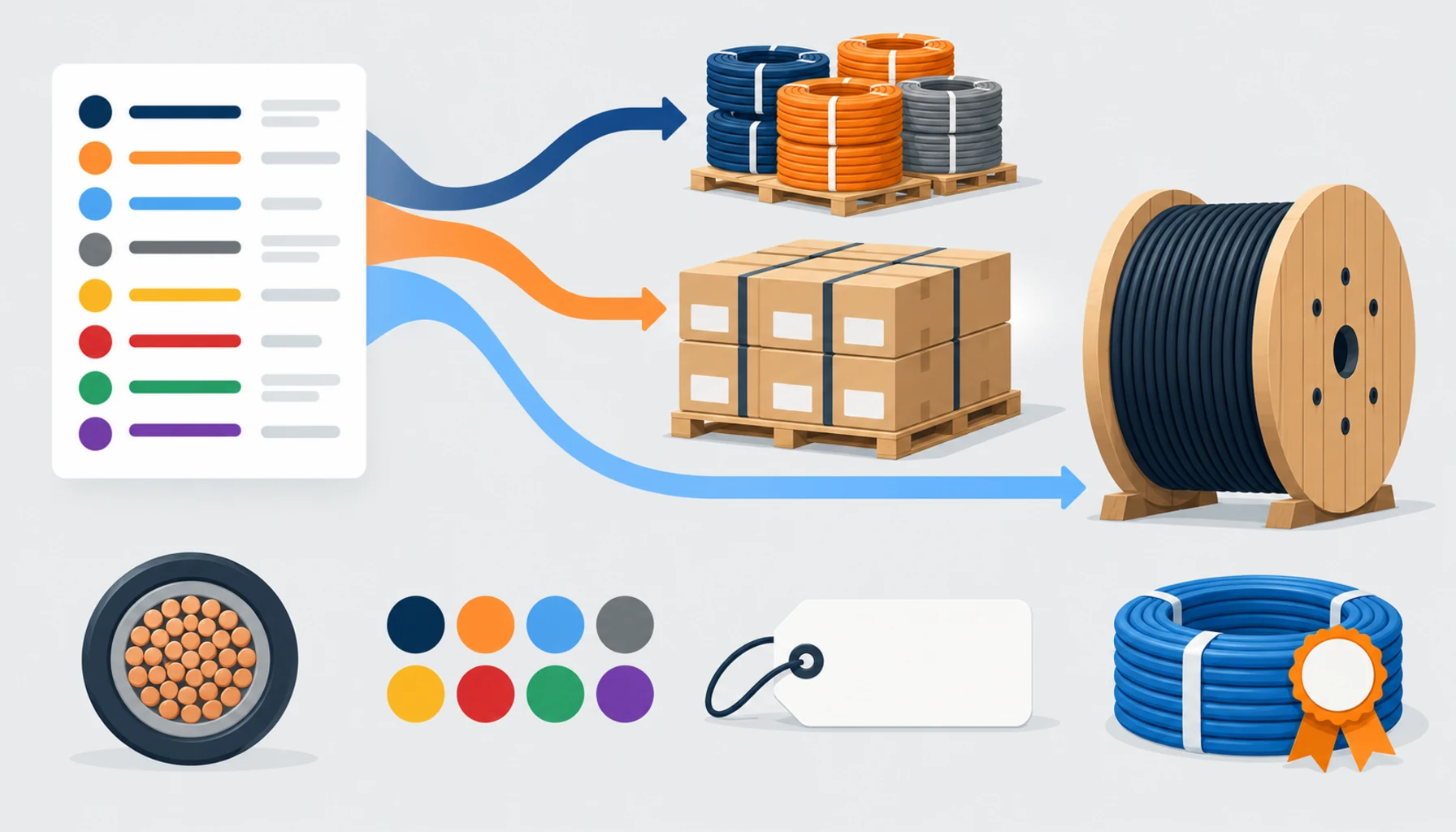
Quick Answer: Building wire is bought by the kilometre and judged by the metre, and a wholesale order for the Uzbekistan market succeeds when the specification is written at the level a factory can repeat: conductor class and cross-section named, insulation colours and their standards fixed, conductor resistance as the acceptance number, coil and drum lengths agreed with their tolerances, and labelling that survives from carton to customer. Add a sample that anchors the batch and a packaging spec that protects the coil, and the order becomes repeatable. This guide sets out each decision in the order a wholesaler meets it, from the enquiry to the shelf.
Introduction
Building wire is the cable trade’s volume business: standardized constructions, colour-coded insulation, sold in coils through electrical wholesalers to contractors and retail counters. Volume is exactly why small specification drift is expensive, a colour that misses the local convention, a conductor that measures under its nominal section, a carton count that short-ships the shelf, because none of these is discovered until the wire has crossed a border and entered distribution.
This guide is for electrical wholesalers, importers and project buyers ordering building wire in volume for Uzbekistan. It covers the conductor decisions, solid versus stranded and what the class means; cross-section and the resistance number that polices it; insulation colours against local expectations; coil and drum lengths with their tolerances; labelling and batch records; the sample and batch checks that keep repeat orders consistent; and the packaging that delivers the product in sellable condition. The product families this guide applies to are shown in our building wire range, and the construction basics of the common Chinese building wire types are set out in our note on BV and BVR building wire. Country-level supplier screening for Uzbekistan is covered by the procurement checklist in this series, and the wholesale order mechanics shared across product families are set out in our wholesale order guide.
Decide Solid Versus Stranded on Use, Not Habit
Solid and stranded conductors serve different installation styles. Solid wire terminates firmly in screw terminals and suits fixed wiring runs; stranded wire flexes into place, absorbs vibration and suits terminations that move or equipment connections that are serviced. The wholesale assortment carries both, and the order decides the split per size and application rather than defaulting to whatever the last order shipped.
Conductor class is the language both sides share. International conductor classes distinguish solid from the flexing grades of stranded construction, and the class, written into the order per line, removes the ambiguity that words like “flexible” invite. The class system and what each grade means for bending and termination is set out in our note on conductor classes, and it is the reference the factory’s production plan reads.
Match the assortment to the market it feeds. A wholesale programme for Uzbekistan should reflect the sizes and styles local contractors actually pull, and the first orders are the research: record what moves, in which sizes and colours, and let the assortment harden around the data. Importers who order by catalogue habit tie their capital to stock their customers do not want.
Pin Cross-Section to the Resistance Number
Nominal cross-section is a name; conductor resistance is the promise. Two conductors can carry the same nominal size and measure differently, and the number that governs acceptability is the maximum resistance the standard allows per class and size. Writing that limit into the order, and requiring batch test results against it, is what keeps the wire honest from one production run to the next.
Copper quality decides whether the number is met economically. Purity and drawing practice determine both the resistance and the stranding behaviour, and the questions that separate a proper conductor from a marginal one are set out in our note on conductor copper purity. A wholesale price that sits far below the copper market’s own arithmetic is telling the buyer something, and the resistance requirement is how the buyer asks.
Know what the conductor is made of before the order, not after. Solid copper, copper-clad aluminium and copper-clad steel all exist in the building wire trade at very different prices and very different performance, and the distinctions are set out in our note comparing copper, copper-clad aluminium and copper-clad steel conductors. The order should name the conductor material explicitly, because a quoted price for a construction the buyer did not intend is a misunderstanding priced by the kilometre.
Fix Insulation Colours Against Local Convention
Colour is a safety function, not a finish. Line, neutral and protective conductor colours follow conventions the local electricians work by, and a wholesale assortment that misses the convention becomes stock that needs explanation, or worse, wiring that gets guessed at. The enquiry should list the colour set per size and the expected convention, and the supplier’s confirmation should map the colours to the sizes they will ship in.
Colour availability varies by production run, so confirm the split. Some colours run economically in volume and others do not, and a per-colour MOQ is the quiet reality of insulated wire production. The order should state the colour mix the wholesaler’s market needs and confirm what the factory can produce in what quantities, before the production slot is booked rather than at packing.
Insulation type and colour travel together. The insulation compound, PVC grades being the building wire standard, carries its own requirements for voltage rating and temperature, and the colour pigment sits inside that compound. Where the market expects specific insulation properties, they are written per line alongside the colour, so the confirmation answers both at once.
Agree Coil and Drum Lengths With Their Tolerances
Retail formats decide the length specification. Building wire ships in coils of standard lengths, cartons of coils, and larger drums for project pulls, and the wholesale order names the format and length per line. Lengths that drift, a coil short of its metres, a drum under its label, surface as customer complaints at the counter, where they cost the most to fix.
Tolerance is part of the length, not an apology after it. Coil and drum lengths are produced to tolerances, and the order states the accepted tolerance per format along with the evidence, the metre marking on the insulation or the label, that lets the length be checked at receipt. The tolerance mechanics and how they interact with ordered lengths are set out in our note on cable length tolerance.
Count discipline runs the same way as drum orders. Coils per carton, cartons per pallet, and the reconciliation between the order sheet, the packing list and the physical load follow the wholesale order discipline set out in our wholesale order guide, and building wire’s volume makes the count worth automating rather than eyeballing.
Require Labelling and Batch Records That Survive Distribution
The label is the product’s identity in the trade. Size, insulation type, voltage rating, standard reference, colour, batch and the manufacturer’s name are what the wholesaler’s customers read, and what the wholesaler’s own stock system reads. The label content, language and durability are order-line items, agreed before the cartons are printed, because labels agreed at packing are labels done from memory.
Batch records are the wholesale buyer’s leverage. When a counter customer reports a fault, the batch reference on the label is what connects that coil to its production records and test results, and to every other coil from the same run. Wholesalers who keep the batch file can answer complaints with evidence; those who cannot answer with discounts. The labelling and documentation practices that make this work are set out in our note on cable labelling and documentation.
Marking on the insulation complements the label. Printed metre marks and identification text on the insulation itself stay with the wire after the carton is gone, and their content and durability belong in the order alongside the carton label specification.
Sample the First Order, Then Police the Batch
The first order’s sample round sets the reference. For each specification and colour in the assortment, a sample from the production route, sealed and referenced in the order, becomes the standard the repeat orders are compared against. The process is set out in our note on the sample approval process, and building wire’s simplicity makes the discipline cheap to run.
Routine tests are the batch’s report card. Conductor resistance and insulation integrity per production batch, tied to batch numbers, are the evidence the acceptance reads, and the wholesale order asks for them as a standing commitment rather than a one-time courtesy. The measurement that polices the conductor is set out in our note on insulation resistance testing.
Receipt checks are quick when the specification was written. Colour against the confirmed set, resistance against the batch reports, lengths against the tolerance, labels against the agreed content: a carton sample checked at receipt covers in minutes what a customer complaint discovers at cost. The wholesale order guide’s inspection table applies directly to building wire lines.
The Building Wire Order and Check Table
The table is the working sheet for a wholesale building wire order: each decision, what to specify, and the check that confirms it.
| Decision | What the Order Specifies | Confirmation and Check |
|---|---|---|
| Conductor style | Solid or stranded per line, named by conductor class, material stated explicitly | Class on the datasheet; conductor material named; stranding visible on the sample |
| Cross-section | Nominal size per line with the maximum conductor resistance allowed for that class and size | Batch test results against the resistance limit, tied to batch numbers |
| Insulation and colours | Insulation type and voltage rating; colour set per size against the local convention | Colour mix confirmed per size with per-colour quantities; colours checked at receipt |
| Lengths and formats | Coil lengths, coils per carton, drum lines for project pulls; accepted tolerance per format | Metre marking readable; sampled coil lengths against the tolerance; count reconciliation at receipt |
| Labelling | Carton label content, language and durability; printed marking on the insulation | Label artwork approved before printing; labels checked against the order file at receipt |
| Samples and batch | Sealed samples per specification and colour; standing commitment to routine batch reports | Sealed sample file kept; repeat orders compared against samples and batch reports |
Cost and Lead Time in Building Wire Wholesale
Copper sets the floor and the rhythm. Building wire is among the most copper-intensive products per metre, and its wholesale price moves with the metal. Quotes compared across different validity periods or price bases mislead until the basis is aligned, and repeat orders need a price mechanism, indexed or re-quoted, agreed in advance. The mechanism options are set out in our note on copper price and cable procurement.
Standard constructions shorten lead times and narrow margins. Building wire runs economically when the factory’s plan absorbs it alongside similar work, and a wholesaler whose assortment matches standard sizes and colours buys from the plan rather than against it. Exotic colours and non-standard sizes pay a production penalty in both time and price, which is why the assortment decision is a cost decision.
Freight density favours building wire and punishes bad packaging. Coils and cartons pack densely, but crushed cartons and deformed coils are unsellable at the counter, and the packaging spec, carton strength, palletization and wrapping for the route, protects the margin. Export packaging practice is set out in our note on export drum and cable packaging, and carton lines read the same logic.
The repeat order is where wholesale building wire earns. Specifications confirmed, colours mapped, samples sealed, labels approved: the second order ships against a file, and its coordination cost is a fraction of the first. Wholesalers who maintain the file compete on availability; those who re-negotiate every order compete on price, and only one of those competitions is winnable long term.
| Format | Packaging to Specify | Receipt Check |
|---|---|---|
| Retail coils | Coil binding, carton strength for stacking, coils per carton fixed, carton label content agreed | Cartons intact; sampled coil lengths and colours against the order; labels readable |
| Cartons on pallets | Pallet pattern, stretch wrap, corner protection, stacking limit for the route | Pallet integrity; carton count against the packing list; no crushed layers |
| Project drums | Drum type and size per length, flange protection, cable-end sealing, drum label content | Drum condition and end seals; drum label against the order; length checked against the tolerance |
| Every format | Language and durability of labels; batch references present and readable | Batch references recorded into the stock system on arrival, linked to the test reports |
When a Wholesale Building Wire Programme Is Not the Answer
When the volumes are project-shaped, not shelf-shaped. A contractor buying for one job wants project drums and delivery to site, not an assortment; the wholesale programme serves distribution, and project supply has its own process.
When the local market’s conventions are still unknown. Order a small trial round before committing capital to an assortment, and let the first season’s sales data, not the catalogue, size the programme.
When the price sits below the copper arithmetic. A quote that cannot survive the conductor material and resistance questions is not a bargain; it is a different product wearing the same label. Resolve the material question first.
When the supplier cannot tie batches to reports. Building wire’s simplicity is not an excuse for absent traceability; a factory that cannot produce batch-linked routine results cannot support the complaint handling a wholesale business lives with.
RFQ Checklist
- Conductor style per line: solid or stranded, named by class, material stated explicitly
- Nominal cross-section with the maximum conductor resistance written as the acceptance limit
- Insulation type and voltage rating per line, alongside the colour
- Colour set per size mapped to the local convention, per-colour quantities confirmed
- Coil and drum lengths per format with accepted tolerances and metre marking required
- Carton and pallet packaging specified for the route, stacking and wrapping included
- Label content, language and artwork approved before printing
- Sealed samples per specification and colour, kept as the repeat-order reference
- Standing commitment to routine batch reports tied to batch numbers
- Receipt checks sampled: colours, lengths, labels, and batch references into the stock system
Conclusion
Wholesale building wire rewards buyers who write the specification at the level the factory, the border and the shop counter all read the same way: conductor class and material, resistance as the acceptance number, colours mapped to the market, lengths with tolerances, labels that carry batches, and a sample that anchors every repeat order. None of it is complicated, and all of it is cheaper before shipping than after.
Kexingyu Cable Group (KXYE) manufactures building wire in Quanzhou and supplies wholesale programmes for the Uzbekistan market on line-by-line terms: conductor class and resistance limits agreed, colour sets mapped, coil formats and labelling confirmed before production. Send us your size and colour list, quantities and destination, or upload your assortment plan, and we will quote it line by line. A request for quotation is the fastest route to start.